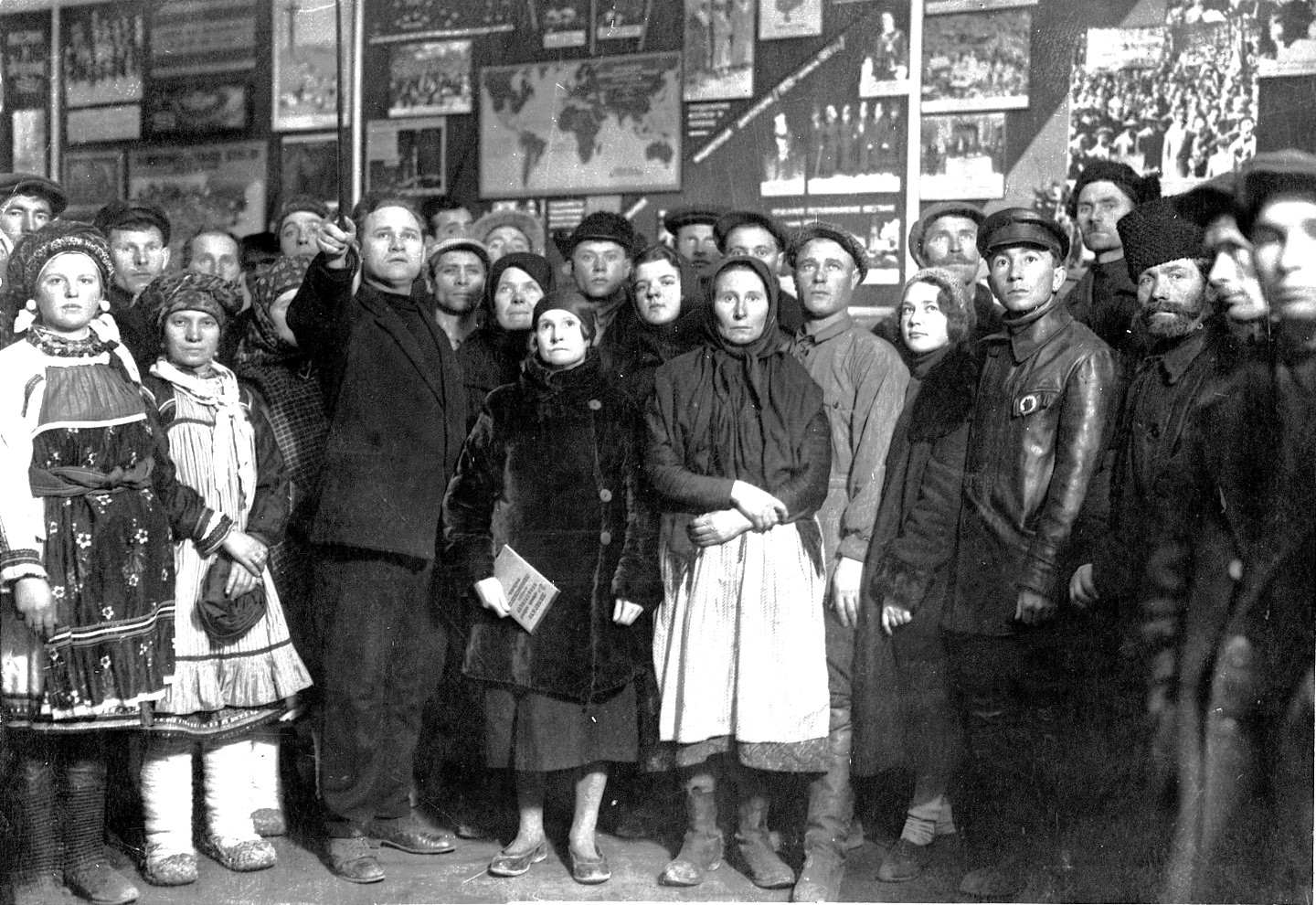
Kruse reports on the exhibits at newly-established Museum of the Revolution in Moscow. Today called The Museum of Contemporary History of Russia, it is one of the largest institutions of its kind in the world.
‘Moscow Museums Are Schools for Workers’ by William F. Kruse from the Daily Worker. Vol. 3 No. 112. May 22, 1926.
ORDINARILY the suggestion that one seek an organization’s history in a museum could hardly be considered a complimentary one. Here in Moscow the museums are not mere institutions dedicated to a dim and dusty past—they are vital, living organs that play an important role in the life of the workers. Museums for labor protection, for mother and child welfare, for home industry—all deal with living, every-day matters of concern to the masses and their state. Even such collections as in capitalist countries represent the last word in antiquarian isolation, a collection of valuable old violins, for instance, here serves the purpose of a people’s treasure chest from which qualified artists can borrow a rare old Stradivarus in order to give a concert just as a child can borrow a book in an American public library.
Revolutionary Museum.
The response on the part of the workers is commensurate with this living conception of museum purpose. In a single institution of this sort, the Revolutionary Museum, 37,000 workers visit every month to study the story of their own struggle for freedom, as well as the liberation efforts of their brothers in other countries. The section dealing with the history of the Russian movement and of its revolutionary struggles is already in excellent condition, beginning with the early uprisings of Stenka Rasinanti Pugatcheff, the story goes on the period of the Decembrists, Narodniki, Social-Democrats and finally the victorious Bolsheviks. This collection would well merit a story all its own.
A new section, now in the course of preparation, is devoted to the history of the Communist International.
Party Material.
By means of pictures, graphs, original documents, and actual objects from the struggle of the International and all its various sections the labor history of the recent past will be told in terms that can be understood by the humblest worker or peasant.
Here is displayed material from the work of every Party and on every field, mass agitation, party education, publishing, activity in trade unions, co-operatives and other mass organizations, among women, children, the youth—all phases of the Parties’ work, battles, their experiences under persecution—in short a cross section of the life of the Communist Parties and their international.
Each of the Communist International congresses is dealt with. A gigantic original painting of the Second Congress with Lenin speaking, painted by Brodsky, covers one entire wall.
Then there are 140 portraits of comrades who have taken leading parts in Communist International activity, as well as illegal mandates oh linen and silk, that were presented by brave workers who risked life and liberty to cross the hostile borders which separated them from the world-capital of the revolution. Here are displayed also the many gifts made by Russian workers and peasants and presented to the Comintern congresses as tokens of their solidarity with the revolutionary movement of the whole wide world. Here for instance in a model of a red torpedo boat, another of a locomotive, still another of an electrified village. Long have these gifts been treasured in the offices in the Kremlin, here they will be on every-day view for the workers of the world.
Mongolian Youth Banner.
A most interesting exhibit is a banner presented by the Mongolian youth organization to the Russian youth—a red banner on which a young Mongol and a young Russian are fraternizing, but incredible as it may seem this is under the sign of a swastika. Of course the designers had no intention of using the international emblem of the Fascists, but used the swastika for its original Indian symbolism of friendship.
The most revered banner of ail is a bullet-torn red flag stained with the blood of the Berlin workers who fought desperately to carry it to victory in front of the Reichstag in January, 1919. The German Party’s exhibit is a large one and besides photographs, posters and other material illustrative of Party work, it includes also banners and emblems captured from Fascist and monarchist corps in clashes with the Red Front.
Rare Historical Material.
Thus present and past are fully illustrated by these exhibits. Many rare and valuable historical materials are to be found. The first illegal copy of the Zlmmerwald manifesto can be seen here. A letter Zetkin to Zinoviev telling of Jogische’s account of Rosa Luxemburg’s attitude toward the Bolsheviks and her regret at the differences that arose out of her pamphlet—a conversation which took place shortly before her death. It is impossible to give in detail more than a glimpse of the many treasures brought together here. Their value is absolutely inestimable to future students of the world’s revolutionary movement. And this is only the beginning. From year to year, from struggle to struggle, from each new Soviet Republic to the next, the exhibition will grow in richness and interest.
American Section.
Unfortunately the American section is as yet but poorly represented. True there are copies of our thirty odd papers, and of many of our pamphlets and books in various languages. Charts show the relative strength of the organized and unorganized proletariat, as well as of the radical parties. There is material on the Negroes and on the foreign born. Thus far the picture material is confined almost entirely to the Negro question. Of posters and original photographs there is nothing.
This is certainly not because of any lack of this kind of agitational material—the American Party has been wide awake enough to use even motion picture film in its work, and its pictorial material has been of the best and most effective kind. The fault lies in that thus far this material has not yet been made available to the exhibition. Furthermore, there Is a complete lack of authentic historical exhibits, early copies of the first left wing or Communist organs, of The Revolutionary Age, Class Struggle, Cleveland Socialist, etc. Copies of the illegal leaflets and papers published after the Palaver terror should also be dug out of their hiding places and made available to the museum. Photographs, whether professional or snapshots, of party work, parades and demonstrations, of trials and conventions, should also be sent, properly labelled.
Aid Moscow Museum.
From China and Persia, from France and Norway, from all over the world the life of the Communist International and its sections Is shown here. It should be a matter of pride and joy to the American comrades to contribute everything possible in the line of such material to the collection. All units of the organization, all functionaries, should lend every possible aid in bringing together this material and having it dispatched.
The Daily Worker began in 1924 and was published in New York City by the Communist Party US and its predecessor organizations. Among the most long-lasting and important left publications in US history, it had a circulation of 35,000 at its peak. The Daily Worker came from The Ohio Socialist, published by the Left Wing-dominated Socialist Party of Ohio in Cleveland from 1917 to November 1919, when it became became The Toiler, paper of the Communist Labor Party. In December 1921 the above-ground Workers Party of America merged the Toiler with the paper Workers Council to found The Worker, which became The Daily Worker beginning January 13, 1924. National and City (New York and environs) editions exist
PDF of full issue: https://www.marxists.org/history/usa/pubs/dailyworker/1926/1926-ny/v03-n112-NY-may-22-1926-DW-LOC.pdf

