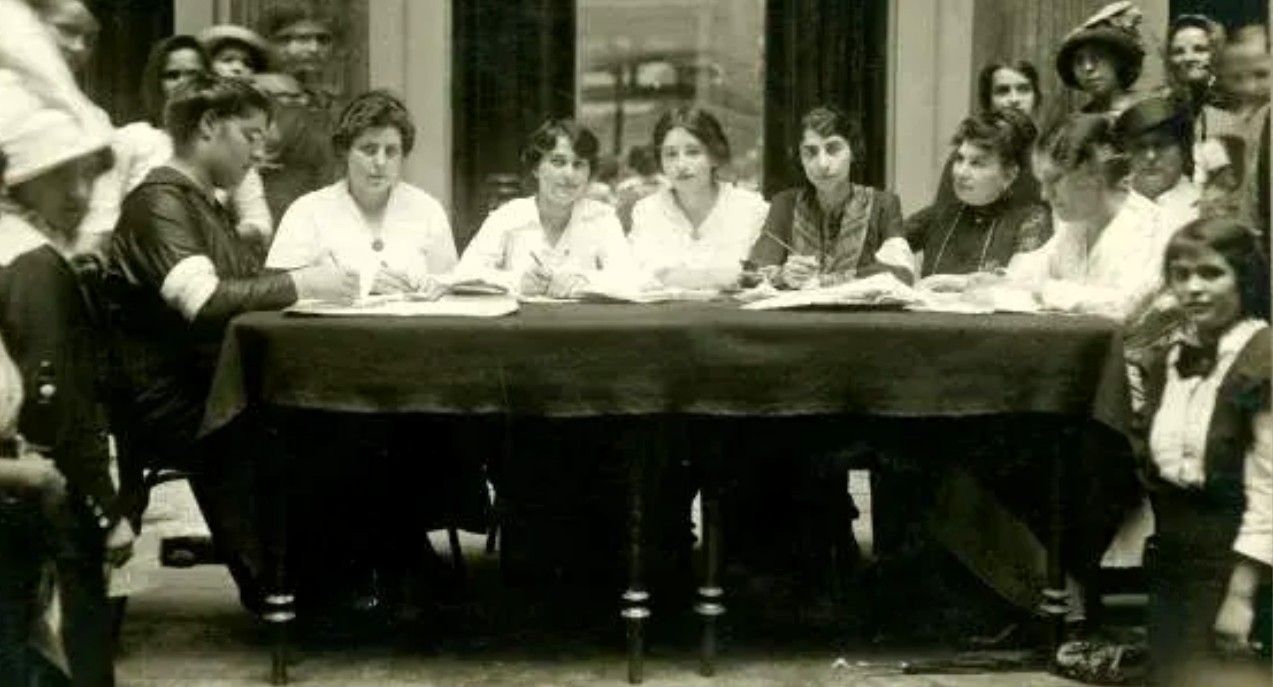
The veteran U.S. suffrage activist, feminist, and journalist introduces us to some of the remarkable women active in the work of Hungary’s short-lived Soviet experience. Though anonymous here, Hunt would later publish a number of works, including this, on Hungary under her own name.
‘Hungarian Women Rank Equal to Men’ by Alice Riggs Hunt from The Butte Daily Bulletin. Vol. 1 No. 281. July 23, 1919.
The following letter sent to the New York Call is a description from a woman’s point of view of the Hungarian soviet government. The letter is written by an American woman, whose name is withheld for obvious reasons, and is an amazing revelation of the complete change in the conditions of womankind in Hungary under the new regime.
***
Budapest, Hungary, May 30th. Bela Kun told me that women helped considerably in establishing the Communist Government of Hungary, but I observed that they are not yet holding high office in the Government. There are twenty women in the Budapest Soviet, and there are women heads of departments specialising in school and recreation work, but there is no woman Commissary. The work of women in public life in Budapest has been more for feminism than for revolution, and the feminist Leaders are not found among those working with the Communist Government.
Adel Spady, the Secretary of the Social Democratic Party and a member of the Budapest Soviet, now has her office in the House of Parliament, and arranged for me to meet twenty revolutionary leaders there. Maria Gardos, leader of the women tailors, Landone Vinese, president of the organized office employees, Palno Kuno, Secretary of the women iron workers, Therese Braddstein, shoe maker, who is at present editing the revolutionary woman’s paper: “The Woman Worker,” Kalica Horvash, book binder, and Jenka Gergoly, President of the Women Clerks’ Trade Union, proved by their presence that the group was truly representative.
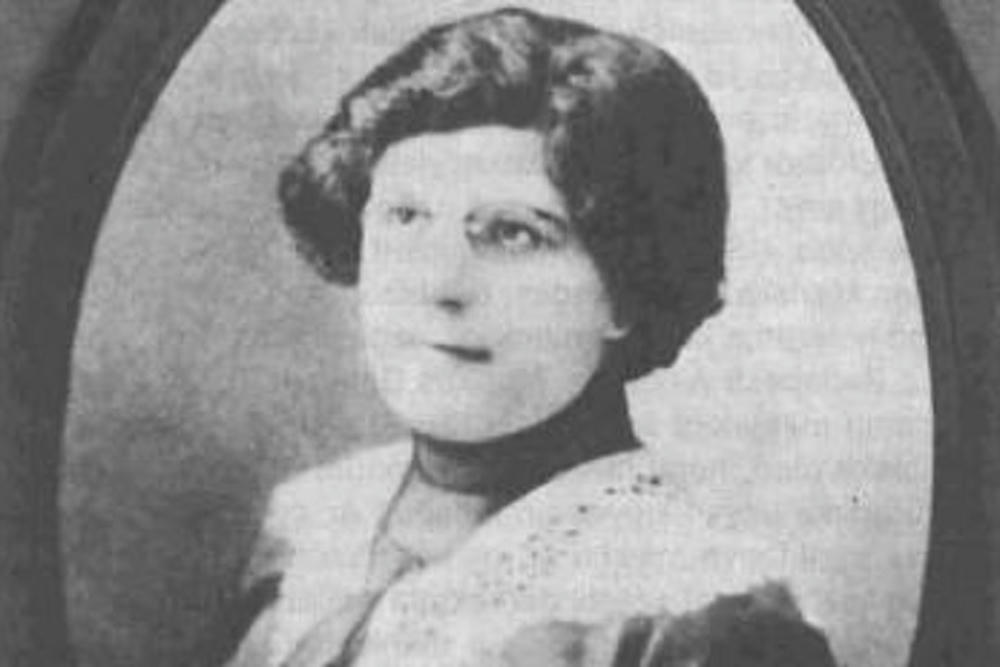
The most interesting woman present however was an old woman of sixty years, Maria Chober, an earth worker, and member of the Budapest Soviet, who, all her life has been speaking, organizing and working with the peasant women in the country, who hire themselves out as day laborers to dig ditches and other hard earth work. She is a speaker of great power, and for twenty-five years has travelled throughout the provinces of Hungary preaching Communism to these women diggers and has many times suffered imprisonment. Practically all of the women present had been in prison more than once under the old government, and several had just recently escaped from the invading Rumanian Armies.
Women as Diggers
“The digging laborers were paid very badly under the old régime,” said Maria Chober, “The men were paid three crowns a day and women 1 ½ crowns a day. The revolutionary spirit was strong under these circumstances, especially as institutions where women could get aid for their children were lacking. Many children were born on straw in stables, and in spite of the discoveries of the Hungarian physician, Semmel Weiss, thousands died without help. The hours of labor for these earth workers were so long that it was extremely difficult to teach the women, but we organized along socialist party lines. We had an enormous number of meetings wherever there was a new piece of work undertaken in small towns and villages, and our literature was distributed very thoroughly. Under capitalism women had worse jobs than men, as they were forbidden to organize, and they were terribly exploited. The proportion of payment for men and women was, for unskilled labor, twenty crowns a week for men, and six, eight, ten and twelve for women doing the same work. Skilled workmen got thirty to fifty crowns a week, while skilled women got twenty to twenty-four.”
Sexes Get Equal Pay
“Under Communism,” said Adel Spady, “Women are paid exactly the same wage as men, and the hard physical worker is placed in the highest paid rank.
“Scrub women and washerwomen now get 160 crowns a week and board, and household employees are now in the first class of workers also. However, while the Soviets, in principle, make no difference between men and women, in reality women have to battle still against some people’s ideas, and especially we have to combat the ecclesiastical influence which would keep women back We find little opposition to our proposals and bills when they are once brought to the attention of the men. In spite of the prohibition in the old days, women organized into trade unions, and even household women were of a revolutionary spirit. We had an underground press and a woman’s paper called ‘The Woman Worker’ with a circulation of several hundred thousand copies, and the domestic employees also organized and had a paper of their own. In Budapest alone this organization of domestic workers had forty thousand members and branches in twenty-five provinces. Between the first and second revolution most of the women worked with the Social Democrats, as the overwhelming majority of women were socialist, but not communist.
Reactionists Cruel to Women
“When however Karolyi formed the new government, with Bela Kun then in prison, the union of Social Democrats and Communists was brought about. There should not be any separate woman’s movement, as this is contrary to the teachings of Marx. In the occupied regions hundreds of women are in prison, and how many have been hung by the Czechs we do not know, but we have direct knowledge that the Rumanians and Czechs have committed horrible physical crimes upon women as well as upon men.
“No, none of our leaders or trade union secretaries were paid, as we always believed that it was the plan of the capitalists to establish a sort of aristocracy of labor, which would combat the real revolution through its desire to retain its paid positions. We have been fortunate in having no so-called ‘democratic’ period, as we went from feudalism to communism without it.”
Maria Gosthonyi, a very beautiful young leader, became a convinced socialist when quite a child from her observations of the way the peasants worked on her father’s estate. “I never worked with the feminists but joined the Socialist Party at the beginning of the war, and volunteered for the front as a Red Cross Nurse,” said Miss Gosthonyi. “All the four years of the war I was talking to the soldiers against the killing and for socialism, and held meetings in the hospitals to which the soldiers came in crowds. Three times I was brought up before the military tribunal and asked about my activities, but I refused to answer questions, and was released.
Communist Cannot Be Killed
“I am against militarism and violence, but when the revolution comes it seems best to have a show of power, as there must be a temporary dictatorship, and the dictatorship of the proletariat is much to be preferred to the dictatorship of capitalism. The women did not take a very great part in the revolution and the peasant women are very ignorant and can be easily led. It really makes little difference whether the Entente succeeds in starving the Government of Hungary or not, as the seed of communism is planted and cannot be killed. I am not nationalistic or individualistic enough to care very much whether this particular government lasts or not, as communism is sure to triumph by the mere establishment of it in Russia and Hungary, so that the workers can see that it can be done.”
Miss Gosthonyi was twice arrested by the Socialist Government of Austria during the month of May for her activities in the communist movement at Vienna after the establishment of the second revolution in Hungary.
Paula Poganyi, a strong anti-militarist and pacifist worker in Hungary, became a communist at the time of the first revolution last November. Although opposed to the use of force she strongly upholds the Communist Government, but believes that women must teach men the folly of organized murder.
How Revolutions Are Made
“Revolution is not made by revolutionists, but by economic circumstances,” said Miss Poganyi. ” The revolutionists only educate the people to be conscious. Capitalism has fulfilled its historic task. This was proved by the world war, and is proved by the results of the Peace Conference in Paris. Its existence is of immense danger to the race, and keeps the greatest part of humanity in slavery, and drives the people to murder each other in new wars.
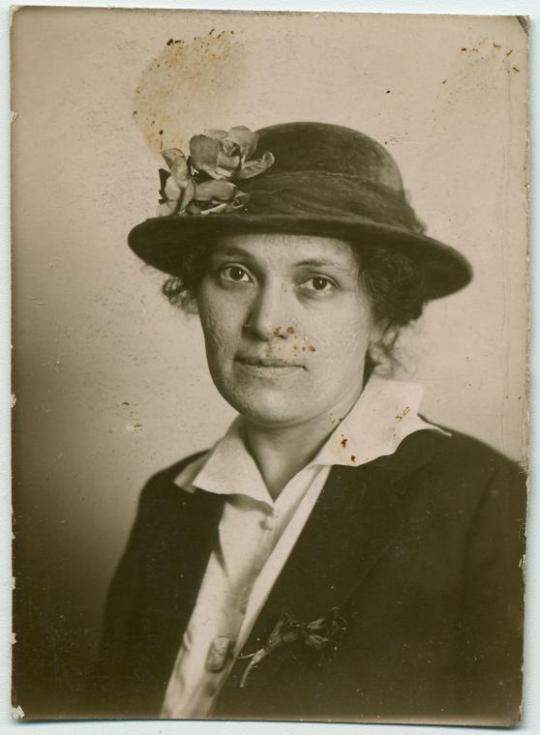
“The Leaders of this Hungarian Government do not want to kill for the sake of killing. Their orders punish most severely even quite unimportant illegal things done by the members of the Red Guard or other officials. But it seems that the prophecy, ‘Capitalism will not consent to surrender its power without a struggle,’ has become a reality in Hungary too, for capitalism here is not dead, it is only agonizing in the form of counter-revolution. It asks help from the Entente, and Rumanian troops march towards Budapest, Czecho-Slovaks approach and Austrian agitation begins in Western Hungary. With every possible underground method and artificially caused famine, capitalism is trying to weaken the young Soviet Government of Hungary.
White Terror Begins It
“It is very difficult to believe that with these counter-challenges the embittered mass will behave pacifically. Besides, wherever the ‘White Guards’ put their feet, a terror never heard or dreamed of is beginning. They persecute and hang the communists, they even persecute the families of the communists. They begin it, and the proletarians answer. Men know no other way than to destroy each other when there is discord in their points of view. The task of women is to face fearlessly the situation and to try by education to reduce the resistance and collision to the smallest possible degree.”
Yolan Fried, a young woman only twenty-seven years old, is at the head of the Child’s Welfare Department of the Government’s Social Welfare Department. Her duty is to look after and organize recreation, amusement, health, and home conditions of the children. She has been working for six weeks, and has already established! public baths in each district of Budapest where seventy thousand children take one compulsory bath each week.
“At these baths they are thoroughly rubbed, examined by a physician, given a cold water massage and tea after the process is finished. Each public school has a certain day of the week for the bath in that district and every child, whether rich or poor, must take the bath,” said Mrs. Fried “or else it would be exactly like the old system.”
Tubercular Children
“I have also established an office with two departments for the protection of children, one for outside and one for inside the home. If the conditions in a family are bad for a child, it can be taken from the parents and placed in a state institution. Just now we can specialize only in tubercular children–there has been such an enormous increase of them during the war–but we intend taking all children, six years of age, to make children’s societies, so that the child is not subjected to the egotistic influence of the small family circle, and so that it learns from the beginning that it is a member of the community and owes something to the community. The home surroundings are probably very bad now, as there are no materials and sometimes the mother is not fit. The commissariat also take charge of the amusement of children, and I am planning to have stories written, especially adapted for children from 6 to 10, 10 to 13, 13 to 19 years. Children’s playthings will also be distributed so that each little girl owns at least one doll. I have changed the orphan asylums into homes for all kinds of children so that the unfortunate orphans need not feel their isolation and other children, not orphans, may mix with them.
“An integral part of my work is the establishment of an office for psychological investigation of each child, so that we can adapt children to the kind and amount of work for which they are fitted. I am also establishing a colony for children on Lake Balaton and have adapted many confiscated villas and removed intervening fences, so that it is an open village for the children. Doctors and nurses accompany the children and later on I expect to do it on a more extensive scale, by placing the children in peasant families for their holidays.”
Fogarissi, one of the People’s Commissary for Education, and a former student at the Sorbonne and follower of the French Philosopher Bergson, has placed the women teachers in the first category of highest paid workers, as he says under the former regime they were very badly paid.
Women Teachers Get Top Pay
“The women teachers now get the highest salary which the best physical workers get,” said Mr. Fogarissi. “They therefore have no more pecuniary troubles to handicap them in their work. For a year before the revolution the teachers were organized, because of their great misery, and they have all been assimilated into the teachers organization since October, so that there is concerted action, and many teachers are members of the Budapest Soviet. We have removed reactionary professors from their posts, because we do not want modified ideas taught, but their salaries are paid until we can place them as librarians, or in other suitable positions. At present we are restricting the method of teaching, but later when the system has been thoroughly changed the teachers will have absolute freedom.
“We have experimental schools in the method of teaching, and have stopped the study of law, as it is based on the old capitalist system. I am now organizing a new university on the lines advocated by Marx and Engels for a workers’ university, and we are already using the building of the law school for preliminary classes. This university will give not only practical knowledge, but will train workers to take the leadership in the Soviets. The students will be accepted on the recommendation of their trade unions and will be paid while studying, with a subsidy of two hundred crowns a week, and will be exempt from other work. Some students will study two hours a day and work four hours a day, thus actually making the products of their chosen trade while in school. The subsidy eliminates the need for child labour to supplement the family income.”
The People’s Commissary for Education also plans for two types of high schools, one of which shall be compulsory for every student under eighteen. One type will unite the classical and industrial system, and the other will include technical and practical business schools. Already he has established in the higher classes of the schools disciplinary tribunals, elected by the students and all students studying a trade or profession automatically belong to the teachers union of that trade or profession, and can have a voice in their meetings.
At a meeting of 5,000 women held in the Buda Concert Hall several of the women communist leaders held the audience spellbound for five hours. Bela Kun addressed twelve such meetings during one afternoon, which were organized by Adel Spady, to explain to the women the difficulties of food distribution. After the announced speakers had finished there were spontaneous speeches from the audience, and women young and old, rich women and poor women, peasant women and women from Budapest spoke vehemently for or against the Government. Whether the women took a great part in the communist revolution or not there is no doubt that the Hungarian woman can speak for herself in no uncertain terms.
The Butte Daily Bulletin began in 1917 in reaction to the labor wars in Montana, the Speculator Mine fire killing 168 miners; IWW organizing, and the murder of IWW organizer Frank Little in Butte. Future Communist leader and IWW organizer William F. Dunne and R. Bruce Smith, president of the Butte Typographical Union published the paper as an outgrowth of a strike bulletin with the masthead reading, “We Preach the Class Struggle in the Interests of the Workers as a Class.” It became daily in August 1918 and in September 1818 officers raided their offices and arrested Dunne and Smith on sedition charges. An extremely combative revolutionary paper, while unaligned, it supported the struggles of the Left Wing in the SP, reflecting the large radical Irish working class of Butte also supported Ireland’s and the Bolshevik revolution, as well as the continued campaigns of the IWW locally and national as well as the issues in Butte. It ran until May 31, 1921.
PDF of full issue: https://www.loc.gov/resource/sn83045085/1919-07-23/ed-1/?dl=page&q=women&sp=3&r=0.553,0.916,0.346,0.17,0#viewer-pdf-wrapper

