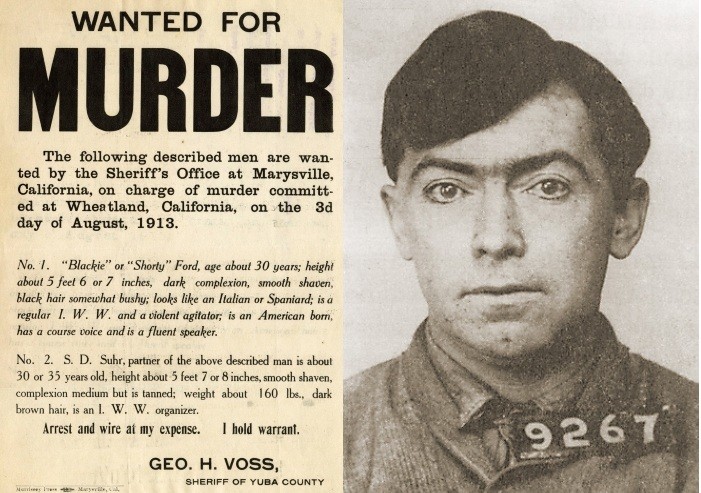
Mortimer Downing reports on one of the first major modern U.S. agricultural workers strikes, the hop pickers organized against the Durst Brothers in Wheatland, California led by the I.W.W. and the ‘riot’ which led to four deaths and a series of frame-up cases against worker militants.
‘Bloody Wheatland!’ by Mortimer Downing from Solidarity. Vol. 4 No. 52. January 3, 1914.
Bloody Wheatland is glorious in this, that it united the American Federation of Labor, the Socialist party and the I.W.W. in one solid army of workers to fight, for the right to strike.
Against the workers are lined up the attorney general of the state of California, the Burns Agency, the Hop Growers’ Association, the ranch-owners of California, big and little business and the district attorney of Yuba county, Edward B. Stanwood. For the army of Burns men, engaged in this effort to hang some of the workers, somebody must have paid as much as $100,000. The workers have not yet gathered $2,000 to defend their right to strike.
Follow this little story and reason for yourself, workers, if your very right to strike is not here involved.
By widespread lying advertisements Durst Brothers assembled twenty-three hundred men, women and children to pick their hops last summer. A picnic was promised the workers.
They got:
Hovels worse than pig stys to sleep in–for which they were charged seventy-five cents per week, or between $2,700 and $8,000 for the season.
Eight toilets were all that was provided in the way of sanitary arrangements.
Water was prohibited in the hop fields, where the thermometer was taken by the State Health Inspector and found to be more than 120 degrees. Water was not allowed because Durst Brothers had farmed out the lemonade privilege to their cousin, Jim Durst, who offered the thirsting pickers acetic acid and water at five cents a glass.
Durst Brothers had a store on the camp, and would not permit other dealers to bring anything into the camp.
Wages averaged scarcely over $1 per day.
Rebellion occurred against these conditions. Men have been tortured, women harassed, imprisoned and threats of death have been the portion of those who protested.
When the protest was brewing, mark this: Ralph Durst asked the workers to assemble and form their demands. He appointed a meeting place with the workers. They took him at his word. Peaceably and orderly they decided upon their demands. Durst filled their camp with spies. Durst went through the town of Wheatland and the surrounding country gathering every rifle, shot gun and pistol. Was he conspiring against the workers? The attorney general and the other law officers say he was only taking natural precautions.
When the committee which Ralph Durst had personally invited to come to him with the demands of the workers arrived, Durst struck the chairman, Dick Ford, in the face. He then ordered Dick Ford off his ground. Dick Ford had already paid $2.75 as rental for his shack. Durst claims this discharge of Ford broke the strike.
This was on Bloody Sunday, August 3, 1913, about two o’clock in the afternoon.
Ford begged his fellow committeemen to say nothing about Durst’s striking him.
At 5:30 that Sunday afternoon the workers were assembled in meeting on ground rented from Durst. Dick Ford, speaking as the chairman of the meeting reached down and took from a mother an infant, saying, “It is not so much for ourselves we are fighting as that this little baby may never see the conditions which now exist on this ranch.” He put the baby back into its mother’s arms as he saw eleven armed men, in two automobiles, tearing down toward the meeting place. The workers then began a song. Into this meeting, where the grandsire, the husband, the youth and the babies were gathered in an effort to gain something like living conditions these armed men charged. Sheriff George Voss has sworn, “When I arrived that meeting was orderly and peaceful.” The crowd opened to let him and his followers enter. Then one of his deputies, Lee Anderson, struck Dick Ford with a club, knocking him from his stand. Anderson also fired a shot. Another deputy, Henry Dakin, fired a shot gun. Remember, this crowd was a dense mass of men, women and children, some of them babies at the breast. Panic struck the mass. Dakin began to volley with his automatic shot gun. There was a surge around the speaker’s stand. Voss went down. From his tent charged an unidentified Porto Rican. He thrust himself into the mass, clubbed some of the officers, got a gun, cleared a space for himself and fell dead before a load of buckshot from Henry Dakin’s gun.
Thirty seconds or so the firing lasted. When the smoke cleared, Dakin and Durst and others of these bullies had fled like jack rabbits. Four men lay dead upon the ground. Among them, District Attorney Edward T. Manwell, a deputy named Eugene Reardon, the Porto Rican and an unidentified English lad. About a score were wounded, among them women.
Charges of murder, indiscriminative, have been placed for the killing of Manwell and Reardon. This Porto Rican and the English boy sleep in their bloody graves and the law takes no account–they were only workers.
Such are the facts of Wheatland’s bloody Sunday. Now comes the district attorney of Yuba county, the attorney general of the state of California and all the legal machinery and cry that these workers, assembled in meeting with their women and children, had entered into a conspiracy to murder Manwell and Reardon. They say had no strike occurred there would have been no killing. They say had Dick Ford, when assaulted and discharged by Durst, “quietly left the ranch, the strike would have been broken.” What matters to these the horrors of thirst, the indecent and immodest conditions? The workers are guilty. They struck and it became necessary to disperse them. Therefore, although they, the workers were unarmed and hampered with their women and children, because a set of drunker deputies, who even had whisky in their pockets on the field, fired upon them, the workers must pay a dole to the gallows.
To vindicate and establish this theory an army of Burns men have been turned loose. They took one Swedish lad, Alfred Nelson, carried him around the country through six jails, finally beat him brutally in a public hotel in the city of Martinez. One of these Burns thugs is now under a sentence of a year in jail and $1,000 fine for this act.
These same Burns men arrested Herman D. Suhr in Prescott, Arizona. He was confined like a beast in the refrigerator of a box fruit car. These Burns men poked him with clubs and bars to keep him awake. He was taken to Los Angeles and tortured in that jail. Thence they carried him to Fresno for further torture. Thence to San Francisco, thence to Oakland. Here for four days three shifts of Burns men tortured him by keeping him awake. In order that no marks should show on his person, they rolled long spills of paper and thrust the sharp points into his eyes and ears and nose every time his tired head dropped. He was placed in a three-foot latticed cell so that these animals could easily torture him without danger from his fists. He went crazy, signed a “confession,” and the judges of Yuba and Sutter counties and the district attorneys thereof have tried to make it impossible for him to even swear out a warrant for his torturers.
Mrs. Suhr’s wifehood was questioned when she first visited her husband.
Edward B. Stanwood, the present district attorney of Yuba county, has had more than a score of men arrested. He has kept them for months in jails at widely separated points. Burns men have been permitted to enter their cells and use every effort to frighten them into confessions. Men say they have been brought before Stanwood, himself, and when they told the truth about their actions these Burns men have called them “God damned liars.” Stanwood has sat by. Again and again Stanwood has refused to take any action concerning Durst’s gathering of arms, concerning the actions of the Burns men. He has refused to put charges against these men until compelled to do so by writs of habeas corpus. Here were a band of men, all of them armed, many of them drunken, who charged a peaceful meeting endangering the lives of women and children. Stanwood says it was because of a conspiracy among the workers that anybody was killed. None of the workers had arms. All the deputies had pistols and rifles. In the city of Marysville, where the trials will take place the newspapers constantly allude to the men in jail as fiends. The judge is the life-long friend of the dead Manwell, every juror possible knew the sheriff and the other deputies. They publicly allow them to be called fiends. The acts of the Burns men are excused as necessary. To cinch the whole thing the courts have refused a change of venue. The whole community fears that this case should be tried by a jury not involved directly in the facts.
Under the same law the next strike can be broken in the same way. Let a drunken Burns man or deputy or strike breaker fire upon strikers, kill some of them and the same method will be used. If only these two workers had been killed the six men now held would be charged with murder. It is only handy and incidental to the movement of the bosses that two of their own were involved, whose deaths enrage their friends. The case is plain, workers. Unite to free these six men or it will be your turn next.
The most widely read of I.W.W. newspapers, Solidarity was published by the Industrial Workers of the World from 1909 until 1917. First produced in New Castle, Pennsylvania, and born during the McKees Rocks strike, Solidarity later moved to Cleveland, Ohio until 1917 then spent its last months in Chicago. With a circulation of around 12,000 and a readership many times that, Solidarity was instrumental in defining the Wobbly world-view at the height of their influence in the working class. It was edited over its life by A.M. Stirton, H.A. Goff, Ben H. Williams, Ralph Chaplin who also provided much of the paper’s color, and others. Like nearly all the left press it fell victim to federal repression in 1917.
PDF of full issue: https://www.marxists.org/history/usa/pubs/solidarity-iww/1914/v04n52-w205-jan-03-1914-solidarity-texas.pdf

