Arts’ work can permit activists to openly wrestle with theory and method in a way that traditional political work simply does not allow for. Bu his own admission, in search of a technique, Alfred Saxe on the specific needs in putting together a revolutionary agit-prop performance.
‘Directing the Agit-Prop Play’ by Alfred Saxe from Workers Theatre. Vol. 3 No. 5-6. May-June, 1933.
If we are to accomplish our results in much less time than the usual drama, if we want maximum of results within our limitations, if we wish to create versatile actors, directors, playwrights, technicians, we must learn our weapons even more thoroughly than the ordinary actor and director. It is a conviction which has been strengthened with the continuance of the work, that to do agit-prop–actors, director, playwright, technician must be highly developed. Some comrade once said that it was nothing to get up and shout a few slogans–anyone can do that. Quite correct. But shouting a few slogans is not agit-prop. This false idea has created a gulf between the agit-prop groups and our capable left wing playwrights–an idea which has manifested itself in all fields of the work and accounted to a great extent for the slowness with which professional technicians have been drawn to our theatre. Where agit-prop groups have gone beyond slogans into a developed theatrical range taking in realism, stylization, symbolism, vaudeville, mass chant, etc., it has succeeded in drawing in professional technicians and in fact has been responsible for the organization of our stationary theatres. I go into this analysis for the simple reason that there are many directly in the work still backing under the illusion that agit-prop must consist of either slogans or mass recitations. In no sense must agit-prop be considered a theatre of slogans. Agit-prop must strive to be as creative as the best of the art theatres. We must not underestimate the training necessary for agit-prop. If we do, we will find ourselves stagnating after the first two or three plays.
To those in the work, the immediate step is training in all fields of the theatre–a conscious research, analysis, study. In accordance with this training a series of articles dealing specifically with the problems confronting a director and constant discussion of these questions in this magazine is one of the foremost tasks for the development of our work.
DIRECTING denotes a knowledge of various technical problems such as contrast, design, unity, tempo, voice, movement, emotion, pantomime, etc. In the workers theatre directing not only has these technical problems to consider but is also faced with the problem of developing a unified collective group of comrades able not only to conquer problems but also to assist them towards a Marxist-Leninist understanding of the world they live in. This means that the director himself must be conscious of his technical development, his political development as a guide to the others. Working together with others, he must learn to analyze the weaknesses of all comrades, including himself–and work to remedy them. Working on this collective basis, we have found that the best plan of action in direction is through the organization of a directing committee, consisting of two, three, or four comrades in the group who are interested in this phase of the work, or a director in case there is no committee, who plan the production before coming to rehearsals. This is an extremely important part of the work. It is necessary to stress the planning of rehearsals. It is necessary to watch the rehearsals and analyze results very carefully. Just as planless production under capitalism leads to chaos, so planless production under a director will lead to chaos.
One of the members of this committee is chosen as the chief director. He is to conduct all rehearsals without interference from the directing committee or the acting group. It must be understood that during a rehearsal the director is in complete charge. The actors are to follow his directions with thorough discipline. Following every rehearsal, it is best to have a short meeting with the entire group to discuss the errors made by the director, the weaknesses of the play, individual problems, etc.
As the first of a series of articles taking up technique from the directors angle, I present a general plan of action, step by step, an outline of a production. This is hardly a baking recipe–we are not as scientific as that yet. And it should be understood that such an outline will have to be varied from group to group. Our basis of work is experimental and our theory will reflect this. As our work broadens so the theory will take in new and larger fields.
OUTLINE FOR DIRECTING
We divide the directing into two large sections:
1. Planning of the production–Working with the directing committee, in advance of the rehearsal.
2. Work with the group–Rehearsals.
A. PLANNING First meeting with Committee.
1. Reading with a view to revising.
In most plays it is necessary to make some changes. One of the first tasks of the directing Comm. is to see that the obvious weak points in script are strengthened. That points about changes that were raised at first meeting should here be considered for revision–strengthening dialogue–building of climaxes–unity.
2. Discussion of Theatrical Potentialities.
a. Contrasts–for example–voice and action tempo.
High–low
lyric–staccato
fast—slow
Heavy–light
b. Design: pictures formed by various positions for example circles, squares, triangles, diagonals, verticals, parallels.
Use of levels
use of lights color
unity of design.
3. Dividing the Play into Scenes.
The director will find it much easier to work if he divides the play into small sections. Instead of spreading your problem over the entire play, you concentrate your work and narrow it down to a scene at a time. This division into scenes may be made at points where there is an abrupt change in action, entrance of new character or set of characters, bringing in a new set of ideas, etc. This is in the hands of the directing Comm. and should offer very little trouble. Nevertheless for beginners especially it is extremely important that this division be made.
4. Now that the play has been broken up into scenes the next step is to begin all over again. Work over scene by scene going into the scene more minutely until you have a thorough picture of what the scene will look like at least in the raw. This means recreating the entire play before you take it to rehearsal. Think over the characters very thoroughly becoming so familiar with the scene that you do not find it necessary to use the script but you work with a mental image of the scene always in front of you.
5. If possible the directing Comm. should meet before every rehearsal to plan the evenings work and to discuss the progress of the play. A half hour spent in laying out the plan of action before a rehearsal will make up for much indecision and stammering during the rehearsal. The question of planning cannot be underestimated. The Committee should keep its eyes and ears open for suggestions from the group during the group discussion.
B. WORKING WITH GROUP– Rehearsals.
1. First Rehearsal Reading and discussion.
The second reading with the group should be very thorough–discussing the background of the plays its history–background of the characters, etc., giving every one a thorough picture of the entire play. Strive to provoke discussion from the group. If there is time left, the next problem is casting.
CASTING It is best to try out several members for one role. The directing Comm. then submits a tentative cast which of course may be changed as the play progresses.
2. Second Rehearsal
It is the task of the director to allow for gradual development, getting acquainted with the characters or lines, establishing contact with each other. Let the characters establish a natural contact—don’t throw yourself into the thing without first letting the ideas, the thoughts, sink in very thoroughly.
3. Third Rehearsal
Get rid of scripts. Take off your coat and set to work in earnest on shading, tempo, design, unity, etc.
4. Fourth Rehearsal, fifth, sixth etc.
As the play develops from rehearsal to rehearsal, from scene to scene, stop it less and less–jotting down your criticism on paper. Thus you allow the play to gain continuity, unity, polish. Spend time on the weak scenes.
5. Last Rehearsals.
Do not criticize during the rehearsal at all. Only at the end after complete rehearsal. Watch especially for tempo. It is important at the last rehearsals that the attitude of the director be positive. That is encouraging regardless of how poor the work is. The psychology of the actor who knows that the director already has set his doom as far as his job is concerned means a mental state which is hard to overcome and balks all possibility of development.
As has been stated before, this general outline is the first of a series of articles on directing and is assuredly not the last word. We urge all who have other ideas on directing to write in for only through a thorough thrashing out of these ideas can we arrive at the knowledge and theory (or points to add to this outline and the following articles) necessary to build workers theatre into a mass movement. The next article will deal with the problem of design and action, concretely explaining how to put action into a play that lacks it and how and what we mean by design and its problems.
Directors should send in articles dealing with their methods of work. We must build on our collective experience. We need technique!
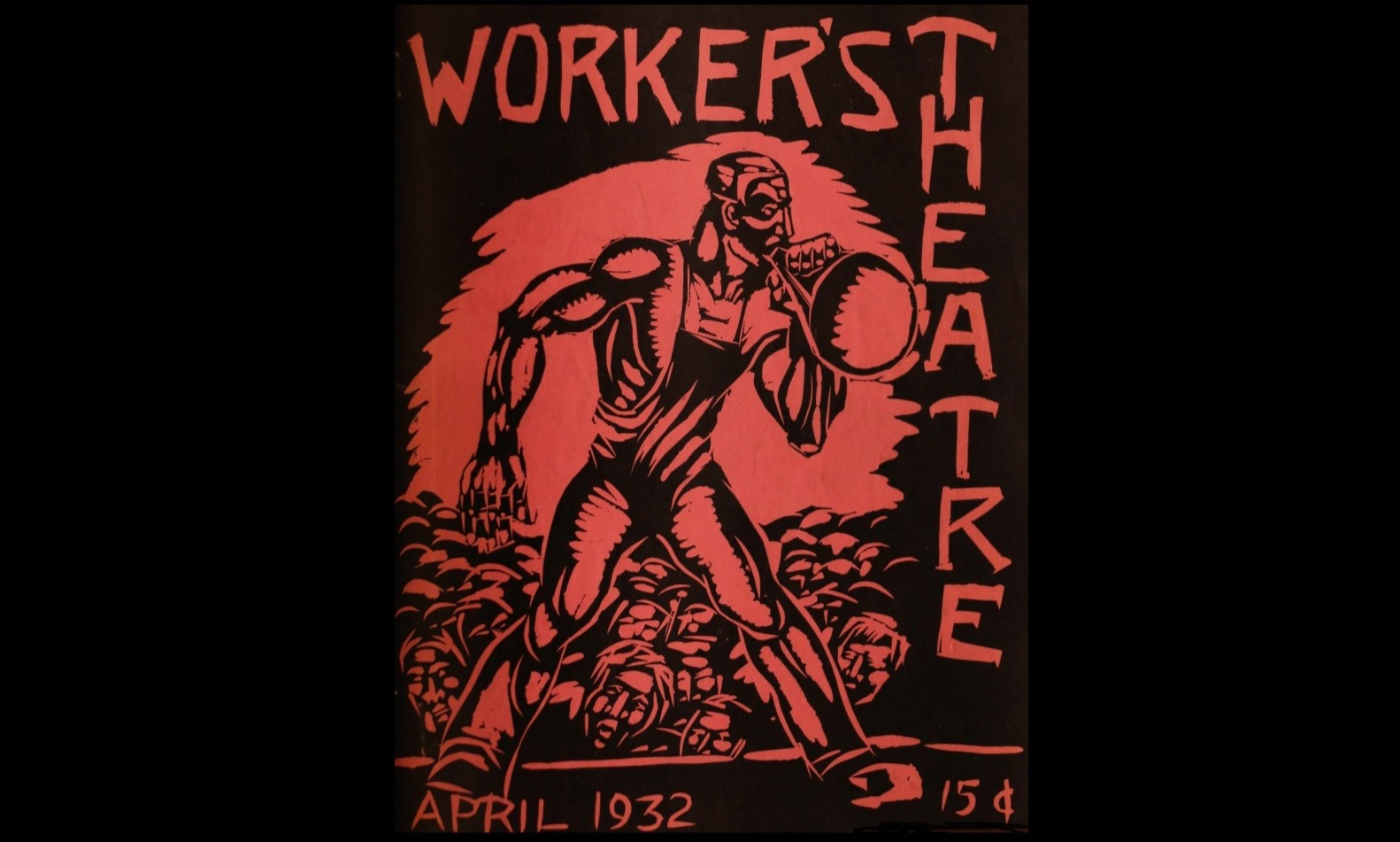
The New Theater continued Workers Theater. Workers Theater began in New York City in 1931 as the publication of The Workers Laboratory Theater collective, an agitprop group associated with Workers International Relief, becoming the League of Workers Theaters, section of the International Union of Revolutionary Theater of the Comintern. The rough production values of the first years were replaced by a color magazine as it became primarily associated with the New Theater. It contains a wealth of left cultural history and ideas. Published roughly monthly were Workers Theater from April 1931-July/Aug 1933, New Theater from Sept/Oct 1933-November 1937, New Theater and Film from April and March of 1937, (only two issues).
PDF of full issue: https://www.marxists.org/history/usa/pubs/workers-theatre/v3n5-n6-1933-may-jun-Workers-Theatre-yale-mf.pdf

