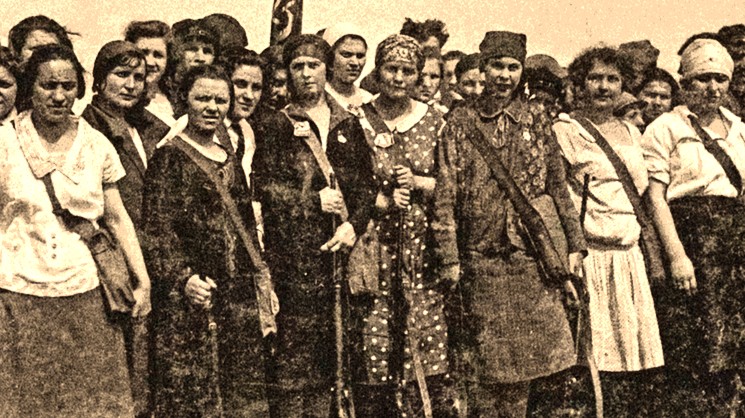
Hertha Sturm on the already battered working class women of Germany as less than five years after the end of the First World War and added to the economic stress of reparations and the Versailles regime, came the invasion of the Ruhr by French imperialism and a new conflict, with German fascism taking the initiative and threatening every meager gain won.
‘The Women’s Struggle against War Danger and Fascism’ by Hertha Sturm from International Press Correspondence. Vol. 3 No. 39. May 24, 1923.
For 4 years the proletariat has been retreating step by step before the attacks of capital; at a thousand fronts it quivers beneath the blows of its hereditary enemy, the bourgeoisie. The proletarian women, the working women of the whole world, have had bitter experience of this in their own lives: longer working hours at reduced wages, unemployment, high prices and lack of housing, want and misery for children and mothers, in such frightful forms as have never been experienced before. And all this need never have reached such a point, had the working class, and above all the working women, placed themselves energetically on the defensive. International allied capital would never have succeeded, after the so-called revolution, in systematically bringing one proletariat after another beneath its yoke again, and drawing the noose around the neck of its victim, if the proletarian men and women of all countries had been more prompt in closing the ranks of their international fighting front.
And now the international proletariat is confronted by a new and gigantic danger. The capitalists on both sides of the Rhine, of the English Channel, and of the Atlantic Ocean, greedy for spoil, are threatening to decide the reparation conflict on the Ruhr by a new world war. In every country the Fascisti are arming, that they may drown in blood every revolt of the working class, against the rule of sweat and blood of their hereditary exploiters.
Do the women of the proletariat want a new war? If there are any in whom the horrid memories of the four years of the great war have faded, they should cast a glance at some of the preparations being made by the capitalist world for the next war. According to a speech by Lloyd George, had the last war continued, the allies would have been able to employ a gas—lewisite–by means of which, experts declare, the whole population of Berlin could have been exterminated within 24 hours. In the meantime even this gas has been surpassed. Thus the American state laboratory, in which more than 4,000 investigators are engaged every day in experimenting for fresh means of chemical destruction, has produced a liquid poison of which the amount to be carried by one aeroplane would suffice to annihilate every living creature within seven miles. There are similar laboratories in almost every country in the world.
A French expert, speaking with regard to experiments made with sinapic and other gases, declared that there was one gas among them “whose employment causes temporary incapacity to think, converting human beings into idiots or rendering them intoxicated for the time being.” (Extract from Fimmen’s speech at the Hague peace conference.)
The horrors of this threatened capitalist war should make proletarian, women shake off their lethargy, and take up the weapons of defence.
Class-conscious proletarian women do not shrink in terror from all recourse to force; they do not faint away if they see a drop of blood. They have experienced so much bloody misery and violence against themselves, that they fully realize that force can only be broken by force: And in the class war they will take their place in the ranks against the capitalists, even with weapons in their hands.
The proletariat must rebel against being driven to the shambles again, as in 1914, for the profits of the capitalists; it must avert this war, for it would immeasurably intensify the sufferings of the proletarians, of their wives and children, instead of opening out an avenue of escape from chaos and misery.
If the women of the proletariat are seriously determined to prevent the imperialist war, they must put a speedy end, to the proceedings of those elements which are endeavoring to incite the working class to stand for a war of “national emancipation”, in the hope that they may thereby seize the opportunity of crushing the revolutionary labor movement, and of establishing the naked and brutal dictatorship of the exploiting bourgeoisie. The National Socialists or Fascisti, the bitterest enemies of the class-conscious working class, must be prevented by all possible means from setting up their unlimited sway over the whole world, as they have already done in Italy. Have proletarian women not seen enough of the “legal”. White Terror let loose by class justice the world over? Have not victims enough already fallen on the battle-fields of the class war, are there not yet enough languishing in the prisons of the class states? Are not the prisons of Germany and France, Poland and Yugoslavia, filled with revolutionary fighters? Are there not hundreds of political prisoners slaving in the mines of Walachia in Roumanía, many of them delicate women and girls? Are not the ears of all proletarian women filled with the cries of the victims tortured by the Hungarian executioners?
Will the women of the proletariat tolerate conditions in their own countries like those which prevail in Italy? Where Fascist bands go unpunished when they set workers’ houses on fire, beat workmen, ill-treat women and girls, murder sons before their mothers’ eyes, shoot down women with their children in their arms, and throw pregnant women out of the windows?
It is only by closely joining forces in self-defence organizations, only by the creation of proletarian defence units, that the working class can ward off these evils. May there be many more such courageous spirits as those among the working women of Zella Mehlis in Thuringia, who with calm determination formed female defence units or had themselves enrolled in the units belonging to their factories or locality.
In this spirit the women of the proletariat must join with their husbands and children in meetings and in demonstrations, must unite in proclaiming their determination to fight with every means at their disposal against every attack made on the life and interests of the working class, against fresh capitalist wars, and against Fascism. They will oppose the front of international capital with the international united front of the men and women of the proletariat!
International Press Correspondence, widely known as”Inprecorr” was published by the Executive Committee of the Communist International (ECCI) regularly in German and English, occasionally in many other languages, beginning in 1921 and lasting in English until 1938. Inprecorr’s role was to supply translated articles to the English-speaking press of the International from the Comintern’s different sections, as well as news and statements from the ECCI. Many ‘Daily Worker’ and ‘Communist’ articles originated in Inprecorr, and it also published articles by American comrades for use in other countries. It was published at least weekly, and often thrice weekly. A major contributor to the Communist press in the U.S., Inprecorr is an invaluable English-language source on the history of the Communist International and its sections.
PDF of full issue: https://www.marxists.org/history/international/comintern/inprecor/1923/v03n39[21]-may-24-1923-Inprecor-stan.pdf

