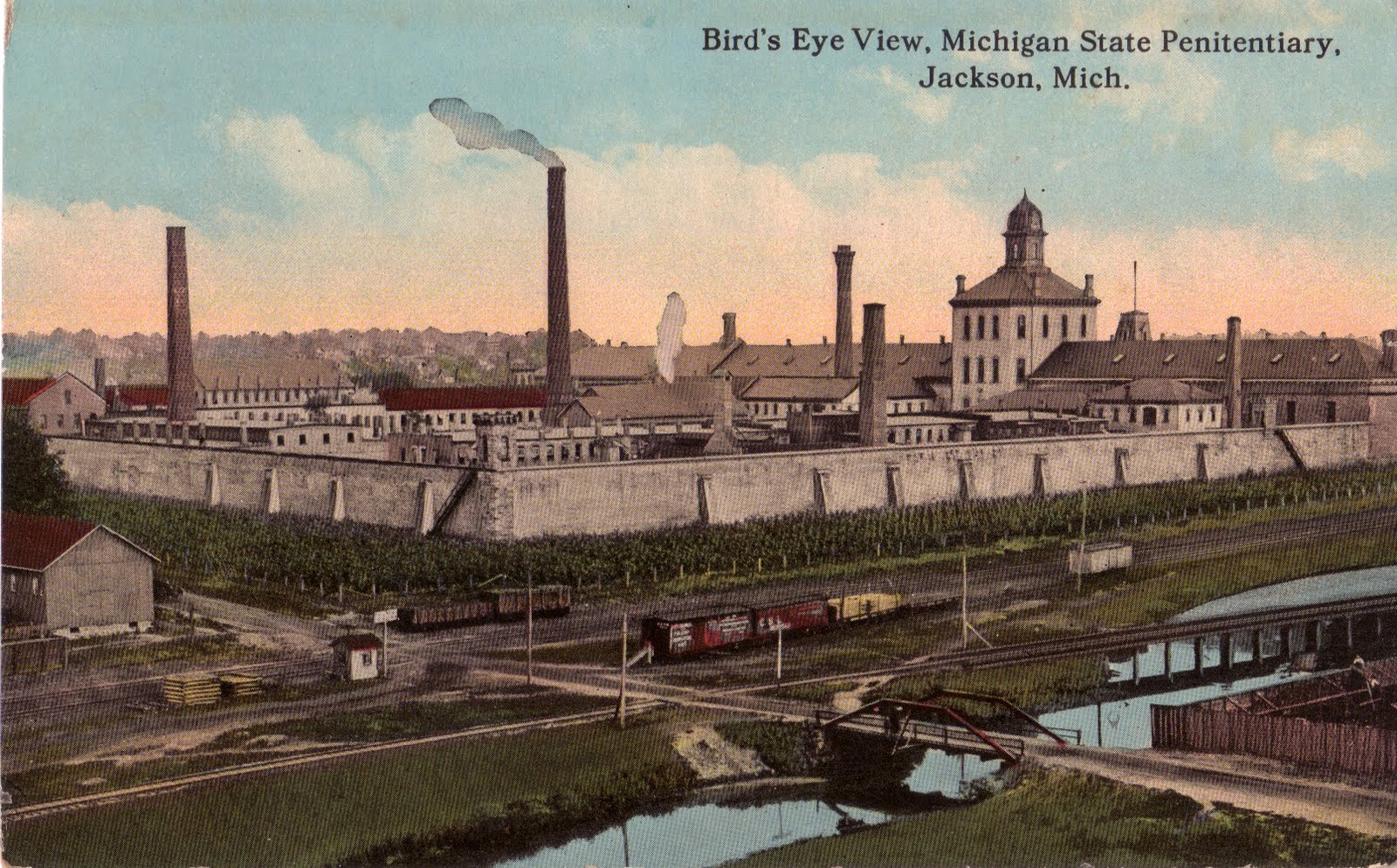
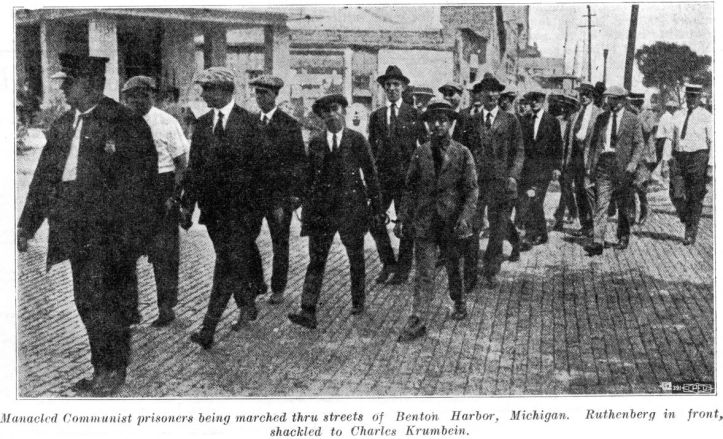
The “old” Jackson State Prison in Michigan has a history as sordid as the society which has made use of it. In 1925, Communist leader Charles Ruthenberg entered its walls to serve a sentence for criminal syndicalism. In this essay, Robert Minor listens to the prison and hears the stones speak of the Underground Railroad and the right of revolution. On August 22, 1922 a police raid against the convention of the illegal Communist Party held in rural Michigan netted much of the top leadership of the movement, charged with criminal syndicalism. One of those arrested, “Charles Ashworth” was federal agent Francis Morrow. The subsequent legal labyrinth, trials diverted huge amounts of time and resources over the following years, as it was intended. All the cases came to naught except for Foster’s, which ended in a hung jury, and Ruthenberg’s conviction. He was out on appeals, which failed in front of the U.S. Supreme Court, when he died in 1927.
‘An Old Prison Speaks’ by Robert Minor from Workers Monthly. Vol. 4 No. 4. February, 1925.
Into the doors of one of the worst prison hells of America—the state penitentiary at Jackson, Michigan—on the seventh day of January, 1925, walked C.E. Ruthenberg, national executive secretary of the Workers (Communist) Party of America.
The new convict—or rather the old ex-convict turned convict again—is one of the founders of the Communist Party in this country. On August 22, 1922, he was arrested for “assembling” at one of the Party’s annual conventions— assembling, nothing more.
“–and in the County and State aforesaid, C.E. Ruthenberg did voluntarily assemble with a certain society, group and assemblage to teach and advocate the doctrines of criminal syndicalism, contrary to the form of the statute in such case made and provided, and against the peace and dignity of the people of the State of Michigan.”
As Ruthenberg enters the penitentiary under a savage sentence of three to ten years of penal servitude in addition to a $5,000 fine, the famous wholesale political prosecutions at St. Joseph, Michigan, begin again. In addition to Ruthenberg, thirty-one others, including nearly all of the national leaders of the Workers (Communist) Party, are to be locked into the Jackson penitentiary if the prosecution succeeds.
It is attack upon a political party.
It is an attempt to establish for police practice the principle that a certain type of political party cannot exist in the United States. Working behind the screen of the state government of Michigan is the entire power of the old Harry Daugherty and William J. Burns machine (still unofficially in power!) of the federal government at Washington. The precedent established in a little rural community of Michigan at an enormous cost with large sums of money coming from a mysterious and unrevealed source is intended to be applied over the whole United States so that any organization of the working class or the exploited class of farmers can at the will of any prosecutor be adjuged as criminal, destroyed, and its members thrown into prison under savage sentences. This will apply to labor unions equally with political organizations. The effort is to establish complete police control of the labor movement, with governmental, terroristic suppression of all labor programs not in accord with the interests of the capitalist class.
Attack Upon Political Party
But especially is this an attempt to destroy the political party which is known to be the key to any successful resistance of the working class and exploited farmers to the ruthless power of capitalism.
The struggle is an incident in the birth, expansion and growth to mass leadership of a new political party, a party of most profound historical significance. The struggle to put forward and give mass character to the Communist party, is in reality the effort of the proletariat—the new, the future ruling class—to crystalize, to form, its class organ of leadership in the struggle for power.
Each class which rises to power must first form its political organ of leadership, its party—its class party, sharp and clear, freed in its composition and in its program from intermixtures of the classes which it must fight.
In the Communist Manifesto Marx wrote of the historical process by which occurs the “organization of the proletarians into a class, and consequently into a political party…” The process of development of the proletarian political party (i.e., the party having the requisites for leading the proletariat through struggle to the position of ruling class), is the process which the capitalist state attempts to arrest through these prosecutions.
A Political Program Under Prosecution
The center of the fire of the prosecution is the political program of the party. The basic point of the indictment is that the defendants assembled with a political party which had such and such a program. The accusation is that the defendants as an organization BELIEVED IN certain things as embodied in a program. Technically the legal statute puts it as a question as to whether they as an organization “advocated” certain views or actions, but in practice the term “advocate” is interpreted by the court as meaning not a direct solicitation of some person to do a concrete thing at a concrete time and place, but as meaning to “advocate” in the colloquial sense of holding within one’s mind the opinion that certain things in general should be done, and expressing such opinions as political beliefs. The defendants are not accused of any overt act, nor of soliciting any definite person to any definite act.
The Workers (Communist) Party of course will continue to exist regardless of any decision of any court or any other act of the government power; but it fights here in the clammy air of the legal pettifoggers for the legal acknowledgment of its right to exist. In fighting for this right, the Workers Party is fighting in behalf of the whole working class and for every working class organization, be it trade union or any other.
The trial of Ruthenberg, and before it the trial of William Z. Foster (which resulted in a hung jury), teemed with questions about “force and violence” and the “overthrow of the capitalist state,” and civil war.
A political party is being prosecuted because its purpose is to substitute a new ruling class in the place of a present ruling class, and the legal basis of the prosecution in that this political party makes a historical analysis which shows that the revolutionary act of substituting one ruling class with another ruling class is invariably accompanied by violence and civil war.
The prosecution of these Communists in Michigan is characterized by the heaviest emphasis upon the fact that the political convention in which they assembled was a secret convention—an “underground” convention—and that the Communist Party maintained an “underground” organization.
Heavily underscored was and is the question of the Communist Party having the purpose of confiscation of the property of the wealthy classes through the medium of a workers’ and farmers’ soviet government and without compensation. Thus, if the state and the financial powers behind it have their way practically the entire leadership of a young revolutionary class party will enter the ancient dungeon of Jackson, Michigan, in the effort to destroy, to head off and prevent the revolutionary movement of the present day.
An Old Prison Speaks
An ancient prison, indeed, is the one at Jackson, Michigan! It was established in 1839! (Whether the present structure has been remodelled since 1839, this writer does not know, though he may soon be able to examine the ancient masonry from the inside.) The old stones are grey and splotched with green like the face of an aged man. Speak, old stones! Speak! You who have endured through eighty-six years—through some of the most stirring times of this country’s history—have you ever before seen a struggle like this?
And it seems as though the old grey stones do speak!—speak like an old man muttering in his heart, groping slowly for memories that are dim.
Speak, old stones! Have you ever before been witness to a struggle of a new, up-coming, vital young class to form its own class party as leader of its fight to become the ruling class?
“Yes,” says the old prison wall, “yes, I have seen such a struggle. Here in Jackson, Michigan,—here under the window of Ruthenberg’s cell—here within sight of the thirty cells which you may occupy, you young revolutionists—I once looked out upon the founding of a new, young class party which had the purpose of making its class the ruling class of this country…That was a long time ago…It is the ruling class…It has remained the ruling class for seventy years, undisputed until you came to dispute its rule. It was the capitalist class, and here in Jackson, Michigan, under my walls it founded its class party for the winning of its undivided rule. It held its first convention here in Jackson, Michigan, and here it gave its party its name: the Republican Party…The class party of the capitalist class.”
But tell us, old stone walls,—you speak of the Republican party—was it a revolutionary party?
“Yes, to a certain extent it was—in that day. That was a period of great class struggle, the struggle between the capitalist class of the North and the semi-feudal landlord class of the South. It was a struggle to complete the Revolution of 1776—to put the industrial capitalist class undisputedly and alone in the saddle.”
But tell us, old stone walls, what was the method of the then new party, to put its class into power? The old stones reply:
“Civil war! The War of 1861.”
But was there at that time any overt act of violence?
“Yes. The sympathizers and some men who later became organizers of that party were then engaged in armed combat in the state of Kansas—‘bloody Kansas,’ they called it then.”
But in that convention of 1854 here in Jackson, were there any wilful and purposeful violators of the law? Was there any talk of law violation?
“Yes, there sat in the convention men who were openly committed to the violation of the Fugitive Slave law and who advocated its violation and solicited others to violate it.”
And tell us, old stone walls, you didn’t hear anything of an underground organization then, did you?
“Yes,” says the old prison wall, “yes, the first and original ‘underground’ of this country’s history—and probably the one from which all ‘undergrounds’ of the world obtained their name—the ‘underground railroad.’ Among the men who met here were some who were founders and organizers of that underground, secret organization having the direct and sole purpose of violating the laws of the United States by the forceful and illegal confiscation of property in the form of slaves.”
But was not the Republican party a legal party? Did it not conduct itself as a lawful party participating in the elections to obtain its objects?
“Yes, it acted as a legal party while some of its members conducted an illegal underground association. It went into the elections lawfully, and being unable fully to obtain its object it went into civil war to obtain them.”
But it fought in the lawful name of the United States government—
And I hear the old stone walls laugh. “It used whatever means were at hand, as will any class that is struggling for power. That it secured the formal name of the state power in the election of 1860 was but a fortunate incident. Among the men who in other states followed the lead of the Michigan convention in forming the Republican party were some who contributed money to John Brown who used it to purchase weapons for armed insurrection against the United States government. The soldiers who marched through Georgia singing ‘John Brown’s Body Lies Mould’ring in the Grave’ were only validating the armed insurrection at Harper’s Ferry.” The old stones chuckled again, like an old man in his beard. “A class whose historical mission it is to obtain state power and to inaugurate a new social order, uses all legal possibilities, but it obtains power!”
But would not the class have waited for legal—
“It did not in 1776!”
By what right–
“By the right of REVOLUTION! The right which is written into the Declaration of Independence—the first of all the fundamental laws of the American Union.”
But we also are revolutionists—
“You are of a different class. We are the capitalist class; you are of the working class. We in turn imprison you for a revolutionary program.”
But justice? Why do you open your prison gates for us?
“Class justice. You are getting it. Our class justice exists to keep us in power at any cost.”
The law—
“The law must be interpreted in whatever way is necessary to keep us in power, or set aside entirely when necessary to crush you.”
But the masses are exploited, robbed—
“Yes, by us. That is the purpose of the law.”
That which we have imagined the old prison walls to say, is perfectly true.
Had the Republican party been a mere parliamentary party, and no more, the Southern states would have closed the issue by putting into practice their “constitutional right” to secede (which was then widely credited). That would have ended the matter, and the “foolish” republican experiment on this continent would have died. A great slave empire, with its capital at Richmond and extending by conquest over Cuba, the West Indies and Mexico, and into South America, would have risen above its ruins. But the Republican party was more than a mere parliamentary party—it was a CLASS party in the true sense of the word, that is, in the sense that its function was TO PUT ITS CLASS INTO POWER BY WHAT MEANS MIGHT BE NECESSARY, and not merely to march to the borders of some legal quibble on the “constitutional right to secede,” and to stop there.

Being a class party in the true sense of he word, the Republican party marched ahead, through parliamentary action, through civil war, through an iron, military, class dictatorship over the whole South, through constitutional changes made possible only by military suppression, and attained for its class complete and undivided power.
The Republican party did what we all agree to call “right.” Its work of revolution was historically justified. When in all history has a revolution been “wrong”?
But the class which formed its first clear-cut and exclusive class party in Jackson, Michigan, in 1854 has outlived its once-revolutionary role. It has become the monster of reaction. The capitalist class the world over, and all of its parties, have long ago become deadlier enemies to the human race and heavier obstacles to historic progress than the old slave oligarchy was in 1860.
Through the state power in the form of the little rural court at St. Joseph, Michigan, the big capitalism of this country is fighting against the next phenomenon of the procession of revolutions—against the formation of (or the development to a mass scale) of the political party of the class which will overthrow the present capitalist ruling class and become itself the ruling class. The Workers (Communist) Party is small; it is not yet a mass party. But even as early as the summer of 1922, it became clear to even the most stupid that the Communist Party is already in its essence the class party of the working class.
The term “class party” refers to the major class composition of the its membership; and in the deepest sense the term “class party” also implies the, political purpose, that is the program of action taking SUCH A COURSE AS WILL MAKE ITS CLASS THE RULING CLASS.
It is already clear to the most stupid stock-broker or wheat speculator, that the downfall of the parasite class will not come in this country until the Communist Party, as the class party of the working class, becomes the mass party to which the majority of the active elements of the working class look for leadership.
For that reason the effort to stifle the young Workers (Communist) Party is being made at St. Joseph.
It will be a political event of first importance to the working class and the exploited farming class of the United States when, at the beginning of February, the third of the Communist defendants takes his place in the prisoner’s dock at St. Joseph, to be followed, one by one, by his comrades.
This trial comes at a time and place of great significance. The great revolution has begun. Across the water our flag of revolution flies victorious. The Soviet Republic, which is also ours and not merely Russia’s, has for more than seven years withstood the onslaughts of our enemy, which is world capitalism. One sixth of the earth has been conquered by the heroic fighting of the working class and exploited farmers. Our comrades have established there the only relative prosperity of the toiling masses which can be found in Europe. A large part of the rest of the world is crumb. ling into ruin under the rule of capitalism and under the effort of capitalism to make civilization continue to function under its exploitation. Before the next trial at St. Joseph ends we may quite possibly hear that our comrades in Italy or in Germany are again marching under the red banner of liberation. We, here in America, stand in the strongest remaining center of capitalist control. About us we see disintegration of capitalist economic processes, accompanied by the fast and feverish consolidation of a capitalist state machine of hitherto unequalled force and violence for civil war against the exploited masses of America, as well as for new foreign wars of conquest. In direct proportion as the capitalist economic processes disintegrate, the capitalist machine of destructive violence is increased in effectiveness and strength.
It is our honor to be able to fight upon the ground of the center of world reaction. We fight against superhuman (?) odds. The masses of the exploited are not yet conscious of the meaning of the fight. But the process of disintegration even in this country has already begun to reveal to them the first and crudest lessons. Millions of workers have begun to grasp the elementary fact—exposed sharply by the famous Daugherty injunction which was practically simultaneous with and intimately connected with the arrests in Michigan—that the boasted government at Washington is a class government of, for and by the capitalist class. Millions of working farmers have already learned that “Capitalism can no longer feed its slaves.” And rapidly in the sharpening class antagonisms of the immediate future, more and more millions of both exploited classes will learn the further lesson that only by consolidating their class party and struggling to replace the present dictatorship of the capitalist class with the dictatorship of the working class can they hope for a human existence.
That some of them may learn through the Michigan trials is our hope. There can be seen an important lesson—that constitutional and “legal” rights do not exist for the working class under capitalist class justice. There, in this unique case of prosecutions based solely upon the opinions of those prosecuted, is shown the outstanding fact of the present day: that capitalist rule is obliged at last to throw off its mask of “democracy” and to strike its class enemies with naked steel, with subversion of its own “democratic” laws and contempt for its own “constitutional guarantees.”
Every possible effort must be made to draw larger numbers of workers to understand that we are fighting their fight. It is not half so important to keep the Communists out of prison as it is to make the working class understand why the Communists are prosecuted. For this reason we will stand at St. Joseph, clearly, uncompromisingly, for the cause of the working class revolution.
To the accusation of crime, we will give the ringing answer, “Not Guilty!” To the charge that we represent the cause of Revolution, we will proudly say, “We do!” In entering the prisoner’s dock, and if need be, in entering the old prison for years of penal servitude on behalf of our principles, we have the honor to represent all there is of hope for our class, for those who toil.
Workers of the world unite! You have still five-sixths of a world to gain.
Workers Monthly began publishing in 1924 as a merger of the ‘Liberator’, the Trade Union Educational League magazine ‘Labor Herald’, and Friends of Soviet Russia’s monthly ‘Soviet Russia Pictorial’ as an explicitly Party publication. In 1927 Workers Monthly ceased and the Communist Party began publishing The Communist as its theoretical magazine. Editors included Earl Browder and Max Bedacht as the magazine continued the Liberator’s use of graphics and art.
PDF of full issue: https://www.marxists.org/history/usa/culture/pubs/wm/1925/v4n04-feb-1925.pdf

