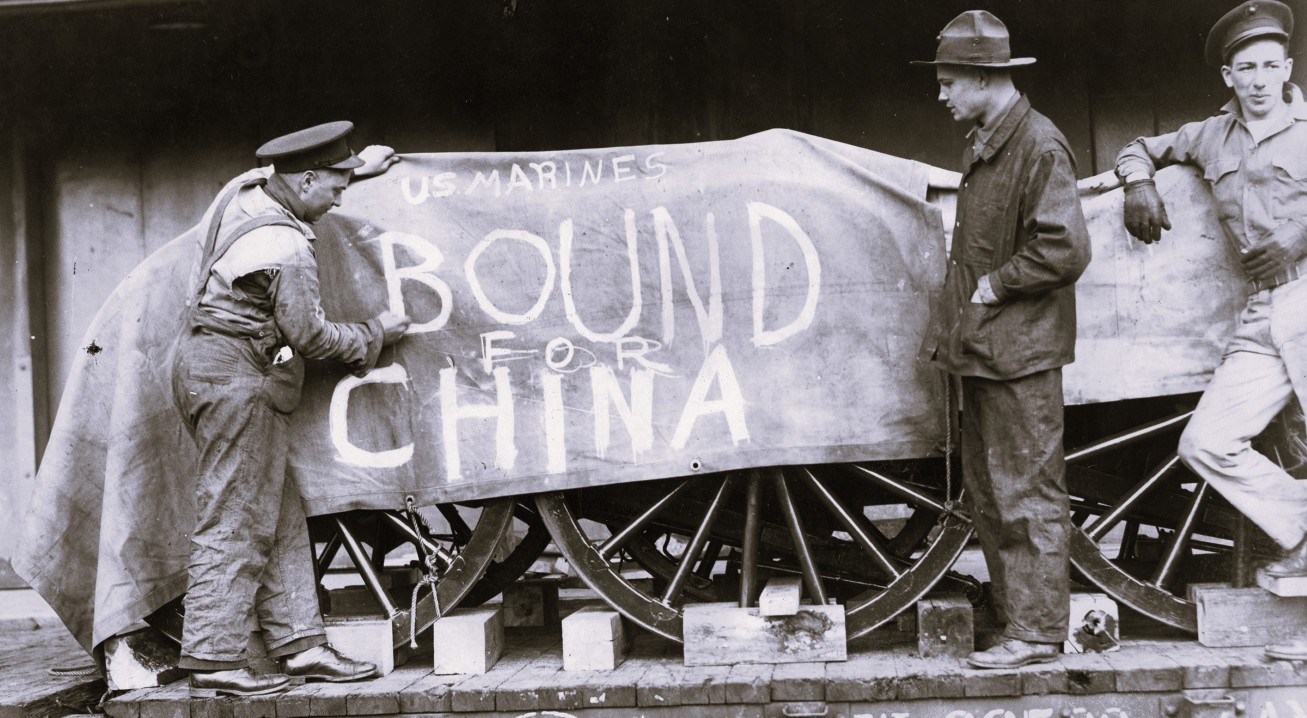
Voitinsky with the why and the how of China emerging as the center of conflict among imperialists after the First World War, as older powers and new poured investments and weapons, often intervening directly, into the then fractured country. Voitinsky was the first head of the Comintern’s Far Eastern Bureau, liaison to China’s emerging Communists and central to the formation of the C.C.P.
‘Intervention in China’ by Grigori Voitinsky from The Daily Worker Magazine. Vol. 2 No. 198. November 8, 1924.
China during the last few weeks has been the center of attention of the contending forces of the world.
The Communist proletariat of Europe and America is beginning to understand the significance of the risings of the huge population of China, India and the other colonial and semi-colonial countries. The imperialist powers, who in the present historical phase are ruling thru the liberal bourgeoisie and the opportunist leaders of the working class, are being compelled by events, and in spite of their program and declarations, to reveal their acquisitive ambitions in the colonial countries. The recent stormy developments in China opens up a page in that phase of imperialism in which the latter, clad in the toga of Christian-democratic-pacifism, is obliged in this garb to compel the toiling masses of the East by blood and iron to submit to the power of finance capital.
Almost simultaneously with the London conference of the imperialists of Europe and America, the declared aim of which was to secure the long promised “pacification” of Europe, began the attack of these same imperialists in the Far East. What are the conditions compelling the imperialists to develop a defensive movement against the colonial and semi-colonial countries at the present moment, and especially against China? Why has a whole series of events occurred in the autumn of this year, beginning in Sudan, Morocco, Persia and Afghanistan and ending with the imperialist actions in the large ports of Southern, Central and Northern China, actions which are characteristic of the aggressive instincts of the imperialists? There are three important reasons in our opinion.
First, the endeavor of a section of the victorious countries—England and America—since the world war to united action not only against the imperialist powers that were defeated in the war, but also against some of their former “allies.” While the London conference in reality signifies the growth of Anglo-American influence in Europe at the expense of French influence, the present struggle of the Chinese imperialists in the Far East is being fought in order to destroy the influence of another “ally” of England and America—Japan.
The struggle has not yet ended with the definite victory of one group of imperialists and the definite destruction of the influence of the other Such results at any rate are not to be obtained by “peace” conferences. But these conferences, by destroying the former balance of forces only render the conflicts between the imperialists more acute and bring the period of armed conflicts even nearer. We have the example of the Washington “peace” conference, held at the beginning of 1922, which, by destroying the Anglo-Japanese treaty, created still more acute relations between the chief protagonists in the Pacific—America and Japan. One of the first results of the Washington conference was the armed struggle in Northern China between the Japanese group of militarists and the American group.
The second reason for the attacks and intrigues of the imperialists in the Eastern countries is the growth of the movement for emancipation, which, to no small extent, increases the contradictions between the imperialists.
The third reason is the steadily growing popularity es the U.S.S.R. among the masses throughout the East. In the present article we shall deal with the first reason only.
The Imperialist Struggle for China Since the World War.
It was the small island Japan which at the conclusion of the world war held the hegemony in China. Itself directly very little concerned in the struggle on the European continent, young full-blooded Japanese capitalism turned its ambitions towards China, which possessed the coal and iron, these essential raw material of production which Japan so much lacked. But it was not these riches alone which attracted Japan to China.
The blooming of Japanese capitalism after the Chinese-Japanese war of 1894 when Japan received Formosa and established its influence in Korea, increased the appetites of the Japanese bureaucracy and Japanese monopoly-capitalism which were protected by the ruling cliques of large land-owners and militarists. This led to the war between czarist Russia and Japan in 1905 during which, as we know, England helped Japan. The Russo-Japanese War, in spite of the intervention of America in the person of Roosevelt on the side of Russia, nevertheless resulted In Japan’s securing tremendous advantages in the Pacific Ocean. Japan received the Liau-Tung Peninsula which since 1898 had been leased by China to czarist Russia for a period of 25 years. As a result, there passed into Japanese hands, Port Arthur and Dairen, two important ports in the Chili Straits making direct contact with the rich province of Shantung and the chief province of Northern China, of Chill possible. A brief glance at a map of Asia will help us to understand the tremendous possibilities which were opened up for Japan as a result of the Russo-Japanese War. Japan obtained the possibility of building a railway line from Mukden, the chief town in Manchuria, to Port Arthur, thus exporting agricultural produce from Manchuria thru the port of Dairen. It also built the line from (Mukden to Seoul, connecting the centre of Korea, thus uniting its sphere of influence In China with its colony, Korea.
Holding these “advantages” in China before the world war, Japan took advantage of the slackening of the imperialist grip in China. She associated herself with the British group partly because of her treaty with Britain (1902) and partly because she saw the possibilities of enriching herself at the expense of Germany. She seized the province of Man-Tung with the excellent port of Tsin-Tao and the railway connecting Tsin-Tao with Tsinan-Fu.
This sphere of influence however, did not satisfy Japan. Her ambitions were stimulated by the enfeeblement of the opposition of China and the protracted nature of the world war. In 1915, as the result of threats, bribery, and provocation, she succeeded in concluding a secret treaty with the Chinese president, Yuan-Shih-Kai, the effect of which would be to transform China into a semi-colony of Japan.
This treaty, which is known as the 21 demands, contains points according to which the Chinese government undertakes to employ Japanese military instructors, Japanese police chiefs, and Japanese advisers to the ministry for foreign affairs, not to speak of the privileges granted to Japanese banks in the coal, textile, and other industries.
After our October revolution, Japan lost all sense of proportion and seriously began to think of the seizure not only of China and Manchuria, but also of Mongolia and our Siberia as far as the Urals.
Under the pretext of protecting the counter-revolutionary Csecho-Slovak legions, who had forced their way through Siberia overthrowing the Soviet power in their path, Japan organised descents upon Vladivostok, where in conjunction with the Czechs it overthrew the Soviet government in 1918, reinforced its descents by any army of from 70 to 80 thousand men and sent divisions to the Chinese Eastern Railway at Harbin and to other stations along the railway. At the same time she sent forces Into the Amur, Trans-Baikal (Chita), and Irkutsk, and a military mission to Kolchak in Omsk. Japan possessed considerable influence over the Central government in Peking and thru General Hsu, nephew of the then president of China, Hsu-Shih-Chang, conducted her policy in Mongolia she later (1920-21) supported the bands of Baron Ungem In their invasions into the region of Troilsko-Savsk and the Province of Irkutsk.
Such was the position of Japan and such were her plans at the time of the Versailles “peace” conference. Of course, the robber policy pursued by Japan, towards our government and towards China did not alarm the other imperialist powers very much, particularly since as far as we were concerned, the Japanese action was part of the general imperialist plan. But neither America nor England, nor the other “allies” could reconcile themselves to the fact that Japan had taken advantage of the world war in order to secure exclusive influence in China. From that moment began the imperial struggle for China, or rather, for the destruction of Japanese influence.
The chief antagonist of Japan in China is the United States of America. This is easily understood when it is remembered that America neither before nor since the war possessed territorial spheres of influence in China.
America regarded China chiefly as a market for her products; it began to value China as a sphere of investment for her capital only since the world war, when the accumulation of milliards began to suffocate American industry.
But no less Important than direct trade with China, no less important than the direct investment of capital in China, were America’s strategic plans.
From Southern China, which Is two days distant from the Philippines (an American colony since 1898), America can best control these possessions and also keep her eye on the basis of British imperialism In the Pacific—Hongkong and Singapore. From Southern China America can beat maintain communication with the islands of the Dutch Indies, where exploited by Anglo-Dutch capital are to be found oil and rubber, and whither American capital has recently begun to strive. The prospect of a subsidiary means of communication with Australia from Southern China was another bait to America, whose ambition is to be the first power in the Pacific Ocean. Already great American merchant vessels regularly ply in the Pacific, and commercial connections are being established with the important centers of the Pacific. The lines between San Francisco, the Japanese ports, Shanghai, Hongkong, and the Philippines and back, have been thoroughly organized this year and America is now seeking a passage to the Chinese ports which is not subject to Japanese domination.
In order to have a free hand in China, in order to be able to exploit her most advantageously as a market, a sphere for investment of capital and a base from which to extend her influence over the Southern Pacific, America after the world war was obliged first to reduce the influence of Japan.
In pursuance of this aim America first of all attempted to defeat Japan in China by means of the dollar.
In the spring of 1920, Lamont, the representative of American and British banks, came to China with plans for the formation of a consortium of bankers, i.e., a single international financial center for the exploitation of the wealth of China and for the industrialization of the country according to a general imperialist scheme. America, as the richest country, would naturally play the first fiddle in the consortium. This attempt at a “peaceful” solution of the American-Japanese conflict in China suffered shipwreck at the very outset. The Japanese government, which apparently at the Versailles conference gave its consent in principle to the formation of such a consortium in China, was in 1920 unable to fall in with the “public opinion” of the monopolists and militarists, she started a violent campaign against Lamont and exposed to the Chinese masses the danger which threatened them from the united action of the imperialists. It appeared, for instance, that as security for the loan which the consortium would advance to the Chinese government or to individual militarists the consortium would receive the right of levying agricultural taxes on the Chinese peasants and, moreover, would get the monopoly right of imposing indirect taxation upon certain articles of general consumption.
And since the government in China at that time was created by the victorious Japanophile group after the struggle between the armies of Tuan-Chi-Jui, who was supported by Japan, and Generals Tsao-Kum and Wu Pei Fu, who defended the interests of Britain and America, and therefore for a certain period acted more or less independently, the revelations of Japan compelled the Peking government thru the minister of foreign affairs, W.W. Yen, to address an open letter to Lamont demanding the denial of the reports of the acquisitive schemes of the consortium. The reply was couched in such a form as to leave the Chinese with not the least doubt as to the true intentions of the imperialists.
After the scheme for a consortium broke down, America came forward demanding an “open door” in China and the maintenance of Chinese Sovereignty.
The Washington “peace” conference which was held during the second half of 1921, was summoned by America under the pretext of defending Chinese sovereignty and of limiting naval armaments. Its real object however, was to break the Anglo-Japanese treaty in order to isolate Japan in the Far East and weaken her influence in China.
America as we know, only partly achieved her purpose. The Washington agreement of February, 1922, did in fact, weaken Japanese influence in China, but by no means to the extent which was formally proposed to the conference.
In order to create a situation in China which would correspond with the formal victory achieved by America at the Washington conference, it was necessary to break the real forces in China which were supported by Japan, and to set up a Central government in Peking which would hearken to Washington and London, and not Tokyo. And in fact, but a few months after the Washington conference there broke out in Northern China a bloody struggle between Wu Pei Fu (representing Anglo-American interests) and Chang-Tso-Lin (representing Japanese interests). The fight continued until Wu Pei Fu obtained a certain superiority over Chang-Tso-Lin; a superiority sufficient to increase the influence of England and America in China, but not sufficient to destroy the influence of Japan. This situation reflected the true relation of forces between America and Japan at that time.
From the summer of 1922 to the present time political life in China has been taken up with the struggle between the imperialists. The slightest enfeeblement of Japan, either nationally or internationally, immediately called forth an attack on the part of America.
The success of our partisan forces and our red army against the Japanese agents in the Russian Far East–Merkulov, Diederich, Kapelev, and others and the final liquidation of the white and black governments in the Maritime Province, compelled Japan finally to evacuate our territories. This reflected on the relation between Japan and America in China. America became more aggressive, and in 1923, drove out the Chinese president, Li-Yuan-Hung, and placed in his stead the tool of American capitalism, Tsao-Kun.
The earthquake in Japan last year, which considerably impoverished and enfeebled her, aroused American ambitions to liquidate Japanese influence in China as rapidly as possible. She is now only awaiting a pretext.
The events which occurred in China during the last few weeks are in fact a real war in China between Anglo-American and Japanese imperialism. The same Chinese militarists, Chang-Tso-Lin and Wu-Pei-Fu, are again the participants in the struggle. They are again fighting around Shanghai-Kwan where the territorial spheres of influence of Japan, in Manchuria and of America and Britain in the Province of Chili touch on each other.
The present antagonism between the imperialists in China is far more acute than in 1922. If only for the reason that one side is much weaker than the other. At the same time the Chinese militarists themselves are far better armed and dispose of far larger armies than formerly. The present struggle is therefore pregnant of far greater dangers than any collisions which have occurred in China in recent times.
Will the imperialists in China go as far as to make an open conflict between America and Japan in this present instance inevitable? We think that the struggle will not take such a form. Japan, while doing her utmost to protect her own interests, will avoid open conflict with America. The American government, which is facing a presidential election, will hardly care to test the attitude of the workers and farmers on the question of war.
We imagine that the result of the present struggle in China will be an armed truce in China with a certain advantage in favor of the Anglo-American imperialists. But all truces will be based upon a readjustment of the spheres of influence and will be made at the expense of the interests of the population of China and partly the U.S.S.R. inasfar as we are concerned in China.
Each year the possibility of the imperialists overcoming their internal conflicts by means of peace conferences, armed truces, and groupings and balancing the political forces in the world arena become more remote.
The events in China reveal to the proletariat of the world both the true ambitions of the imperialists and the tremendous danger of a new world war in the Pacific Ocean, where the interests of world imperialism are more entangled and confused than anywhere else. The slightest weakening of one of the parties which now contribute to the equilibrium in the Far East will inevitably call forth such a collision between the world imperialists as the world has never seen.
The Communist proletariat of the west and the toiling masses of the East must zealously follow the events in the Far East and be prepared for a struggle against imperialism.
The Saturday Supplement, later changed to a Sunday Supplement, of the Daily Worker was a place for longer articles with debate, international focus, literature, and documents presented. The Daily Worker began in 1924 and was published in New York City by the Communist Party US and its predecessor organizations. Among the most long-lasting and important left publications in US history, it had a circulation of 35,000 at its peak. The Daily Worker came from The Ohio Socialist, published by the Left Wing-dominated Socialist Party of Ohio in Cleveland from 1917 to November 1919, when it became became The Toiler, paper of the Communist Labor Party. In December 1921 the above-ground Workers Party of America merged the Toiler with the paper Workers Council to found The Worker, which became The Daily Worker beginning January 13, 1924.
PDF of full issue: https://www.marxists.org/history/usa/pubs/dailyworker/1924/v02a-n198-supplement-nov-08-1924-DW-LOC.pdf

