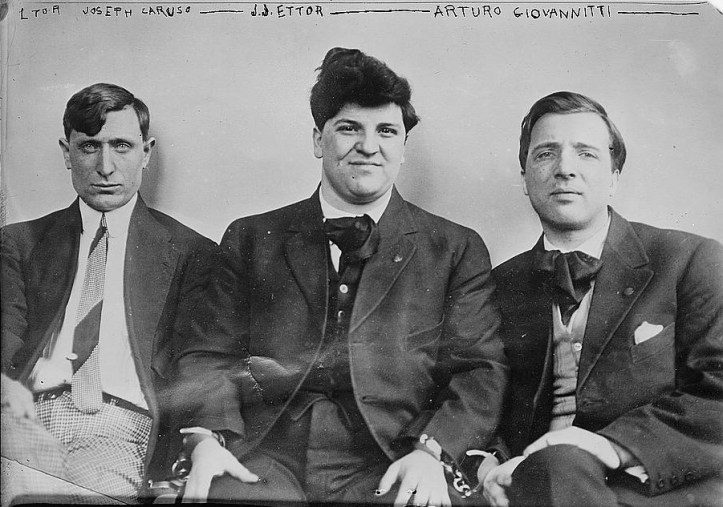
Citing many examples of solidarity internationally, Justus Ebert, a central activist in their defense campaign, celebrates the release of Joseph J. Ettor, Arturo Giovannitti, and Joseph Caruso. The three labor organizers were on trial for their lives with the ridiculous charge of the murder of Lawrence striker Anna LoPizzo, shot by police during a confrontation on the picket line.
‘Free! By the Mighty Power of United Labor!’ by Justus Ebert from Industrial Worker. Vol. 4 No. 38. December 12, 1912.
With Ettor, Giovannitti and Caruso free, we may now proceed to give our thanks and impressions to the world. When the history of this celebrated Case is written it will be plainly seen that a new political and legal power has arisen in this country, based on the industrial solidarity of labor, especially that of the textile workers. For the first time in the history of labor have governors’ secretaries and capitalists taken the stand to testify in favor of labor leaders engaged in conflict with big corporations with which they are identified.
Many were the acts of labor which brought about these results. It is reported that the Wood woolen mill at Lawrence, the greatest and best equipped in the world, had decreased 12 per cent in efficiency as a result of a systematic sabotage practiced in retaliation for the unjust imprisonment and trial of the three men. This is one of many salient sets, inflicting millions in loss, that made the capitalists anxious to sue for peace and grant labor a victory. There are other acts, such as the exposure of dynamite plants and other infamies, whose continued publicity was productive of a huge anti-capitalist sentiment, which contributed to success.
Back of the solidified textile workers in the mills at Lawrence stood the solidified workers of all lands. To those who took part in thins memorable defense it will ever be a source of grateful recollection to think of the support that came from across the seas. The workers of the industrial nations of Europe seemed to vie with each other in their acts and pledges of support. From France, Germany, England and Scotland, even from far-away Australia, came denunciatory resolutions, newspapers containing reports of meetings, money orders and letters of sympathy and support From Panama, from Cuba, from the Hawaiian Islands, from Canada, came the messages of good cheer and substantial aid. It was great; it was grand; the beginning of the world-wide brotherhood of toil in the shop that is destined to overthrow the international capitalist system of profit.
Most enthusiastic, most idealistic, most emphatic and most helpful were the international protests, the general strikes and the parliamentary nomination of the workers of Italy. The fellow-countrymen of Giovannitti and Caruso were not to be outdone in their devotion to and sacrifice for the three victims of capitalism. Their agitation in Italy, which threatened international complications, had a wide-spread, beneficial effect, both in a general way and within the cabinet at Washington, D.C.
As equally practical was the boycott proposition of the Swedish workers. This proposition was the source of some worry in Wall street. In the present stage of international competition, it would have placed American capitalism at a considerable disadvantage in European markets, if carried out, hence the anxiety lest it go into effect.
To international support was added, of course, domestic support. Many unions in Massachusetts, New York and Pennsylvania took part in the general strike at the beginning of the trial. While this strike was confined mainly to Lawrence, it was still full enough of menacing possibilities in other cities, as to prove impressive. Shoe, granite, ship building, mining and other industrial centers were affected.
In the matter of financial support, the United Mine Workers’ Union was the best contributor. All kinds of domestic labor organizations contributed financially, but the bulk of all contributions came from the mine workers. The reason for this is not hard to find. There are a great many Italian locals in the United Mine Workers. Ettor is well known among the mine workers. His valuable and courageous work in the anthracite and Pittsburg districts. especially in Westmoreland, has endeared him to the miners. He was once offered the position of national organizer among them, but declined. Under the circumstances, the support of the miners was but the payment of a debt of gratitude; a species of fraternal reciprocity; a case of one good turn deserving another.
Of course, there were some refusals of assistance where aid was most expected. We recall a presidential candidate of labor who refused to lift up his voice in Boston against a threatened repetition of San Diego in Lawrence. This man condemned the friends of Ettor, Giovannitti and Caruso to the furies of reaction, on the ground that they were anarchists who were reaping what they had sown. Now this man is in the clutches of the law himself, the victim of a federal frame up. His publisher is a suicide, and the pressure against him is great. Shall we condemn him as an anarchist! Shall we refuse him support as a weakling? On the contrary, we’ll stand by him. True to the working class principle which binds all the factions of the labor movement into one solid body when fighting capitalism, we’ll heap coals of fire on his head and show him that the word “solidarity,” which he mouths so much, has deepest significance in just such crises as these.
But, enough of this; we, the working class, have won a victory, in spite of our shortcomings. Having won, we can afford to be magnanimous. Ettor, Giovannitti and Caruso are free by the might of a united working class, at home and abroad; especially by the might of the textile workers of Lawrence, on whose shoulders the brunt of the actual struggle for freedom fell.
Having won another victory, let us go on to more. Our slogan now should be: “Little Falls and Legere next.”
JUSTUS EBERT.
Brooklyn, N.Y.
The Industrial Union Bulletin, and the Industrial Worker were newspapers published by the Industrial Workers of the World (IWW) from 1907 until 1913. First printed in Joliet, Illinois, IUB incorporated The Voice of Labor, the newspaper of the American Labor Union which had joined the IWW, and another IWW affiliate, International Metal Worker.The Trautmann-DeLeon faction issued its weekly from March 1907. Soon after, De Leon would be expelled and Trautmann would continue IUB until March 1909. It was edited by A. S. Edwards. 1909, production moved to Spokane, Washington and became The Industrial Worker, “the voice of revolutionary industrial unionism.”
PDF of full issue: https://www.marxists.org/history/usa/pubs/industrialworker/iw/v4n38-w194-dec-12-1912-IW.pdf

