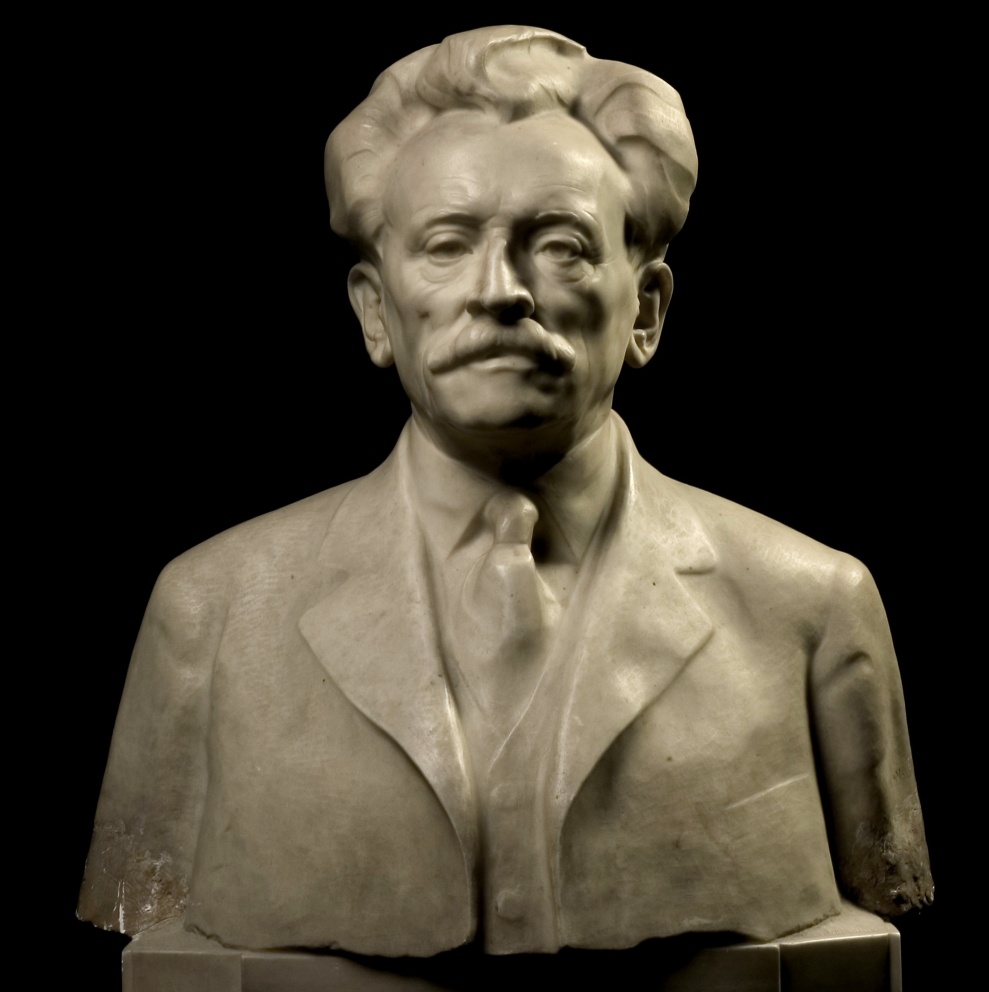
Abraham Cahan’s editorship of the Jewish Daily Forward, begun in 1897 by anti-De Leon dissidents from the S.L.P.’s Yiddish paper Dos Abend Blatt, gave him a powerful voice in both Jewish political life and the labor movement for decades. Always on the right, and target of the left, of the Socialist movement, Cahan’s specific politics, combined with his real authority, developed into an ism, with Cahanism described below by Paul Novick as a Jewish Hearst on the occasion of his seventy-fifth birthday.
‘The Rise and Fall of Abraham Cahan’ by Paul Novick from New Masses. Vol. 16 No. 8. August 20, 1935.
ABRAHAM CAHAN, editor of The Jewish Daily Forward, was seventy-five years old last month.
There was no fanfare, no celebration. The romantic press called it modesty. But love is blind and has no memory. Cahan did appear before Jewish workers not so long ago, May 5, at the opening of the convention of the Socialist-controlled Workmen’s Circle. He was booed down.
The “Patriarch” could not think of meeting his “flock” again; there was no festive mood inside the offices of the “great” newspaper either. The paper is fast declining. The Cahan-Lang-Hearst scandal has cost The Jewish Daily Forward a great deal. When the turmoil began—with the appearance of the Lang articles in the Hearst press—Cahan told a stormy meeting of the Forward Association: Give me a couple of weeks and it will all be forgotten. But his old tricks do not work any more. The anti-Soviet articles in the Hearst press of the then assistant editor of The Forward made a tremendous and lasting impression upon the workers—quite different from the impression Cahan hoped to create when the helped negotiate the contract between Lang and Hearst. And so The Forward, which has steadily declined for the last ten years, began losing ground more rapidly. Many thousands of readers gave it up in disgust. The Forward was condemned at public meetings throughout the country. The loss in prestige The Forward suffered among its own following was even more significant. Dissension was created within its own ranks. In an effort to remove Cahan, B. Vladeck, for years manager of the paper, handed in his resignation. A rumor has it that he was forced to withdraw it. Cahan triumphed, but The Forward is a house divided.
Cahan is going from one pyrrhic victory to another. In order to “justify” his Lang-Hearst deal, he introduced to Jewish workers a series of articles by Fred Beal which immediately found their way to Hearst. These will again have their repercussions among the readers of The Forward and Cahan will no doubt pick up another white-guard scoundrel, Cahan’s hatred for the Soviet Union, for the Communist movement, knows no bounds. The man is mad with rage. It is his ambition in whatever is left of his life to besmirch the Soviet Union in any way possible. In his rage, he is smashing The Forward, but he cannot be stopped. Cahan is The Forward.
He possesses an instrument which is still powerful, not only among the Jewish masses. His tie-up with Hearst shows it. The Forward is a national, even an international cesspool of white-guard propaganda. It is a breeding ground for characters like Lang and Beal—to be later turned over to Hearst. One may expect the Hitler press to pick up the Beal articles next. Cahan, like Hearst, cannot be ignored, no matter how disgusting the job of fighting him may be. A glimpse at the career of this man Cahan may explain a thing or two. How has he risen?
CAHAN became the editor of The Jewish Daily Forward on March 15, 1902. On that day, there appeared on the front page of The Forward the following “box”:
“To the Readers Tomorrow’s
“(Sunday’s) Forward will appear in eight pages. That is how it will appear every day from now on. There will be much more to read than heretofore and little by little improvements will be made in every department.
“The news and all articles will be written in pure plain Jewish Yiddish, and we hope that every line will be interesting to the entire Yiddish-speaking people, young and old.
“In tomorrow’s issue there will be found articles:
“1—About Irish or Italian gentiles who have become converts to Judaism because of girls of the Jewish Quarters. These are true occurrences, remarkable love stories collected from our life here in America.
“2—About poor Jews who send their children to college or to High School.
“3—Usurers in the sweat shops. Tricks employed by the bosses to get the Jewish workers into their hands.
“4—From here and there. A new department in The Forward which will contain little sketches, short and snappy remarks, stories, anecdotes, jokes, remarkable things happening the world over.
“5—There will be more news than heretofore. All other departments will be left as they are. The new novel, The Usurer’s Daughter (from Jewish life in Russian Poland and in America), will begin Saturday.”
This was the program laid out by Cahan while taking over the socialist Forward. The “pure plain Jewish Yiddish” meant the polluted “Americanized” Yiddish used by Cahan, which is neither Yiddish nor pure. Cahan’s contempt for Yiddish—the vehicle of his success–has been too often pronounced in the columns of The Forward. It can perhaps only be matched by his contempt for the readers of The Forward.
But paragraph No. 1 in Cahan’s program was the thing. It was amplified two weeks later, March 29, 1902, by the following announcement on an inside page of The Forward:
“To the Readers
“First, about the news as printed in The Forward. 1: The very latest news. 2: The most interesting and most important news to be found in the entire world. 3: A lot of Jewish news, particularly news about the present turmoil in Russia against the Czar.
“Second, about special articles which we will print about matters of concern to everybody, or which are interesting to know. We have collected piles of facts about marriages in the Jewish Ghetto (quarters), about girls of the Ghetto who remain unmarried, about girls who marry too young, about the old bachelors of the Ghetto—various interesting reasons why a girl stays unmarried. For instance, are all unmarried girls not pretty? The answer is “No.” And there is a lot to tell.”
Class struggle? The toiling immigrant’s miserable existence? Unions? The Socialist Party? The new editor of the struggling socialist paper on the East Side who had just come from five-years’ apprenticeship in the yellow New York English press was bent on making a success of the paper with Hearst’s methods. “What is a Pretty Woman?”, “Men Who Boss Their Wives,” “Wives Who Boss Their Men,” “Unmarried Girls,” “Three Unmarried Girls,” “What Price Beauty,” “Too Young Brides,” “Little Girls Who Get Married,” “The Bride Who Was Spanked”—these were the “feature” articles let loose by the new editor. Where the struggle of the tailors for a 25 percent raise got only seven lines, a story: “Did Florence Burns Eat Supper With Walter?” got a full column.
Cahan started The Forward along the easiest way toward financial success, over the protests of many socialists. Some readers broke through the columns of The Forward with their protests. (Cahan did not have a full grip yet.) One asks (March 29, 1902) whether the new “features” have anything to do with scientific socialism…Another contends (March 31) that a socialist paper cannot be the organ of all Jews. “A socialist paper must be socialistic and must be a workers’ paper.” This reader was answered in a long editorial on April 2, to the effect that “for this purpose we never needed here and do not need now a daily Jewish newspaper.” The Forward, the editorial contends, is a “socialist paper, not of a group, not of a sect, not even of a party, but a paper to sow and to disseminate socialist thought, to preach the socialist system among the great mass.”
And so the “socialist system” for all Jews was preached with the aid of material very often surpassing Hearst in vulgarity and salaciousness. The “Bundle of Letters” (letters from the lovelorn, with editorial advice) introduced in the revolutionary year 1905 (and kept up ever since) became a pillar of Cahan’s “socialist system.”
The crowning glory of Cahan’s career as a sensational yellow journalist was his great effort at Flemington, N.J., not so long ago. Cahan would not trust his staff alone to cover the Hauptmann-Lindbergh trial (he had several “hands” there, too). The seventy-five-year-old “patriarch” more than once was on the verge of fainting in the suffocating court house. But he stuck to his post with the tenacity of a man who has his heart and soul in the criminalistic sensations that made his paper “great.” And his detailed descriptions of the “fat” and “not so fat,” “unattractive” and “nearly attractive” women in the jury box was a sample of vulgarity and imbecility, true to the tenets of Hearst and Beatrice Fairfax.
In the court house of Flemington, Cahan was in his own element. When he undertakes to dabble in political economy and socialist theory he is so crude and outlandish as to be amusing—were it not for the tragic fact that he is the editor of a socialist newspaper. His History of the United States (Yiddish) was the laughing stock of East Broadway before the war. There is no better way of getting an idea of Cahan’s “serious” writings in The Forward than to imagine Beatrice Fairfax writing about politics…though she might not be using the street corner invectives against political adversaries Cahan is employing against Communists and—recently—against revolutionary and militant elements in the Socialist Party.
THIS tells only a small part of the sordid history of Cahanism. Naturally, Cahan’s yellow journalism was an expression of crass political opportunism. For a fuller appreciation of this phenomenon—Cahanism—it would be necessary to present some detailed episodes, to relate how The Forward preached the “socialist system” in election time, how it fought De Leon and Bill Haywood, how it fostered corruption and—yes—gangsterism in some unions.
One would have to examine the record of The Forward during the World War. The Forward has the distinction of having been both pro-German—before the United States entered: the war—and pro-Ally afterward, and each time violently pro. All these acts of Cahan and his colleagues were of course motivated by crass opportunism, a hatred for revolution, for class struggle, just as the pornographic methods of the “successful editor” were not merely products of a diseased mind. Cahan himself, like Hearst or Bernarr Macfadden, is a product and a representative of certain elements, The small-town petty-bourgeois immigrant “intellectual” whose “education” consisted of a short term in a school for reform rabbis in Vilno (at that time Russian Poland) was from the very beginning muddled up in his “revolutionary” ideas. In America, he became the representative of the petty-bourgeois elements among the Jewish immigrants and of workers and trade-union bureaucrats with petty-bourgeois psychology. The muddled, intellectually half-baked immigrant went in for “Americanism” with gusto, for the vulgar “Americanism” and patriotism of a Hearst and for Hearst’s kind of journalism. He looked down upon the “uneducated” Jewish immigrant with contempt. One of the by-products in the struggle for the establishment of The Forward—the struggle against the Socialist Labor Party Jewish Daily Abendblat—was the fight between the “liteerates” and the “illiterates” (the Russian terms of Gramotnie and Bezgramotnie were used). To be able to speak Russian and to study to become a doctor, a lawyer or a dentist meant to be “literate,” educated. To this day, Cahan, the chief of the “iterates,” regards a doctor with the eyes of a smalltown petty trader. When the Menshevik leader, Abromovitch, first came to the United States, in 1908, Cahan could not find better praise for him than to say: “From a distance he looks like a doctor…”
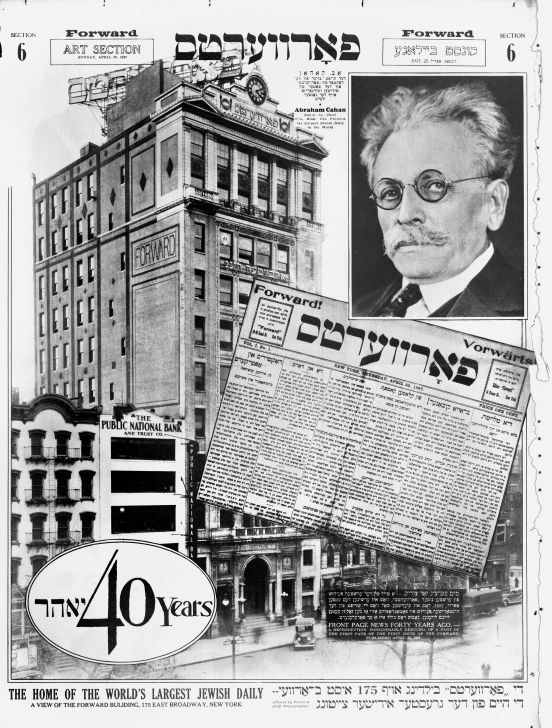
Cahan has the petty trader’s respect for the rich and has himself aspired to become rich (his salary is $20,000 a year “and expenses”). He has regarded the Louis Marshalls and Adolph Ochses and Felix Warburgs with admiration and has always given them support in “Jewish activities” (hence, his particularly high standing with The New York Times).
Cahan attained his goal. Under his guidance The Forward became a financial success. Under his guidance the clique now known as the Old Guard in the Socialist Party was built up and it is no accident that the Old Guard is strongest among the Jewish Socialists brought up on the “system” of The Forward.
Neither is Cahan’s present tie-up with Hearst an accident. One may see in the present collaboration only a continuation of old relations.
SOME years ago—I think it was 1922—in an article in The Nation, O.G. Villard crowned The Forward the best newspaper. in the United States. One can hardly imagine what impression this created among people who happen to know Yiddish…The Nation seems to have learned a little since that time, but Mr. Villard’s statement was a reflection of a widespread opinion built up by the publicity of a financially powerful institution—The Forward—in control of the bureaucracy of a number of unions and in alliance with William Green and Matthew Woll.
There is hardly anything more grotesque than the impression created about Cahan and The Forward among certain elements unfamiliar with the Jewish language. Whatever the merits of Cahan as a fiction writer he is primarily the builder of The Forward and the leader of The Forward crowd. If it is correct to picture Cahan the way The Times does, one might as well shout from the housetops that Bernarr Macfadden and W.R. Hearst are the most “literary,” most “beneficial” and most “humane” publishers in the United States.
It is only recently, as a result of the rift inside the Socialist Party and as a result of Cahan’s alliance with Hearst in the struggle against the Soviet Union that some elements outside the Yiddish-reading public have learned something about the true Abraham Cahan. But this struggle was his undoing in many a sense. Cahan got away with his most unscrupulous, Hearst-like, struggle against De Leon, Bill Haywood, the Jewish dramatist Jacob Gordon, against all protesters inside the socialist movement. Things are much more difficult, however, when it becomes a matter of fighting the Soviet Union. Here, Cahan cannot do with impunity what he did all his years against his many adversaries. He is paying the penalty.
In his crusade against the Soviet Union, Cahan has been doing for years what Hearst began doing after he returned from his visit to Hitler. I shall not attempt to review here something which has been going on in The Forward for thirteen years without a stop. I will quote one instance, relatively an unimportant one, to give an idea of the state of Cahan’s mind and of what he is capable.
On May 5, The Forward printed an article about the Moscow subway. It wound up with this unique idea: In former days the Russian people were made to build palaces for the Czars, now they are made to build palatial subways for Stalin…
As if Stalin is keeping the subway to himself, riding back and forth all the time…When the Soviet Consulate opened its headquarters in New York, The Forward wrote editorially (March 31, 1934): “The palace was once built with workers’ blood, and now it will be maintained with workers’ blood.” The Forward printed an article by Harry Lang stating that there is a tax on the dead at the cemetery of Kiev and that they are evicted from their graves in case their relatives do not pay the tax (Forward, Dec. 6, 1933). More recently The Forward told its readers through the mouth of Fred Beal that in the Ukraine they are making sausages out of human flesh…(Forward, June 27, 1935).
Cahan’s material about the Soviet Union matches his material about the Ghetto in luridity. But the reader, even The Forward reader, does not appreciate the anti-Soviet tales. The alliance with the Hitlerite Hearst against the Soviet Union is not much appreciated, either. Cahan has become among great masses of Jewish workers and intellectuals and poor middle men—the Jewish Hearst. That is why he was booed down so contemptuously in Madison Square Garden. That is why he dare not show himself before Jewish masses.
The New Masses was the continuation of Workers Monthly which began publishing in 1924 as a merger of the ‘Liberator’, the Trade Union Educational League magazine ‘Labor Herald’, and Friends of Soviet Russia’s monthly ‘Soviet Russia Pictorial’ as an explicitly Communist Party publication, but drawing in a wide range of contributors and sympathizers. In 1927 Workers Monthly ceased and The New Masses began. A major left cultural magazine of the late 1920s and early 1940s, the early editors of The New Masses included Hugo Gellert, John F. Sloan, Max Eastman, Mike Gold, and Joseph Freeman. Writers included William Carlos Williams, Theodore Dreiser, John Dos Passos, Upton Sinclair, Richard Wright, Ralph Ellison, Dorothy Parker, Dorothy Day, John Breecher, Langston Hughes, Eugene O’Neill, Rex Stout and Ernest Hemingway. Artists included Hugo Gellert, Stuart Davis, Boardman Robinson, Wanda Gag, William Gropper and Otto Soglow. Over time, the New Masses became narrower politically and the articles more commentary than comment. However, particularly in it first years, New Masses was the epitome of the era’s finest revolutionary cultural and artistic traditions.
PDF of full issue: https://www.marxists.org/history/usa/pubs/new-masses/1935/v16n08-aug-20-1935-NM.pdf

