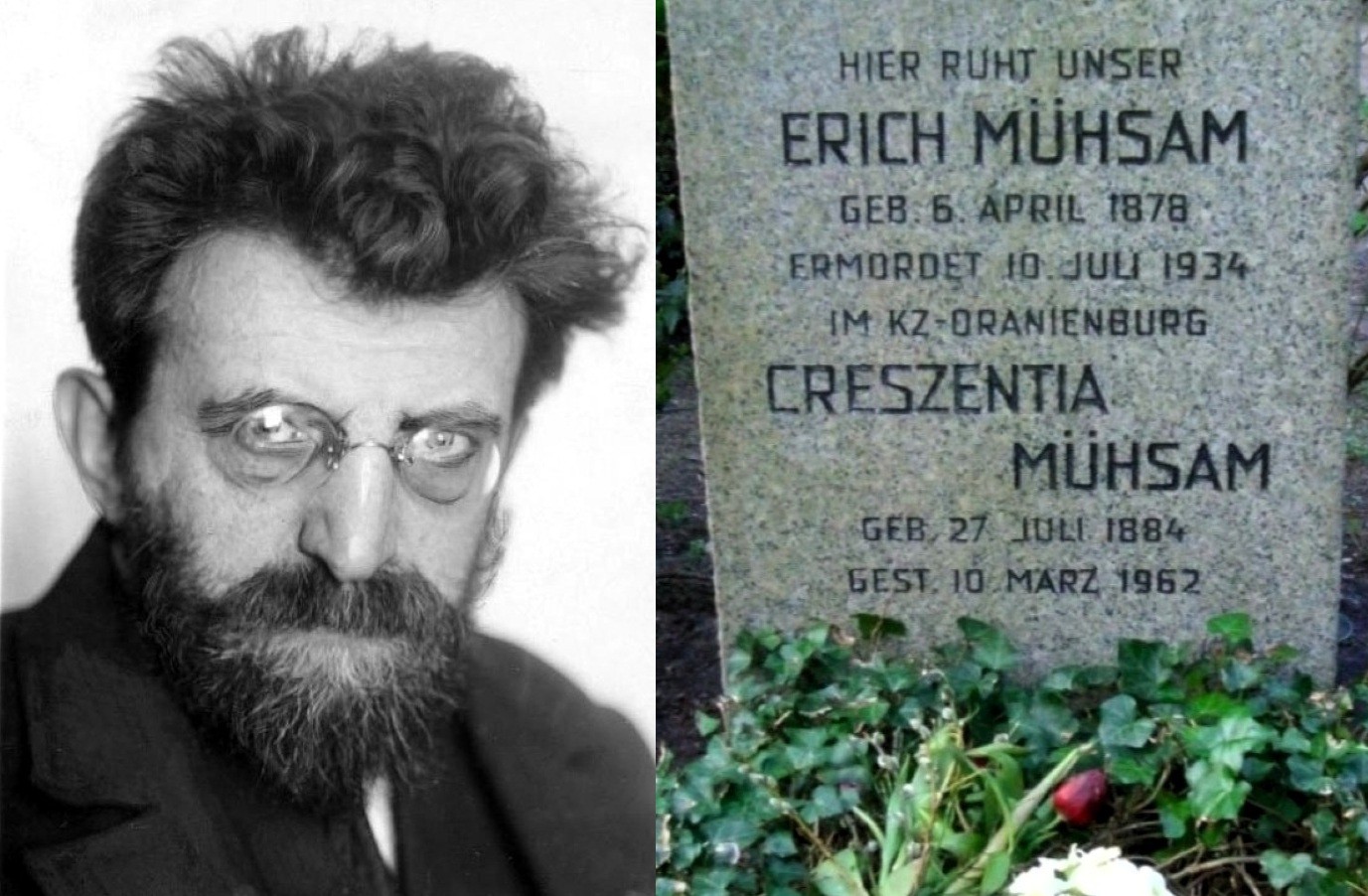
The German Jewish anarchist writer, performance artist, antifascist, and leader of the short-lived Bavarian Soviet Republic, Erich Mühsam was murdered by the Nazis in the Oranienburg concentration camp, where many Leftists were first taken, on July 10, 1934 and is remembered by a writer of the next generation, Leschnitzer then in exile in the Soviet Union.
‘Erich Mühsam’ by Franz Leschnitzer from International Literature. No. 5. 1935.
An Account of a German Writer and Rebel
He was born in 1878 in a Jewish middle class family living in the north of Germany. Although his father chose the profession of a pharmacist for him upon his graduation from high school he was not the least bit interested. He was drawn to Bohemian life early: to that gypsy-like, unconventional life of artists usual in Germany at the end of the past century, particularly in Munich and in the suburb of Schwabing. True, the life of artists in Schwabing had nothing in common with the romantic Bohemia of Henri Murger’s La Boheme. The unconventionality of the Schwabing artists, the “freedom” and “free living” of those musicians, painters, sculptors, poets, actors, newspapermen, critics and journalists had little of the romantic about it. The poverty which plagued the life of every one of them did not allow for the carefree life of the Parisian Bohemia which relied on the richer French rentier parasitic class. The Munich artists were mostly idle students or bankrupt aspirants to the professions. Products of middle class families, they had usually a scattered general education of the high school or college in the smaller university towns of Germany. Estranged from bourgeois life by the wreck of their careers, and still far from proletarian life, being still primarily bourgeois minded, they represented a section of society economically midway between the petty bourgeoisie and the working class, vegetating themselves and imagining, even boasting about being “in between the classes.” Ideologically and politically their sympathies were nevertheless rather for the proletariat than the bourgeoisie.
Erich Mühsam grew in this section of society “in between the classes.” He not only grew up in it, he also grew out of it. He gained considerable popularity with short, witty verse in the satirical magazine, Simplicissimus, published by the left bourgeois publisher, Albert Langen, sympathizing with social democracy. These verses were by far less irritation to the hundred thousand bourgeois readers than the caricatures by Th. Henie, Olaf Gulbransson, Ernst Thony, Wilhelm Schultz and F. v. Reznicek, which also appeared in this magazine; or the polemics and pamphlets by Karl Kraus and Ludwig Thoma which the loyal German philistine swallowed lustily. Mühsam’s verses of that period were spicy rather than stinging.
The satirical undertone of these verses, the ridicule of bourgeois comfort and patience was unmistakable; but there was also the soothing, kindly, harmlessly gay undertone: light satire and light humor combined charmingly. Artistically they were slight.
“The Eleven Executioners”
Slowly Mühsam developed a more serious vein. The change came at the “Cabaret of the Eleven Executioners” in Munich. This cabaret got its title from the fact that eleven authors used to appear there as “executioners,” that is satirical “judges” of bourgeois society, principally, the “morals” of bourgeois society; among them were journalists like Emil Faktor, who later became editor in chief of the Berlinger Borsen-Courier, and such men of genius in portraying the decay of bourgeois morals as the dramatist, Frank Wedekind, then very young. The influence of the latter on Mühsam’s development was very great. Almost all the verses Erich Mühsam then wrote and recited were socio-critical pieces, on the type of Wedekind’s work. What prevailed in this work was not so much the ideology of socialism as of anarchism. It was not surprising that these young “executioners” were closer to anarchism than to scientific Marxian socialism; that was a result of their class origin, a result of their endeavor to stay “between the classes,” like sitting on two chairs, and still trying to present the cause of revolution (as if this were possible without the class struggle) with enthusiasm. Reading the verses, prose-polemics and pamphlets of young Mühsam today, one finds a seemingly incomprehensible mixture of ultra radical and highly philistine ideas at every step. On one hand, the young man let himself be carried away by his hatred of the bourgeois toa passionate repudiation not only of the bourgeois state, but of the state as a whole, with all its arrangements, laws and organization; on the other hand—and dialectically considered, perhaps directly because of this—he took pleasure in disparaging historical materialism and Marxism generally. To the very end of his life Erich Mühsam remained a decided anarchist in politics and an absolute idealist in ideology.
Closer to Communism
Mühsam was a close friend of Landauer’s, as well as of Kurt Eisner and Ernst Toller. All three were convinced pacifists even during the World War; all three stood closer to the USPD (the Independent Social Democratic Party of Germany) after the war than to the KPD (Communist Party of Germany). The only thing that at least negatively brought them close to the communists was their profoundly justified indignation against the betrayal of the German November revolution by leaders of social democracy. Mühsam has given deep expression to this indignation as a satirical lyricist.
In Mühsam’s play, Juda, the only worthwhile play he wrote, he sharply settles accounts with social democratic leaders of the Ebert, Noske and Scheidemann ilk, branding them as betrayers of the cause of the toilers. To Mühsam the political tendency was always more important than artistic portrayal. Yet it must be said that he was a gifted writer of fiction and the essay, high above the average talent. His temperament led him to the political and he wanted to achieve more in politics than in poetry. The result was just the opposite. It must be admitted that in the collapse of the Munich Soviet Republic, of whose “independent” Social Democratic and Anarchist coalition government he was a member together with Gustav Landauer and Ernst Toller, he bears, although not alone, much of the blame for the catastrophe. His anarchist idealistic looseness, his bourgeois pacifistic soft-heartedness, his complete lack of contact with the masses of the agricultural proletariat in Bayern helped, even though unquestionably without his knowledge and against his wishes, to clear the way for the counter-revolution, the white bandits who imprisoned him and Toller and literally tore the noble Landauer to pieces. The heartless government of Herr v. Kahr, which established itself in Bayern after the fall of the Soviet government, condemned the “dangerous mutineer” (who never called himself a revolutionist but only a rebel) to fifteen years’ imprisonment. (He was freed after seven years by the so-called “Hindenburg amnesty.”) These terrible years not to be compared, it is true, to the gruesome subsequent “arrest for safety” under the “Third Empire,” he spent together with Toller in the Niederschonenfeld prison. Toller wrote there his first explosive, semi-impressionistic drama The Change which was performed by the left bourgeois Berlin theatre “Die Tribune,” while Mühsam wrote a number of poems in which his unbreakable spirit was shown forcibly.

How little he was inclined to submit to the powers that be Mühsam proved immediately upon being freed. He had already written an excellent poem, “Lenin,” in which he showed himself more than ever a loyal sympathizer of our struggle. Although he never got off his anarchist hobby horse even after his imprisonment, he began to take a more intensive part in the activities of the revolutionary workers under Communist leadership. He spoke at meetings on the question of the confiscation of the property of the former princes, supporting the communists in this; he helped us in our revolutionary union work in the Union of German Writers; he took part in the preparations and organization of the Amsterdam International Anti-War Congress (August 27-29, 1932); he even put at the service of these activities the columns of his earlier magazine Kain, suppressed during the war.
The Brilliant Orator
When one heard him at this time as speaker at meetings or even as participant in discussions on political and cultural subjects, one understood the colossal effect he produced on friend and foe at the period of the Munich Soviet. One understood particularly the frantic hatred of his enemies. As a speaker he was an agitator and rebel of great power. I shall never forget two of his speeches. The first I heard in 1928 on the first anniversary of the electrocution of Sacco and Vanzetti. These two victims of infamous bourgeois class justice in the United States were, as anarchists, dearer to the anarchist Mühsam than others. His memorial speech was sprinkled with political errors, but the power of this speech was tremendous. It must be taken into account that Mühsam’s appearance was not impressive. He looked like the typical representative of his social milieu, a Bohemian of doubtful sort. Disheveled red hair, a wild full red beard, a pale face, his glasses crooked, necktie awry, he stood at the edge of the platform close to the public…in the assembly room of the former Prussian House of Lords (Herrenhaus) in Berlin, that high gathering place of the nobility and the most privileged, who functioned in old Prussia as the highest government body next to the monarch. The very contrast between the elegant hall and the definitely plebian external appearance of the speaker was exciting. And the contrast was strengthened by the no less violent contradiction between the solemn silence of the audience and the shrill cutting voice and frenzied gestures of the speaker.
I heard Mühsam speak a second time three weeks after Hitler’s accession to power and a week before the Reichstag fire. It was in a Tetow street hall an South-west Berlin at the last session of the Union of German Writers. Carl v. Ossietzky had just spoken effectively in favor of a red united front and the left bourgeois journalist, Rudolf Olden, as well as our comrades Karl August Wittfogel and Heinz Pol spoke effectively. Then came Mühsam’s turn and it was like the eruption of a volcano. It is still a puzzle to me how this meeting was allowed to continue to the end—the “normal” end in such cases was the interference of the police.
Murdered by the Fascists
It was not his fate to fight on in emigration and the struggle in prison was nothing like what he had known in Niederschonenfeld. He was doomed to experience the hell of the fascist torture chamber, the Golgotha of their concentration camp. On the night of the 27th of February 1933, Reichstag Fire night, he was dragged out of bed and arrested together with some hundred and thirty other Berlin intellectuals and brought to the Alexanderplatz police station; from there to an abandoned old prison in Brandenburg on the Havel; from there, on February 2, 1934, together with some hundred or so other prisoners in an open truck for three hours in the biting cold to the concentration camp in Oranienburg. He had been tortured horribly in Brandenburg. One of his companions in “safety arrest” from October 24, 1933 till April 28, 1934—Kurt Hiller, the very lively left bourgeois journalist who escaped and is now, in emigration, an active anti-fascist, reports: “I shall never forget the picture he made as he stumbled about one of those prison yards, pale, one ear turned into a thick swollen formless mass by repeated blows.”
On July 12, 1934 the German press and agencies spread the report that Erich Mühsam had “strangled himself” at the Oranienburg concentration camp. Everyone who knew Mühsam knew that this report was a lie. Mühsam’s proud courage was well known and the most gruesome tortures could not break it; everyone recalled Mühsam’s determination to withstand persecutions expressed in numerous poems with deepest sincerity; everyone knew that the noose in which he was found “hanged by his own hand” was laid around his neck not by his own but by others’ hands. The knowledge, first surmised, was confirmed by eye witnesses of the foul murder and especially by the report of our Comrade Werner Hirsch who was confined in the Oranienburg concentration camp at the time. It is known that on the night of the ninth of July Erich Mühsam was hanged on the wall of the closet at the orders of the brigade leader Eicke, a functionary of Adolf Hitler’s bodyguard (SS) who was appointed commandant of this camp after the internal fascist massacre of June 30, 1934.
The memory of this bestial crime effects every sincere anti-fascist profoundly. We shall always remember the firm and courageous poet and sincere rebel. Like an oath, we repeat the passionate closing lines of Johannes R. Becher’s poem on the death of Erich Mühsam:
We shall avenge you all,
Erich, and you, you too!
Literature of the World Revolution/International Literature was the journal of the International Union of Revolutionary Writers, founded in 1927, that began publishing in the aftermath of 1931’s international conference of revolutionary writers held in Kharkov, Ukraine. Produced in Moscow in Russian, German, English, and French, the name changed to International Literature in 1932. In 1935 and the Popular Front, the Writers for the Defense of Culture became the sponsoring organization. It published until 1945 and hosted the most important Communist writers and critics of the time.
PDF of full issue:https://www.marxists.org/subject/art/literature/international-literature/1935-n05-IL.pdf

