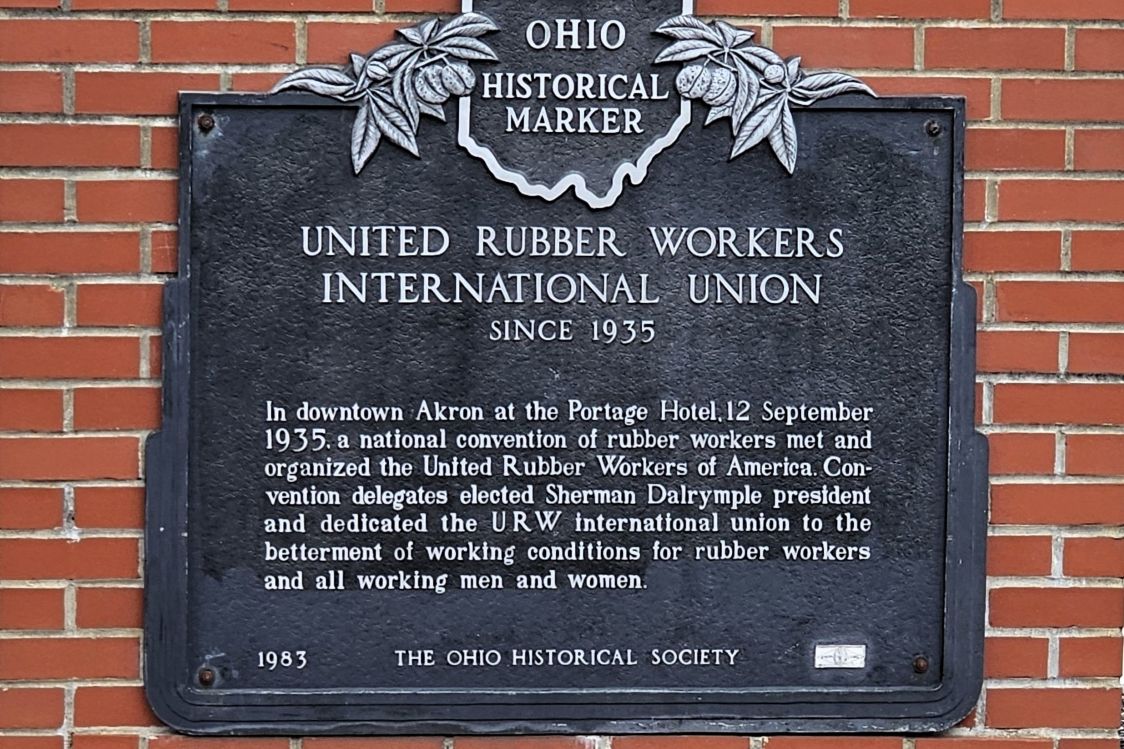
A year before the dam broke for the United Rubber Workers, and the C.I.O., Akron was seething. How the C.P. met some of the issues in this internal report.
‘Examination of Agitation and Propaganda in Akron Rubber Strike Situation’ by Evelyn Burns from Party Organizer. Vol. 8 No. 5. May, 1935.
THE CONDITIONS of the rubber workers and the stubborn open-shop policy of the rubber barons in their refusal to deal and negotiate with the Rubber Workers Union (A. F. of L.) brought the rubber workers in motion against the employers.
The leaders of the Rubber Workers Union and especially Claherty played around with the National Labor Relations Board, Regional Labor Board for a period of 20 months.
But the conditions of the workers remained the same. The N.L.R.B., a few months ago, ordered a vote in the big three, Goodyear, Goodrich and Firestone. The companies refused to take a vote and the case was handed over to the Cincinnati courts.
The patience of the workers was exhausted. The union leaders were forced to present an agreement to the big three. The companies flatly refused the agreement. Strike talk began.
The Communist Party immediately reacted to the situation by issuing a leaflet headed, “Answer the Challenge–Strike.” In this leaflet the following was advanced, nothing came of the courts and N.R.A. Boards. A general strike in the rubber industry is the only weapon in your hands to make the rubber barons come across with more pay and recognition. No back-stage wire pulling should be allowed. Now is the time to act.”
Communist Party Proposes Economic Demands
The demands as presented to the companies in the agreement, lacked economic demands. The following were the demands of the union:
1. Collective bargaining;
2. 30-hour week;
3. Recognition of the United Rubber Workers Union;
4. Company to cease financing the company union.
The Communist Party, knowing full well that such demands could not rally all workers behind the agreement, issued a leaflet proposing in addition:
1. 15% increase in pay for all rubber workers;
2. Economic demands essential for mobilization of all workers;
3. Broad rank-and-file strike committee;
4. No Arbitration! Direct Negotiations!
5. Unity of action.
The leaflet also dealt with the role of the company union, and the role of the Party. This leaflet was literally grabbed by the workers. It became a guide of action to many workers. Workers gathered in circles to read and discuss the leaflet. It forced certain leaders to change their tone of speech to the rubber workers.
At this time, the forces of the rubber barons were openly being mobilized for strike-breaking duty. Actual war was being prepared against the rubber workers. Factories were barb-wired. Machine guns were placed in the shops. The Sheriff began openly to deputize thugs and gunmen. The fascist Blue Shirts were deputized. The church, radio, women’s clubs and press were set against the strike. This situation created among the workers the opposite effect desired by the company. In spite of the provocation and intimidation, the workers began to join and reinstate in the union by the thousands. The mass meetings of the union were crowded. The Union Buyers Club, an organization of wives and sisters of the rubber workers carried on excellent work for the strike. The workers were ready for action!
The Communist Party immediately once more reacted with the following leaflet, headed: “Organize and Strike! Allow No Division in Your Ranks! Join the Union! Vote Strike!” The text follows:
“The events of the last few days offer only one conclusion—The rubber workers will strike. Union ranks are growing. Ever larger masses of workers are demanding organized action to answer the threats and provocations of the rubber bosses, to fight for their demands. The rubber barons thought to fool the rubber workers’ wives but they now know that the wives of the rubber workers will be with their men and not with the exploiters.”
The leaflet further exposed the forces of the capitalist class in Akron as follows:
“The acts of the Democratic and Republican politicians in public office, Sheriff Flower and Mayor Myers, arming thugs and gunmen to take away our civil rights to organize, strike and picket must arouse every working man and woman. This action proves that they are the agents of the rubber barons. The nest, called American Blue Shirts, where a few political racketeers by flag waving, gather to mislead the poor, is also to join the vigilantes, the scab-herders of Akron. Reverend Hendershot, Dutton and others, who are supposed to be occupied with church affairs, also line up with the rubber barons who wish to struggle against organized labor, for which they are rewarded by the companies with fat checks.” (Reference is made here to whole pages of the local press bought by the rubber companies for their attack against the rubber workers and the union.) The workers were advised:
“No retreat or delay is permissible at this time! An immediate general strike in the rubber industry is the only way to win your demands. Therefore, join your union, set up your organizing committee right on the job and when the call to strike comes, walk out as one solid body—on the picket line! Vote for strike! Do not allow any pussy-footing with any arbitration boards!”
Party Leaflets Welcomed by Workers
This leaflet was welcomed by the workers with enthusiasm. The majority of the union men and women were in agreement with the leaflets. Many of them would not even lend a leaflet to their fellow workers, because they wanted to take it home and study it. It also forced Claherty to come out in the local press with the statement that the union will not battle the Communists, which everyone must agree was a victory for the Party!
In the second leaflet the Party no longer spoke of demands separate from those of the union, but called for support and struggle for these demands. It was correct to propose economic demands in the first leaflet. But as soon as the workers adopted the demands of the union, we had to support them in order to unite and strengthen the ranks of the workers.
The tide was turning. Not among the rubber workers but among the leaders of the A. F. of L. Claherty or Green were to report the situation to Roosevelt. McGrady, assistant Secretary of Labor was reported coming to Akron. Miss Perkins was negotiating with the rubber employers in New York. The strike-breaking forces took on a different face—arbitration. The Party reacted with a leaflet headed
“Set Rubber Strike Date! No Arbitration! Direct Negotiations! Don’t Rely on Labor Boards or Department of Labor Representatives!”
The contents follow:
“The rubber barons could not intimidate and terrorize the rubber workers with their anti-strike preparations so they are now bringing Edward F. McGrady. He is known to the workers throughout the country as one who sold out strike after strike. The West Coast Longshoremen refused to deal with McGrady because of his treacherous role in the labor movement. Refuse to negotiate with McGrady or any other representative of the Labor Department or Labor Boards! Only an immediate general strike in the rubber industry, backed by the working class of Akron and the entire country, with mighty mass picketing, will win your demands. The auto workers will support you with strike. The Cleveland Federation of Labor is pledging 100% support. The Unemployment Council is supporting you. Now is the time to strike!”
The following slogan was advanced: Do Not Allow Washington to Settle Things For You! It goes on to expose Roosevelt’s strike-breaking record. “The rubber workers who have voted almost unanimously for strike should have no illusions regarding the stand of President Roosevelt. Every time unions have gone before the President they have lost all their demands and failed to gain recognition. Because the A. F. of L. leaders signed a “truce” in the auto industry with Roosevelt and the manufacturers, and agreed not to strike, the demands were lost and the Company Union was legalized and strengthened. Labor Boards were set up by Roosevelt which are anti-union agents of the employers.
The government is controlled by the Lichfields, Firestones, Goodriches, Morgans and Mellons, Fords and Rockefellers. It carries out the wishes and desires of the ruling class–the capitalist class.” “Rely on your own strength.”
These three leaflets alone, had an enormous effect on the situation. Because the Party correctly, and on time, reacted to the daily events in the situation, the prestige of the Party grew tremendously. The “red scare” was defeated at the time of preparations. The influence of the Party multiplied.
Besides the leaflets we used the Daily Worker as a means of influencing the situation. On the day the vote took place on the agreement we distributed hundreds of copies of the Daily Worker with Browder’s editorial. And we can boldly state that had we not circulated the article of Comrade Browder, the vote against the agreement might have been smaller. As a result of the Daily Worker and our general agitation and propaganda, the vote resulted in from 25 to 35% of the workers voting against the agreement.
We issued only one shop paper during this time—The Goodrich Worker. This paper was primarily a strike issue. Even the letters from the shop and our editorials were all strike letters.
Weaknesses in Agitation and Propaganda
1. We did not link up our agitation with organization sufficiently. We did not utilize the excellent influence of our agitation to crystallize it into broadening the rank and file movement and recruiting into the Party. This situation, however, will be remedied in the future. Steps have been taken to this effect.
2. We did not hold the planned open air meetings and shop gate meetings, primarily due to weather.
3. Most of the agitation was carried on from the top and the units were not directly involved in writing neighborhood leaflets, shop paper, etc.
4. We did not link up our agitation with May First, to involve the rubber workers in preparations for the demonstration and parade.
However, one thing is clear. When our agitation and propaganda is spoken and written in line with the Party policy it penetrates the workers and if utilized to organize the workers, must bring the desired effect.
The Party Organizer was the internal bulletin of the Communist Party published by its Central Committee beginning in 1927. First published irregularly, than bi-monthly, and then monthly, the Organizer was primarily meant for the Party’s unit, district, and shop organizers. The Organizer offers a much different view of the CP than the Daily Worker, including a much higher proportion of women writers than almost any other CP publication. Its pages are often full of the mundane problems of Party organizing, complaints about resources, debates over policy and personalities, as well as official numbers and information on Party campaigns, locals, organizations, and periodicals making the Party Organizer an important resource for the study and understanding of the Party in its most important years.
PDF of full issue: https://www.marxists.org/history/usa/pubs/party-organizer/v08n05-may-1935-Party%20Organizer.pdf

