
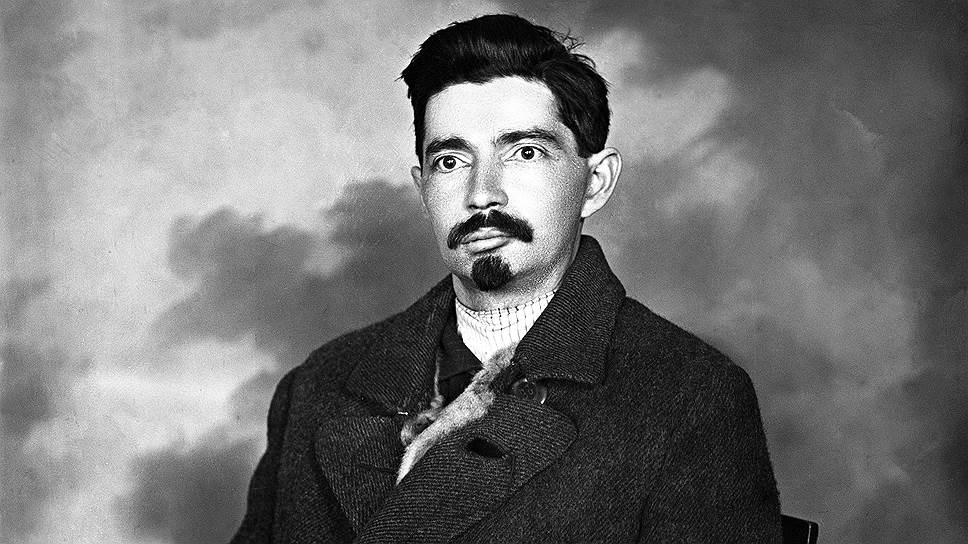
Larin on early NEP-era labor laws. One of the leading Mensheviks to align with the Bolsheviks in 1917. An original member of the Supreme Soviet of the National Economy, he would spend much of his Soviet career in that field. He also did not fit into any of the blocks emerging in the factional disputes of the 1920s, leaving him increasingly isolated at the decade’s end. From a Crimean Jewish background, Larin took an interest in Jewish affairs, headed the Society for Settling Toiling Jews on the Land and advocated for Jewish agricultural communes in the Crimea and was sharply opposed to the Birobidzhan creating an autonomous Jewish region and removing Jews far from their traditional communities. He would perish of natural causes in 1932.
‘Recent Labor Legislation in Soviet Russia’ Yuri Larin from International Press Correspondence. Vol. 2 Nos 79 & 80. September 15 & 19, 1922.
One of the most prominent workers in the Russian Party, whom the Proletarian Revolution in 1917 entrusted with the supervision of Russia’s economic life, Comrade Larin, at present sojourning in Germany, has placed at our disposal a series of articles conveying the latest information on the Country of the Proletarian Dictatorship.
I. General: Litigation Rights of the Trade Unions.
The last six months in Russia have, among other things, been a period of revision of the whole labor legislation. The New Economic Policy, by which the government shops and factories have been accorded a limited measure of autonomy, the restrictions on trade and barter abolished, and the official attitude towards the peasantry changed, has of itself already resulted in a relative stability. Thanks to this situation, it was possible to discontinue the practice of issuing decree after decree to regulate the legal status of the proletariat, and instead, to proceed to a well regulated labor legislation, which became an accomplished fact in Spring and Summer of 1922. Its extent as well as its comprehensiveness and importance can only be compared with the labor legislation during the first half year after the ascension to power of the Soviets.
There is, however, a notable difference between these two periods of legislation. Four years ago the laws hat to anticipate the development; they were manifests forecasting what the Bolsheviki intended to do in this or that respect. During the last half year, the laws have followed in the footsteps of development, uniting past achievements, more a picture of what is than a forecast of what is to be.
The first period of Soviet legislation followed close upon the heels of a bourgeois regime, while the second is the outcome of a few years dictatorship. The same spirit and the same sentiment are, however, animating the Soviet legislation of both periods. If one compares it with what has been done in Germany in that respect, one will immediately grasp the difference between a bourgeois regime and the dictatorship of the proletariat, and find an explanation for the stubbornness with which the Russian workers defend their “barbarous” order “built upon coercion”, and against its replacement by the advantages of European “Democracy.”
The German trade-union and labor press has, for instance, for the last years dealt with the problem of whether or not representatives of the trade-union should be admitted into criminal courts either as accusers or counsel, and have so far been unable to solve this problem. For these reasons it would, perhaps, not be amiss to acquaint the German public with the corresponding laws passed by the last summer session of the All-Russian Central Executive Committee of the Soviets, which went into force throughout Russia on July 1st, 1922.
The ratification of the penal code by that session was made the occasion for defining minutely the litigation rights of the trade-unions. Up to that time there were no laws in Soviet Russia defining exactly what deed or rather misdeeds should be considered as deserving punishment, or the extent of such punishment. For more than four and a half years the courts have passed judgment merely on the basis of the personal revolutionary sense of justice of the judges elected by the Soviets. Their revolutionary conscience decided whether or not a case merited punishment. Nor could another system have been evolved during the first years of the Soviet Regime, because the bourgeois law code had, of course, been declared void of any legal force or effect by the Workers’ Republic, while there had been no time to evolve a new revolutionary code. It took years till the effects of the victorious Revolution had permeated public as well as private life in all its various aspects. Only in proportion to the revolutionizing of life itself and to the progress of revolutionary practice in the new courts could the foundations be laid in the public opinion of the working class, for a new penal code,–foundations of the period of historical development characterized by the existence of a proletarian dictatorship,
The Penal Code which has just come into force in Russia is essentially a juridical generalization of the practice evolved during the last few years. This code provides a better basis for passing an opinion on the conditions prevailing in Russia than dozens of malicious and slandering articles turned out by the European gutter press in the attempt to prove that the Communist Party of Russia has been disappointed in the social forces of the proletariat and is now looking to the bourgeoisie for everything. The new Soviet Penal Code is a timely answer to the demands of the bourgeois representatives at Genoa to put a stop to “judicial arbitrariness”, and issue a detailed legal code so as to inform all foreigners in Russia as to what they can or cannot do, and what risks they run. Such a code is now in existence and contains the provision that it is to apply to foreigners (who will peruse it in vain for any concessions to capital).
In connection with this code, the same session passed a series of laws regulating the procedure in the criminal courts, the litigation rights of the trade-unions, and furthermore, recorded a decision regarding the establishment of Labor Courts.
The clauses of the Penal Code which provide punishment for the following acts merit the attention of the trade-unions especially:
1. The refusal on the part of the employer to recognize the trade-unions, i.e., to conclude with them collective wage agreements, or the recognize them as representatives of the employees. In this as well as in all other paragraphs the term employer includes both private persons and administrators and directors of government shops, factories or offices. The law accords equal rights to manual and clerical workers, with all of whom the employers (the state included) must conclude collective wage agreements, and whose trade unions they must recognize. The workers in the enterprises of special importance to the common weal, (as for instance, the water works), are no exception to the rule.
Russia suffered nothing when it granted these rights; Germany whose economic situation is much better than Russia’s has not yet had a government to pass similar laws.
2. Any offense on the part of the employer against the collective wage agreements (the trade-unions are not held responsible if these agreements are violated by any of their members). If an employer refuses to abide by the agreement, the trade unions can, apart from the punishment prescribed, bring action against him for compensation for any losses incurred.
3. Any interference, on the part of the employer, with the rights of the trade unions, their organs or their representatives. (Meetings of the trade union members in the shops or offices, even after working hours; inspection of the workshops at any time or hour; maintenance at the expense of the shop or office of a room for the local bureau of the trade union members; declaration of strikes or boycotts). In Russia there is no limitation of the right to strike even of the workers in the public service (railroads, etc.). The law establishing Conciliation Boards and Arbitration Courts, as passed in July of this year, emphasizes the point that the appeal to these courts is left to the discretion of the workers.
It cannot rightly be said that all this interferes with Russia’s industrial life and that there are more strikes in Russia than anywhere else, the lies of the European press of a general strike at present in Moscow and then in Petrograd (as the case might be) notwithstanding. There is just as much truth in the statements as in the recent report circulated by the Reuters Agency to the effect that the Soviet Government had decided upon repealing the prohibition laws and making the manufacture of vodka a state monopoly.
4. Any attempt on the part of the employers to subject the workers to any working conditions tending to reduce (if only temporarily) the capacity of the workers.
5. Any offense against any of these paragraphs, on the part of the employer, which is calculated to harm the workers.
Any of the 5 offenses enumerated above will be punished by not less than 12 months imprisonment in addition to av fine of not less than 1000 gold roubles, (2160 gold marks) up to the confiscation of the entire property of the offender.
II.
In regard to the above mentioned non-payment of insurance contributions it must be noted, that the question of social insurance of the workers in its whole extent was first settled in Soviet Russia through a new law in July, 1922. For several years there was in Russia no social insurance of the worker whatever. Since November, 1921, there have been gradually brought in various measures of insurance relating to workers and clerks, so that at present these embrace all its various forms (unemployment, sickness, child-birth, incapacity for work, etc.).
In July, 1922, the Soviet Government combined the contributions for the various kinds of insurance, and for this purpose divided all the workshops and offices into five classes. The insurance contributions varied from 21 to 28 per cent of the workers’ wages according to the character of the workshop or office, i.e., an average of 25 per cent. In no other European State are the insurance contributions so high, and this gives Russia the possibility of fixing a much higher standard of maintenance than is the case in Germany and other countries. This could be carried through as a consequence of the reduction of the military budget, without injury to the state finances and even with some reduction of the deficit. The reduction of the military budget was rendered possible through the victories which Soviet Russia gained on all the war fronts,
The principal outlines of the Workers’ Insurance in Russia as it has been set up since November, 1921, up to July, 1922, are as follows:
1. The organization of workers’ insurance is uniform without division into workers’ insurance, clerks’ insurance and officials’ insurance. In Soviet Russia, the economic organizations of those engaged in work are never divided into three sections.
2. The insurance extends without exception to all engaged in employment, to private employees as well as to state employees.
3. The insurance contributions are paid exclusively by the employer (consequently in the state undertakings as well) without the right of making any kind of deduction from wages.
4. The whole workers’ insurance is based on the self-administration of the insured.
All laws relating to insurance form an organic part of the unified labor laws, so that their infringement on the part of the employer is subject to the same penal clauses as the infringement of the remaining portion of labor legislation. It should be specially noted here, that in Germany, there is continual talk of the necessity of consolidating and unifying the labor laws. Soviet Russia, however, this task has already been accomplished. In the Spring and Summer of 1922 a Committee consisting of several Comrades, effected a revision of the labor legislation, and also carried out the condensation of the new Soviet labor laws into an organic, united whole with that portion of the labor legislation evolved during the first years of the Soviet Republic. The new labor law-book created by this Committee was later ratified and adopted by a gathering of the representatives of the Central Committees of all the trade unions in a series of sessions where the matter was discussed in detail. This will be confirmed at the next session of the All-Russian Central Executive Committee of the Soviets, in September, 1922.
The last of the important special labor laws which came into force in the middle of 1922, and which constitute an essential part of the material contents of the legal code for the protection of the workers and clerks is the Minimum Wage Law (I do not refer to the less important, as for example the law with regard to the labor bureaus in whose management representatives of the trade unions and of the Labor Commissariat take part but no representatives of the employer). The obligatory minimum wage which applies alike to state as well as to private enterprises is fixed in Russia according to a method which is entirely different from that employed in Germany. The German trade unions seem to be bound up in their wonted traditions which were formed at a time when the mark was still of good and stable value. In this connection the Russian labor organizations (whose activity, by the way, is never described in the German trade union newspapers under the control of the Right Socialists), found a very correct method for countries with depreciating paper values.
For the fixing of the minimum wage in Russia a definite quantity of calories necessary for the sustenance of a human being. Every two weeks it is determined (with definite participation by the trade unions) how much this quantity of food stuffs costs at retail rates in the local markets. This sum is increased by about two thirds in order to cover the remaining cost of living, to which is added an average increase to meet the expected diminished purchasing power of the rouble. In addition to this, the average purchasing power of the rouble has been fixed recently. (In the last few months, moreover, the depreciation of the paper rouble has ceased, and the gold rouble at present costs in the open market, 200 roubles of the 1922 issue). The sum arrived at in this way forms the minimum wage of the first, i.e., the lowest class in the wage scale. All workers, clerk and officials are divided into 17 wage classes, whereby the minimum wage for every class is increased by a degree determined by law. Piece work is paid accordingly. It is forbidden to pay a wage below the minimum, while all recipients of wages and their organizations have the full right to strive for an increase of wages. The setting up of this system resulted in a considerable increase not only of the nominal, but of the real wage, in May-July, 1922. This circumstance confirms in practice the correctness of the conclusions of the Soviet Government whereby the interior economic condition of Russia has considerably improved even under the present difficulties.
The regulation of the application of the Minimum Wage law, as well as the determination of the minimum, is effected through a Wage Council consisting of nine members. These members are: the People’s Labor Commissar, three representatives of the All-Russian Central Council of the Trade Unions, two representatives of the state organs with the greatest number of workers (namely, out of the Department for Transport and Industry), two representatives from the organs of supply (namely, the Finance and Food Commissariat) and one representative of the Soviet Government.
In the event of a serious difference of opinion in the Highest Wage Council, the question is then submitted for decision to the Communist Party of Russia whose decision the Council of the People’s Commissars accordingly publish in an appropriate decree. This system means the surest guarantee that every improvement in the general economic situation of the country is taken advantage of in the interests of the proletariat. The working class of Russia knows, that any other government outside the Dictatorship of the Workers, only renders the condition of the working class under the present economic circumstances, worse.
International Press Correspondence, widely known as”Inprecorr” was published by the Executive Committee of the Communist International (ECCI) regularly in German and English, occasionally in many other languages, beginning in 1921 and lasting in English until 1938. Inprecorr’s role was to supply translated articles to the English-speaking press of the International from the Comintern’s different sections, as well as news and statements from the ECCI. Many ‘Daily Worker’ and ‘Communist’ articles originated in Inprecorr, and it also published articles by American comrades for use in other countries. It was published at least weekly, and often thrice weekly.
PDF of full issue: https://www.marxists.org/history/international/comintern/inprecor/1922/v02n079-sep-15-1922-Inprecor.pdf
PDF of full issue: https://www.marxists.org/history/international/comintern/inprecor/1922/v02n080-sep-19-1922-Inprecor.pdf

