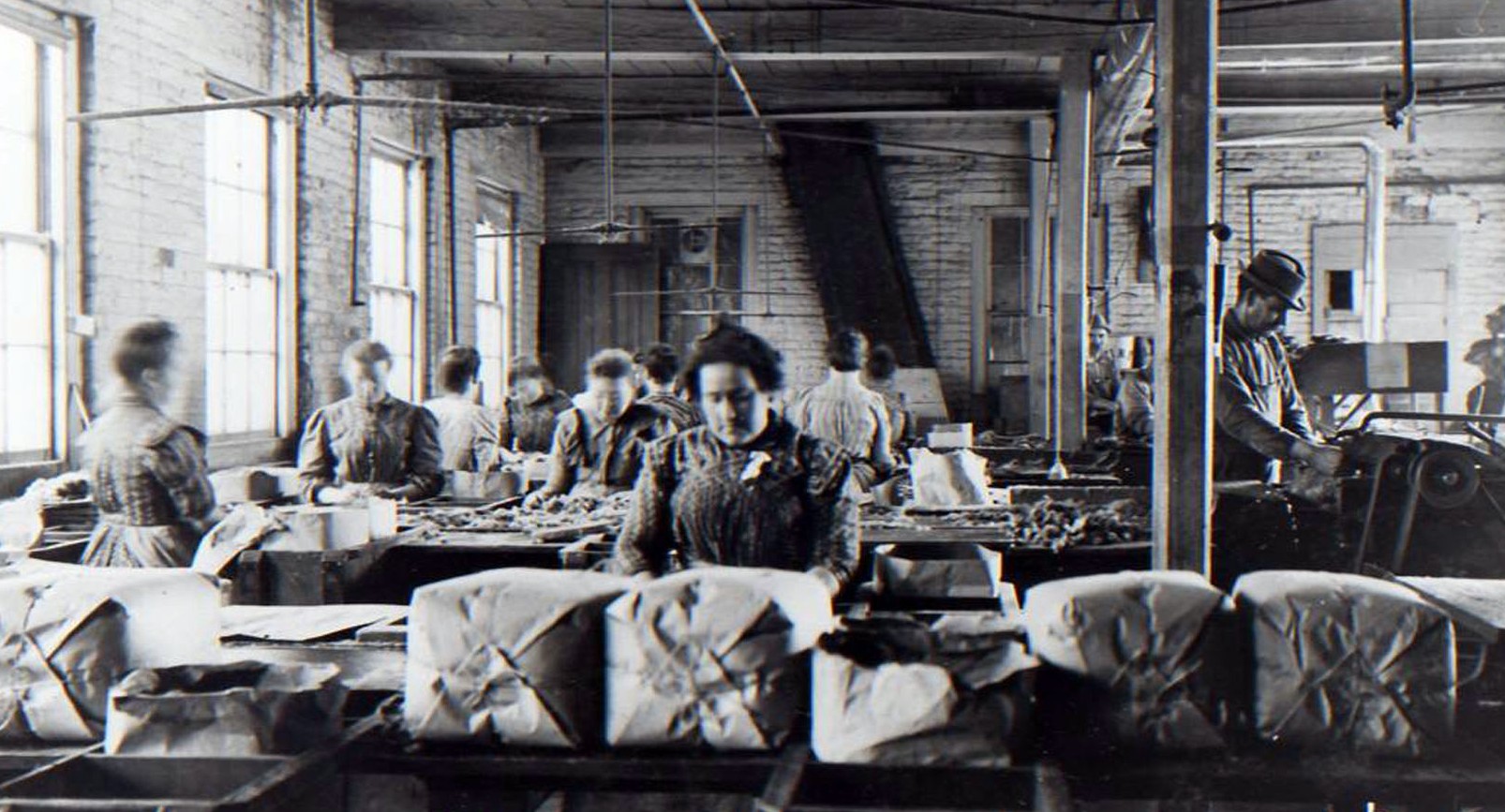
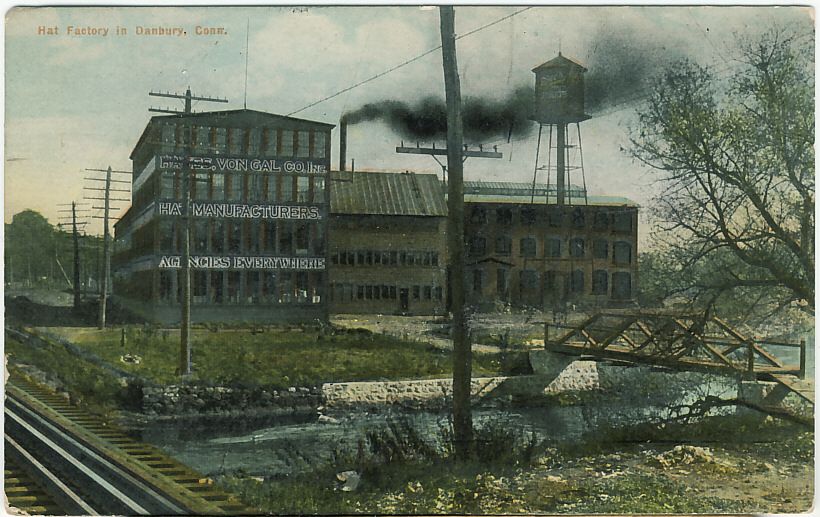
Who knew making hats could be so dangerous. A fascinating look at the Connecticut city, the workers of its hat and associated industry; ‘skilled’ and ‘unskilled,’ men and women, union and non-union, immigrant and U.S.-born, as the processes of automation and mass production were about to transform this once citadel of craft unions.
‘The Hat Industry in Danbury’ by Charles T. Peach from The Worker (New York). Vol. 17. Nos. 5 & 6. May 4 & 11, 1907.
A Study of a Rapidly Revolutionized Trade and the Condition of the Workers Therein.
Danbury, Fairfield County. Conn. is a town of about 20,000 population. Judged by its size it may appear insignificant, but from an industrial standpoint it is worthy of more than passing notice by the student of economics.
Before the Revolution Danbury was noted for the manufacturing of hats. While it is true that the hatting industry has decentralized, Danbury still makes more hats than any other place in this country. A large number of these are “hats in the rough”, sold to be finished elsewhere.
Danbury has another claim to distinction. It is the strongest trade-union town in New England. Thirty-three trades are organized and affiliated with the American Federation of Labor, no other town having unions so large or numerous. Three of the unions, the Hat Makers’ Association, the Hat Finishers’ Association, and the Hat Trimmers Union, belong to the principal industry. The two former have a membership of over 800, each, while the last named, composed of women, has 1,500.
The material from which hats are made, fur, is also a part of Danbury’s industrial activities. There are also silk factories, in which hat trimmings are made. Of conditions in these industries I shall speak later.
A Trade Revolutionized.
In the light of evolution, it is doubtful if any town presents economic conditions so striking as those of Danbury. It is not uncommon for revolutionary changes to take place in industries during the lifetime of an individual, by one machine supplanting another, or changes from a mixture of hand and machine labor to complete machine production: but for an industry to change completely from individual to social production in so short a time is rare. There are men in Danbury who were hatters in the true sense of the word. They could take the fur and produce the hat for the wearer, even to trimming it. The modern hatter is a social worker, the hat going through a number of processes, each worker doing only a small part.
Division of Labor.
Briefly told, the processes through which the hat goes are as follows: The various kinds of fur are run through a machine called the “devil”, which mixes them. The mixture is put through a machine called the “blower”. It is then weighed, the requisite number of ounces to a hat, and fed onto a forming machine, which draws the fur by suction onto large cylindrical cones. These are taken by men called “corners” and “slippers”, covered with cloths, and immersed in hot water. These are next taken in hand by a “hardener”, and then shrunk by the “sizer”. The hat bodies are then taken in hand by the “shaver”, “stiffener”, “dyer” and “blocker”. This completes the part of the production known as the making department. The dyers and dyers’ helpers, by the way, are not members of the hatters’ union. In the finishing department the hats are “pressed” and “brimmed” on special machines; then go to the worker called the “finisher”; then they are “rounded” and “wined” with alcohol, and the process called the finishing department is completed by the “curler” and the “matricer” who gives the brims the proper shape. The hats then go to the trimming department, where the leathers are sewn in, the brims bound, and the bands put on, thus completing the product. This we have some twenty successive processes, performed by as many sorts of workmen with appropriate machines.
Hand and Machine Labor.
The difference between hand and machine methods can best be shown by giving the ratio of production under each. The work of bowing and blowing the fur is done 84 times faster by machine than by hand. The sizing machines do the work six times faster than the old method of the tank, plank, and rolling stick. The operations by the hydraulic press and other finishing machines show that the work is done twelve times faster than by hand. In the trimming department the steam sewing machine does the work of sewing in reeds or leathers in the hats 66 times faster than by hand. In total time consumed on the product was four times longer by hand than by machine. These figures are taken from the Thirteenth Annual Report of the United States Commissioner of Labor.
The hat factories are large frame buildings, cheaply constructed, and do not have the appearance of substantiality possessed by the brick buildings used for other industries. The factories are divided into the forming mill, the plank shop, the dye house, and the fluishing and trimming departments. The best parts from a sanitary point of view are the finishing and trimming departments. In the making department of some of the factories the sanitary conditions are vile, and although the hatters boast of the strength of their union, conditions fit for human beings to work under have not been obtained. In one of the factories I visited I was struck with the lack of provision made for even common decency. The men, after putting on their working clothes, had to hang their “street” clothes on natis driven in the beams in a damp and dirty cellar. The place was nothing short of repulsive. I have heard many hatters complain of these conditions. One of these complaints is
worthy of notice, because it represents the case from the employer’s standpoint. On this occasion, the employer went to investigate, after a committee of the men had interviewed him.
On entering the “plank shop”, the steam was so dense that it was impossible to see any object a few feet from the door. The only satisfaction the men got can be judged from the employer’s remark: “Oh, hell! this isn’t so bad. You hadn’t ought to kick about this.” The toilets provided in the thuishing and trimming departments of some of the factories would not be tolerated did the health officer attend properly to his duties. That these conditions exist can be learned from the common talk about town, especially where hatters congregate.
Work and Wages.
The hatters work by the piece, and as the trades are divided by the seasons, they have to work very hard during the busy times. To make their large wages they are not infrequently taxed beyond their strength. One hatter fold the writer, that so fast is the pace under which some of the men work in the finishing department, that, in order to stand the strain and to deaden the pain caused thereby, they wear porous plasters on their backs and sides. (I am not aware that “Terrible Teddy” knew anything about this when he wrote on the strenuous life.) In the forming mill, a part of the making department the men are frequently compelled to stop work because of mercurial poisoning caused by the “carrot” in the fur, which gives them what is commonly called “the shakes”.
One point as to the practicability of capitalistic ethics. Many a hat manufacturer’s fortune has been built up by the burning down of his hat factory. The construction of the building has facilitated this.
Danbury, in one respect, differs from many other industrial centers. The hatters do not as a rule live near the factories. They either rent or own (or apparently own, for mortgages are filled in Danbury as elsewhere) houses in the residential portions of the city. Many of the homes are well furnished and have an air of prosperity not so general in many other industries. The houses in the vicinity of the factories are occupied by laborers and unskilled workers, and have the same appearance as those near mills in the textile and other industries, which have so often been described in The Worker.
The hatters are probably the best paid workers in New England. The average wage paid in all industries, according to the Connecticut Bureau of Labor Statistics, is $1.59: the hatters are listed as receiving an average daily wage of $1.95, there being but one industry quoted higher. These figures were published in 1904, the last volume issued containing no wage statistics. The hatters’ wage is placed under the title of “hat and cap industries”, and is not altogether reliable, as the cap industry is distinct. The most recent bulletin issued by the census places the manufacturing establishments in Danbury among the best paid in the state. The average earnings of factory employees men, women, and children is given as $510 a year. The average earnings for men over 16 years is put at $600, while women over 16 are reported as receiving $325. While I admit too much dependence should not be placed upon these figures, yet they form à basis of comparison with other industries which cannot be ignored. Upon investigation, I found that the hatters working in union shops, according to their different callings, when working full time, received wages as follows: Finishers, from $3.50 to $4 a day; curlers, about $6: matricers, $4 to $5; sizers, $3 to $4; blockers, $5 to $6; shavers, $6.50 to $7.50. These wages may appear high, but I have been assured that these are not below the actual earnings of union hatters. One blocker told me recently that he earned last year $1,000, and a curler, whose word I can rely on, told me he earned $1,200. A short time ago a New Haven business man came to Danbury to investigate business conditions here. He was shown the books of one of the hat factories, and figured the average wages of all employees as being $15.30 for the week he visited the factory.
Labor and the Law.
The hatter is an egotist. He firmly believes that, as he makes the covering for the head, those in other industries where the other wearables are made, are socially beneath him. He believes in only two things, the trade union and the union label. That his union is strong can be judged from the fact that the men work under a stint of the union’s own making, no hatter being allowed to exceed it, and also by the salaries paid to local officers of the union. The presidents of the Makers’ and Finishers Associations receive $1,000 a year. The secretary of the Makers’ receives $750 a year and percentage on monies collected in the shape of dues and assessments, which brings his income up to about $1,200 a year, while the secretary-treasurer of the Finishers receives $1,000 a year, and percentage on dues and assessments. The national association, known as The United Hatters of North America, keeps men on the road for the purpose of advertising the union label, and their success with this device has been greater than that achieved by any other organization, not excepting the cigar makers. However, it is the opinion of some that the high-water mark has been reached by this means, and one or two things seem to prove this.
In 1903 a suit was brought against the United Hatters of North America and the American Federation of Labor by D.E. Loewe & Co., a Danbury hat manufacturing firm, on the charge of boycotting, alleging damages to the amount of $100,000. This suit is still pending. Among other counts in the writ is the following:
“Said combination (known as the United Hatters of North America) owns and absolutely controls the use of a certain label or distinguishing mark, which it styles as the Union Label of the United Hatters of North America, which mark, when so used by them, affords to them a ready, convenient, and effective instrument and means of boycotting the hats of any manufacturer against whom they may desire to use it for that purpose.”
In the beginning of the strike against D.E. Loewe & Co., the hatters made considerable headway, and it is alleged the firm lost considerable business. Whether this was brought about by means of the distinguishing mark, the union label, the writer cannot say, but certain it is that some damage must have been sustained by Loewe & Co. or the suit would not have been instituted. In 1905. D.E. Loewe went to California and got an injunction against the California State Federation of Labor restraining them from boycotting the hats made by Loewe & Co. The injunction was granted, and then made permanent: the decisions of the Connecticut Supreme Court on boycotting were quoted in it and upheld, and the injunction was witnessed by Chief Justice Fuller of the United States.
Since the issuing of, this injunction the factory of D.E. Loewe & Co. has been one of the busiest in town, and it has taken an unoccupied factory and commenced work therein in order to fill the orders in its rapidly increasing business. So it does appear that injunctions do work.
Legality of the Label.
Another case regarding the union label was the one brought by the United Hatters in 1904 against Charles H. Merritt & Son of Danbury for using fraudulent labels for the purpose of injuring the union label of the United Hatters of North America. There were six labels got out by Merritt & Son, each of which the union claimed was in imitation of its label. Damages to the amount of $2,000 and a permanent injunction were asked for. The case was heard by Judge Shumway, who granted an injunction and awarded damages to be ascertained, from which verdict the defendant appealed. On appeal the Supreme Court decided against the United Hatters. The decision shows that the hatters’ label has no legal standing. It is in part as follows:
“Under the general statutes, a label (quoting the Cigar Makers’ label as an example) of such a kind became the proper subject of equitable protection, and any member of the association owning it (although neither he nor the association might be manufacturer or owner of the goods to which it was attached, nor a dealer in them) was invested with a right of action. But the label on which the plaintiff relies on this action is one of a very different character. Instead of announcing that the hat to which it may be affixed has been manufactured by a member or members of the United Hatters of North America, if it announces anything as to its origin. It is that it is manufactured by the association itself. It is not therefore such a label as can support his action.”
The effect of this decision cannot be realized. It is the opinion of one of our local lawyers that no union labels, the Cap Makers’ excepted, are legal in Connecticut. But there are two points in connection with this decision that should not be overlooked. First, should the suit of D.E. Loewe & Co. be sustained on the count quoted, the law legalizing the union label will be of no effect, because all labels will come under the scope of the Conspiracy Act, as the decision will declare, in such a case, that they are weapons of boycotting, and boycotting is illegal. Second, it is the opinion of lawyers that the Merritt decision will have a most damaging effect on the Loewe case, and should the Loewe case be decided adversely for the defendants, It is more than probable that the hat manufacturers will make a strong move for the open shop, which means free competition for labor in the fur hatting trade.
(Note: This article was written several weeks ago. Since then a decision favorable to the hatters’ union was rendered in the United States District Court by Judge James P. Platt in the case of D.E. Loewe vs. “The United Hatters of North America”. This suit was brought under the Sherman Anti-Trust Act, which on a favorable decision would give three-fold damages to the plaintiff. The judge ruled chat the case did not come within the meaning and Intent of the act, and from the decision the plaintiffs took an appeal. In the Merritt label case, the union was beaten on the spent to the Supreme Court, and has been unsuccessful in all efforts to reopen the case. The last more was to amend the label law (so as to cover the hatters’ label) during the present session of the Connecticut legislature. The committee reported the amended law unfavorably and the measure was defeated. This is the latest that can be learned of the situation.)
***
The silk factories are a part of Danbury’s industrial life. In them are made the trimmings for the hats, which connects them closely with Danbury’s principal industry. There are also fur factories, in which the raw material for the manufacturing of hats is produced.
In the silk mills the principal workers are women and young girls. They are not organized. The wages paid locally in this industry are as follows: Weavers, $1 a day: warpers, when busy, from $8 to $9 a week: winders, $1 a day: spinners, $4.50 to $5 a week; band cleaners, $4.50 to $5.50 a week. The average daily wage is below one dollar–to be accurate, 90 1/6 cents. The Bureau of Labor Statistics gives the average daily wage in the silk industry for the state as $1.30, which shows that Danbury is below the average. These factories are cleaner than the hat factories, and the sanitary conditions are better. The operatives complain that their wages are low. When they go into the silk factories to learn any branch of the industry, young girls of 14 or 15 years have to work for nothing during their apprenticeship, and their wages start at $2.50 a week. I do not think any efforts to organize the workers in this industry have been made by the local trade unionists.
Nothing is Wasted but Workers’ Health.
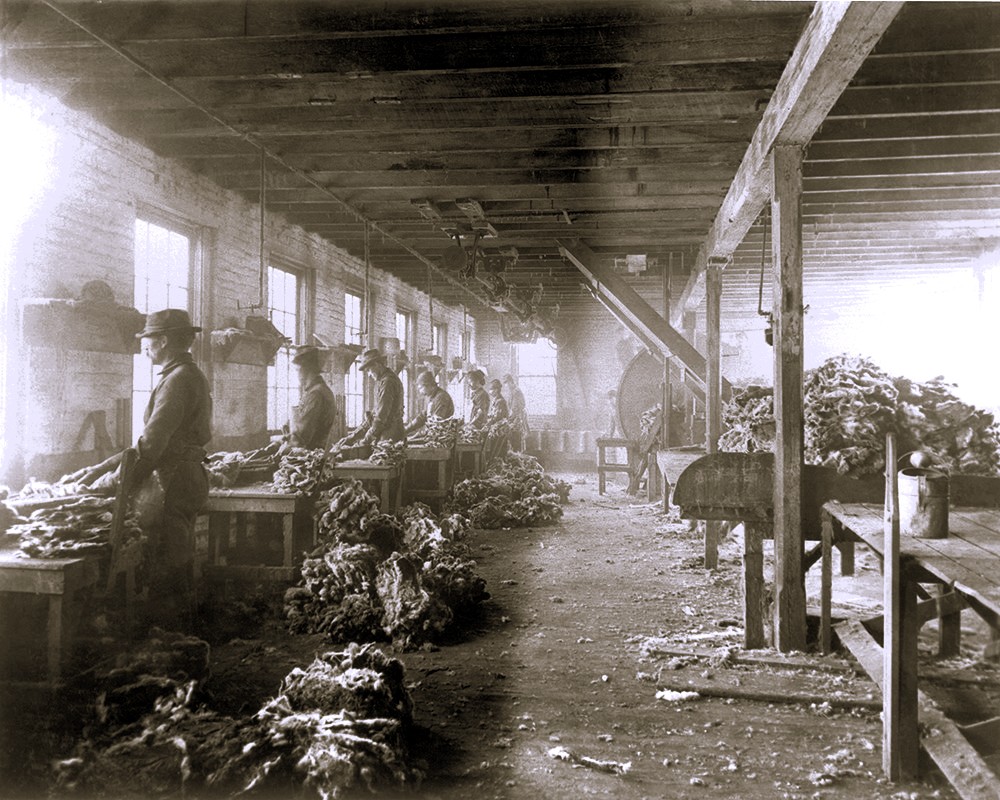
In the fur factories are employed workingmen receiving perhaps the lowest wages for the most unhealthful work in the state. In the days gone by the older men in this industry received larger pay, some of the men who now receive $8 or $9 a week formerly getting $25. In the old days the fur factories produced only new stock–that is to say, only the fur produced from the newly received skins of rabbits and other animals were the product of this industry. Today, however, nothing goes to waste. The hat roundings, trimmed off at the hat factories, and even old fur hats, are taken to the fur shop where they are treated with a powerful solution called “tin crystal”, which takes out the stiffening and dye coloring, after which they are torn to shreds by pickers and other machinery, and the fur is made fit to be worked into hats again. There are also carloads of these old fur hats and hat roundings brought to the local fur factories from hat factories in other localities.
The skins from which the new fur is prepared are sorted and cut open by women, mostly Italians or Syrians, who are able to earn from 60c to $1 for a day’s work of ten hours. The latter sum is earned only by those who are very fast. These skins are then dressed with a solution called “carrot”, which is prepared from nitric acid and mercury. So powerful and poisonous is this mixture, that it has to be compounded in a small building outside the main factory. When the nitric acid and mercury are poured together in a large stone receptacle, the worker doing it has to beat a hasty retreat and shut the door of the building (the fumes being very dangerous), and a large volume of yellow fumes bursts forth through a hole in the roof. After the mercury is cut by the nitric acid, it is ready for dressing the skins, and is called “carrot” because of its yellowish color. After the skins are thus dressed they are run through a machine, which cuts off the fur so perfectly that not a particle is left on the skin and this is the most valuable product of the industry. The machine then cuts the skins into little pieces, which are converted into glue, and the refuse at the glue factory is converted into fertilizer, so that nothing in this industry goes to waste.
The men working in the fur factories, with few exceptions, are Syrians, Italians, and Slavonians. The foremen are mostly Americans, but their wages are not high, being about $15 a week. The Syrians and like laborers, considered unskilled, get $1.25 a day, which is about 25 cents a day more than was paid for the same labor-power five years ago. About that time a union of the fur workers was formed, but it soon went to pieces, because it was impossible to bring the Syrians into the organization. The difficulty of conversing with them in their own language, and their unwillingness to put any money into a project like a trade union, were the barriers that trade unionism could not overcome.
Working with Poisons.
I have alluded to the unhealthfulness of the work in the fur factories This can readily be comprehended when one realizes that mercury is a powerful poison. It is used in this industry in large quantities in the form of “carrot”. It gets into the systems of the workers, and they are afflicted frequently with the malady called the “shakes”. I have met old men who have practically lost the use of their hands thru mercurial poisoning. Some have had their teeth fall from their gums. In some instances, men in the for factories, after their teeth have become very loose, have pulled them out with their fingers and not a drop of blood has flowed from the cavity. One of the fur workers told the writer that the “tin crystal” used for taking the dye and stiffening from the old hat bandings is worse in its poisonous effects than the “carrot”, but they do not know the components of the mixture.
The Syrians live in the houses near the fur factories, and many of them huddle together in few rooms, as do the poorest classes of labor in the mill towns of Massachusetts and Connecticut. By the scanty manner of their living the single men manage to save small sums from their low wages.
These being, the principal industries, perhaps a few words regarding other labor may not be out of place. The building trades are organized and work is done under conditions similar to those prevailing in other cities, the exceptions being the carpenters and painters, who work nine hours, while the other trades work eight.
There are two silver plate factories, but the wages paid are not above the average–in fact, the proprietor of one of them boasts that labor is cheap in Danbury. There are also a shirt factory and shirt waist factory. The girls are piece workers, and can earn from $3 to $5 a week. The latter sum can be earned only by those who are favorites of the forelady or boss.
The Ill-Paid Clerks.
According to the census figures, the salaried officials, clerks, etc., of Danbury receive lower salaries than those of almost any other city in the state. Their average is quoted as being “$824 a year, while in no other city is the average below $1,000, and in several of them It runs up to $1,300 or more.” These figures are not correct, for they are too high for Danbury. Any clerk who gets $780 a year, or $15 a week, is getting big pay in Danbury. Upon investigation I found some were getting this amount, while others were receiving from $3 a week, or $150 a year, up to $7 a week, or $364 a year. Upon one point the Bulletin is correct. The wages of clerks are undoubtedly lower in Danbury than those of the same class of labor elsewhere in the state. And there is a reason for this.
Nearly every hat factory in Danbury is a “closed shop”, the number of apprentices is limited, and therefore there is a limit to the competition in the hatting trade. There is no limit to competition among the clerks in Danbury, perhaps on account of lack of organization, which is not the case in other cities, as the clerks are organized in many of them. A member of the firm of D.E. Loewe Co. showed a friend of the writer a long list of names of clerks who had standing applications for a position to learn hatting whenever a vacancy should occur. This, as I stated before, is a non-union shop, and offers them the only escape from clerking to a trade. The clerks in Danbury have to put on a good appearance on their small income, as do clerks elsewhere, and although poor in purse, are proud, believing themselves more nearly allied to the proprietors than to the proletariat.
There is also a large printing and pamphlet binding establishment. It is non-union. The nine-hour day prevails. Journeymen compositors receive $12 to $14 a week. The girls in the bindery are paid $3 a week, or a fraction over 5 cents an hour. Should any of them be five minutes late she is fined one hour’s pay. Some people may ask: “Why don’t these people organize?” Let us investigate.
It is a well known fact, particularly to Socialists, that there is a limit to organization upon the economic field in any given community. The reason for this is on account of the surplus labor-power remaining unemployed. This has been styled by Marx the “reserve army of capital”, and it flocks to those trades or callings most easily entered for employment. Should there be a case of a town where thorough organization existed, from the loins of the workingmen themselves would spring this “reserve army”. Many an organized trade has been swept out of existence by reason of Improved machinery, simplifying methods, women taking the places of their husbands and fathers and children in turn taking the places of women, their mothers. The “Communist Manifesto” is particularly clear on this point.
Employers Organized.
The manufacturers and the business men of Danbury are organized, and it is difficult today to work along the lines of the old-fashioned trade-union methods. There was a time when the committees of organized labor would call upon the business men and inform them of the union label goods they wanted them to keep in stock, or of the boycotted article they did not want them to keep. The business men, now having a union of their own, have decided to keep in stock what manner of goods they desire, and as these gentlemen collectively have a legal adviser to keep them posted on the laws relating to capital and labor, they know the workings and interpretation of the Conspiracy Act, and possess a big advantage in their organization which the laborers have not.
It is not uncommon to learn, in this citadel of trade unions, of a union man who has aroused the ire of his capitalist master by taking a too radical part in the labor movement. Then it is that the blacklist comes into play. Many a hatter, although he would have you believe that he is the most independent person on earth, has had a taste of this. It was for this reason that the president of the local hatters’ unions was taken from the bench and paid a salary, for it was hard work to hold the office and a job at the trade at the same time. It also affects other trades. A short time ago I met a union barber who had just returned to Danbury. He had taken a more prominent part in the union than the boss barber liked, and as a consequence lost his job. He informed me that he was out of the active part of trade unionism, and he did not intend to be looked upon as an Anarchist or Socialist in the future. I cite these instances to show that, while no single capitalist owns the laborer, the laborer belongs to the capitalist class, for he cannot live without them. And yet Samuel Gompers and others of his kind talk of the emancipation of the laborers by means of autonomous trade unionism.
Socialism in Danbury.
In conclusion, I should like to say a few words upon a topic we are all vitally interested in. Socialism has not made the progress in Danbury that some outsiders consider it should have made. No doubt there are many reasons for this. Some years ago, before the writer became a Socialist, there was an energetic local of the S.L.P. with over 40 members in this town, and much propaganda was done and good literature distributed. Then came the split and the forming of the Social Democratic Party. A reorganization was effected, but in some manner the old spirit of unity was lost. Some of the old leaders left town, and new ones to take their places did not rise up, and in many instances the old workers have become discouraged. The Italian comrades have nearly all fallen out of the active part of the Socialist party’s work, although when election time comes they vote the ticket. Another cause that retards the growth of Socialism is the one so common elsewhere. The members do not study Socialism from the recognized authorities, but imagine that Hearstism is Socialism and that imbibing Brisbane’s editorials will develop a person into a Socialist of the grand revolutionary party. There is perhaps no town in which a larger number of Hearst’s papers are sold, according to the population, than in Danbury, and I know of no more reactionary population than we have here. There is but one thing for the comrades, locally and elsewhere, to do, and that is to get their knowledge of Socialism from the recognized standard Authorities. Liebknecht gives us the keynote when he says: “Modern Socialism is the child of capitalist society and its class antagonisms. Without these it could not be…On the ground of the class struggle we are invincible; if we leave it we are lost for we are no longer Socialists. The strength and power of Socialism rests in the fact that we are leading a class struggle.” There must be “no compromise, no political trading.”
But one thing is certain. Changes are bound to come in, the production of hats, and machinery of the more automatic mechanism will supplant the present methods. Many patented devices are owned by a large hat-machine manufacturing firm, designed to simplify and increase production, and when once these are perfected and made practicable and the time is ripe, they will be introduced. Capitalism recognizes only one law, and that is the law of profit, and there is recognized limit to the percentage. Whether a capitalist runs a union shop or an open shop, profits must be made or the business will stop. I know that some of the union hat manufacturers believe that their profits are not adequate, are chafing under the union’s restrictions and are looking for a way out. Whether “the way out” will come through the on-coming industrial crisis, or whether the pending suits will be the entering wedge. I know not, but this I do know: The class interests of the Journeymen and the hat manufacturers do not run together without friction, and the day may not be far away when another lockout will come as it did during the financial crisis about thirteen years ago. Then the hatters may realize that the owners of the machines and factories, those social relations of production, are the “masters of the bread” and will again be able to dictate the conditions under which the work shall be done, the same as they have done heretofore.
The Worker, and its predecessor The People, emerged from the 1899 split in the Socialist Labor Party of America led by Henry Slobodin and Morris Hillquit, who published their own edition of the SLP’s paper in Springfield, Massachusetts. Their ‘The People’ had the same banner, format, and numbering as their rival De Leon’s. The new group emerged as the Social Democratic Party and with a Chicago group of the same name these two Social Democratic Parties would become the Socialist Party of America at a 1901 conference. That same year the paper’s name was changed from The People to The Worker with publishing moved to New York City. The Worker continued as a weekly until December 1908 when it was folded into the socialist daily, The New York Call.
PDF of issue:https://www.marxists.org/history/usa/pubs/the-people-the-worker/070504-worker-v17n05.pdf
PDF of issue 2: https://www.marxists.org/history/usa/pubs/the-people-the-worker/070511-worker-v17n06.pdf

