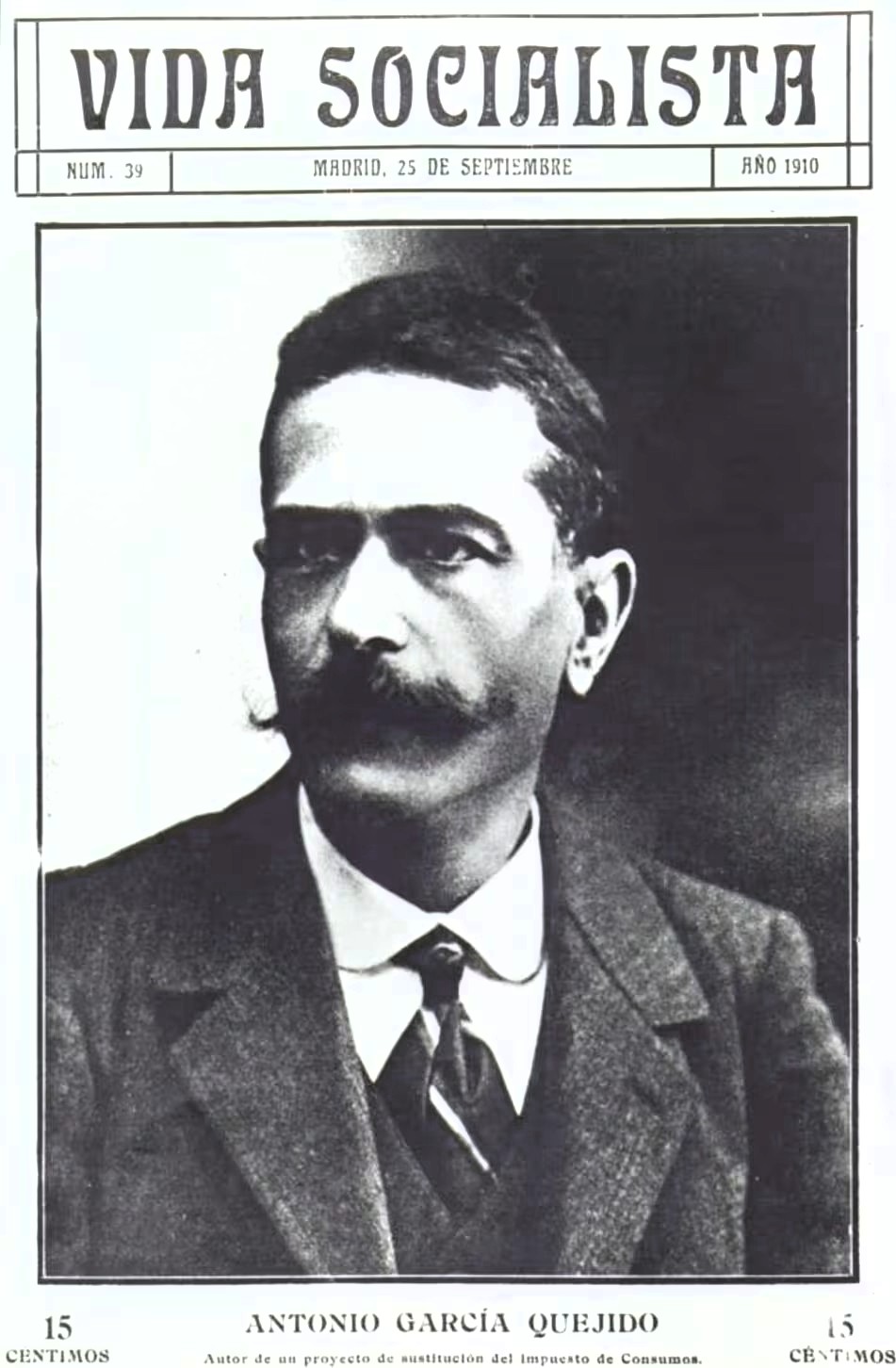
From the beginnings of Spanish Marxism, he literally set the type for the a Spanish translation of Capital, to the founding of the Communist Party, the full revolutionary life of working-class leader Antonio García Quejido, a central figure of the Spanish left for ever fifty years.
‘Antonio García Quejido’ by Jar from International Press Correspondence. Vol. 7 No. 41. July 14, 1927.
After a long and painful illness, Antonio Garcia Quejido, a working printer, has died at the age of 70 in Madrid. Garcia Quejido was, together with Pablo Iglesias, the founder of the Worker’s Socialist Party of Spain, in which party he was an active militant worker until 1921 when he left it to join the Communist Party. Garcia Quejido devoted fifty-five years of continuous work to the Spanish Labour Movement.
In 1879 he was secretary to the first Socialist group in Spain. During his years of service there he was sent to prison many times, in Madrid, Valencia and Barcelona. In 1888 the Union General de Trabajadores (General Workers’ Union) was formed and Garcia Quejido was its first president. By that time too Barcelona was the centre of an active Anarchist movement. Garcia Quejido worked against it, having a continuous struggle against Anarchism. This campaign of Garcia Quejido’s however was not backed by other leaders of Socialism who did not know or did not want to know how to put an end to the campaign against Anarchism, with the result that Barcelona was abandoned. Garcia Quejido alone understood the great importance of converting those masses of Anarchist workers to Socialism.
In 1894 he attended the International Socialist Congress at Zurich; in 1896 the one held in London; in 1900 he went to the Paris Congress and in 1902 to the Stuttgart Conference.
Garcia Quejido was also the founder of the Spanish Workers’ Printers’ Federation. From 1897 till 1899 he was. the secretary of the National Committee of the Socialist Party. From 1909 to 1913 he was an elected member of the Town Council of Madrid, and from 1919 to 1923 he was an appointed Provincial Deputy, from 1920 to 1921 Vice-President of the Spanish Socialist Party until the formation of the Communist Party of Spain in that year.
In 1901 Garcia Quejido edited a Socialist review called the “New Era”. He also wrote a pamphlet “Pablo Iglesias in the Labour Party”. In the last years of the past century Garcia Quejido also founded a Socialist library; he edited a Spanish translation of the first volume of Marx’s “Capital”, the only one extant in the Spanish language. Garcia Quejido himself set the type for this book.
In 1923 he published one of the most interesting theoretical books written in Spanish: “Karl Marx and the International”. From 1922 to 1924 he was the editor of the “International Book Editorial” of the Communist Party of Spain.
Garcia Quejido had more influence and moral authority. over the Spanish Labour movement than any other militant worker. He belonged to the “Heroic age” of Spanish Socialism. His faith in Marxism was strong and never failed; he represented the intransigent Marxist school. Consequently, when the Communist Party was founded in 1921, Garcia Quejido, like other veteran Socialists, such as Isidoro Acevedo and Facundo Perezagua, joined the Communist Party without hesitation. His speech at the Congress which caused the split will always be remembered by Spanish Communists. We, those who in favour of the formation of a Communist Party, were accused at that time of being young men with no love for the history of the Socialist Party, so that we did not dare to destroy its unity. Then Garcia Quejido, who had worked in the party for fifty years, began to speak and declared that he was joining the Communist Party because he considered that it was the party which represented the ideology he had been fighting for his whole life.
Garcia Quejido and Pablo Iglesias worked together for fifty years, but their activities were always divided by important differences in their theoretical views. These differences increased towards the end of their lives. While Pablo Iglesias’ ideas were developing towards Reformism, so that he did not approve of the Russian Revolution and he worked for co-operation between the Socialist Party and the Bourgeoisie.
Garcia Quejido was an active fighter in the Communist International, working incessantly for the oppressed and persecuted, and denouncing in no measured terms the treachery of Spanish Socialism.
Pablo’s old age was peaceful and happy; he did not suffer need. Garcia Quejido, though 70 years of age, worked as a proof-reader in a printing works until two months before his death. He was obliged to earn his living up to the last.
At Pablo Iglesias’ funeral representatives of all the Spanish bourgeoisie were present; even Primo de Rivera sent a presentative. At Quejido’s funeral only workers were present: all the members of the Communist Party of Madrid, non-Party workers and almost all the workers in the printing trade in Madrid. The funeral was conducted by Isidoro Acevedo, Garcia Quejido’s comrade during the struggles of forty years.
In Garcia Quejido we have lost one of the pioneers of the Spanish movement. Hand in hand with Pablo Iglesias and Anselmo Lorenzo he was the creator of the Spanish Labour movement. His whole life was a vivid example of sacrifice for the revolutionary ideal. Furthermore he was the only old Socialist who never accepted a paid position under the Spanish Government. He died as he had lived working until the last moment, and fighting for the Communist International. His life will always be an example to the young revolutionary elements belonging to the Communist Party.
International Press Correspondence, widely known as”Inprecorr” was published by the Executive Committee of the Communist International (ECCI) regularly in German and English, occasionally in many other languages, beginning in 1921 and lasting in English until 1938. Inprecorr’s role was to supply translated articles to the English-speaking press of the International from the Comintern’s different sections, as well as news and statements from the ECCI. Many ‘Daily Worker’ and ‘Communist’ articles originated in Inprecorr, and it also published articles by American comrades for use in other countries. It was published at least weekly, and often thrice weekly. A major contributor to the Communist press in the U.S., Inprecorr is an invaluable English-language source on the history of the Communist International and its sections.
PDF of full issue: https://www.marxists.org/history/international/comintern/inprecor/1927/v07n41-jul-14-1927-inprecor-op.pdf

