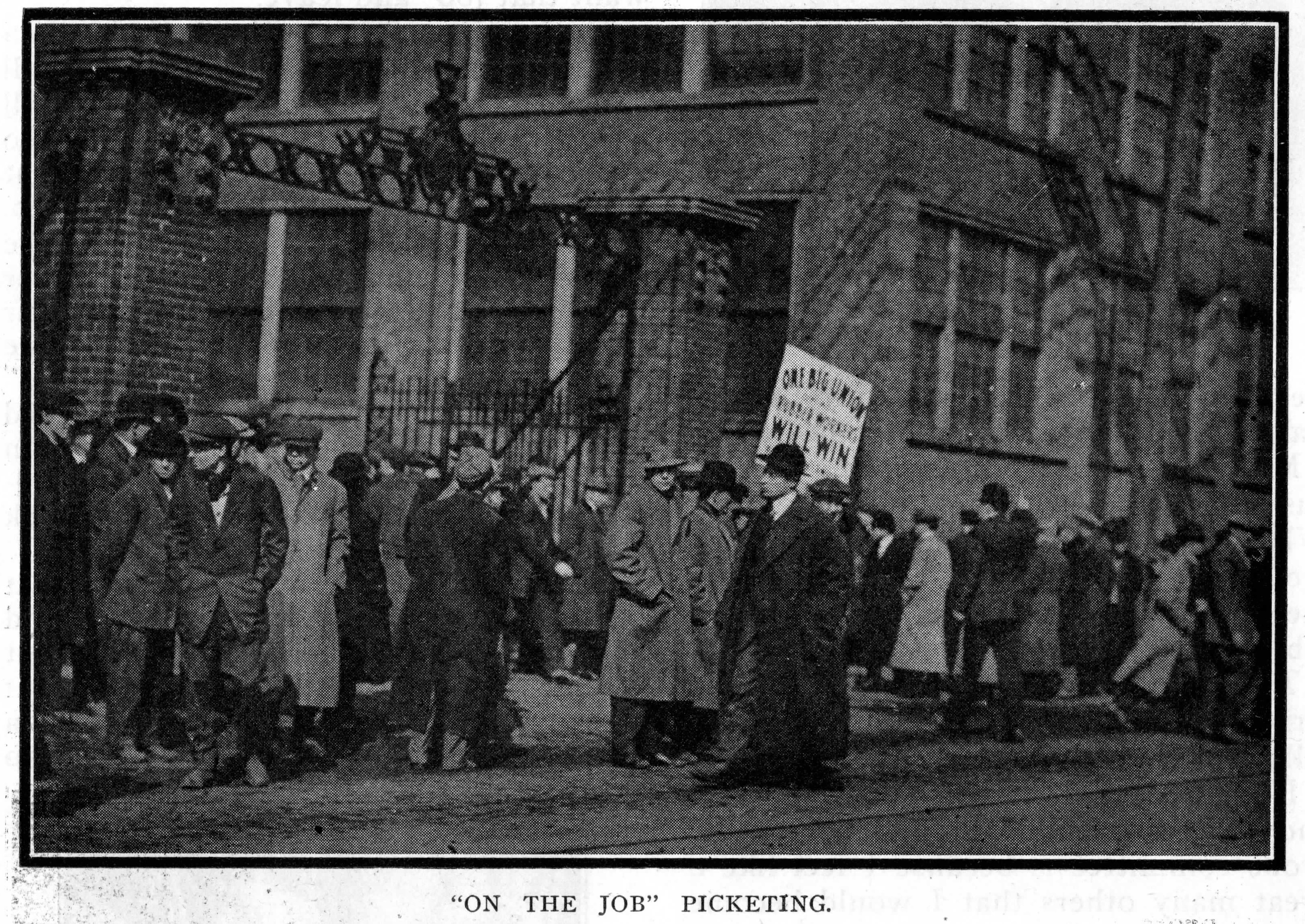
Heady days and spirits are high–the city ran out of red ribbon–in struggle ultimately defeated. The 1913 Akron rubber strike was one of the largest attempts at unionizing the industry before the C.I.O. and an early (non-mine) case of industrial organizing among masses of ‘unskilled’, largely immigrant workers, forces largely ignored by the American Federation of Labor.
‘20,000 Rubber Workers Revolt in Akron’ by George H. Swasey from Solidarity. Vol. 4 No. 9. February 22, 1913.
I.W.W. IN FULL CONTROL–AKRON WORKERS STRIKE AGAINST CUTS OF WAGES AND SPEEDING UP
Akron, O., Feb. 18. Fourteen thousand now out. Picket line at the Goodyear plant today was the greatest ever. All the red ribbon in town sold out. Everybody wearing red. Firestone, Miller, Swinebart, American plants completely shut down. Goodrich, Diamond and Goodyear crippled, with only one-third forces inside. Among others are 2,000 Hungarians and Servians in the I.W.W. I.W.W. in complete control. Rush funds to Gill, Treasurer, 42 West Miller Ave., Akron, O.
GEO. H. SWASEY.
Akron, O, Feb. 17. On Tuesday. February 11, there broke out in this city a revolt of rubber workers which promises to shake the foundations of capitalist society to the same extent or more than Lawrence did last spring.
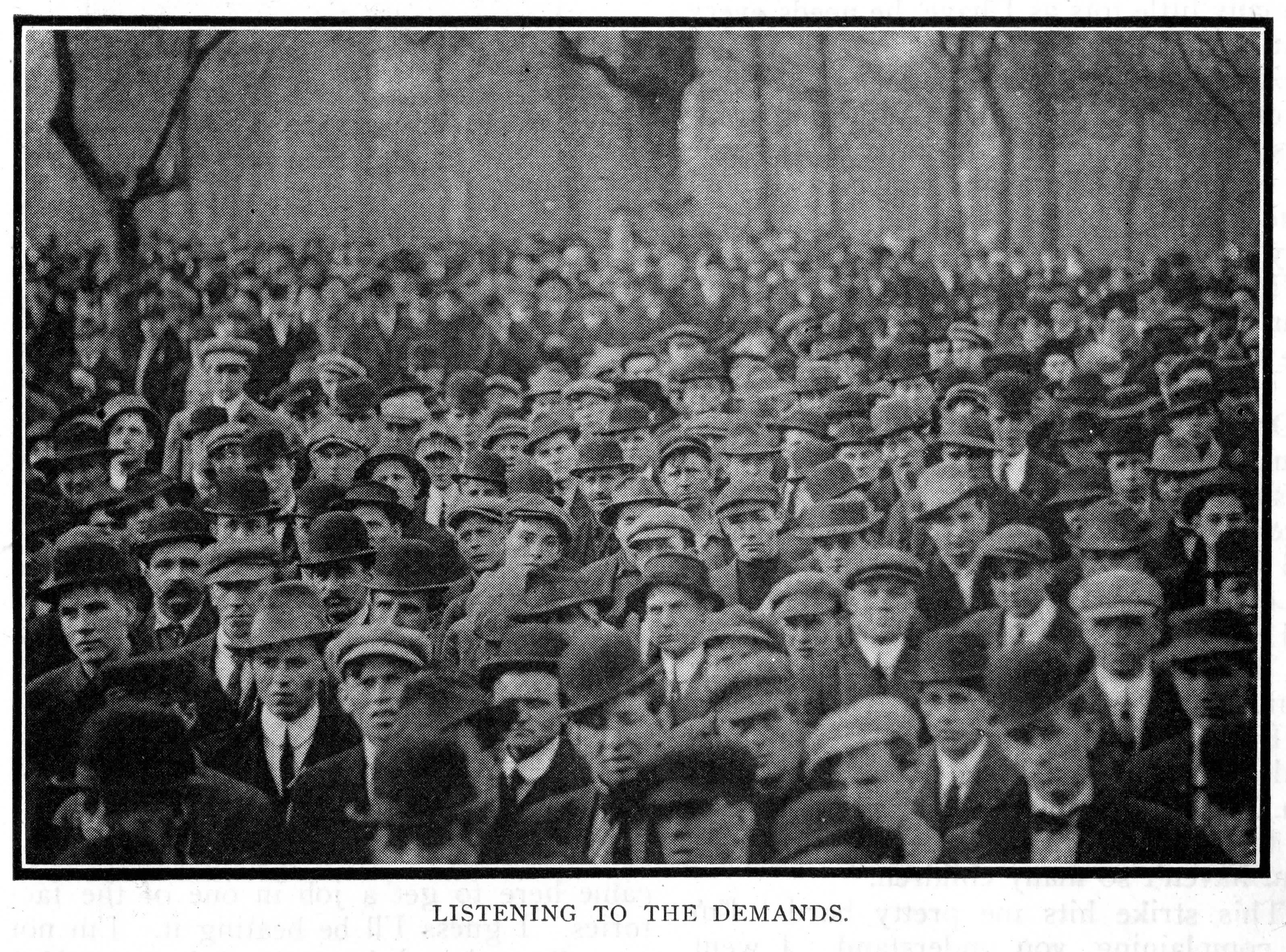
All strike meetings are jammed to the doors and thousands have been unable to bear the message. No meeting place in half big enough to accommodate the men, women and children who have laid down their tools against the cuts in wages, which have totaled 50 per cent in many cases.
The revolt started when the Firestone Auto Tire Co. announced a new scale for piece workers which meant a decrease in the price per tire. Where men had received 21 cents for a 3 1-2 inch tire they were cut to 11 cents. No wonder they revolted.
In the Buckeye plant, which is about down, there was no cut; but the entire shop of 600 emptied when the pickets parade first approached the plant. The solidarity of otherwise loose and divided elements is really wonderful. The Saturday afternoon parade, which took place immediately after Arturo Giovannitti spoke to 5,000 in Reindeer Hall, was inspiring The Akron Times, a scabby sheet, says that only 500 are on strike. This parade of 8,000 men, with a dozen banners, many flags and red ribbons on all their coats, proved this to be a lie.
All the papers (except the Scripps McRae paper the “Press”) are trying to incite the “people” to violence, a la Lawence “American.” The articles are highly incendiary and calculated to start trouble, so that the militia may be called. The strikers laugh at these articles, as they are pure bull. The newsboys who are right, won’t sell any paper except that favorable to the strike. A boycott of the Akron Times is being enforced.
Railroad men have declared that they will not haul freight in or out of the shops if scabs are secured, which is unlikely.
The Street Railwaymen’s Union declare officially that if the A.F. of L. tries to butt into the Akron strike and oppose the I.W.W., they will turn in their A.F. of L. charter and get an IW.W. one Some solidarity, eh?
The girls in the Werner Book Publishing concern have asked for a raise or they will strike. I tell you that Akron is shaken to its foundations. All creeds, colors and flags are represented in the strike. The workers are determined to put a crimp in the bosses’ pocketbook, especially that of the Goodrich Co., which declared a 400 per cent dividend on January 1.
Committees are working night and day, and by Wednesday we expect to have all the 17 mills closed.
George Speed, Walter Glover, Walter Knox and myself are working about 18 hours a day. Six secretaries are working 12 bours signing men up in the I.W.W.
Haven’t seen a cop since I have been here (four days) and everybody says it is the most peaceful strike ever heard of. All hail the rebel proletaire! Hurrah for the strike!
Less booze for bosses! More bread for workers!
GEORGE H. SWASEY.
***
THE BIG REVOLT
“It never rains but it pours,” must be the uppermost thought in the minds of our masters, in times of almost continuous working class revolt. Three years between McKees Rocks and Lawrence; and only one year between Lawrence and Akron. Verily, that “people of the abyss”–the machine proletariat which has been “naught” is moving rapidly to the state where it “shall be all.”
Advises from Akron direct to Solidarity are meager so far, but sufficient in connection with daily reports in the Cleveland papers, to confirm the statements of strike leaders, to the effect that this strike of rubber workers is bigger and more significant in many respects than that of Lawrence a year ago.
Citizens Civilized.
One noteworthy difference is the apparently peaceful attitude of Akron citizens. Although some of them, doubtless at the instigation of the mill owners, induced the mayor to ask the governor of Ohio for the state troops, others protested that there was no need of such action, and commended the governor for, refusing at this time. Extra deputies have been sworn in by the police department, but they have little to do, and when congestion of strikers takes place anywhere, they have only to call upon the captains of pickets to clear the sidewalks and streets, and it is done. Only about two arrests have been reported in the week of stirring struggle. Only another proof that soldiers and bullying police are mainly responsible for violence in strikes.
Shaw’s Bull.
The superintendent of the big Goodrich plant commonly known as the “rubber trust” $90,000,000 corporation vows that if compelled to shut down on account of this strike, he will move his plant from Akron. The strikers treat this bluff as a huge joke, and in one of their parades carried a banner saying: “Ten thousand rubber workers wanted to help move the Goodrich mill. (Signed) O. SHAW.” Another amusing stunt is reported to have been palled off by the strikers on Wednesday this week. In the strike parade was a real live bull, with a sign on his back bearing the legend: “This is Shaw’s bull. Going to move from Akron.” Following this was a cow labeled: “I.W.W.; this no bull.” Superintendent Shaw will have to quit shooting the bull.
Reasons for the Strike.
The revolt started, as all such revolts do, after repeated and merciless efforts of the bosses to grind their slaves to the limit of human endurance for the sake of ever more dividends. The Goodrich Co. declared a dividend of 400 per cent on January 1. This was followed by a cut in prices on piece work–one of several, in the past six months, aggregating altogether about 50 per cent. In order to make up the difference, machines were speeded, up at a killing pace, and the working day extended until the slaves broke under the strain. So when 300 workers walked out after a cut in the Firestone plant, one of the small concerns, the rest of the Akron workers were ready, and the strike rapidly reported out, four big plants are completely shut down, and the Goodrich, Diamond and Goodyear are trying to operate with only one-third of their forces. The capitalist papers report that both strikers and bosses expect a complete tie-up before the end of the week.

Stocks of the big rubber companies have taken a great tumble in Wall Street. Goodyear went down an even hundred points following the advent of the strike, at a loss of some $10,000,000, and it will take about that sum to fight the strike.
The strikers are going to make a determined fight for the abolition of the speeding-up system, for an eight-hour day, and above all, for the right to organize and stay organized to hold what they get. This last point is the one which the companies say they will never concede. But they said that in Lawrence, and they always say that everywhere. The strikers will have a word to say on that point.
The I.W.W. is in complete control of the situation, and available organizers are being rushed to Akron. Some 10,000 to 12,000 strikers have already been enrolled in the I.W.W. and the financial secretaries are working overtime with the rest. Overflow meetings are being addressed by I.W.W. speakers, while all the big halls are filled to overflowing with slaves absorbing the message of industrial unionism. Revolutionary songs are sung everywhere, and, as our correspondent telegraphs, “all the red ribbon in town has been sold out,”
As usual, A.F. of L. disorganizers are on the ground knocking the I.W.W. and watching for an opportunity to butt in. But there is little danger that the strikers will be deceived by these craft union disorganizers, who have never yet won a strike of unskilled workers, and are wholly out of place in a situation like this. Even A.F. of L. unions in Akron recognize this fact, and have served notice to A.F. of L. organizers not to butt in.
The revolt is on! The men and women of Akron are waging the battle with up-to-date methods. THEY MUST BE SUPPORTED BY THE WORKING CLASS ON THE OUTSIDE! RUSH FUNDS FOR RELIEF TO AKRON!
This fight must be won! Then on to the next battle, and to THE END OF CAPITALISM AND WAGE SLAVERY!
The most widely read of I.W.W. newspapers, Solidarity was published by the Industrial Workers of the World from 1909 until 1917. First produced in New Castle, Pennsylvania, and born during the McKees Rocks strike, Solidarity later moved to Cleveland, Ohio until 1917 then spent its last months in Chicago. With a circulation of around 12,000 and a readership many times that, Solidarity was instrumental in defining the Wobbly world-view at the height of their influence in the working class. It was edited over its life by A.M. Stirton, H.A. Goff, Ben H. Williams, Ralph Chaplin who also provided much of the paper’s color, and others. Like nearly all the left press it fell victim to federal repression in 1917.
PDF of full issue: https://www.marxists.org/history/usa/pubs/solidarity-iww/1913/v04n09-w165-feb-22-1913-solidarity.pdf

