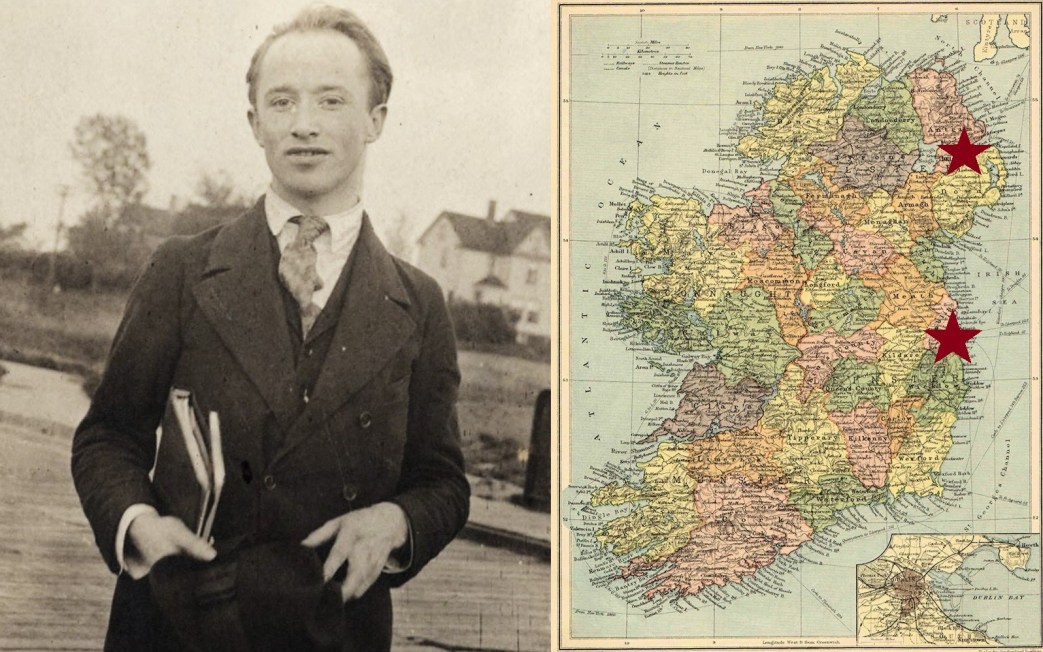
Carney writing just as the War of Independence was beginning on the religion and politics of Ireland’s two main cities, both of which he knew well, Dublin and Belfast. Jack Carney (1887-1956) was born in Dublin, orphaned young and was raised by relatives in Liverpool. There he heard Jim Larkin as a teenager in 1906 and began his life as a socialist. After odd jobs and ‘tramping,’ Carney returned to Ireland to be a founder of the Irish General Transport Workers Union in 1909. He soon moved to Belfast where he worked on the shipyards and edited the ITGWU’s paper, ‘The Irish Worker.’ While in Belfast he worked closely with James Connolly. Emigrating to the U.S. shortly after 1916’s Easter Rising, which he did not participate in, he met his old comrade Jim Larkin in Chicago, and together they produced a short-lived U.S. version of ‘The Irish Worker.’ In Chicago Carney married socialist activist Mina Schoeneman, who would remain his life-long comrade, and joined the I.W.W. and the Socialist Party, becoming one of its paid lecturers. As staff for the Party he moved to Indiana in the late summer of 1916 where he was a lead organizer for Eugene V. Debs’ Senate campaign. After that, Carney moved to Duluth and there became editor of the insurgent Left Wing paper ‘The Truth.’ Carney was an early supporter of the tendency around John Reed that would become the Communist Labor Party, of which Carney was a founder in 1919. After leaving under repression in 1920, Carney moved to Butte, Montana to work with William F. Dunne on that city’s ‘Daily Bulletin; which had similar politics and attitude to ‘Truth.’ From there he went to Chicago, where he worked for the new United Communist Party’s ‘Voice of Labor’ in 1921 and the briefly to California where he edited ‘Western Worker’. Arrested for criminal syndicalism against 1922, he was pardoned and followed Larkin back to Ireland after his release from Sing Sing. There he worked for the Workers’ Union of Ireland and edited ‘Irish Worker,’ then the paper of Comintern affiliate the Irish Worker League. He was a delegate to the Sixth World Congress of the Communist International in 1928 where he presented on Ireland. With the new leadership of Irish Communism developing around Sean Murray and Larkin’s increasing isolation, Carney eventually broke with Larkin and the W.U.I. over the Spanish Civil War and moved to London, where he continued to write and do politics. Jack Carney died in London in 1956 at 69 years old. His wife Mina Schoeneman, an accomplished sculptor well-known for her bust of Debs, passed away in 1974.
‘The Irish Question’ by Jack Carney from The Butte Daily Bulletin. Vol. 1 No. 105. April 25, 1919.
Due to the brave stand taken by the Irishmen and women, Easter Sunday, 1916, the Irish question is in the forefront of world politics. It has been taken out of the field of national politics into the arena of world politics. Therefore at this time, we are going to deal with, hitherto, untouched aspects of the Irish question.
Many people in this country have been led to believe that the only Irish question is the Sinn Fein question. The Irish question in the last analysis is a social question.
Why Ulster Opposes Home Rule.
The opposition of the north of Ireland, while seemingly a religious opposition, is an economic opposition. The men who constitute what is known as the Ulster Unionist council, the backbone of the Ulster opposition, are, in the main, manufacturers, distillers and shipbiulders. These merchants depend upon outside resources for the raw materials necessary to the carrying on of their respective industries. For instance, Workman and Clark depend upon outside sources for steel, etc. Captain Craig, Dunville’s Distillery, for grain, etc. Richardson, Sons & Owden, Stirling, York Spinning Mills and many other manufacturers also depend upon outside sources. The Nationalist party, in the main, represents the agricultural interests of Ireland. The agriculturalists of all countries are firm believers in the tariff. They believe that if they place a tariff on all things coming into the country, they can obtain a better price for their own produce. Therefore, the Ulster manufacturer reasons that if the Nationalists obtain home rule, they will owing to the overwhelming majority of the Irish people being in favor of home rule, pass a tariff law. If such a tariff law is passed, then the cost of production must be increased for those firms that depend upon outside sources for their raw materials. Hence the reason why the northern manufacturers so vigorously oppose the passing of a home rule bill.
Religion As An Issue.
If for one moment you believe that the opposition to home rule for Ireland, by the Ulster Protestant, is a religious objection, perhaps you will explain why it is during the Dublin lockout of 1913-14, the Unionist employers joined hand with the Catholic employers and fought the Irish Transport union? The capitalists of all countries and their holy trinity is profit, interest and rent. Take Belfast for instance, as a religious city, as our English friends tell us. In Belfast you will find poverty and sweating going on, that would shame the devil himself. Belfast is a peculiar city. You can stand in the midst of its slums and see the green sides of the Cave hills in the distance, that seem to beckon you on and say, “Come out of the sordid atmosphere of the slums and taste of the pure air and sniff the sweet-smelling breeze from off the Irish sea.” Belfast is a typical capitalist city. Tremendous factories, warerooms, shipyards, tobacco factories and ropeworks. The Belfast citizen will tell you with pride that they have the biggest linen factory in the world, likewise the biggest tobacco works, ropeworks and shipbuilding yard. They forget to inform you that they have also the most abject poverty and the worst kind of slums. They forget to tell you that girls go to work in the early hours of the morning, bareheaded and barefooted, winter and summer. They forget to tell you that husband and wife both must work in order to obtain a living. One firm gives out work to be done at home. It is the tucking-in of ragged corners of the fine cambric handkerchiefs and stitching them down neatly. This kind of work puts an enormous strain upon the eyes and demands the utmost care with the needles. The smartest worker can sew two dozen per hour. The pay is one cent per dozen. Just think, for eight hours work per day, and six days per week, a woman, an expert stitcher, can earn ninety-six cents per week! The wage account of a widow, with the help of her three boys, who separated the handkerchiefs and threaded the needles, was $1.50 for one week’s work. Another woman had earned $2.64 in two weeks.
“City of Religion. Here are a few instances, briefly given, of other wages paid in this city of “religion”:
Ladies’ blouses, 32 cents per dozen, one hour to a blouse, cost of thread 3 cents per dozen blouses. Chemises, 18 cents per dozen, ten hours for one dozen, cost of thread 3 cents per dozen garments. Men’s heavy cotton shirts, double sewing, 32 cents per dozen, less five cents for thread, thirteen hours for one dozen, rate! of pay two cents per hour.
We are not concerned with a person’s religious beliefs. Every person is entitled to believe what he or she likes. But having lived in Belfast and having heard so much in this country about the religious fervor of the Ulster Protestant, we feel compelled to let the American people know something of the cant and hypocrisy that passes as religion in Belfast. Under the very eyes of every church that you may care to visit in Belfast you will find ill-clothed, half-starved and barefooted children. You will see poverty stamped on the faces of the poor as they walk to church side by side with their employers. All through Belfast the gaunt spectre of poverty stalks. Ask the people about this poverty and they accept it as their natural condition. Their religion is but a rubber-stamp religion. It serves to distract the attention of the workers from the real Source of their poverty and misery. Insofar as Belfast is religious, it is the religion of mammon. It is cheaper to build churches than to pay high wages. Better by far to hear the prayers of the workers than to hear their defiant protests. The employers of Belfast are the living descendants of the Pharisees! Belfast a religious city! You might as well say that Sir, Edward Carson is a pious monk.
Poverty of Dublin.
Now let us turn to Dublin. Dublin is not a manufacturing city, rather a distributive center. Visit the various places of interest and you will hear a story that will transport you to the land of clear delight. A story of old-time battles, of daring escapades and the glorious story of how so-and-so Irish patriot played his part. Dublin to the Irishman and Irishwoman is the city that they like to think of, as the last place they would like to live in. Dublin is of exceptionally historical interest, but Dublin also has its poverty. But whilst the slums of Belfast are a typical product of capitalism, the slums of Dublin are an anachronism. Still they exist and their presence in Dublin is a scathing indictment of the boasted love for Irish freedom and the supposedly possessed love for Ireland by the Dublin employers. As regards the wages and living conditions of the workers, the following extracts from the brilliant and historical speech of Jim Larkin, the fearless and powerful secretary of the Irish Transport union, delivered before a British commission during the Dublin strike, speak for themselves:
21,000 Families Live in Single Rooms.
“Let us take the statement made by their own apologist, (Dublin capitalist). Let us take the statement by Sir Charles Cameron. There are, he says, 21,000 families, averaging five to each family, living in single rooms in this city. Will these gentlemen opposite accept responsibility? They say they have the right to control the means by which the workers live. They must, therefore, accept responsibility for the conditions under which the workers exist. Twenty-one thousand families living in the dirty slums of Dublin, five persons in each room, with, as admitted, less than 500 cubic feet of space. Yet it was laid down that each adult should at least have 300 cubic feet space. In Mountjoy Gaol–where I have had the honor to reside on more than one occasion–criminals (but I am inclined to believe that most of the criminals were outside and innocent men inside), were allowed 400 cubic feet. Yet men who slave and work, and their women–those beautiful women we have among the working classes are compelled to live, many of them, five in a room, with less than 300 cubic feet. They are taken from their mother’s breasts at an early age, and are used up as material is used up in a fire. These are some of the conditions that obtain in this Catholic city of Dublin, the most church-going city, I believe, in the world.
“See at every street corner the mass of degradation controlled by the employers, and due to the existing system. Their only thought was the public house, and, driven to death, they made their way thither to poison their bodies and get false stimulant to enable them, for a time, to give something more back to the employer for the few paltry shillings thrown at them. These are the men whom the employers call loafers. Mr. Murphy has agreed with me that in the main the Dublin worker is a good, decent chap: but Mr. Murphy and others of his class deny the Dublin men the right to work on the Dublin trams, on the Dublin quays, and in the Dublin factories. They deny Dublin men the right to enjoy the full fruit of their activities. Why? Because they want to bring up in their place poor, uncultured serfs from the country, who knew nothing of Dublin or city life–to bring these men into a congested area, so that they would bring down the wages of the men already here. The employers do this because their souls are steeped in crime and actuated only by the hope of profit-making, and because they have no social conscience. But this lockout will arouse a social conscience in Dublin and in Ireland generally. I am out to help to arouse that social conscience and to lift up and better the lot of those who are sweated and exploited. But I am also out to save the employers from themselves, to save them from degradation and damnation.
20 Cents Wages for 10 Days’ Work.
“I can produce a document issued by a Belfast firm who came down to employ Dublin Catholic girls out of sheer philanthropy–the capitalists are all philanthropists! Two of the girls employed by this firm their father having been ill for some time worked for the firm on material that is sold in Grafton street at five dollars an inch. What were their wages for ten days? Twenty cents each! That cannot be denied. No fines, no deductions, total paid, twenty cents. Fancy a girl working for ten days and only receiving twenty cents. Let us turn to Mr. Wallis, who so kindly suggested that I should become his manager. Perhaps it would be as well for his business and for the country generally if I were appointed manager for a time.
Clerks’ Wages $3.50 a Week.
“With regard to Mr. Eason, he was very fair with me. He admits he sent for me. Is Mr. Eason prepared to submit his wages’ book to any people, even to his own class? If he would agree to pay competent clerks and clever dispatch men 20 per cent less than London rates, I will be satisfied. It does not matter to him how many hours men work, and work at top speed, and very few know the weary work of handling newspapers. What about a man with a family getting $3.50 a week in Dublin where house rent is 10 per cent more than in London, and where the cost of living is as 106 to 100? They are paying 50 per cent less wages than in London. Is it any wonder there is unrest? Mr. Eason says it was impossible for him to stop supplying the ‘Independent’ and ‘Herald.’ Let me ask him why he tried to stop the ‘Irish Worker’ or ‘Clarion’?
Girls’ Wages 60 Cents Per Week
“A man is the best judge of his own actions. If he thinks a thing is right he should do it, and when I think a thing is right I am going to do it. After all, character has got something to do with a man. The appearance of a man has got a great deal to do with the man. If a man is doing right he can answer ‘Yea’ or ‘Nay.’ Mr. Healy has claimed that Mr. Jacob is a Quaker There is not a system of working in Great Britain like that carried on by Messrs. Jacob. It is a system of espionage, and in other respects it is a hateful system. The wages paid to women by this firm in 1910 when I had reason first to interfere was 60 cents per week. It was by reason of that fact that I interfered Some of the girl workers’ came to me and informed me that they were forced to work under duress-I like that word to subscribe to Mr. Jacob’s daughter’s wedding present. I replied to them, ‘If you are going to subscribe do so from the heart and not from the pocket under duress.'”
It can be readily seen that even if the peace conference decides to recognize Ireland as a nation that the problem known as the Irish question will not be solved.”
You cannot eliminate the social evils of today by the creation of laws. So long as men and women make huge fortunes out of the degradation of the poor, so long will your laws fail to even alleviate the distress and want of the poor. You must go down deeper. The surgeon who is successful is not the one who dilly-dallies with the wound and applies outside treatment, but the one that sticks in the knife and takes the trouble out by the roots.
A Real Union.
The organization that is causing more concern in Ireland than even the Sinn Fein movement, is the Irish Transport union. A union of workers who have seen through hypocrisy of politicians and who have pulled away the green flag of Erin from off the home rule sweaters and witnessed for themselves the blatant hypocrisy and cant of those that curse the British government and at the same time enslave the Irish workers. They use their anti-British feeling as a cloak to cover their own misdoings. This they did for many years, until a figure stepped upon the streets of Dublin carrying with him a new message, A message of solidarity to the workers and a message of warning to their employers. The bearer of that message was Jim Larkin. Larkin, single-handed, against the most terrible odds that ever a man fought against, worked night and day until he formed a permanent organization of workers in the city of Dublin. The Irish Transport union did not talk about freedom, it set about showing the workers how to obtain freedom. It made real men and women out of the oppressed workers of Dublin. You may ask what has this union to do with the Irish question? It is the Irish question. In a word, the Irish Transport union stands for the complete freedom of Ireland, not like the Sinn Fein movement that only stands for the political freedom of Ireland. Jim Larkin is feared by the British government more than they fear a thousand Griffiths or Valeras. They recognize that behind the words of Larkin and his union, and well might it be called his union, there is a power growing up that will soon sweep Ireland free of its tyrants and make Ireland the free-loving race of people that it was under Gaelic forefathers.
We have had to hurriedly deal with the Irish question. But believe that we have made it clear that the Irish question is a social question. The Irish question is summed up in an able manner by James Connolly in his masterly work, “Labor in Irish History,” when he states: “Irish toilers from henceforward will base their fight for freedom not upon the winning or losing the right to talk in an Irish parliament, but progress towards upon their mastery of those factories, workshops and farms upon which the people’s bread and liberties depend.”
The Butte Daily Bulletin began in 1917 in reaction to the labor wars in Montana, the Speculator Mine fire killing 168 miners; IWW organizing, and the murder of IWW organizer Frank Little in Butte. Future Communist leader and IWW organizer William F. Dunne and R. Bruce Smith, president of the Butte Typographical Union published the paper as an outgrowth of a strike bulletin with the masthead reading, “We Preach the Class Struggle in the Interests of the Workers as a Class.” It became daily in August 1918 and in September 1818 officers raided their offices and arrested Dunne and Smith on sedition charges. An extremely combative revolutionary paper, while unaligned, it supported the struggles of the Left Wing in the SP, reflecting the large radical Irish working class of Butte also supported Ireland’s and the Bolshevik revolution, as well as the continued campaigns of the IWW locally and national as well as the issues in Butte. It ran until May 31, 1921.
PDF of full issue: https://www.loc.gov/resource/sn83045085/1919-04-25/ed-1/?sp=3&q=jack+carney&r=0.109,0.228,0.242,0.119,0#viewer-pdf-wrapper

