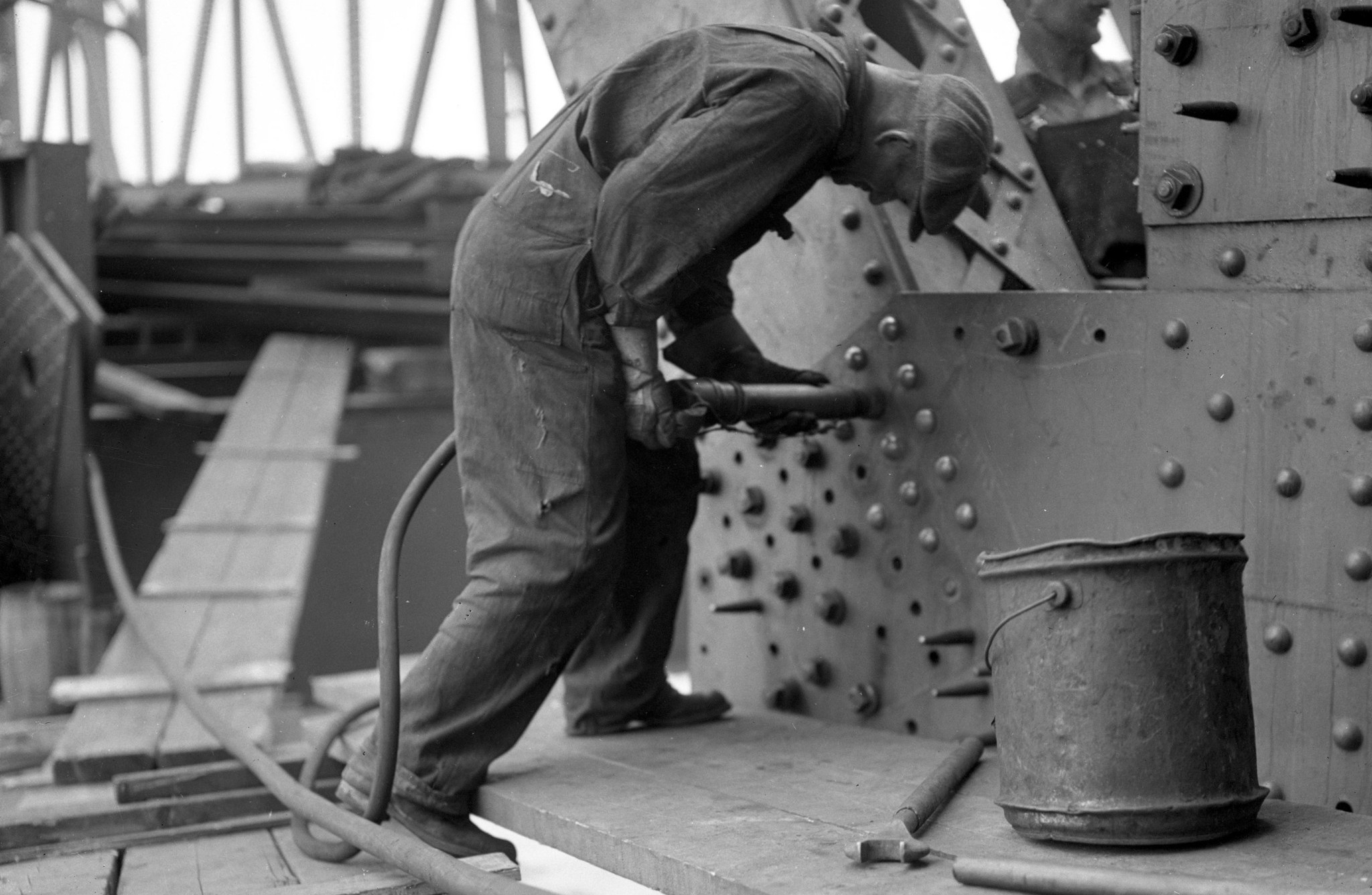
Untold numbers of our class have been felled by poisons at work in illnesses that could have been prevented if profit had not been the overriding motive. Lead poisoning has long been a particular hazard, and often in places not first thought of. A look at the impact on the riveters building New York City’s Triborough Bridge.
‘Lead—The Workers Poison’ from Health and Hygiene. Vol. 3 No. 2. February, 1936.
The poisoning of 50 riveters on New York’s Tri-borough Bridge; the lead hazard in other industries; the effects of lead, and how poisoning can be prevented.
WHEN Mayor La Guardia snips the ribbon at the festive ceremonies which will mark the opening of the New York Tri-borough Bridge next July, no testimonials will be offered to the workers whose bodies were crippled and whose lives were ruined by lead poisoning acquired on the job.
Last year some fifty riveters, more than half of the riveting force working on the job, developed lead poisoning because they were forced to work under conditions which cruelly exposed them to the deadly fumes of molten lead. This criminal exposure of workers to almost certain lead poisoning cannot be excused on the grounds of ignorance, for the same method the riveting of lead-painted beams was used earlier on the Golden Gate Bridge between San Francisco and Oakland, California, with the result that over two hundred riveters suffered the effects of lead poisoning.
On the Tri-borough Bridge, the riveters were forced to work within small enclosures without proper ventilation. The contact of the red-hot rivets with the paint-covered steel beams produce a lead-containing vapor which the workers inhaled. Within a short time, the men developed mild symptoms of lead poisoning, but they continued at work unaware of the cause of their complaints. Only after many serious cases of poisoning developed did they learn the source of the trouble. Riveters who were already suffering from lead poisoning were kept on the job by the contractors and the seriousness of their complaints, as well as the danger of continued exposure to the poisonous fumes, was minimized by the company physicians. Thus the profits of the contractors were protected, since a change of personnel and method of work would have necessitated a delay for which the contractors would have been penalized.
Hearings on the compensation claims of the disabled riveters were disgracefully prolonged and are still in progress. The industrial insurance companies have haggled with the riveters all during this period, taking full advantage of the poverty of these now unemployed workers who, in many instances, have been forced into accepting miserable settlements amounting to a few hundred dollars.
Some of these riveters, suffering from the milder effects of lead poisoning, but still able to work, are prevented from securing employment by a blacklist which is broadcast throughout the construction industries. Most workers are familiar with this vicious instrument used by employers against workers who are active in labor unions, but what is not generally known is that it is employed against workers in those industries dealing with lead products.
Several large lead-refining and smelting companies in New Jersey maintain the practice of weekly blood examinations for the earliest detection of blood changes resulting from lead poisoning–not for the purpose of starting proper treatment immediately, but to avoid, illegally, the possibility of workers’ just compensation claims. Immediately following the detection of the earliest signs of lead poisoning, the worker is discharged, no reason being given, and his record as an early case of lead poisoning is then sent to all possible employers. The blacklist is at work: this worker will never get employment in his field again, and, in most instances, he never learns why.
In Brooklyn, New York, in several storage battery plants where the exposure to lead is particularly great, the same blood tests are given, and with the first sign of lead poisoning, the worker is generously allowed a vacation for a week or two, and, on his return, is told that his services are no longer required. His name is broadcast throughout the industry and his working days in this field are over. Despite the cut-throat competition in their business dealings, employers are united in a program which denies the worker even the meager compensation prescribed by law and which makes it impossible for him to obtain a job in the industry in which he has had training and experience.
Lead poisoning was known and described by early Arabian, Greek, and Roman physicians. In the seventeenth and eighteenth centuries the dangers of lead poisoning were brought sharply to the fore by a common practice among wine merchants. It was found that the acrid taste of spoiled wine could be eliminated if some lead-containing chemical were added to the wine. It was not long before an overwhelming number of deaths occurred from drinking these adulterated wines. The situation became so serious that in several localities the addition of these chemicals to wines was made a criminal offense punishable by death.
Not until the modern industrial age, however, did lead poisoning become a serious danger to the worker. Today, lead is utilized to some extent in a wide variety of industrial processes and the worker must be aware of the hazards of exposure to this metal, the recognition of its effects, and the means of preventing its absorption. A partial list of the lead industries and processes will give some idea of this widespread menace. These are the lead mining, smelting and refining industries; the storage battery, paint, glass and rubber-compounding industries; the typographical trades; the application and removal of lead-containing paints, enamels and glazes, including spray painting; pottery dipping; flame cutting of painted surfaces; and tree spraying with lead-containing insecticides.
***
“The earliest symptoms of lead poisoning are marked constipation, and vague, irregular, and intense abdominal pain (lead colic). The latter has often been mistaken for appendicitis, or disease of the gall bladder.”
Lead may get into the body in three different ways: first, by inhalation of lead-containing fumes and dusts; second, by the swallowing of lead products; and third, in some instances, by absorption through the skin. Experts are agreed that the first is by far the most common and most serious means of producing industrial poisoning. The worker need only breathe in an amount of lead the size of a pinhead every working day and he will have symptoms of lead poisoning within a month or two. Lead-containing vapors and dusts, when inhaled, are readily absorbed into the general blood circulation through the lungs, and lead is deposited in the liver, spleen, kidneys, nervous system, and bones. The ease with which air in the workshop becomes contaminated with lead vapors and dusts, and the rapidity of absorption following inhalation, are the factors which account for almost all cases of industrial lead poisoning.
The swallowing of lead products plays a less important role, inasmuch as there is less likelihood of its occurrence, and the absorption is slow and incomplete. In some instances, lead can be absorbed through the skin. This may occur, for example, with the lead compounds of the type known as “organic,” such as tetraethyl lead (used in “ethyl” gasoline). When this chemical was first used, its dangerous qualities were not recognized, and many cases of serious poisoning resulted before adequate means of prevention were developed. Instances of introducing new processes and methods involving exposure to lead, with little regard to the possibility of harm to the worker, have been only too common in recent times.
A curious form of lead poisoning appears in children who acquire the habit of gnawing and nibbling away at the paint on the crib, other furniture, or toys. After a child has continuously absorbed small quantities of lead from paint for weeks or months, his nervous system becomes affected. Usually, the first warning of poisoning appears in the form of a convulsive seizure, though this may be preceded by abdominal pain, headache, and drowsiness.
This condition is extremely serious; even with the best treatment, permanent damage to the nervous system often results. The importance of prevention is obvious, and the habit which some children acquire of putting all sorts of objects into the mouth, must be overcome by persistent watchfulness and training.
Symptoms of Poisoning
The earliest symptoms of lead poisoning are marked constipation, and vague, irregular, and intense abdominal pain (lead colic). The latter has often been mistaken for appendicitis, or disease of the gall bladder. The appetite soon becomes poor, and there is loss of weight and strength. A constant metallic taste is noticed. The face takes on a peculiar ashen gray pallor as a result of the anemia which develops. A certain sign of absorption of lead is the appearance of the black “lead-line,” a deposit of lead at the margin of the gums. With increasing absorption, there are attacks of vomiting and even more intense abdominal pain. Certain muscle groups, particularly of the forearm, become weak and may become paralyzed. The red blood cells invariably show a change known as “stippling,” resulting from a deposit of granules in the red corpuscles. In addition, the urine contains large quantities of lead. Because of the changes which take place in the blood and urine, careful examination of both should be made whenever lead poisoning is suspected. Nowadays, the more severe forms of poisoning are not so common as formerly, but it is almost certain that there are a large number of mild cases which remain unrecognized, and which, in the end, undermine the health of the worker.
The treatment consists of immediate removal of the worker from all sources of lead and placing him under the best possible hygienic conditions. This means rest, outdoor exposure, proper diet, and an effort to remove the lead stored in the internal organs. The last, known as “deleading,” is a prolonged and difficult procedure, and is in most cases unsuccessful. Lead can remain stored in the bones in fairly large quantities for many years without producing any symptoms. But should an acute illness occur, such as an attack of grippe, or even undue fatigue, chemical changes may be produced in the body which cause a liberation of the lead into the blood circulation. As a result, all the symptoms of acute lead poisoning appear with great suddenness. This is one of the most serious aspects of lead absorption and may incapacitate the worker long after the original exposure. An example of the delayed effects of lead poisoning was reported by English military doctors during the last war when an alarming number of recruits coming from districts where the glazing of pottery was the leading industry developed symptoms of acute lead poisoning after mildly prolonged drilling, despite the fact that they had not been exposed to lead for a year or more.
Prevention of lead absorption can be accomplished only when every effort is made to render factory conditions safe. Adequate ventilation, washroom facilities, and, above all, efficient suction drafts to remove all dusts and vapors must be provided. Wet processes should be substituted for dry ones so that dust can be eliminated. Painters should not sandpaper painted walls nor should they work in enclosures without sufficient ventilation. Lead should be stored and transported in air-tight containers. All lead-working machines must be equipped with proper suction drafts, and pots of molten lead such as are used in the printing trades must be kept under a special suction hood which will prevent the fumes from contaminating the air. Mechanical processes should be substituted for manipulations by hand. Unduly hazardous industrial processes should receive the close attention of engineers and chemists, so that safer methods can be substituted.
Women Susceptible to Lead
Only those men in the best of health should be permitted to work in the lead industries, and women should be entirely excluded, since they are especially susceptible to the effects of absorption, which may cause abortions and still-births. Prolonged exposure to lead, even under the best conditions, is unwise, and workers so exposed should be shifted at reasonable intervals to other types of work, preferably outdoors.
The importance and effectiveness of even such simple measures as preventing dust and fumes from accumulating is shown by the fact that a survey of one unusual English pottery in 1924, where such precautions were enforced, failed to reveal a single case of lead poisoning. Contrast this with the findings of the Public Health Service in the lead mines of Utah and Colorado where no precautions against dust accumulation were observed, and where examination showed two out of every three workers to be poisoned. The most careful medical supervision for all workers in lead industries should be insisted upon, for only by thorough and frequent examination will the tragedy of advanced lead poisoning be avoided.
Prevention of Disease
Much has been written about occupational diseases, but very little has been done to prevent their occurrence. Only eight states have set up bureaus for the prevention and study of industrial disease, and of these, two have discontinued the bureaus during the depression. Those bureaus which still operate are of little or no value to the worker, since only the employers and state authorities are represented on them, and their chief function is to furnish the employer with hints on how to lower his industrial insurance rates. In Connecticut, every physician must report the cases of industrial disease which he is called upon to treat, but this information must be kept secret, and the records and findings of the Industrial Disease Bureau cannot be used by the worker for collecting his just compensation. Employers allow the health authorities to examine those parts of the plant where conditions are the worst only with the provision that the findings will be kept confidential.
Industrial disease can and must be eliminated. One step in that direction is for the trade unions to demand labor representation on the industrial disease bureaus so that these bureaus may become a real force in eliminating occupational disease and in protecting the workers’ health. It is also imperative that trade unions incorporate as an integral part of all collective bargaining demands for healthful working conditions.
Health was the precursor to Health and Hygiene and the creation of Dr. Paul Luttinger. Only three issues were published before Health and Hygiene was published monthly under the direction of the Communist Party USA’s ‘Daily Worker Medical Advisory Board Panel’ in New York City between 1934 and 1939. An invaluable resource for those interested in the history history of medicine, occupational health and safety, advertising, socialized health, etc.
PDF of full issue: https://www.marxists.org/history/usa/pubs/health/v3n2-feb-1936-health-hygiene.pdf

