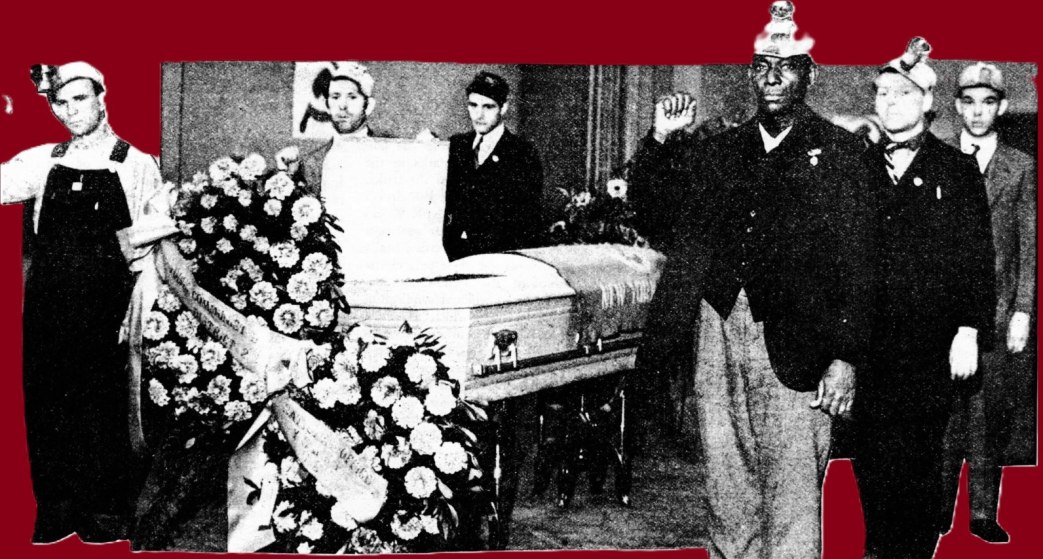
Harry Simms writes from ‘Bloody Harlan’ just a month before his murder by the operators’ gun thugs. Simms was a Young Communist League activist originally from Springfield, Massachusetts sent to the south to help organize the National Miners Union in Kentucky and Tennessee during the 1931-1932 NMU strike there. On February 10, 1932, Simms was shot by a sheriff’s deputy and mine guard as he walked along the railroad tracks to a food and clothing distribution meeting. Badly wounded, Simms was left bleeding in front of the town hospital which refused to treat him without guarantee of pay. He died the following day; comrade Simms was 20 years old. 25,000 people attended his funeral in New York City. ‘The Death of Harry Simms’ a folk song written by Jim Garland and ‘Aunt’ Molly, who knew Simms and were in the area when he was killed, was later made popular by Pete Seeger.
‘The U.S. Working Class Watches Kentucky’ by Harry Simms from The Daily Worker. Vol. 9 No. 4. January 5, 1932.
HUNDREDS of thousands of workers have their eyes fixed on the coming strike of Kentucky and Tennessee miners against starvation and terror on January 1, under the militant leadership of the National Miners Union.
The workers of the South have a special interest in this struggle. The well known facts of the Harlan and other fields here are typical though a bit worse than the conditions of the industrial southern workers and particularly the miners. It is the first real large scale strike to take place in the South under the leadership of the revolutionary unions of the Trade Union Unity League, since the Gastonia struggle, against misery and starvation.
A few words suffice to show the conditions, Men working every day in the week yet not a crumb of bread in the house. Scores of children dying daily of the dread starvation disease “flux”, and hundreds more unable to go to school because of their nakedness. Company prices are 100 per cent higher than elsewhere. Every miner’s paycheck shows a big list of deductions and a round “0” at the end of his statement or maybe he owes the company money for working. Many haven’t seen a red cent in months.
The terror regime in Harlan, Ky., is so brutal and open that even the bosses’ own vile sheets are forced to admit that “lawlessness of the law”—kidnapping, brutal cold-blooded murder and hundreds of jailings of militant workers is the order of the day for Sheriff Blair and his gun thugs hired by the “respectable, upstanding coal operators.” Thousands of Negro miners are forced to work under the gun and endure the same conditions as the white miners. Side by side, they work with them in the hell holes and side by side they and their families are slowly starving to death under the starvation rule of their common enemy, the boss class.
The miners are determined to win in spite of the threats and actions of the operators and their tools. Already over 12,000 are lined up in the N.M.U. Men and women, young and old, white and Negro, children, and all are preparing solidly for January 1.
The Kentucky miners have a responsibility before the American working class. They stand ready, every man, woman and child, to fight to the bitter finish against the feudal starvation terror system. They lead the fight of the southern workers. Upon their struggle will hinge a great deal of the future of the class struggle of the South. They are organizing solidly—some places openly, others secretly. Significant is the welcoming in open, brotherly fashion of Negro miners into the ranks of the National Miners Union and the strike in the struggle against the common enemy, who oppresses all workers—the coal operators.
Negro workers sit on the leading bodies of the union and all leading committees beside their white comrades. It shows that the poison prejudice which the bosses have put into the white workers’ minds can be broken through militant organization and struggle against the boss class.
The Kentucky and Tennessee miners will do their share—fighting not alone, the companies’ starvation and eviction plans—but the murderous gun thugs and government tools and other stool pigeons of the operators. The American working class expects much of these Kentucky toilers, born and bred in the hills and hollows of that historic battle ground.
They will not be disappointed. The Kentucky miners, too, depend on and count on the unfailing support of the entire American working class, white and Negro, to aid them in their struggle.
The Kentucky miners and their families are counting on the support of the broad masses of this country to help them win their fight for better conditions and against the terror reign. Relief will be needed from the first day of the strike. Miners now working are starving—the minute they quit starvation faces them. Many may be evicted—though not without a fight—but they must be provided with tents. Many have no shoes or clothes to go on the picket line.
The Daily Worker began in 1924 and was published in New York City by the Communist Party US and its predecessor organizations. Among the most long-lasting and important left publications in US history, it had a circulation of 35,000 at its peak. The Daily Worker came from The Ohio Socialist, published by the Left Wing-dominated Socialist Party of Ohio in Cleveland from 1917 to November 1919, when it became became The Toiler, paper of the Communist Labor Party. In December 1921 the above-ground Workers Party of America merged the Toiler with the paper Workers Council to found The Worker, which became The Daily Worker beginning January 13, 1924. National and City (New York and environs) editions exist.
PDF of full issue: https://www.marxists.org/history/usa/pubs/dailyworker/1932/v09-n004-NY-jan-05-1932-DW-LOC.pdf

