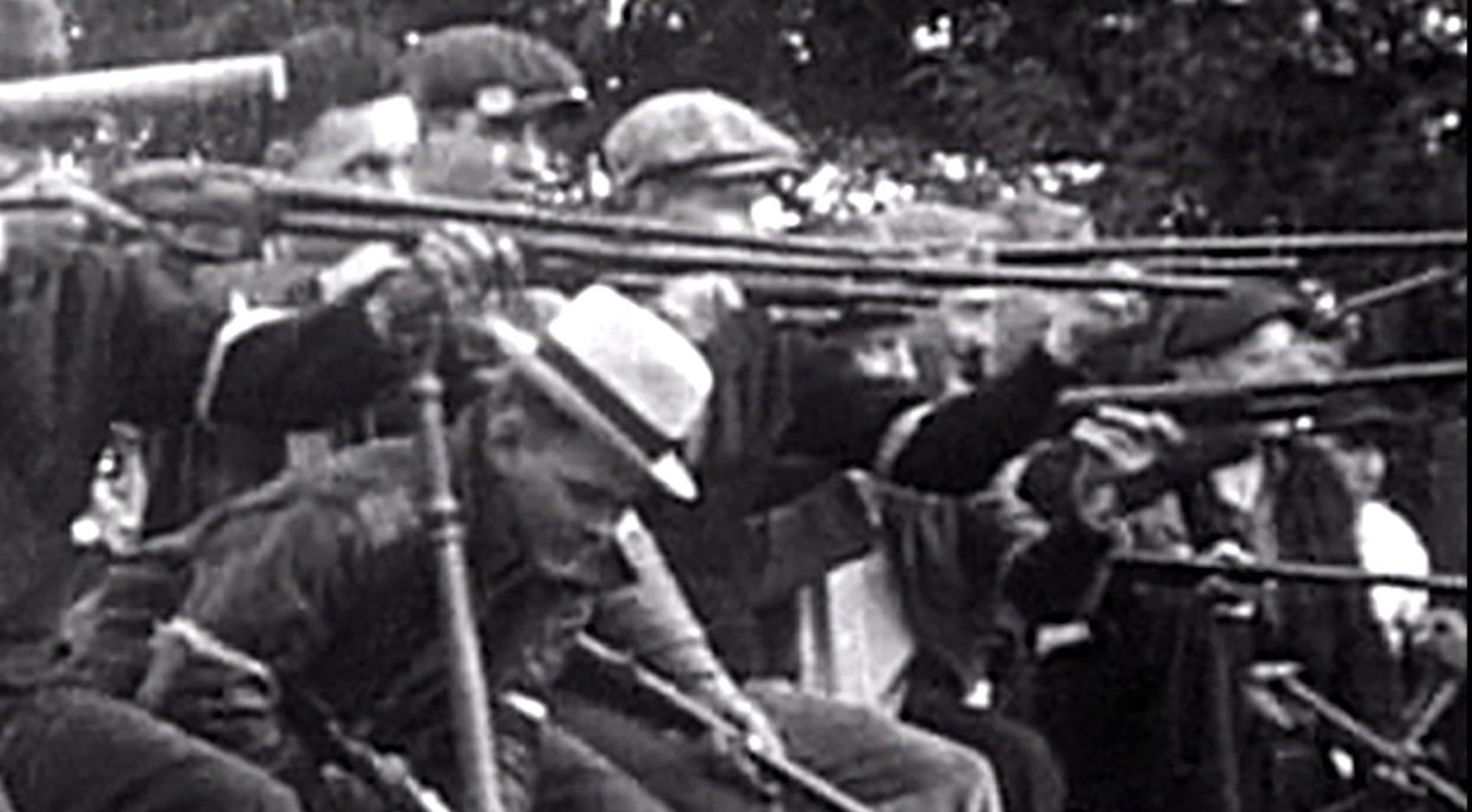
A generation before Kent State, the entire working force of the city of Kent, Ohio answers–squirrel guns in hand–when armed guards attempt to break scabs through picket lines of an injunctioned local of the Machinists striking against the Black & Decker Co.
“Inciting to Riot” by Sandor Voros from New Masses. Vol. 20 No. 1. June 30, 1936.
Kent, Ohio. The plans had been laid carefully following the usual pattern: First, an injunction against mass picketing. Next two truckloads of “guards”—assorted thugs from Cleveland, Pittsburgh and points East. Then an assault on the picket line, a burst of gunfire, a barrage of teargas bombs, warrants against the wounded strikers and union officials for “inciting to riot,” followed by a couple of days of simulated industrial activity inside the plant. Finally, the grand climax. The strikers, their morale broken, abandoning their union and slinking back to work, Blacklisting of the most militant and best union men, the rest eager to accept whatever terms the management of Black & Decker Electric Co., Kent, Ohio, manufacturers of fractional horsepower motors, chose to offer to them.
Then something miscarried. The injunction had been granted as per schedule at the end of May, some three weeks after the outbreak of the strike. It had been issued against Local 1203 of the International Machinists Association, which was leading the strike of the 400 men for a 10 percent increase in pay. Shortly after, a score or more strikers were arrested for violating the injunction against mass picketing and hauled into court.
The first indication that something might go wrong with the plan came at the trial when the judge, sensitive to the high community feeling, felt compelled to dismiss the arrested on the ground that it was impossible to establish that out of the hundreds gathered in front of the plant these were the men guilty of mass picketing.
Disregarding the hint, the company proceeded with the plan.
On June 18, six A.M., two huge moving-vans full of “guards” appeared out of nowhere in front of the gates. The heavy iron chains stretched across the entrance by the strikers were removed before the twenty-odd sleepy pickets in tents across the road clearly realized what had happened. When they ran over to investigate, operation No. 3 occurred. The “guards” inside the vans opened up with a burst of gunfire and a barrage of teargas bombs. Seven pickets were shot by point blank charges, the rest of them choked and blinded by gas fumes. The “guards” entered the factory triumphantly. Everything was perfect.
Company officials inside the plant congratulated themselves. The old and tested formula had once again proved a success. Now to stimulate a little activity and end the strike soon.
They rejoiced, but not for long. As they were soon to learn, Kent, just 12 miles outside of Akron, has not failed to absorb the lessons of the Goodyear Rubber and the Barberton Insulator strikes. The workers in Kent, too, had a plan. It hadn’t been as carefully worked out and calculated as far in advance as that of the company.
There is good squirrel hunting around Kent and its citizens have lived with their constitutional right of keeping firearms. In less time that it takes to tell, the embankments around the factory have been occupied by men out hunting—but not for squirrels.
Reinforcements came on the double quick from nearby factories. There was no official declaration of general strike, but workers in the Twin Coaches Company, The Lamson Sessions Company, the Gougler Machine Company, the principal plants in this small Ohio town of 8,500 population all dropped their tools, grabbed clubs, blackjacks and whatever else was handy and rushed to the “front.”
The aim of the men was good. Aided by high-power binoculars they let loose with a charge on anything that moved.
The “simulated activity,” always an effective ruse to dampen the spirit of the strikers, came to a halt before it began. Slugs were whizzing by with deadly aim for taking chances on moving ground. A few direct hits were scattered. A charge smashed the hips of one of the “guards.” The arm of another was shattered. A third was wounded in the abdomen. The “guards” threw themselves on the ground, hugging the cement floor, too frightened to raise even their heads. They had two machine guns, plenty of sawed-off shotguns, revolvers, gas bombs, but the workers entrenched in strategic vantage points along the embankments had the drop on them.
The “guards” were not given a chance to bring their machine guns into play. Besides, they were too frightened even to try.
A physician approached the gate, summoned by telephone from inside to attend to the wounded thugs. He was refused entry.
“They are wounded in there—” the physician pleaded.
“They asked for it, we didn’t. Now they got what they asked for,” he was told grimly.
“This is war!” another told him with finality. The wounded would be cared for later.
Company officials pleaded frantically through the telephone for help. They called for troops, for ambulances. “Send in a couple of machine guns in the ambulances,” they suggested delicately.
Then the wires were cut and communication with the outside world was stopped.
With their quarry foe hidden from view, the marksmen looked for other targets. The 150 foot water tank was riddled with bullets and transformed into a spouting fountain. Windows were peppered. The moving vans left standing on the grounds were shot into sieves.
After long negotiations two ambulances were permitted to enter to take out the three most seriously wounded thugs. Before entry, they were searched from the springs up for hidden weapons by the swollen army of pickets, many of whom acted like military police, carrying clubs, blackjacks and some even sporting steel helmets.
The climax came later in the evening.
Under the pressure of an organized army of ten thousand union men and sympathizers from Akron, Barberton and the surrounding territory, that literally swamped this small town, the marshal and his force disarmed the “guards” and arrested them for “inciting to riot” on John Doe warrants sworn out by the strikers,
The triumphant yell: “Here come the rats,” could be heard for miles as the “guards,” escorted by a convoy of union men, were taken to the city jail.
Labor in the 14th Congressional District once again had given a demonstration of the new spirit, of the new growth of unity and solidarity that is beginning to permeate labor throughout the land. As in the case of the Barberton Insulator and Akron Goodyear strike it served notice once more on the employers and authorities that vigilante methods, terrorism and violence would not be tolerated but summarily dealt with. In Barberton, last November, they had forced “military sheriff” Jim Flower to evacuate and close down the Insulator plant and admit publicly that responsibility for “disorder, violence” would rest on the company if it persisted in operating its plant with scabs.
It took labor in Kent, however, to place legally the responsibility for “incitement to riot” where it rightfully belongs—on the management and its hired strikebreakers. “It was all a mistake,” said Mr. S. Duncan Black, president of the Black & Decker Company. “The men who, they thought, were strikebreakers entering the plant were deputy sheriffs, sent there to keep order.”
“Oh, yeah?” answered a striker. “We are keeping order here now. There was order here before and order there is to be, unless they are going to try to pull another fast one on us.”
“Their kind of ‘order’ don’t go with us here,” answered a third striker amid much laughter from the surrounding crowd.
The New Masses was the continuation of Workers Monthly which began publishing in 1924 as a merger of the ‘Liberator’, the Trade Union Educational League magazine ‘Labor Herald’, and Friends of Soviet Russia’s monthly ‘Soviet Russia Pictorial’ as an explicitly Communist Party publication, but drawing in a wide range of contributors and sympathizers. In 1927 Workers Monthly ceased and The New Masses began. A major left cultural magazine of the late 1920s and early 1940s, the early editors of The New Masses included Hugo Gellert, John F. Sloan, Max Eastman, Mike Gold, and Joseph Freeman. Writers included William Carlos Williams, Theodore Dreiser, John Dos Passos, Upton Sinclair, Richard Wright, Ralph Ellison, Dorothy Parker, Dorothy Day, John Breecher, Langston Hughes, Eugene O’Neill, Rex Stout and Ernest Hemingway. Artists included Hugo Gellert, Stuart Davis, Boardman Robinson, Wanda Gag, William Gropper and Otto Soglow. Over time, the New Masses became narrower politically and the articles more commentary than comment. However, particularly in it first years, New Masses was the epitome of the era’s finest revolutionary cultural and artistic traditions.
PDF of full issue: https://www.marxists.org/history/usa/pubs/new-masses/1936/v20n01-jun-30-1936-NM.pdf

