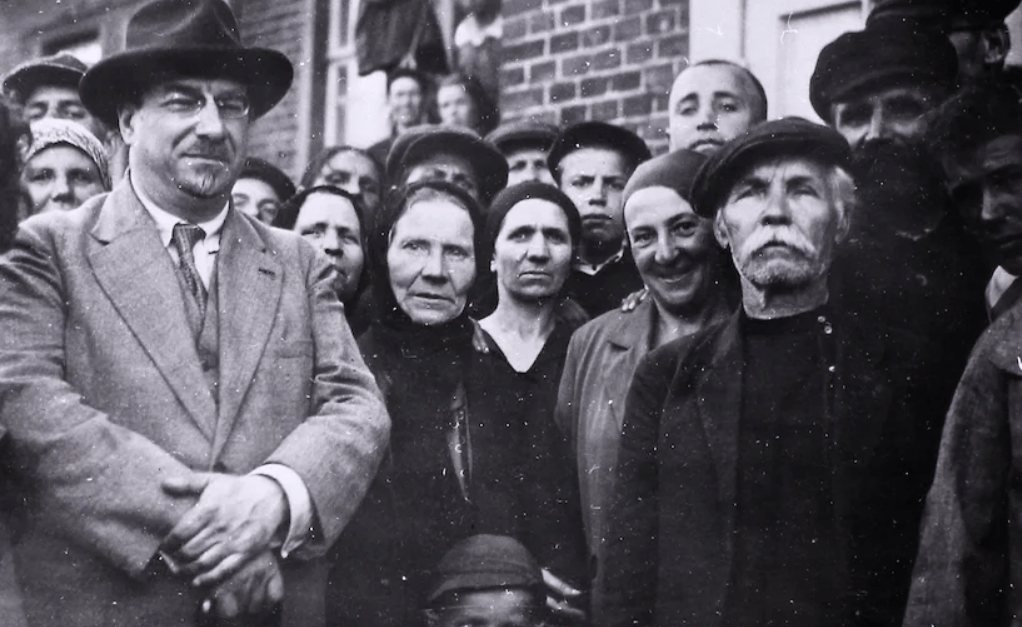
The uncommon Commissar for Education with a three-part telling of the ideas, obstacles, and implementations in the first years of Soviet Russia’s truly revolutionary system of universal education.
‘Public Education in Soviet Russia’ by Anatoly Lunacharsky from Communist International. Vol. 1 Nos. 2, 4, & 6. 1919.
Aiming at the systematization of every and all state functions, the Soviet has fundamentally changed the competence and character of the government organ that under the old regime bore the name of Ministry of Public Education.
1) This ministry formerly confined its activity chiefly to schools. A whole series of highly important cultural institutions were beyond its reach, even though they were purely state institutions. Thus the state theatres were under the management of the Court Ministry, the theatrical high-school of the Academy of Arts. The Musical Department was managed by the imperial Musical Society that, strangely enough, was under the control of the ministry of Internal Affairs. Thus the artistic education of the growing generation and, in general, the regulation of the relations between the state and the world of art did not come within the sphere of the ministry of Public instruction.
In Soviet Russia these tasks are part of the activity of the Commissariat of Public Education; to which is attached a special art section.
2) The steadily growing tasks of the state, as well as the difficulties that private, public and, lastly, state publishing business in Russia meets with at present, has induced the Soviet to create a special organ which would regulate the whole flood of literature, would in view of the shortness of paper choose the most necessary books among those intended for publication, superintend the very process of publishing and, finally, regulate the distribution of printed matter on a socialistic basis.
According to the plan adapted by all the state institutions concerned and laid for approval before the All-Russian Central Executive Committee, the aforementioned organ is to form an integral part of the Commissariat of Public Education.
Such an extension of the idea of public instruction to art and the publishing of literature will greatly enlarge and systematize the educational tasks of the government. But yet another great difference exists between the Commissariat of Education and the former ministry.
3) By its very spirit the Tsar’s Ministry of Public Instruction was not so much concerned about the promotion of education in Russia as to try to hamper it by all possible means, in order that this stream, indispensable though it was to the then government, (much to its regret), should not overflow its banks. Yet the military and economic development of Russia sternly put forth the most imperative demand for a supply of educated men. Therefore, under the pretext of founding special schools, a number of government offices formed their own little ministries of public instruction where life was sometimes more pleasant than under the heavy fiat of the Tsar’s ministers. The Ministries of Finance, of Commerce and Industry and of Agriculture harboured a great number of schools of an essentially higher type than the normal ministerial ones. The war Ministry did the same. And however strange it may seem, even under the auspices of the Holy Synod some units of educational interest grow up, notwithstanding the despicableness of the whole net of so-called clerico-parochial schools; the normal type of clerical school, the parochial girl’s school and other institutions for crippling children.
The necessity for such specialisation completely drops out in Soviet Russia. By decree of the Council of People’s Commissaries all the little ministries of public instruction in the other commissariats have to be liquidated, and the affairs of public education in its most general and widest sense are gradually going over to the Commissariat of Public Education.
4) In the Russia of compromises, in the epoch between February and October there was a tendency to hand over all the schools that had no exclusive state Importance to the local government organs.
For even in Tsarist Russia, under the frequently unbearable supervision of the ministry, the municipalities, in particular the county councils, were burdened with a large part of the primary public education and were already proceeding to organise their own higher education. This tendency was cut short by the October revolution. The schools are, of course, under the immediate management of the local councils, i.e. the district, province and town departments of public education, but they are developing within the compass of the general regulations as drawn up by the Commissariat. The schools in Russia are not municipal, but national ones, just as the soviets in Russia are no organs of self-government as contrasted with the central governmental power, but parts of that power which in its whole realises the self-government of the working people.
5) The abolition of all school fees has made private schools in Russia an impossibility. Not that the Commissariat of Public education is interested in cramping private initiative and cutting down all schools to one general pattern; but diversity of school life has henceforth to be attained within the state schools, since, the fees being abolished, the government alone is able to keep up schools.
Thus, nowhere in the world has the Commissariat of Public Education so great a task and so wide a competence in questions of cultural structure as in Russia.
At the close of this chapter that is meant to give a general idea of the mechanism regulating the state function of public education, I wish to enumerate the chief departments, the sum total of which form the Commissariat.
At the head of the Commissariat stand the People’s Commissary and assistant Commissar. They are both members of the board of eleven at whose sittings all questions of any importance are decided. According to a recent decision of the board the most important matters are discussed by an extended body, representatives of the Petrograd District Board participating with right of vote. This decision has been brought about as a result of recognizing the particular importance of a centre like Petrograd from the point of view of cultural development.
Lastly, questions of principle previous to being sanctioned by the highest legislative body are discussed by the so-called State Committee for public instruction with the participation of representatives from various state institutions directly or indirectly interested in the work of education.
The whole wide sphere of activity of the Commissariat is divided into several sections: education, science, art. But some departments do not come within the competence or any of these sections.
The section for education comprises in the first instance one huge department of uniform schools that consumes the greater part of the whole budget. Theoretic questions connected with one or the other school-reform are decided by the department for school reform. Further there belong to the section the departments of technical schools, of pre-school education, of out-of-school education and the department for the training of teachers.
The Science section consists of the department of science managing the scientific societies, the department of higher educational institutions and the library department.
The Art section is composed of the departments of fine arts, of the protection of monuments, the musical, theatrical, state publications and kinemotographic departments.
The financial, building, stores school equipment and the and management departments of the Commissariat stand outside of the se sections.
The work of the Commissariat is enlivened by continual conferences. The most important ones that have taken place till now are: the All-Russian Congress of Representatives of the Public Education Departments, i.e. of the Province and District Education Boards; the chief task of the Congress was to definitely establish the principles of a uniform type of proletarian schools. The All-Russian Conference on, the Training of Teachers. Two conferences of teachers-internationalists. The conference of representatives of Province Departments. The All-Russian Conference of Representatives of the Sub-departments on Out-of-school Education. The All-Russian Conference of Museum Workers (in Petrograd). Two All-Russian Conferences on the Reform of High-Schools. At the present moment an All-Russian Congress on Pre-school Education is sitting in Moscow. For the fifth of May an All-Russian Congress on Out of School Education has been summoned, for May 15th an All-Russian Congress on the question of theatres for peasants and workmen. Besides these there are hundreds of provincial and district conferences, called in Moscow, Petrograd and other centres of Soviet Russia.
The Commissariat of Public education has a great many various subsidiary commissions and committees of experts. The most important of them is the State Education Council that has been entrusted by the Central Executive Committee with the reform of colleges and universities in Russia. The Council consists of 5 members appointed by the All-Russian Central Executive Committee and 5 appointed by the Commissariat of Education. The People’s Commissary of Public Education acts as chairman of the Council.
In view of the acute food crits experienced by this country, it became an urgent necessity for the Soviet to do the utmost towards saving of children. For this purpose the Council of People’s Commissaries formed a special Council for the Protection of Children composed of responsible representatives of the Commissariats of Social Insurance, of Labour, of Health and of Food-Supplies and with the People’s Commissary for Education as chairman. One of the functions of the Council for the Protection of Children is to remove the children from famine districts to distant colonies, i.e. in the Ukraina, on the river Volga and so forth.
Such is the construction of the Commissariat of Public Education in its general outline.
In the following I wish to point out the fundamental characteristics of the reforms, or rather, revolutionary changes the Commissariat is carrying through in various spheres of its activity.
Petrograd, end of April 1919.
*) A decree has now been issues and is being carried through that provides for the feeding of all children in the Russian Republic up to the age of 14 At the cost of the Slate.
II.
The revolutionary work of the Commissariat for Public education follows four principal lines: school reform, the creation of an almost completely new school extension and elementary school system of public education as well as a general administration of not so much the artistic creation of the country as the process of acquainting the masses with the treasures of art and of educating them to artistic work.
The chief place in the sphere of school reforms is Occupied by the idea of a Uniform Labour School, according to which all children, independently of their extraction of the financial means of their parents, enter the same school. Lower and middleclass educational institutions exist no longer in Russia. There exists only two grades of the Uniform School: one for children of from 8 to 12 years and the other for young persons of from 13 to 16 years.
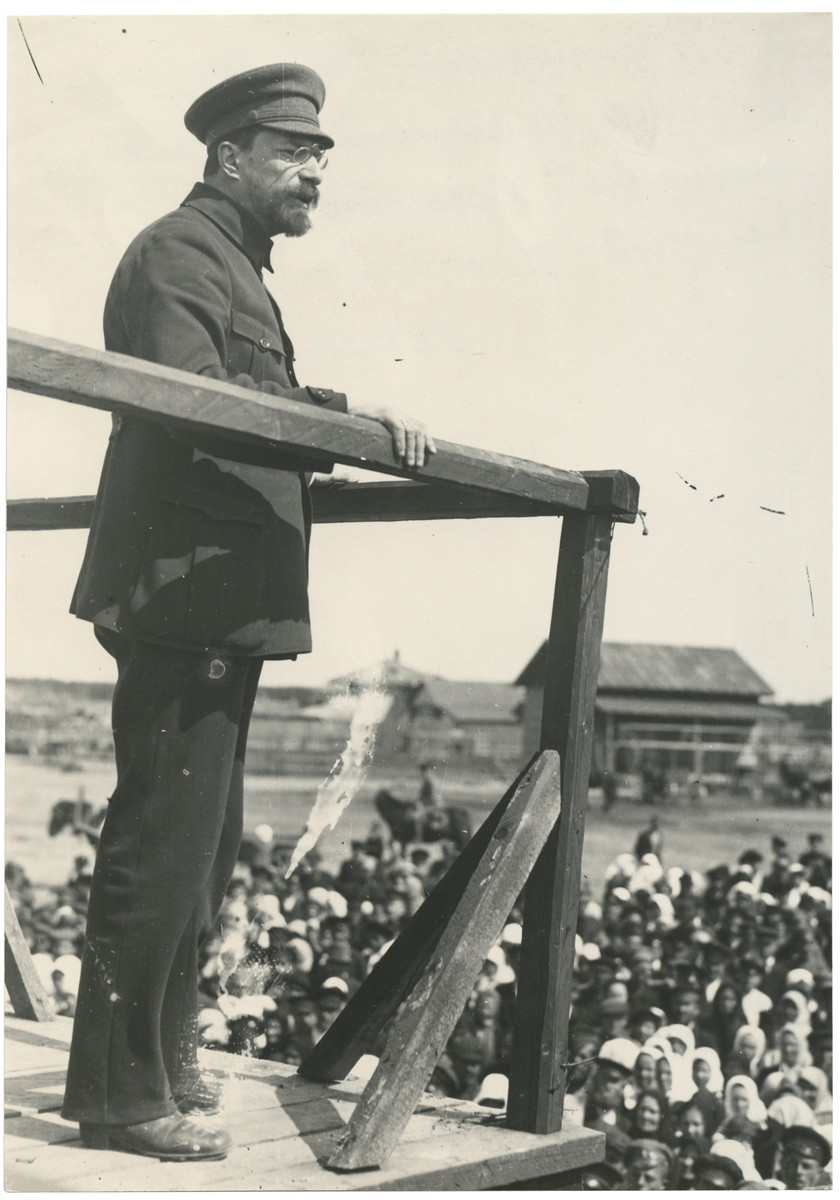
In this manner, the class character that belonged to the School of the past has been completely abolished.
It is also understood that the boy or girl of 17 years of age, who has completed the second grade school, is free to enter any other Special Higher School.
It goes without saying, that until this ideal has been realized, i.e. until we have secured the possibility for the mass of the younger Russian generation to pass through all three, grades of school, we will have many difficulties and obstacles to overcome.
We must remember that a natural condition to the proper working of the Uniform School is that education is open to all. This principle of general accessibility to the Schools was proclaimed by the People’s Commissariat for Education in the decrees on obligatory elementary education, the abolition of all fees to absolutely all schools within the boundaries of the Soviet Republic, the distribution of gratuitous lunches to the scholars, the supply of all primers and school-books by the state, and the distribution of clothes and books to those of them whose parents were themselves unable to afford them.
At the same time, the state endeavours to widen the circle of boarding-schools and, without in any way trying to dislocate family life endeavours at all events to keep pace with its natural disintegration and, so to speak, without interposing itself to take those children who no longer fit into the frame. This process has been hastened to a high degree by the impoverishment of the masses by the war.
The attitude of the state towards the tasks undertaken by it is in the highest degree conscientious, but it is hardly necessary to say that the realization of these tasks meets with almost insuperable obstacles.
Let us glance at the State Budget. The general budget of the People’s Commissariat for Education during the first half of 1919 reached a sum of six and a half millions which makes all 13 millions a year, provided that the sum the current half-year is not exceeded.
Taking into consideration a degrease in the purchasing value of the roubles at 15 times, which more or less corresponds to facts, on an average we shall arrive at an annual budget of the People’s Commissariat for Education, calculated on the basis of the old silver rouble and its normal purchasing value, at more than 800 million robles, as against 280 millions which was the maximum expenditure made under the regime of the Czars. In this manner State expenditure on Education is three times greater than previously. If, however, we calculate at the nominal value of money may say that the endowments of State for Public Education have been augmented 45 times.
Of course, even a State bounty of this kind cannot correspond to actual requirements, if we consider normal development of the school system and the principle of complete, compulsory education for all children of the Russian Republic, is true of course that the school system is growing fairly quickly in spite of all the annoying conditions of disorganization. At the present time exact figures cannot be given, but in reports submitted up to January of the current year, figures which, at, the present time, are of course no longer up to date, 10,00 new schools of the first grade and about 1,000 schools of the second grade are mentioned.
Exact information in regard to the city Kostroma which is, certainly, one of the most favourably situated, is the following.
In 1916 in the elementary town schools there were: 81 teachers and 3600 scholars; in 1917 and 1918 145 teachers and almost 5,000 scholars: in 1918 1919 280 teachers and 6479 scholars. The number of scholars in first grade schools has increased by 79%, and teachers by 245%.
The principal obstacle, however, is not the lack of funds, but the impossibility of purchasing school books, boots and clothes, often the impossibility of organizing the [word missing] to satisfy the purpose for which they are intended.
Almost all the Government branches of Public Education have a surplus of funds for this first half-year, owing, of course, not to the excessiveness of their grant, but to the extreme shortage on the market.
Before the advance of Kolchak and at a time when America entered into flirtation with Soviet Russia, one prominent Anglican social worker entered into consultation with us in regard to the delivery of children’s boots and school supplies from America. My conversation with him convinced me that the establishment of commercial relations with America would mean a very rapid development of the Russian school towards the complete achievement of its ideals.
It goes without saying, that together with the general accessibility to an absence of fees for education, the People’s Commissariat for Education also realized two other demands not only of socialist but, also of liberal pedagogy, namely that the school should be secular and that there should be mixed classes of both sexes.
The abolition of Bible teaching from the school curriculum naturally evoked a little dispute, but not so much as one might have expected. I cannot but mention one extremely characteristic incident. The law permits private teaching of the Gospel by priests in private school. Now, it is interesting that such teaching is being carried on scarcely anywhere. I will mention another Act which illustrates this incident: in the Galicinchy district of the Kostroma government, according the information in my possession out of 150 villages with schools, there are only 13 in which private instruction in the Gospel in given.
How is this astounding fall in religions teaching to be explained? It is to be explained by the fact that the priests, in spite of all their orthodox ardour, have refused to teach the peasant children for nothing, whilst the peasants themselves, in spite of all their partiality for the prevailing religion, have refused to pay money for the teaching. We may affirm, therefore, with certainty that the coming generation will grow up completely liberated from all religious prejudices.
Two words about mixed classes. In various parts of Russia various methods of instruction have been followed. The Petrograd method consists firstly in making female educational institutions open to boys and male educational institutions open to girls, secondly, to accept into the lower classes an equal number of both sexes.
The Moscow method instruction consists in dividing each school in halves and joining the male half to the female. As far as I am able to judge the more circumspectal and gradual method of Petrograd has proved to be the more successful and has not called forth that number of reproaches which, at times, as it appears (I base myself on information of Communist parents) are not altogether unfounded.
Much more substantial, however, is the principle of the Labour School. The People’s Commissariat for Education has wholly accepted the principle of the labour method for all subjects of general normal education. For the moment I shall not dwell upon this. In this connection the People’s Commissariat for Education follows in the steps of up-to-date schools, such as are being formed in Scandinavian countries and in America.
But the People’s Commissariat for Education considers it by no means sufficient for the organization of the Labour School merely to introduce the Labour methods of instruction. It attaches a much larger importance to introducing into it the instruction of labour itself.
We have not merely in view lessons of what is known as manual labour, although we do not deny their usefulness in training the hands, eyes and attention.
In introducing the labour principle in the school we have in view rather the idea of the school maintaining itself in proper working order by its own means, namely the work required to keep everything in order, mutual aid in satisfying the petty requirements of the school-fellows, light repairs in the school, work in the garden and in the cultivation of vegetables, the breeding of animals, the preparation of food and so on. All this must serve at one and the same time as a means of amusement, light but serious work and as a means of conveying visible, perceptive lessons. As Doue quite justly observes,–one lesson in the preparation of mere food can serve as the fundament for a whole encyclopcodia of knowledge.
Self-maintenance plays a more of less dominating role in the first grade school: in the second grade school we consider much more important not the inculcation of work in the school, but the inculcation of school in the process of social labour.
We do not mean by this the excursions made to factories, post and telegraph offices, railway centres and so on, such as are being adopted at present by all new schools.
Having all this in view, and wishing always to acquaint children with various kinds of social labour, we consider it necessary that children should be not mere observers of these processes, but should really work for a certain time in each of such branches, making themselves participators in it to the extent of their ability.
All this work must be connected with general scientific fundamentals so that in the end an all round technical education is received.
We are extremely in favour of a polytechnical education up to the age of 17 years. The People’s Commissariat for Education tries to avoid specialization up to the age of 16 years, although it recognizes that a not too pronounced specialisation is possible after the age of 14 years.
The main obstacle to school reforms in this well thought out, and for every modern teacher exceedingly desirable direction, is the lack of means of which the Russian market disposes. The second difficulty is the extreme unpreparedness of the teaching staff. Here we are faced, firstly, with a low cultural level of the teachers, artificially fostered under czarism, secondly with the apathy of the teachers, who are as it happens very rarely interested in the labour processes of the industrial life of the country, thirdly, the routine nature of work which has predominated particularly, it would seem, amongst the more highly cultivated section of the teachers, precisely amongst teachers of the second grade school, i.e. the late teachers of the middle educational institutions.
In regard to the first obstacle we are deprived of the possibility of meeting it, and all measures undertaken by us serve only as palliatives, until the political victory of Russia will have opened up our frontiers.
We conduct the struggle against the second difficulty by giving close attention to reforming the institutions which train new teachers and by means of an innumerable number of practical courses.
With incomplete statistics it is difficult for me to indicate the exact number of such courses over the whole of Russia since the Commissariat has been in existence, but I have in my possession one highly indicative fact: during the summer of last year (for the present year I am still without figures) in one of the so-called northern provinces, comprising only 6 governments, 200 short-term courses were organized. The number of students in Petrograd, working in the second grade; reached two thousand. The general number of teachers who passed through the courses was not less than ten thousand.
These courses are attended with great success even by teachers whose attitude towards reform is apathetic and who have not yet penetrated its significance.
I will mention yet another curious fact: whilst the Kaiser was still in possession of his throne, a German newspaper, which had printed in its entirety the principal parts of our declaration, on the Uniform Labour School, states that the Bolsheviks, however strange it may seem were the first to lay down the foundation of a real Public School;–it is true that the newspaper at the same time expressed the doubt as to whether the Bolsheviks would succeed in realizing it. As an organ of the bourgeoisie it did not see the necessity of bringing such a magnificent reform to a satisfactory conclusion.
I wish to state further that the fate of school reform is connected in the closest possible manner with the business of training for school. In point of fact, we shall arrive at a real result only when we receive from the organs of preparatory school education, corresponding preparatory material. The first stone of socialist world conception in the deepest meaning of this word, should be developed in these charming Kindergartens and Clubs with which Soviet Russia is adorning itself at present as with spring flowers.
Up till now the People’s Commissariat for Education has been somewhat parsimonious with the preparatory school education, although taking into consideration the almost complete absence of a budget of this kind in the former Ministries, this parsimoniousness is equal to Tzarist generosity, but, in the future, following the indication of the Conference for preschool education, the Commissariat intends to give the most serious attention to this question. In the towns and, particularly in the villages, the idea of Kindergarten has been taken up by the population with the greatest interest. In this sphere, and especially in the sphere of Children’s clubs and colonies, so many model results have been achieved, that we should not be ashamed of showing them to any American teacher, while at the same time we should have the greatest pleasure in showing them to any sincere socialist.
I cannot pass without mentioning the fact that we have an incomparably better staff for the business of preparing for school than for the schools themselves do not wish to say by this that there are very many leading specialists in Russia, there are not, but they have all come over to us and given us real support much earlier than the teachers.
Besides this, we have had to create a completely new staff of preschool directresses (preceptresses). In my opinion, the Russian intellectual and semi-intellectual girl has again performed wonders: during this year we have produced preceptresses insufficiently trained from the point or view es pedagogy, but at any rate imbued with much sincere enthusiasm that it is a pleasure to work with them on this, perhaps, most happy and poetic field of Public Education.
At the other end,–in the sphere of the higher schools–we see something quite different. During the summer of last year, a Commission composed almost entirely of first rate professors marked out a fairly systematic programme of wide reform of the higher schools. Two conferences of representatives of higher educational institutions (professors, docents, students) assembled, but unfortunately, without good results.
It seems to me that complete victory can be claimed for the principle of the Commissariat. Official reports show, without any doubt, to what extent the scruples and conservative arguments of adherents of the old university arrangement have been removed.
Distinguished scholars of European reputation, such as Timiriazev, Mar, Eraun, Kay, and others, have shown themselves very sympathetic towards the reform (disagreeing, perhaps, in small details). In the same manner, almost al distinguished representatives of higher technical education have come forward, and nevertheless the matter of school reform in the universities and high education institutions has come to nothing. Energetic work in the field of autonomy of the school, in view old certain Apathy evinced on the part of the directors, proved impossible, and the reform is conducted at the present time, somewhat fragmentarily and piecemeal, under the guidance of what is known as a special State Educational Council.
The difficult position of the higher school is made worse by the still considerable non-attendance of students, which is to be explain by the difficult economic conditions of life in all targe towns of Russia especially in the capitals. Neither the energetic state aid, wholly unprecedented in any other country besides Soviet Russia, nor the wide opening up of the universities to all citizens who have attained the age of 16 years, has been able to cope with this state of affairs.
However even here we have the best possibilities before us. During his time, 15 higher educational institutions, partly special and partly universities, have been opened. The results in many of them are us yet meagre owing to the above mentioned causes, but the majority of then are healthy. All that has been done in the sphere of the school can be regarded as the planting of seeds with the promise of a bountiful harvest and which need only to be sprinkled with the life giving water of the real means to their realization,–not money, with which you can buy nothing, but school books and the necessary auxiliaries.
Here all our school reform comes up against the same wall by which the present life of the whole of Russia is confronted. We must at all costs make a breach in the blockade.
Here as elsewhere those same stars of hope shine down upon us, hopes firstly, for more or less violent revolution in the Westan countries, secondly,–a definite victory over the most important agent of the Entente in Russia, General Denikin, which victory, as everything inclines us to believe, will serve, at any rate for America as anal to put an end to the nonsensical, and, what has come to be for all a wearisome struggle to compel Russia to return to the ways and means of the old regime.
In regard to the importance of the question of school-extension, and the organization of an extremely complex system of school extension, I shall inform the readers in the next number of our journal.
III.
IN my last article in No. 4 of The Communist International, I promised to devote my next article to questions of school extension: as it happens, however, on the occasion of the forthcoming October festival the School Extension Department will make known the various aspects of its work, and for this reason I propose to postpone my report till the No. 6 issue of The Communist International, in order that I may have completely reliable facts at my disposal.
At present I propose to make our comrades of the Third International acquainted with another exceedingly serious phenomenon in the work of Soviet public education.
In one of my articles I have already pointed out that, notwithstanding the exceedingly friendly attitude shown towards the teachers right from the beginning by the People’s Commissariat for Education, there was to b observed on the part of the teachers a determined hostility. It is true that from the very first it was clear that the centre of this hostility was the All Russian Teachers’ Union, at the head of which stood teachers belonging to the intermediate schools, for the most part of Social Revolutionary and left Cadet tendencies.
The mass of the elementary school teachers included in the union, which number about 50,000 persons, as well as those outside the union, numbering altogether about 300,000, were inclined to hesitate and to disagree, but the higher these teachers stood in the school hierarchy, the more definite became both their malice and their resistance.
The All Russian Teachers’ Union was quietly tolerated for a considerable period, mainly in order to avoid the employment of violence in so important a matter as public education.
Subsequent development in the sentiments of the teachers, however, led us towards another conclusion. The All Russian Teachers’ Union, which had only adopted the character of a political centre–of a cork, so to speak, that bottled up all the good feelings that were beginning to manifest themselves on the part of many teachers towards the revolutionary school–began, simultaneously, rapidly to lose favour in the eyes of the lower grade teachers. Ever more numerous and heartier were the signs of sympathy that were directed towards us in the form of different kinds of conferences and resolutions.
For this reason, therefore, at the end of 1918, finally decided to disperse the All Russian Teachers Union and to substitute for it a trade union of another type.
Dissent arose as to the type of this union. The teachers, particularly the higher grade teachers, were desirous of forming a wide trade union that would more or less be a second edition of the former All Russian Union, whilst, on the other hand, the desire was expressed by certain Communists, representing the Peoples Commissariat for Education, that the union should be organised on a narrow, limited basis, and would be of [] Communist tendency.
Looking at the matter from this point of view, even the political Union of International Teachers, already in existence at that time, was judged to be organized on too wide a basis.
Finally, after a number of discussions; at meetings of representatives of the government sections and also in the Communist fraction of the Conference of Internationalist Teachers, it was decided that middle course should be adopted. The original intention was to create a very wide teachers’ union, with the condition, however, that the local organising groups of this union should always be composed of Communists or people who had given proof of sincere sympathy with the party. In addition to all, a certain election should be made necessary, in other words, only teachers provided with a recommendation were admissible into the union. It was proposed, however, that the threshold to the union should not be raised too high, but that an organisation should be formed which would count many [] persons amongst its members. It was clear that the Teachers Trade Union should also belong to the general family of Workers’ Trade Unions. Our original plan, however, after we had come into contact with the All Russian Council of Trade Unions underwent some changes. The All Russian Council maintained the view that the teachers should be organised on the basis of the same statute (excluding some details and formal changes) upon which the trade unions of all the rest of the workers had been founded.
As we are aware, trade unions in Soviet Russia stand as non-party organisations. Notwithstanding this, however, it will be found that in the corresponding statute a clause will be found which emphasises the condition that only workers such as recognise proletarian dictatorship as the required means of realising a socialist constitution are eligible as members of trade unions.
It was pointed out to us by workers that the mere recognition of this clause on the part of the teacher was fully sufficient to permit of his being looked upon as a worthy collaborator in revolutionary school work.
The trade unionists were also against the title which we submitted for their society, namely the Workers’ Trade Union for Education and Socialist Culture. They wanted to reject the word “Socialist,” owing to its political significance, but at last they agreed to retain it as being useful in the case in point.
The First Conference of the Trade Union, which took place in July of this year, elected a central committee, which was composed exclusively of Communists and in general showed a comparatively high organising capacity in the work of revolutionary instruction.
As a matter of fact, the Communists formed a majority at this conference, and the remaining minority followed so closely in step with the Communists that not on one occasion was any disagreement to be noticed between these two elements.
The union showed itself immediately to be a very powerful one. Seventy thousand persons were registered as members. At the present time it counts probably more than 80,000 members, seeing that it is growing fairly rapidly.
Great possibilities are foreseen for this union by the People’s Commissariat for Education, which is of the opinion that precisely by organising the teachers in this manner excellent work has been carried through. Moreover, without contact between the leaders of the educational movement and the teachers themselves there is small possibility of radical reforms in connection with the school being put into actual practice. It is very probable that the People’s Commissariat will shortly grant to the trade union, the right to have legal representatives, with votes, to take part in the central and local commissions.
I will state further that public teachers and teachers of first grade schools predominate in the union to a very large extent. They predominate not only ins much as they are in general the more numerous but also from the point of view of percentage they are the more powerful, if one takes into consideration the real proportions that exist between these teachers and the teachers of the former middle grade schools.
The number of professors in the Trade Union is a still smaller one. Not only school teachers are eligible for membership but also the teachers of preparatory school and school extensions, as well as all kinds of school employees. It is the tendency of the People’s Commissariat for Education that all the school employees, generally understood as the lower staff, such as servants, porters, cooks, etc., should also receive some degree of pedagogical instruction, seeing that persons who are closely connected with the work of education and are constantly in touch with children must, necessarily, dispose of some general knowledge if they are not to make tactless blunders and to lay obstacles in the smooth running of the pedagogical work.
The sympathy of the teachers towards school reforms has undergone a susceptible change for the better. This has already been indicated in the facts above stated by me, and it is likewise confirmed by the number of letters and inquiries that have recently come to hand. A number of distinguished pedagogues who previously sceptically stood aloof from all real active work have now begun to give proof of great energy and work hand in hand together with us.
It is true that some impatience is being shown, simultaneously, in certain Soviet circles owing to the slowness in the establishment of a second grade school. This impatience is expressed in certain cases by an attempt to bring pressure to bear upon the teachers themselves, in general, in an attempt to intensify the activity of the government and the proletariat upon the school staff (principally to be noticed in Petrograd), or, on the contrary, a distinct reduction of our demands upon this staff and an attempt to make compromises with the “backward” teachers (these tendencies are noticeable in Moscow).
One things, however, is self-evident: it is that the People’s Commissariat for Education will permit of no shilly-shallying either in this or the other direction, because it is convinced that while the path upon which we have entered cannot, of course, give entirely satisfactory results from the very commencement, it is none the less the true path. If we regard the matter in this light, we find that the success made by us is enormous, as is shown, for instance, by the rapid organisation of the union which exceeds by one and a half times the former All Russian Union of Teachers, and which is indeed immeasurably greater from a point of work capacity.
Kreml, October, 1919.
The ECCI published the magazine ‘Communist International’ edited by Zinoviev and Karl Radek from 1919 until 1926 irregularly in German, French, Russian, and English. Restarting in 1927 until 1934. Unlike, Inprecorr, CI contained long-form articles by the leading figures of the International as well as proceedings, statements, and notices of the Comintern. No complete run of Communist International is available in English. Both were largely published outside of Soviet territory, with Communist International printed in London, to facilitate distribution and both were major contributors to the Communist press in the U.S. Communist International and Inprecorr are an invaluable English-language source on the history of the Communist International and its sections.

