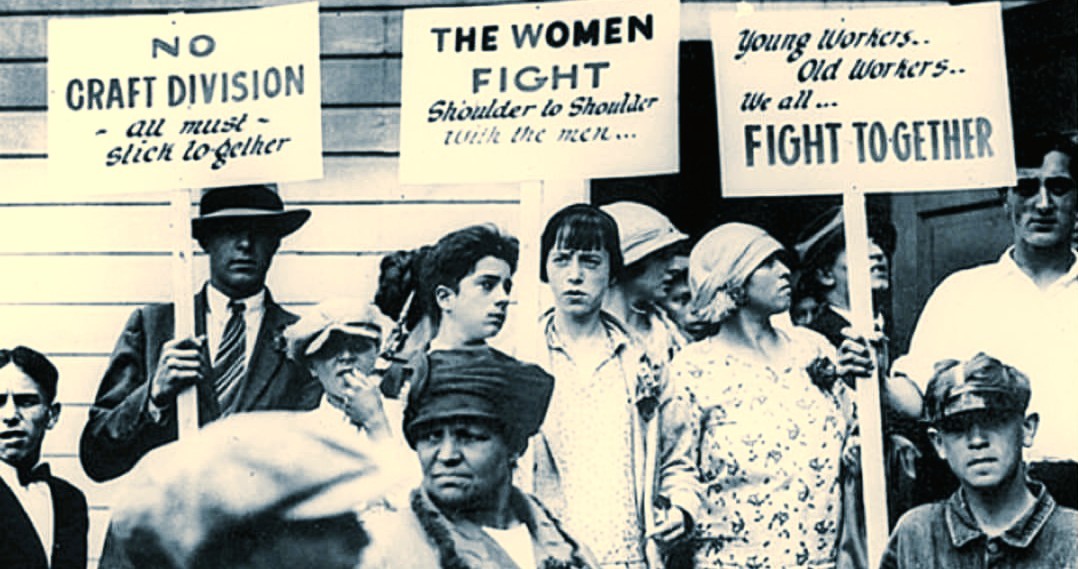
One thing has been true for the entirety of our movement from 1848 until today–union organizing at the workplace is key to organizing the class as a whole. It is inconceivable that there be a strong Socialist movement without there also being strong unions. As the workplace and conditions of employment are constantly moving and changing, the labor movement has always had to play catch-up and more often than not finds itself caught unawares. Below, a look at the specific issues in the mid-1920s that were preventing members of the Communist Party from unionization.
‘Unionizing Party Members’ by H.D. Wendell from The Daily Worker. Vol. 3 No. 33. February 19, 1926.
The following is fundamental: The task of bringing members of the Workers (Communist) Party into the trade unions cannot be separated from the general task of organizing all unorganized workers. Put another way: The business of unionizing members of the party not in the unions involves an understanding of the deterrents to unionization that operate on the mass of unorganized workers.
What are these deterrents? What are the forces and conditions that militate against unionization?
1. Lack of class-consciousness; petit-bourgeois aspirations and prejudices.
2. The propaganda and terrorism of the bosses!
3. Dual unionism.
4. Failure of the unions to take the initiative and deficiencies of craft organization.
These are the causes mainly responsible for the difficulty in organizing the unorganized. They act and interact one upon the other. They are cross-sectional characteristics of the class struggle that can be considered separately only for the purpose of studying them.
Lack of Class-Consciousness.
The comparative low level of class-consciousness of the American workers is explained by a number of reasons. (1) The existence, until recently of a western frontier that offered an “escape” for the more courageous and spirited elements in the working class, sapping it of its strength and robbing it of a tradition. (2) The great wave of immigration from Europe interfered with the normal development of a labor movement and put countless difficulties of race and language in the way of cumulative growth. (3) The bonanza growth of American industry created illusions of “opportunity” and fostered petit-bourgeois aspirations. (4) In the present period of capitalist monopoly Imperialism finds it profitable to bribe large sections of skilled and strategically placed workers by sharing a part of its colonial spoils, thus creating a “labor-aristocracy” whose influence on the rest of the labor movement is depressing. All of these conditions and others to be noted work havoc with the development of a conscious working class outlook.
Boss Terrorism.
Nowhere else in the world is propaganda and terrorism so vigorously employed against the workers and their possible organization as in America. The existence only in this country of monster industrial spy systems is a monument to this fact. The traditional American capitalist practice of suppressing efforts at organization by force and intimidation makes organization in many industries possible only when the workers are exploited to an intensive enough degree to stiffen them to the effort. Company unions, insurance plans, “co-operative” systems” and innumerable other agencies constitute methods of persuasion and propaganda that make organization very difficult. This capitalist double-offensive breaks the spirit of many workers.
Dual Unionism.
Dual unionism, which rationalizes into a philosophy dissatisfaction with trade union methods and leaders, has taken a heavy toll upon the labor movement of this country by stealing the best workers from the trade unions and dissipating their energies in less useful directions. Thousands of the best rebels in America, whose influence on the trade unions would have made for militancy and aggressiveness, have become discouraged and seceded to spend their energies and talents in building “industrial unions” that have wasted away through sheer inability to fit into the conditions affecting the labor movement as a whole. This process is still going on, although to a much less degree than formerly, and has taken its pound of flesh from over the heart of the labor movement. Even today there are many rebels workers who will not join the trade union movement because of their dissatisfaction with it, a dissatisfaction, that, as we said, expresses itself in a philosophy and therefore multiplies the harm.
Union Weakness.
Many workers could, without question, be organized if the existing trade unions would vigorously apply themselves to the task. The deficiencies of the organs of working class struggle, the trade unions, are to a large degree responsible for the unorganized conditions of large sections of the working class. Craft jealousy, job trusting, the domination of a hopelessly reactionary bureaucracy, ineffective structure and a meek philosophy of protection account for the neglect of the dominant unions in organization work. Especially in the case of the unskilled this weakness takes its toll. The failure of the established unions to take the initiative dampens the ardor of many unorganized workers. These then are the principle reasons for the slow progress being made in organizing the unorganized workers in this country. There are members of the Workers Party eligible to join trade unions who are not members. The question comes: To what extent are members of the party influenced by the forces that militate against organizing the workers at large. The forces that weaken the workers in general?
No Excuse for Communist.
A Communist should be immune to the discouragement and apathy of the worker who is overwhelmed by the negative influences enumerated above. A Communist is, above all, class-conscious. A Communist workers’ place is shoulder to shoulder with the other organized workers of his trade or industry, he takes the lead in their struggles, raises their courage by being more courageous than they and directs them in paths that lead to the overthrow of capitalism. If his industry is unorganized, a Communist should be in the forefront of a movement to organize it.
There is no excuse for a Communist to be outside the union of his craft or industry.
The Daily Worker began in 1924 and was published in New York City by the Communist Party US and its predecessor organizations. Among the most long-lasting and important left publications in US history, it had a circulation of 35,000 at its peak. The Daily Worker came from The Ohio Socialist, published by the Left Wing-dominated Socialist Party of Ohio in Cleveland from 1917 to November 1919, when it became became The Toiler, paper of the Communist Labor Party. In December 1921 the above-ground Workers Party of America merged the Toiler with the paper Workers Council to found The Worker, which became The Daily Worker beginning January 13, 1924. National and City (New York and environs) editions exist.
PDF of full issue: https://www.marxists.org/history/usa/pubs/dailyworker/1926/1926-ny/v03-n033-NY-feb-19-1926-DW-LOC.pdf
 Revolution's Newsstand