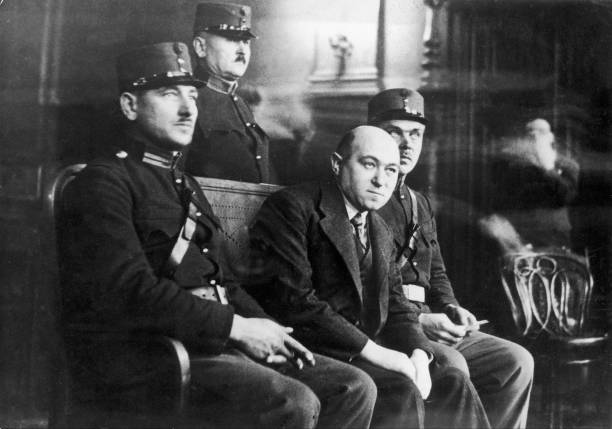
In exile since the fall of the Hungarian Soviet Republic in 1919, Communist Party leader Mátyás Rákosi was arrested attempting to return to build the underground organization. The trial was intensely followed by Communists around the world, with Rákosi eventually spending fifteen years in prison. The story below. He would become the central figure of post-war Hungary and the main rival to Imre Nagy.
‘The Rakosi Trial’ by John Kiss by Workers Monthly. Vol. 5 No. 12. February, 1926.
THE first question which confronts us in the Rakosi trial is this: what gave this affair such significance that it attracted the attention of the proletariat of the world and gave rise to an international movement to save Rakosi and his comrades? It has happened many times in many other countries that the bourgeoisie attempted or actually committed such outrages as the Horthy-Bethlen regime planned against Rakosi. The counter-revolutionary and fascist terror of other countries has not remained behind the Hungarian White Terror in this respect.
The fact that the dictatorship of the Hungarian proletariat followed the Russian proletarian revolution as the second station of the world-revolution gave prime significance to Hungarian revolutionary and counter-revolutionary affairs. In this dictatorship the revolution attacked the heart of Europe, while on the other hand it made it possible for the Russian revolution to overcome the counter-revolution. The proletarian revolution in Hungary kept in check all the forces of the European capitalist reaction for four months and by this fact the Russian proletariat, fighting against a thousand enemies, gained time to concentrate its forces. Neither the Russian, nor the entire world proletariat will forget this heroic self-sacrifice of the Hungarian proletariat.
After the downfall of the Hungarian dictatorship of the proletariat, it was Horthy who introduced the counter revolutionary terror in Europe and since that time he has remained the master of capitalist brutality against the working class. He and his tools have destroyed the Communist Party, forced it into illegality, and for a while buried all the possibilities of the proletarian revolution. No one even dared to pronounce the words “Communism” or “proletarian revolution.” Similar reaction followed in Finland, Poland, Bavaria—later in Bulgaria, Jugoslavia and Roumania.
The Horthys believed that they had buried the specter of Communism forever. But now after seven years of unspeakable terror Rakosi and his comrades, in the name of the oppressed Hungarian Communist Party, which the oppressors believed was dead once and for all, declared war on the “everlasting” counter revolution. The accused became the accuser and there appeared before the Hungarian proletariat openly and with head erect the only true leader in its liberation, the Hungarian Communist Party, and with it the hope and possibility of the new revolution.
This result was achieved not so much by the trial as by the increasing work which the Hungarian Communist Party did not interrupt fora moment by which it organized and mobilized into one militant camp the best forces of the Hungarian working class. If Horthy was unable to prevent this by means of an endless series of crimes and brutality through seven years, he will be able to do this even less after the trial.
Not by this trial but by their entire work, by their death-defying courage, by their organization and propaganda work have they succeeded in breaking the terror of the seven years of counter revolution, so that Horthy and Co. did not dare to do, what they have always done so far—execute such a leader of the Communist Party as Comrade Rakosi.
The merit for breaking the front of the bourgeoisie belongs not only to Rakosi and his comrades but to the entire international proletariat. The international defense movement of the working class saved Rakosi last autumn from execution. The second great significant point of the Rakosi affair lies in the fact that it was a proof of the strength and solidarity of the entire international proletariat. With this affair it became possible to break the counter revolutionary front in other countries, to win the free organization of the workers, and the possibility of the open legal propaganda of the Communist Parties. The importance of this affair for the future revolutionary struggles of the working class is inestimable. Thus all these taken together give to the Rakosi trial its international significance in spite of the fact that it occurred in a small country.
If we keep all this in mind, all the details of the Rakosi affair, beginning last fall, will become clearer and more intelligible in their national and international relations.
This is not the first time that Horthy has imprisoned groups of Communists in order to try to execute them. We mentioned above that the Hungarian Communist Party never ceased to carry on in spite of all the danger and the menace of death. The climax of the seven years’ work was the return of Rakosi and his comrades from Russia, their incomparably brave work, their arrest and trial, which aroused world-wide interest, was a fight between the Communist Party, the revolutionary proletariat on the one side and the counter revolution on the other—a fight in which the revolutionary proletariat gained the victory.
The Background of the Trial.
If we want to understand this trial fully we must take a glance at Horthy Hungary is a small country with a population of seven and one half million (before the war, the country had twenty-one million (before the war, the country had twenty-one million people, mainly an agrarian country, its social machinery resembled that of czarist Russia. Even today we have a great many feudal remnants and before the war actually the feudal aristocracy was the ruling class, sharing its power with the developing industrial bourgeoisie which forced this diviston of domination by its continually increasing economic power. There were struggles for power between them already before the war. The proletarian revolution in 1919 united them for a while, a few years ago, however, in the form of “legitimist” and “anti-legitimist” movement, the struggle was started over again. (The former stand for the restoration of the kingdom; the latter for the republic). The feudal reaction fought for the kingdom while the industrial bourgeoisie and the petty-bourgeoisie preferred the capitalist “democratic” republic. It is more useful in maintaining illusions among the working class.
Besides these two main divisions there were other forces undermining the unity of the ruling class after the revolution. One of these forces was the fascist petty-bourgeoisie (a group of impoverished nobles, so-called gentry, army-officers, petty bureaucrats) who actually held the political power and played the role of the hangman in the hands of the ruling class. (Horthy became the regent and his fascist bands held the armed power in their hands).
To get rid of this unwanted third power, the representative of the feudal aristocracy, Bethlen, started operations years ago. He was unable, however, to obtain the whole-hearted support of industrial capital. This is the reason that he did not succeed in getting rid of Horthy last year, after the franc-counterfeiting scandal.
There was another force undermining the unity of the ruling classes. This power was the rich and middle peasantry. After they had overcome the proletarian revolution, the ruling classes succeeded in obtaining their support. Their leader was Stephen Szabo, who was ready to sell himself to anybody. After his death, however, they also began to leave the counter revolution. The peasantry never were well organized (nor are they well organized in any country), but the wavering of their leader broke up whatever organization they did have. More and more they became the enemies of the Horthy-Bethlen regime, because they were forced to pay the expenses of the counter revolutionary government.
These were the factors which weakened the seven years of counter revolutionary united front on the one hand, and which slowly gave a little more freedom of movement for the working class and for the Communist Party working underground on the other.
The Hungarian Working Class.
Beside the one million three hundred thousand agricultural workers in Hungary there are six hundred thousand in the manufacturing class. The number of the organized workers which was once three hundred thousand has now diminished by two-thirds. Since the war the country has become more of a manufacturing nation and this raised the significance of the industrial worker.
This class of workers after the defeat of the dictatorship fell into terrible oppression. A great help to capitalists in this shameful work was the Hungarian Social Democratic Party, the treason of which stands alone even in the history of the international Social Democracy. It is sufficient to refer to the agreement recently exposed which they officially made with Bethlen. In this agreement they simply gave up the night to organize the agricultural workers, the state employees, and the railroad workers and agreed that they would not support the foreign propaganda against the Horthy terror. We can also remark that these Social Democrats denounced the Communists working underground and helped the police to get their hands on Comrade Rakosi and his companions.
It was the consequence of this and the ever worse condition of the Hungarian working class that, persecuted by the terror and betrayed by the Social Democrats, the Hungarian workers spontaneously began to grow more and more bitter and rebellious. It was then that the miners of Salgotarjan and vicinity, numbering about eight thousand, began a journey on foot toward Budapest to demand explanation and justice for this slavery of seven years. “Fire at us,” said they, “but we cannot bear this without protest.” Again the Social Democrats were those who ran for the police and the Horthy soldiers with whose help they dispersed the miners.
It is but natural that after such lessons the Hungarian workers turned away from the Social Democrats with hate and fixed their hopes secretly on the Communist Party which they felt and saw was still among them. Legally they had no right to gather around the Communist Party. But within the Social Democratic Party and in the trade unions there appeared a legal opposition. (In Hungary there was the strange situation that the trade union movement and political movement of the workers were identical for the reason that before the war the workers had no parliamentary representatives at all.)
This opposition gathering around Stephen Vargi (steel factory worker) and his comrades carried the movement to an open break when Vagi and his companions established the Hungarian Socialist Labor Party. This party became stronger and stronger and Horthy as well as the Social Democrats did everything in their power to annihilate it. Its members were persecuted, denounced as Communists, (which is a He, of course), and at last, together with Comrade Rakosi and his companions, were arrested and brought before the court. In this way they wanted to do away with both revolutionary parties. But they did not succeed. Vagi and his companions bravely told them: Yes, they do fight for the new liberation of the Hungarian workers but they do not belong to the Communist Party and are not members of the Third International.
Another factor revolutionizing the Hungarian workers is their terrible misery. Nowhere in Europe is there, perhaps, greater misery than in Hungary at the present time.
Seven years of the Hungarian counter revolution’s orgies could only be continued at the expense of the downtrodden workers. It was the working class that paid the cost of the reign of terror.
Whereas in Warsaw, where the misery of the workers is also very great, a worker could, with a week’s salary, buy 235.6 pounds of bread, an Austrian worker 239 pounds, a German worker 336 pounds, a Hungarian worker can only buy 135.6 pounds of bread.
The wages are unbelievably low. The average salary is 220,000 Hungarian crowns a week ($3.00) and the best skilled worker does not make more than 480,000 crowns ($6.50). And even these wages are frequently cut. In the steel factory of Diosgyor, which belongs to the state, a working day of 16 hours has just been introduced. It is left to the imagination of the reader how long the working day of the private capitalistic enterprises is.
The misery of the agricultural workers is even more terrible. The average salary of one of these workers is only about $1.50 in the summer months. What will happen in the winter?
Besides this the unemployment is very great. According to the official statistics of the Council of Trade Unions, almost one-third of the organized members were unemployed (31,236 out of 100,000). In most of the industrial centers 50-75 per cent of the building workers are unemployed. Seventy-five per cent of the agricultural workers are unemployed, for instance, in one of the richest peasant cities of the great Hungarian plain, Kiskunfelegyhaza.
Because of this misery the number of suicides has enormously increased. In Budapest alone there are 15 to 20 attempts to commit suicide in one day.
The Hungarian workers would escape out of the country if they only knew where to go and if they had the means for such a journey.
So there is nothing to do but “live and die” there as the anthem of the Hungarian ruling class runs.
This situation drives the masses toward Vagi, but still more although secretly, toward the Communist Party. There is scarcely a day when they do not imprison men for uttering such thoughts: “I wish the Communist dictatorship would come back again.”
This discontent and bitter protest of the workers add greatly to the dissolution of the counter-revolutionary regime. On the other hand, this is the power which with the help of the international proletarian movement, will win the right of organization for the Communist Party and continue the great work which Rakosi and his comrades have so bravely begun.
The Trial and the Sentence.
With the above background we can see clearly the importance and the consequences of the Rakosi trial.
Rakosi and his comrades, as conscious Communists, see the internal and external forces which gave them support during their trial.
They pointed out with incomparable bravery the crimes and baseness of the counter-revolution, the seven years of destruction; pointed out the conditions of the Hungarian working class; laid bare the contemptible treason of the Hungarian Social-Democracy and showed to the desperate masses the way leading out of this earthly hell.
They declared, despite the danger of death that awaited them, the reason why they had come home from Russia and for what goal they will work unceasingly. They bravely demanded a complete organizational and political freedom for this Communist movement and for the Communist Party.
Rakosi and the thirty accused Communists as well as Vagi and the twenty-eight accused members of the Socialist Labor Party behaved magnificently. Among the accused there were the revolutionary allies of the Communists, agricultural proletarians, a fact which adds special significance to this trial. These simple agricultural workers declared with the same clear-sightedness and revolutionary spirit that they would fight hand in hand with the industrial proletariat for the new revolution, and the second and final Hungarian Soviet Republic.
Workers Monthly began publishing in 1924 as a merger of the ‘Liberator’, the Trade Union Educational League magazine ‘Labor Herald’, and Friends of Soviet Russia’s monthly ‘Soviet Russia Pictorial’ as an explicitly Party publication. In 1927 Workers Monthly ceased and the Communist Party began publishing The Communist as its theoretical magazine. Editors included Earl Browder and Max Bedacht as the magazine continued the Liberator’s use of graphics and art.
PDF of full issue: https://www.marxists.org/history/usa/culture/pubs/wm/1926/v5n12-oct-1926-1B-FT-80-WM.pdf

