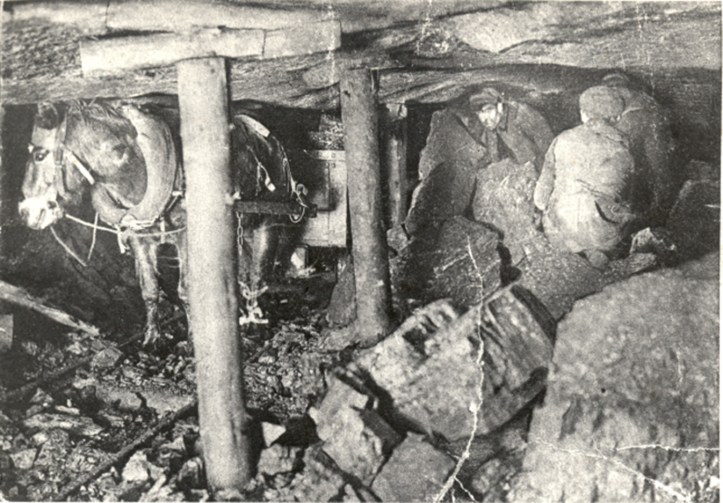
One of the sites of radical opposition to the Lewis leadership of the U.M.W.A. and bastion of Canadian working class militancy were the miners of Nova Scotia. Maurice Spector on the reasons.
‘The Struggle in Nova Scotia’ by Maurice Spector from The Daily Worker. Magazine. Vol. 2 No. 83. April 18, 1925.
THE immediate causes of the Nova Scotia struggle were the refusal of the British Empire Steel corporation to restore the credit to the miners at the company stores and to provide work of at least four days work a week. The twelve thousand miners of Nova Scotia inclusive of the maintenance staffs, affecting fifty thousand men women and children, went out on a strike that has already lasted over seven weeks.
But behind the provocative cutting off of credits and sabotage of production was the determination of BESCO to force a ten per cent wage cut below the 1924 rates, a determination in line with the whole past policy of the corporation to reduce the living standards of the miners to the level of coolies and no less in line with the whole world wide capitalist offensive on the miners of the world under Dawes capitalism.
THE present one hundred per cent strike is by no means the first great struggle of the miners against this ruthless corporation. At the present time when the Canadian middle classes, the politicians, priests, parsons, social service workers etc. are systematically confusing the root causes of the struggle and blurring the class issues involved by their “relief” propaganda, it is necessary to shout from the house tops that capitalism and only capitalism is responsible for the oppression, starvation and degradation of the miners.
Nova Scotia is one of the sorest spots in Canadian capitalism. It is dominated by the gigantic British Empire Steel corporation, one of those war and post war products of capitalist, concentration and monopoly.
BESCO was formed by the merger of all the coal, iron and steel and shipbuilding companies of Nova Scotia. The merger was considerably facilitated by the coal-land leases by which the kept politicians of the provincial government graciously gave to Besco practically all the coal in Nova Scotia–one of the richest fields in the world.
FROM its inception, the policy of Besco has been par excellence to get something for nothing. In the process of trustification, the already inflated capitalization of its constituent companies was still furthered watered to the tune of over $19,000,000 Successive governments have pampered Besco to a sickening degree. It has received over $8,000,000 in bounties and nearly three-quarters of a million dollars in remission of duties at the hands of kindly capitalist politicians who will not hear a word about “demoralizing doles” for the unemployed.
For services to government departments, Besco has received no less than $77,138,459. It has charged the government $39 a ton for rails which it was able to deliver to the foreign market for $24 a ton. But the appetite of a corporation whose aim is to batten by restricting output and intensifying exploitation, is insatiable. Besco demands a still higher tariff from the government and still further wage reductions for the men.
FACED by such an incarnation of capitalism as Besco, the miners of Nova Scotia have been driven along the channels of militancy and ‘class consciousness. Their condition has been that of direct poverty, and semi-starvation. Theirs has been the lowest wage scale of any district in the coal industry of North America. Working an average of about one hundred and fifty days a year in the last three years, the Nova Scotia miner has averaged between $500 and $1,000 a year.
As a consequence of such conditions the miners have been forced to strike for a wage contract every year. As at the beginning of this year, the corporation has always demanded a wage-cut. Their experiences with the policies of Besco has developed these Canadian miners into one of the most radical sections of the United Mine Workers of America and the best class fighters in the Canadian labor movement. To the great alarm of the Canadian bourgeoisie and the trade union bureaucracy, this radicalism manifested itself in the miners’ attempt early in July 1923 to obtain permission (refused of course) from the U.M.W. of A. executive board to affiliate with the Red Labor Union International. The Communist Party became very influential in the district.
IN July 1923 about 4,000 steel workers employed by Besco in Sydney went out on strike for recognition of their union and better conditions. At the behest of Besco the government rushed in the militia. The miners demanded the withdrawal of the military and when this was refused, went out on strike. At this point, the government, the military, and Besco were joined by their ally Lewis the bureaucrat head of the U.M.W. of A., who outlawed the miners’ strike as a “violation of contract.”
The military coerced the miners, the government threw the strike leaders into prison on trumped-up charges of sedition, and Lewis served for his masters by arbitrarily deposing the radical miners’ executive and appointing his own henchmen.
THE strike was mercilessly broken–but let it be remembered, not a murmur of protest from the middle classes and uplifters. They enjoyed the spectacle as cheerfully as the breaking of the militant Winnipeg general, strike a few years before.
In September of the same year, the royal commission appointed to investigate the causes of the strike reported among reasons which are irrelevant, the low rate of wages, the long hours, the refusal of the company to recognize the Steel Workers’ Union, irregular employment, unemployment and the high cost of living. The report of the commission brought with it, of course, no improvement of conditions. On the contrary, Besco prepared to present the miners with another ten per cent wage cut at the beginning of 1925.
THE miners meanwhile seized their first opportunity when permission was finally granted to hold a convention and to elect another executive which was regarded as left-wing and as likely to continue the fighting policies of Jim McLachlan who since his release from prison has been editor of the Maritime Labor Herald. In spite of the utmost provocation of Lewis, the miners held a firmly to their unity. The One Big Union clique in Winnipeg who while not a union have large funds accumulated from their profitable gambling competitions, endeavored to split the miners away from the U.M.W. of A. but when they did not succeed, they managed to split off a few hundred miners in Pictou county. Following Besco’s that wages must be reduced, the minister of labor, the notorious Jimmy Murdock who had done so much to break the postal workers strike last summer, appointed a conciliation board under the Lemieux act to investigate the dispute. About the same time the privy council in London decided that the Lemieux (industrial disputes investigation) act was invalid as “ultra vires” of the federal house which had enacted it. But regardless of this decision, the “conciliation board” could have accomplished nothing much more than it did–which was merely to shake its head wisely, say it was too bad, and recommend another inquiry by royal commission. While applying for the board, Besco was going right ahead with its provocative arrangements for the lockout.
THE corporation resolved to precipitate matters by the drastic weapon of starvation, Besco ordered its company stores to immediately cancel all further credits to the miners already on the brink of starvation, and to extend its lockout at the southern collieries 2, 4 and 6. When the corporation refused to heed the ultimatum of the miners’ executive to restore credits and immediately provide at least four days work a week, the miners walked out solidly taking the maintenance men with them. John L. Lewis at once wired Premier Armstrong that the withdrawal of the maintenance men was contrary to the laws and policy of the U.M.W. But the miners paid no attention.
THE strike was one hundred per cent strike but from the very outset its leadership has been giving all true working class friends of the miners the gravest concern. The bourgeoisie adopted a way of trying to break, the strike, in accord with a changed situation. The directors of Besco itself were unblushing in their frank avowals of determination to starve the miners out.
Vice-President McLurg of Besco in a public interview openly declared his reason for believing that the miners couldn’t win to be that “they could not stand the gaff” that is, starvation, But the bourgeoisie as a whole worked more cunningly.
FIRST, there is an election in the offing and military intervention by the King government, would be political capital for the tory opposition thirsting for the fleshpots of office.
The tories have already exploited the Nova Scotia situation to discredit the liberals. Cynical tory politicians have slobbered all over the miners| and have demanded from King that he send relief, knowing very well that he would take refuge behind the inevitable British North America act and that they themselves were let out of doing anything.
NEXT, there is the genuine fear among the middle classes of the hold and progress of the ideas of the class struggle among the miners. They have a real fear and hatred of the influence of McLachlan, of the policies of the Maritime Labor Herald, of the prestige of the Communist Party. They remember the application for affiliation to the R.I.L.U. And they remember the militant strike of solidarity on behalf of the steel workers.
So the cry has gone up among them as expressed by Canon Scott in his letter to Premier King that the district must be “saved from Bolshevism.” The method of capitalist intervention that has been adopted therefore in this instance is not coercion but throttling the strike with “kindliness.”
A HOWL suddenly goes up in the capitalist press and forums that a calamity has struck Nova Scotia. Relief must be sent immediately. The capitalist game is to represent the crisis as due to some sort of natural catastrophe some earthquake or tidal wave or famine disaster–a pure case for philanthropy.
There was never word from these same sudden philanthropists when the miners of Western Canada were starving as they still are from the effects of a five months’ long struggle against the western coal operators.
THE trade union bureaucracy has taken its cue as usual from the bourgeoisie. On behalf of the Trades Congress, President Tom Moore donated the paltry sum of $500 towards relief. He visited the scene of hostilities gave it the “once-over” and complacently returned to report in his Congress Journal that the days of “red” leadership of the district were over. Other than that $500–nothing. This Trades Congress affiliated with the Amsterdam International which in the emergency of the outbreak of war is pledged to declare a general strike, has not even convoked an emergency conference to consider active aid to the miners. The business of the Trades Congress was to mobilize such forces as it had to prevent a repetition of the disaster which overtook the isolated struggle in District 18 (Western Canada) where company unionism has raised its head.
BUT all that Moore can think about is to “save the district from Bolshevism.” To the same end Lewis himself journeys down directly to participate in the negotiations for a settlement.
And what of the leadership of the strike, the present miners’ executive? President McLeod obtained his office by virtue of support he received from the militants on the district, who were led to believe he was a sincere sympathizer of the left wing program and of the former Livingston-McLachlan executive, deposed by Lewis.
NEVERTHELESS, consciously or unconsciously McLeod has been abandoning the road of class struggled and has leaned on the charity and the good will of the middle classes and of trade union bureaucracy. He went so a far as publicly to deny that the policies of his executive and those of the Maritime Labor Herald under the editorship of Jim McLachln, were the same.
This is a one hundred per cent strike but there has not been a single mass meeting of the men called since its beginning seven weeks ago. The maintenance men have been withdrawn but there has been no picketing of the maintenance men, the corporation has maintained.
BUT the worst action of McLeod and his associates on the executive–an action tantamount to a betrayal–and one, that evoked sharp protest from the rank and file has been his behaviour towards the $5,000 that the Russian workers sent in the name of international solidarity.
The McLeod executive had allowed all relief activity to fall into the hands of the bourgeois’ citizens committee formed in Glace Bay. The Russian money was sent thru Jim McLachlan to the miners and when he offered it to the citizens’ committee, the gang of parsons, priests, politicians, lawyers, etc., who make it up flatly turned it down on the ground that its acceptance would hinder the “public” from giving. This was a bare faced piece of sabotage of the class interests of the workers and internationalism, It was an insult and slap in the face to the Russian workers and the R.I.L.U. but neither McLeod nor any of his executive registered the angry and categorical protest that was due on behalf of the miners.
THESE actions of McLeod’s have evoked sharp warnings from the Communist Party. The Communist Party would not and will not do anything that could be interpreted as disrupting the ranks of the miners at the moment of struggle. But that is precisely why it has not been able to remain silent without warning the miners of Nova Scotia against the poison of class collaboration and the example of Sherman in District 18 who was also once elected on a left wing ticket and then went over to the reactionaries.
The capitalist press is already exultantly drawing its conclusions from the “moderate” tactics of McLeod. Whatever the outcome of the struggle, the left wing and the Communists have been a thousand times justified in their program when they demanded amalgamation, a clean sweep of the yellow bureaucracy from the office, when they demand Canadian trade union autonomy, a Trades Congress with real executive power and international trade union unity.
WHATEVER the outcome of the struggle, the Communists and the left wing continue to make the nationalization of the mines under workers’ control more of an issue than ever before. The immediate program that the Communist Party has been propagating, mines nationalization, a six hour day, a minimum wage and closer unification of the miners organizations in Canada must be pushed with the greatest possible vigor.
The Saturday Supplement, later changed to a Sunday Supplement, of the Daily Worker was a place for longer articles with debate, international focus, literature, and documents presented. The Daily Worker began in 1924 and was published in New York City by the Communist Party US and its predecessor organizations. Among the most long-lasting and important left publications in US history, it had a circulation of 35,000 at its peak. The Daily Worker came from The Ohio Socialist, published by the Left Wing-dominated Socialist Party of Ohio in Cleveland from 1917 to November 1919, when it became became The Toiler, paper of the Communist Labor Party. In December 1921 the above-ground Workers Party of America merged the Toiler with the paper Workers Council to found The Worker, which became The Daily Worker beginning January 13, 1924.
PDF of full issue: https://www.marxists.org/history/usa/pubs/dailyworker/1925/1925-ny/v02b-n083-supplement-apr-18-1925-DW-LOC.pdf

