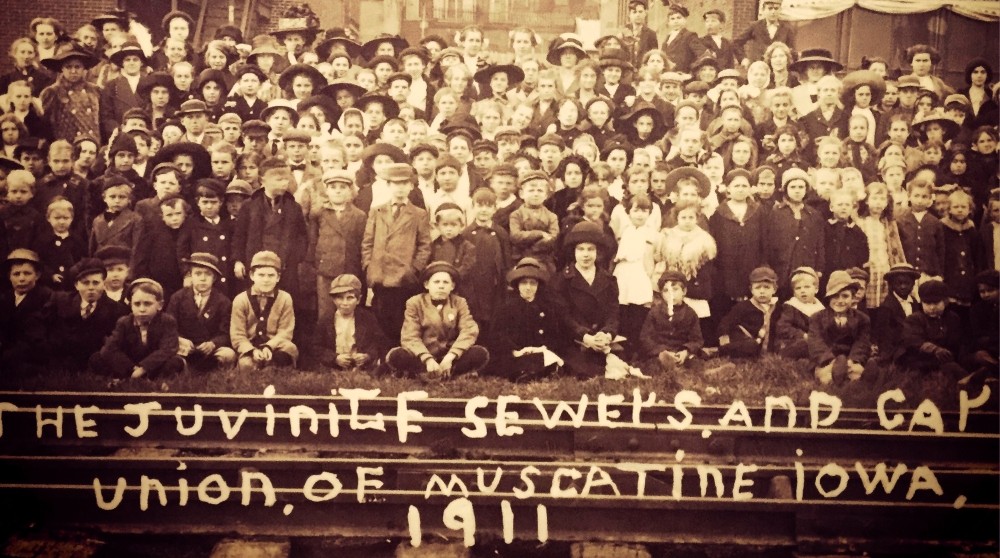
An example of working class Socialism in Iowa. We often think of the Midwestern Socialist Party as being more preacher than proletariat, with much justification. Of course, that is not all it was. For decades, the city was the world’s largest maker of pearl buttons, stamped from clam shells harvested from the nearby banks of the Mississippi River. Muscatine’s workers waged a hard, losing struggle for unionization lasting three after a lockout by the city’s manufacturers. Though it would not be until 1933 that workers would win union recognition, the strike helped build the Socialist Party in the state, with Muscatine itself growing to 125 members and electing two Socialist aldermen during the conflict including the Button Workers’ Union organizer.
‘Victory Follows Lockout of Button Makers in Muscatine’ from The New York Call. Vol. 4 No. 69. March 10, 1911.
(Special Correspondence.) MUSCATINE, Iowa, March 7. This city has taken the first steps toward becoming a second Milwaukee. Columbus, Minneapolis, Los Angeles and other cities that are striving for the honor will have to hustle some to catch up with Muscatine. At yesterday’s election two aldermen were elected to the city council on the Socialist ticket, and the tremendous gain made in the party’s vote is the sensation of the day.
O.C. Wilson, who was elected as alderman from the 3d Ward with a plurality of 279, is one of the pioneer Socialists in Iowa, and at the same time one of the best posted.
William Montgomery, alderman-elect from the 4th Ward, is also a strong Socialist worker. He received a plurality of 207 votes.
The fight was won after one of the most bitter struggles ever fought in this city on the political field.
The Muscatine Journal makes the following comments and report of the Socialist victories:
“Far overshadowing all other features of yesterday’s city election, the most sensational and closely contested in the city’s history, was the wonderful strides made throughout the city by the Socialist party, and the election of the Socialist candidates for aldermen in the 3d and 4th wards by overwhelming majorities.
Old Parties Not Jubilant.
“The Socialist gains filled the hearts of the members of that party with a great joy, which was expressed in the early morning parade through the streets of the city. While neither of the two older parties found enough in the results to grow particularly jubilant over, whatever of advantage there was lay with the Republicans.
“The Republican party retains undisputed control of the city council with the mayor and five aldermen, the four hold-over members and Charles Zeidler elected in the 1st Ward. The Republicans also elected recorder, engineer, attorney and street commissioner. The democrats elected William J. Watson as alderman from the 2d Ward, and their candidates for marshal, sexton and weighmaster. The Socialists scored with the unprecedented feat of electing two aldermen, the first member of their party to be elected to office in Muscatine. Every Socialist candidate carried the 3d and 4th wards, though the majorities of the subordinate officers were materially less than those of the aldermanic candidates, who in both instances polled a greater vote than the combined votes of their opponents.
Socialist Strength Not Shown.
“The Socialistic gains are generally accredited to the present local labor situation, several of the candidates of that party being prominent m the councils of the Button Workers’ Union. While it is on all hands admitted that the vote cast yesterday for the Socialist candidates by no means is indicative of its actual strength, it is certain that in future elections the two older parties will have to reckon, and that mightily, with this comparatively new political organization.
“Oliver C. Wilson was the leader who led the Socialists to victory in the 3d Ward, being elected alderman hy a majority of seventy-five more votes than the combined votes of his two opponents.
“Wison received 556 votes. 123 more votes than were cast for James H. Billings, the Socialist candidate for marshal, who led the remaining candidates of that ticket in the 3d Ward. Mr. Wilson is prominently connected with the Button Workers’ Union and drew an immense support from the members and sympathizers of that organization. The vote follows: Metzger (Rep.). 301. Coon (Dem.). 204. Wilson (Soc.) 580 Wilson’s plurality, 279.
“William Montgomery, the Socialist candidate, caught more ballots in the fourth than were cast for both the Democratic and Republican candidates. Montgomery trotted under the wire, when the distance flag was being waved at the other entries. The result was not a distinct surprise, however, and while his plurality was larger than many members of his party expected, still it was believed that he would nose out. The official vote follows: J.W.C. Henning (Rep.). 207. George W. Brown (Dem.). 205. William Montgomery (Soc.). 414. Montgomery’s plurality. 207. Diercks (Rep.) plurality in 1919, 73.
Victorious Socialists Parade.
“The one enlivening feature of the night was the early morning parade of the victorious Socialists. A band of a limited number of pieces was secured, and about 150 members, the rank and file of the party, dropped into line behind the dispensers of the “sweet strains”, and in spite of the drizzling rain marched through the downtown part of the city, serenaded the newspaper offices, dropped into the Rescue Hose House, and then proceeded on toward South Muscatine. Oliver C. Wilson and William Montgomery, the successful candidates, were in the party, and both gave several very brief addresses when called upon to address their followers.”
The Socialists also made a remarkable showing for several of their candidates for city officials and gave the old party candidates the scare of their lives, as the following summary of the vote for five of the officials demonstrates:
For recorder–Grand totals: Branzan (Rep.). 1196: Wels (Dem.). 1191: Schoenig (Soc.), 1102. Brannan’s plurality, 5.
For marshal–McElravy (Rep.). 1168; Hoffman (Dem.), 4276: Billings (Soc.), 1024. Hoffman’s plurality, 108.
For street commissioner–Graehner (Rep.). 1229: Liebbe (Dem.). 1124: Graf (Soc.). 1091. Graebner’s plurality, 105.
For sexton–Freers (Rep.), 1035; Kobes (Dem.). 1311: Tetrick (Soc.). 1085. Kobes’ plurality, 276.
For weighmaster–Stellright (Rep.), 1045; O’Mella (Dem.). 1411; Murphy (Soc.), 975. O’Melta’s plurality. 366.
Victory Follows Lockout.
One of the most surprising incidents that occurred during the count of the ballots was the fact that in the entire city, at the spring election last year, only 300 Socialist votes were cast. The Socialist victory followed close upon a lockout of workers in the button making industry, which is the most important industry in the city. The workers, many of them girls and women, had been ground down in a most deplorable manner and, out of sheer revolt, had organized into a union.
The bosses at first were dumfounded, but they also organized and then agreed upon the lockout. O.C. Wilson is the organizer for the Button Workers’ Union.
Montgomery was foreman of the biggest button factory in the city and was well liked by those employed under him.
Literature Campaign Waged.
The campaign was mainly carried on by the use of literature in the form of a weekly propaganda and campaign newspaper delivered directly into the homes of the locked out workers and the citizens of the city at large. The Socialist party local of Muscatine has over 125 dues paying members. The members, at an enthusiastic meeting last night, decided to take hold of the opportunity and capture the mayoralty and other positions at the next election.
The city has always held big meetings whenever a Socialist organizer hit the town, but it was not until the revolutionary local hit upon literature as the most effective instrument that any great enthusiasm was aroused. The literature dealt with the local situation and candidates, as well as the ultimate purposes of Socialism.
The New York Call was the first English-language Socialist daily paper in New York City and the second in the US after the Chicago Daily Socialist. The paper was the center of the Socialist Party and under the influence of Morris Hillquit, Charles Ervin, Julius Gerber, and William Butscher. The paper was opposed to World War One, and, unsurprising given the era’s fluidity, ambivalent on the Russian Revolution even after the expulsion of the SP’s Left Wing. The paper is an invaluable resource for information on the city’s workers movement and history and one of the most important papers in the history of US socialism. The paper ran from 1908 until 1923.
PDF of full issue: https://www.marxists.org/history/usa/pubs/the-new-york-call/1911/110310-newyorkcall-v04n069.pdf

