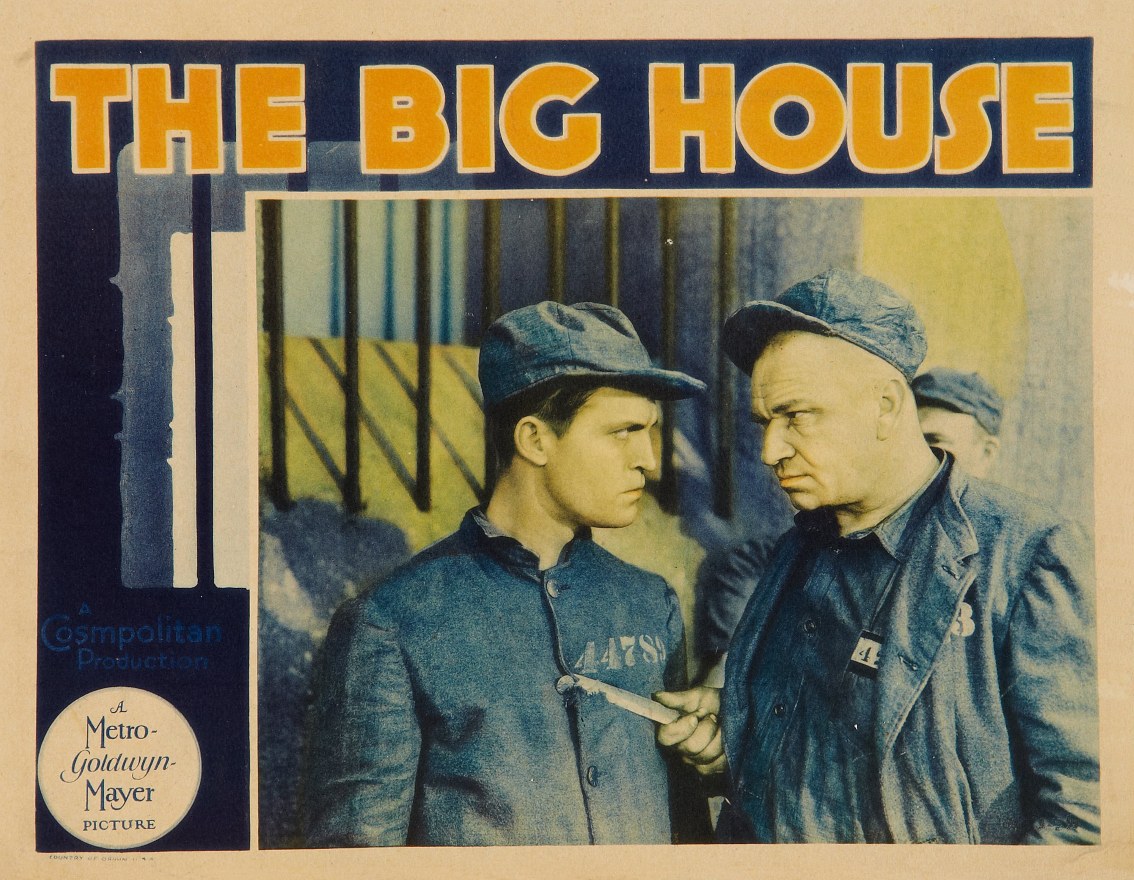
Early Marxist film critic reviews two Hollywood movies, The Big House and Numbered Men, and sees, despite there difference in quality, an identical world-view.
‘The Prison Film’ by Harry Alan Potamkin from New Masses. Vol. 6 No. 3. August, 1930.
The Big House, Metro-Goldwyn-Mayer, Astor Theatre, New York.
Numbered Men, First National-Vitaphone, Winter Garden, New York.
The movie is symptomatic of America at its lowest level. It expresses the social mind at that level. The lowest level of the social mind, the least critical level, is the dominant stratum. Dominant as it is, it defends itself by evasions, by the shifting of the burden of guilt. These two films inspired by the social turbulence of prison-breaks are expressions of this shifting of the charge.
We have here two films, the first a product of one of the best American factories, the other of one of the worst: shop-competence, incompetence. But the minds revealed are identical. Both are frivolous even facetious. The burden of the guilt has been shifted by shifting the emphasis of the story. In The Big House society is accused by the warden, who points to the overcrowded cells as a foreboding; by the genial guard, who warns against putting the boy, whose crime is running down someone with his auto, with the two hardened criminals, and by the machine-gun murderer, who revolts at the food, provoking the entire convictbody into an outburst and himself into solitary confinement. In the first two instances, the charges are only remarks, they do not get into the woof of the film, informing it, giving it meaning. As in All Quiet, the director has not sought to make the entire film the vehicle of the attack, but restricted the attack to some verbal statements. Dialogue cannot carry the mood, the film as a whole is the vehicle. The accusations therefore remain incidents–passing and unemphatic. Whatever suggestion of social guilt they contain is dissipated by the events of the story, and their treatment.
We are not made to experience the accusations: the overcrowding, the bad food. The bad food doesn’t argue in itself, as did the maggotty meat of Potemkin. It does not explain the outburst. The camera does not expose its filth. There was no attempt to construct an unavoidable mood, because there was no wish to construct it, and no ability. The film lacks temper, it is another American jest.
The film, concentrating as it does the major action in the prison, might have been a powerful experience. But the predilection for the comic spirit at once lightens the intensity. The concentration of the theme is severed by moving the action for a period out of the prison into the street, the girl’s bookshop and home. The film should have been contained in the close environment of the prison, unrelieved by whimsicality or horseplay or the soft tone of the letter informing the murderer of his mother’s death. The film. should have been intensive, gray, cumulative. Its model might well have been The Passion of Joan of Arc. We should have felt the slow process of festering, monotonous, oppressive, bursting in the riot–just as the mob-explosion released the accumulation within the dungeon at Rouen. The film, as an art, is a progressive medium moving toward intensiveness. It is a process, not simply a story. But to create a process in the movie requires awareness of the process of society, and the mind of the movie–the American movie–does not possess awareness.
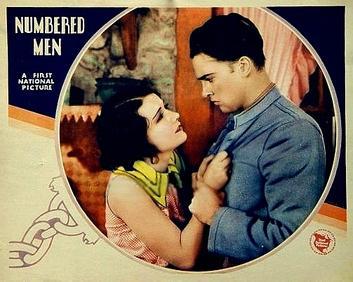
Numbered Men is an incompetent Big House. The idyllic flavor is at once imparted: the farmer’s dame who serves the road-gang doughnuts, the loyal girl who has taken a job at the farmhouse to be near her lover, wrongly imprisoned. The typical formula is carried out: one of the prisoners is advised his wife is dead–this serves as an impetus to escape (as in The Big House); there is a killer here too who boasts, like the murderer in the Metro film, of his prowess (The Hairy Ape motif)–the difference is that in the Metro film we are made to like the whimsical brute whereas in the Vitaphone masterpiece he is the nemesis. He is, in fact, the instrument whereby the guilt is shifted from society. Indeed, there is nothing we can hold against society, save the incarceration of the innocent boy. This blemish is eradicated when another prisoner confesses to the crime, sacrificing himself to an extended sentence. So are problems solved. The prison itself is more idyllic than The Big House. In the latter the warden complains of 3000 men brooding in idleness, though we never get to feel it. In Numbered Men there is a big sunny room where a convict, if he is good, may play the harmonica or read The American Mercury. The moment of the riot is brief. It isn’t a riot, it’s a dash. The prisoners hunt for the runaway to preserve the honor system. Some fifteen years ago Fox produced The Honor System, a more exciting film on the theme. It was a popular motif in those days. In 1905 Vitagraph manufactured Escaped from Sing-Sing…and a quarter-century later we find the film-factories issuing stuff that shows no advance in point-of-view. The mind of the movie is even more callow now.
Callowness has more than orthographic resemblance to callousness. The society that is callow in its cinema is callous in its attitude toward imprisoned men. The audience that is amused by the spectacle of men being marked and numbered is the society that kills Sacco and Vanzetti, imprisons for life Mooney and Billings, railroads the leaders of the workers in New York, North Carolina, Georgia and California. It is that society which produces The Big House and Numbered Men; another society produces In Old Siberia, that poignant lyrical Soviet film of the plight of the political prisoners in Czarist Russia. As the days go on, the American movie will get farther and farther away from the film exposing the social evils. Once it was possible to have The Jungle filmed, pictures of Czarist oppressions and anti-semitism, movies condemning the exploitation of the poor farmer in the everglades of Florida. American society becomes more concentrated, more protective. The movie becomes more concentrated, more symptomatic. A counter-process is at work, the revolutionary threat. This intensifies the instinct for self-preservation in the mind of the dominant class. The movie reveals the intensification. All elements of vital criticism are eliminated, but there is one criticism that is ever-present, the film itself. It is the business of the critic to present in full this evidence of which the movie speaks.
The New Masses was the continuation of Workers Monthly which began publishing in 1924 as a merger of the ‘Liberator’, the Trade Union Educational League magazine ‘Labor Herald’, and Friends of Soviet Russia’s monthly ‘Soviet Russia Pictorial’ as an explicitly Communist Party publication, but drawing in a wide range of contributors and sympathizers. In 1927 Workers Monthly ceased and The New Masses began. A major left cultural magazine of the late 1920s to early 1940s, the early editors of The New Masses included Hugo Gellert, John F. Sloan, Max Eastman, Mike Gold, and Joseph Freeman. Writers included William Carlos Williams, Theodore Dreiser, John Dos Passos, Upton Sinclair, Richard Wright, Ralph Ellison, Dorothy Parker, Dorothy Day, John Breecher, Langston Hughes, Eugene O’Neill, Rex Stout and Ernest Hemingway, Artists included Hugo Gellert, Stuart Davis, Boardman Robinson, Wanda Gag, William Gropper and Otto Soglow. Over time, the New Masses became narrower politically and more journalistic in its tone.
PDF of full issue: https://www.marxists.org/history/usa/pubs/new-masses/1930/v06n03-aug-1930-New-Masses.pdf

