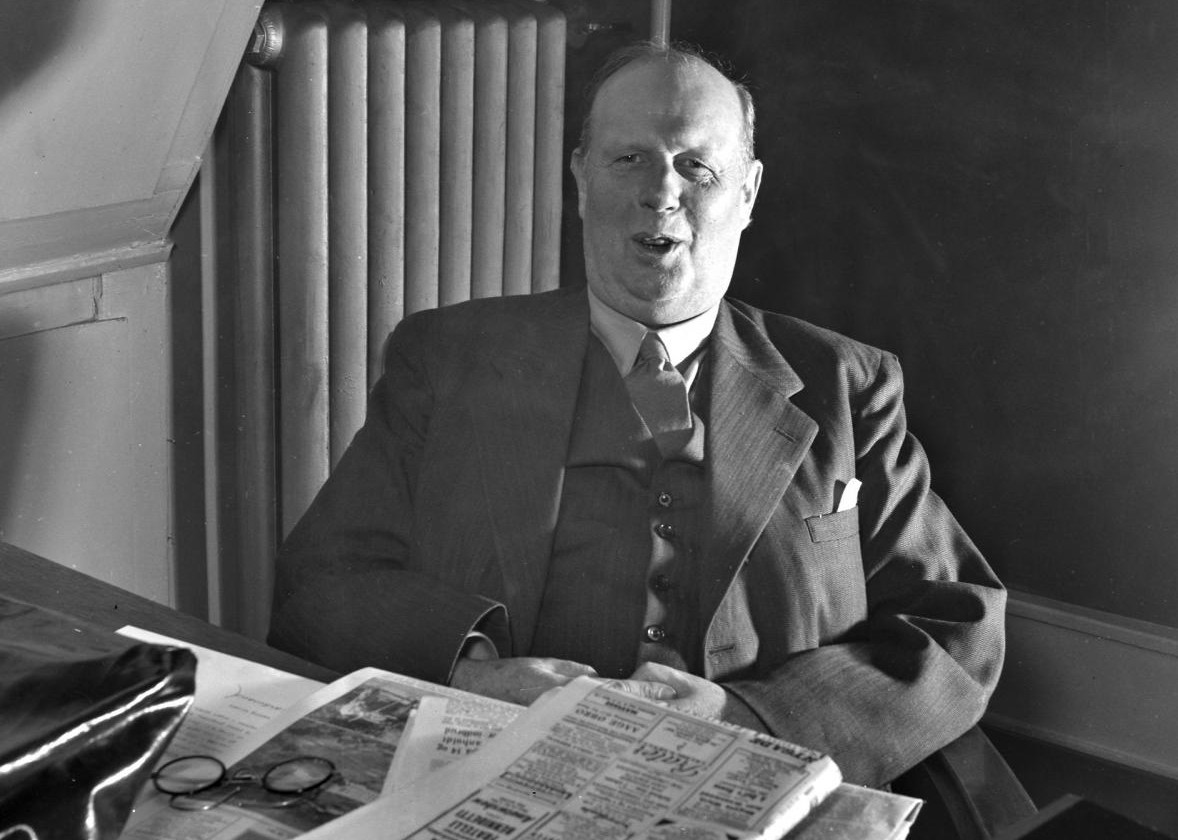
Often the best introduction to the politics of a place or time is through its arts. Prolific left-wing Danish writer, and member of the Communist anti-fascist resistance, Hans Kirk introduces us to Denmark’s literary world.
‘Our Peasant Literary Background’ by Hans Kirk from International Literature. No. 2. 1934.
At the beginning of the nineteenth century, the large landowners had become the most powerful economic force in Denmark, Through the organization of Cooperative Credit Societies they succeeded in raising capital for a thorough industrialization of agriculture; and if hitherto only large landowners had been able to export agricultural produce then now the middle and large farmers dairy and meat cooperatives were in a position to supply the English market with meat and butter. The prolonged political and economic struggle between the large landowners, industry and the bureaucracy on the one hand and the farmers on the other, ended in complete victory for the latter. During the next twenty years, the fruits of this victory disappeared. By tax legislation and supporting the division of land the farmers attempted to prevent the large landowners from regaining even a fraction of their lost power. Together with this process, however, the enmity between the farmers and the industrial workers became intensified. The farmers, who themselves had been victorious in the struggle with the landowners for the reason that they had united themselves into such powerful organizations, now did all they could to frustrate the organization of the poverty stricken farm laborers, The middle sized farmsteads were now forced to hire outside labor.
The years of the struggle intensified the class-consciousness of the peasants. Their leaders were trained in the Peoples Public High Schools, founded by Pastor Grundvig, the peasants’ leader. These public high schools took the platform of democracy and a voluntary religious humanitarianism and they stood in sharp contrast to the academic education which was the monopoly of the reactionary ministry. One may receive a slight idea of the religious character of these public high schools from the picture in which God is depicted as governing the world in the same fashion as a large farmer manages his farm. After the victory of the peasantry, the high schools lost their early activity and with it, their importance to a certain extent. However, this was compensated by the entrance of a number of writers on the literary arena, whose works reflected the mentality of the victorious peasantry. This in spite of the fact that they themselves were not always clearly aware of their connection with the farmers. The more conspicuous of these writers are: Sophus Claussen, Thger Larsen, Jeppe Aakjaer, John Stijoldborg, and Johannes V. Jensen. It is true that each of these five novelists has a different mentality but they share all of peasant descent and their work is characterized by that optimism, peculiar to a victorious peasantry.
Jchannes V. Jensen
Johannes V. Jensen and Jeppe Aakjaer were the most influential. V. Jensen’s father was a veterinary surgeon and this writer’s first novel is a graphic account of the life of a poor farmer’s son living as a Student in Copenhagen. Jensen rapidly developed into a farsighted cosmopolitan who very soon orientated himself towards Britain and British imperialism. However, from the artistic standpoint, he was just as conspicuous a lyric poet as a novelist and his earlier work undoubtedly signifies a rejuvenation of Danish literature.
As long as the big landowners, who chiefly raised wheat retained their economic supremacy in the Danish agricultural economy, Denmark’s agricultural export passed through Hamburg. It is therefore to be understood that Denmark’s cultural import came from Germany. The old Danish novelists were greatly influenced by continental literature. Johannes V. Jensen was the first to turn towards England and his work bears a strong impression of the extent of English influence after the Danish agriculture had completely switched over to butter and meat production for the English market.
Johannes V. Jensen’s leading work, The Long Journey, is a graphic history of the development of the Nordic tribes. Romance is introduced by a few volumes depicting the origin of the Nordic tribes in the ice age, the Viking period and the immigration of the Cimbric Jutland tribes to the south, where, together with the Teutons, they threatened Rome. Jensen’s account of Danish history ended with Christian Il—the Reformation period, when the peasants for the last time attempted a rebellion against the nobles but were decisively crushed. The fact that the Danish branch of the Nordic race had by no means distinguished itself as a conquering people since this period, but, on the contrary had displayed a lamentable disposition to lose its wars, grievously hindered him from extolling Danish imperialism in the same manner as English literature has glorified British imperialism. However, Johannes Jensen overcame this difficulty with royal determination: he glorifies not the nation, but the race. And the Nordic race had mingled their blood with the English and the Spaniards during the ancient Viking period. All the great voyages of discovery, the conquest of India, the colonization of America—all this, you see, is neither more nor less than the product of the Nordic conquering spirit. The Cimbrians, it is true, were annihilated in Italy and the Viking exploits also finally ceased, but an offshoot of the Nordic tree was grafted on to the European stock and—Denmark’s history is continued in America!!
Jensen’s writings bear no great spiritual message. Jensen is a hazy Darwinist and a cloudy race theoretician. His strength lies in his fresh and intuitive graphic description. His attitude towards the proletariat is quite clear: in Johannes V. Jensen’s eyes, the proletariat is a Caliban, who is only watching his opportunity to destroy the culture of the long suffering Nordic people. Previously the slave used to sit covetously and sullenly in the background and snapped up the crumbs as they fell from his lord’s table. Our modern lords, in their hunger for expansion and conquests, have created Technique, that humming driving wheel of the world, now the worker—the modern Caliban—has no other aim in life but to destroy the limits of the mastermen and to replunge the world once more into “Ragnarok.” In many places in his novels, Johannes V. Jensen has conclusively and most forcibly proved how far his opinion of the class conscious workers coincides with that of the large farmers. Thus he depicts a Socialist lying phrase mongering agitator who prowls over Denmark on a bicycle in order to destroy that beautiful, old, peasants’ life. Jensen’s novel, The Wheel, describes a strike in Chicago from nearly the same angle: the cultured humanity are represented by the ruling class, while the worker is on a level with an orang-outang of the dark ages.
After the great war, Johannes V. Jensen’s world broke up and he attempted to put it together. His opinions and trend indicated a permanent advance. Then he plunged deeper into a romantic nature worship.
Peasant Writers
Jeppe Aakjaer, who died a few years ago, was closely connected with the life of the proletariat. His parents were poor mountain peasants and he had an instinctive hate of the puffed up and avaricious large farmers. In his novels, he paints faithful pictures from the life of the land proletariat, even though at times they be artistically by no means adequate. His weakness lies in his theoretical haziness. He wishes to side with the proletariat in the class struggle but at the same time sticks fast to his old democratic ideas, that society can peaceably attain social harmony. His social novels have made him hated among the peasants but at the same time his lyrics have made him Denmark’s most popular poet. Among his best works belong those poems depicting peasant life, about the father’s struggle with heath heather, which threatened to overrun his barley fields, and those poems on the mother’s calm and faithful influence on domestic animals and children, Personal childhood adventures in these songs and poems bear the melancholy mark of reminiscences, Aakjaer was strongly influenced by Robert Burns. Aakjaer’s lyrics to a certain extent also reflect the farmers’ political childhood memories: poverty, discouragement and oppression mingle in a melancholy gloom.
At about the same time when Aakjaer published his agitational social novels, Johann Skjoldborg was pleading the cause of the farmer tenants. The Farmers’ Party policy of land division gave rise to an ever increasing class of “tiny farmers,” who were closer related to the proletariat than the farmers proper, and whose mode of living differed widely from that of the large farmers. In his earlier books, Skjoldborg did much to awaken the self consciousness of these people. Later on, he was more conciliatory towards the large farmers. It is also to be said of him that his literary works are without theoretical foundation and that he ends up with bourgeois democratic humanism instead of with the class struggle.
While the farmer poet Thger Larsen was a witty and sensitive pantheist, Sophus Claussen tis an altogether different nature. His work is far profounder and more forceful, although it has mot attained the popularity of Johannes V. Jensen, Aakjaer and Skjoldborg, he is perhaps after all the only one of the farmer poets who had separated himself from the academic character of the earlier bourgeois literature. His thoughtful but difficult poetry bears sufficient evidence of Sophus Claussen’s attitude towards the theory that once the peasants came to power, all classes would be united in sweet harmony in the embrace of democracy. He is a writer whose difficult style has restricted this circle of readers. But though his poetry is bourgeois to a great extent, it does contain certain revolutionary elements. And it is not out of the bounds of possibility that Sophus Claussen will somehow become the teacher of Denmark’s future revolutionary literature.
It was in the seventies of the last century that Denmark’s industrialization had reached the point where one could speak of an industrial working class. During the years preceding the world war, the working class had gained economic and political successes which naturally had a decided influence on literature. The bourgeois literature, which developed around George Brandes, was distinctly social humanitarian.
But as the working class began to set up their demands with increasing clarity and vigor, these democratic bourgeois novelists repulsed them. In this period Denmark has produced only Martin Andersen Nexo as a real proletarian writer. His Pelle the Conqueror, describing the childhood and development of a young Danish proletarian who becomes the workers’ leader in a strike, soon became the bible of the strengthening social democracy.
Under the then existing conditions in Denmark it was but natural that Martin Andersen Nexo was captured by parliamentary illusions. The plot of his novel is a true picture of the development of Danish social democracy. Pelle is a real spotless proletarian but, in the last volume, he becomes victorious with the aid of an old wealthy librarian’s money. The Danish social democrats hoped in just such a way with the aid of the liberal bourgeoisie to help the working class seize power. The result of this hope was that the social democrats relinquished their program and developed into a democratic party. Martin Andersen Nexo, however, did not stick to this humanistic dream, the great war opened his eyes and when the Bolshevik revolution broke out in Russia, he broke away immediately and openly sided with Soviet Russia. It is difficult to imagine today what that meant in those days.
The world war gave Denmark an economic chance. Everything could be exported to Germany at enormous prices and the bourgeoisie became exceedingly prosperous. The prices of agricultural produce went up by leaps and bounds and the heavens resounded with the joy of life in Denmark when the guns were thundering on the fronts. That generation of writers which followed the footsteps of the big farmer poets, inherited their optimistic conception of life and, in spite of the fact that the general bourgeois democratic philosophy broke up, optimism grew into ecstasy. But none of these war time writers had any lasting importance. The fall in prices after the declaration of peace forced the bourgeoisie to look around for a new philosophy and the religious writers came upon the scene. If it was no longer possible to rely upon the exchange and commodity prices then nothing better remained to a disillusioned bourgeoisie than to hope for a better life.
Crisis and Social-Democracy
The economic crisis swept over Denmark in the form of unemployment, falling values and dwindling markets. The prices for agricultural produce continued to fall, the number of forced auction sales multiplied, every needy manufacturer cried loud for state aid. Seemingly, the governing panty, the social democrats, were as strong as ever. They embraced a most significant part of the middle class and all their theoreticians were unanimous in their belief that now it wouldn’t be very long before they could commence peaceful socialization. But social democracy in its cooperation with liberalism had years ago lost its socialist character and had become petty bourgeois. Its ideology was petty bourgeois, ifs press was petty bourgeois and its literature which bore the mark “social” and which originated in social democratic teachings, reeked of the petty bourgeoisie. They had simply donned the cast off literary clothing of the bourgeoisie and wore it until it fell to pieces in rags and tatters.
With the deepening of the crisis the Danish social democrats as did the German social democrats, accepted the policy of “the lesser evil.” Afraid that the now national-socialistically inclined farmers’ party might be able to seize power, they made concession after concession to the fascist big farmers. Wages were reduced in half by an artificial inflation, and a law prohibiting strikes was passed. This policy was accompanied by an intensified class struggle which had always fermented among the working masses. The writers are, however, silent. They know of no other expedient than to stick their heads in the sand in order not to see the threatening danger.
The young writers who wish to side with the proletariat in the class struggle have here no other way out but to turn their eyes to that land, where socialist work is being carried out and where socialist literature is being created—towards the Soviet Union.
HANS KIRK
Literature of the World Revolution/International Literature was the journal of the International Union of Revolutionary Writers, founded in 1927, that began publishing in the aftermath of 1931’s international conference of revolutionary writers held in Kharkov, Ukraine. Produced in Moscow in Russian, German, English, and French, the name changed to International Literature in 1932. In 1935 and the Popular Front, the Writers for the Defense of Culture became the sponsoring organization. It published until 1945 and hosted the most important Communist writers and critics of the time.
PDF of full issue: https://www.marxists.org/subject/art/literature/international-literature/1934-n02-IL.pdf

