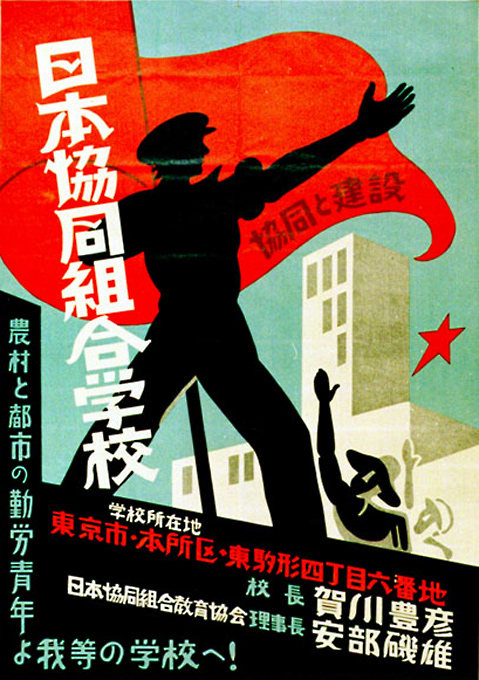
Document from the E.C.C.I. from July, 1927 on the specific development of capitalism in Japan, the growing role of Japanese imperialism, the largely unorganized but massive working class, Social Democracy in the country, and Communist organization and debates within as the illegal movement created the legal Farmer-Labor Party and Hyōgikai labor federations.
‘Theses of the Communist International on Japan’ from International Press Correspondence. Vol. 8 No. 2. January 12, 1928.
Adopted in the Session of the Presidium of the E.C.C.I. on 15th July 1927.
I. JAPANESE IMPERIALISM AND WAR.
The great rise in the relative strength of the Far East in world economics and world politics after the war makes the problem of Japanese imperialism particularly important. The strengthening of Japanese imperialism during the last ten years, its growing aggressiveness, its penetration of China, India, the Near East, the Pacific Islands, U.S.S.R. territory, etc., transformed Japan into a first-class imperialist power of the vast Asiatic continent.
One of the main junctures of antagonisms inherent in world capitalism is forming itself on the Pacific. At the same time, one of the most powerful revolutionary movements of this age is developing in China, which will be of extraordinary significance for the progress of the world revolution. The destinies of Japanese capitalism are becoming ever more closely merged with the destinies of world capitalism. The Japanese imperialists play a most active role in preparing the coming war. It may be stated that they are already conducting this war insofar as Japanese intervention in China is an accomplished fact.
A neutral position on the part of Japanese capitalism in regard to the Chinese revolution is out of the question, as its most vital and essential interests are linked up with those of China. China is the main source of raw material for Japan with her limited coal and iron deposits. China is the principal market for Japanese industry and 35% of Japanese exports are carried to Chinese ports. China is also the principal field for investment of Japanese capital. The Japanese bourgeoisie has invested about 2,500,000,000 yen in Chinese, particularly Manchurian, factories, mills, mines and railways. Naturally, Japanese imperialism sees in the development of the Chinese revolution a direct menace to its own interests and will not stop at anything, at any expenditures or alliances in order to choke the labour and agrarian movements.
Being the most dangerous foe of the Chinese revolution and pursuing an extraordinarily crafty diplomatic game, Japanese imperialism managed to get possession of the most important strategic positions in China. Japanese imperialism is adopting an ever more open and active counter-revolutionary policy in China, particularly since the Chinese bourgeoisie headed by Chang Kai-Shek went over to the camp of the counter-revolution.
The hostility of Japanese imperialism to the Chinese revolution is being intensified also because its development constitutes a direct menace to Japanese colonial domination, it may affect her most important colonies particularly Korea. The struggle against the Chinese revolution drives and to a considerable extent has already driven the Japanese imperialists to form a bloc with the British imperialists for joint action against the Chinese workers and peasants at the present time and for joint preparations for war against the U.S.S.R. in the more or less immediate future.
A bloc of Japanese imperialism with America and Britain for a struggle against the Chinese revolution and the U.S.S.R. will not eliminate the profound and ever sharpening contradictions between them. The interests of Japanese and British imperialism are already sharply clashing in China. The erection of a British naval base in Singapore is not in vain regarded by the Japanese press as a hostile act openly and directly directed against Japan.
The antagonisms between Japan and the United States are still sharper. The American immigration law affected Japan most of all. At the same time there is a process of United States expansion on the Pacific conflicting with Japanese expansion and bringing about a clash between the two powers ever closer and more inevitable. Combating jointly, the Chinese revolution and jointly preparing a war against the U.S.S.R., the United States, Britain and Japan are at the same time preparing for war amongst themselves, preparing a sanguinary struggle for an imperialist partition of the Pacific basin.
II. THE INTERNAL SITUATION.
The development of Japanese imperialism which began rather late as compared with Europe only in the ’60s of the 19th Century proceeded with unusual rapidity. The rate of development of Japanese capitalism was not only not retarded by the war and after but on the contrary Japanese capitalism made enormous progress during that period. In contradistinction to Britain, in contradistinction to the capitalist countries of Europe, Japanese capitalism is undoubtedly now on the rising curve of development, although the resources and possibilities of its development are incomparably more limited than those of the United States. The mercantile tonnage of Japan was 2.5 times greater in 1926 than in 1912; her railway network was 87% greater than in 1912; the output of textiles was 273% greater than in 1912; and the production of electric power increased more than 6 times.
The extraordinarily rapid growth of industry was connected with a rapid development of capitalist relations, with a growing political importance and relative strength of the Japanese bourgeoisie which resulted after a whole series of internal conflicts and compromises between the nobility and the bourgeoisie in the transformation of the government. The present Japanese government is in the hands of a bloc of the capitalists and landlords. The capitalist and landlord bloc being in general an extremely characteristic feature of the Japanese imperialist epoch possesses however certain specific peculiarities resulting from the peculiar conditions of development during the last 60 years.
The revolution of 1868 opened the path for capitalist development in Japan. Political power however remained in the hands of the feudal elements, in the hands of the big landowners, in the hands of the military and royal clique. The feudal traits of the Japanese State were not merely traditional relics, rudimentary survivals of the past, but also a very convenient instrument for primitive capitalist accumulation skillfully utilised by Japanese capitalism throughout the entire course of its further development.
The transformation of the old Japanese State into a bourgeois State proceeded along two different ways: on the one hand the relative strength and the political significance of the industrial, commercial and financial bourgeoisie was continually increasing and on the other hand the process of blending the feudal strata with the new bourgeoisie was very rapidly developing, stimulated by economic causes, by the fear of the labour and peasant movement and by the requirements of imperialist policy.
The Japanese State is in itself a powerful element of Japanese capitalism. Not in a single European country has there been such proximity to State capitalism as in Japan where according to some estimates 30% of all capital invested in industry and finance, not including the railroads which are almost entirely in the hands of the government, belong to the State. The Mikado is not only a big landowner, but also a very rich stockholder in many stock companies and combines. Finally, he has also his own bank with a capital of 100 million yen.
The process of capitalist concentration and merging of industrial with bank capital into finance capital, the process of trustification and concentration, has also gone very far in Japan. Thus if on the one hand the Japanese State is the greatest capitalist enterprise, on the other hand, of the two ruling parties of Japanese bourgeoisie the Seiyukai and Kenseykai is maintained by, and ministers to, the interests of the Mitsui concern and the other is maintained by, and ministers to, the interests of the Mitsubishi firm. Thus there is a two-fold process of lending to the old feudal forms a bourgeois content and a parallel process of transforming the bourgeoisie into a counter-revolutionary factor which, although it does have a good many differences with the feudals, is nevertheless acting jointly with them against the labour and agrarian movements.
The struggle for the democratisation of the Japanese State, the liquidation of the monarchy, the removal of the present ruling cliques from the government, in a country which reached such a high level of trustification, will therefore inevitably transform from a struggle against feudal survivals into a struggle against capitalism itself. The bourgeois democratic revolution of Japan will very rapidly grow into a socialist revolution because precisely the contemporary Japanese State, with all its feudal attributes and relics, is the most concentrated expression of Japanese capitalism, embodying a whole series of its most vital nerves, and a blow at which will also be a mighty blow to the capitalist system of Japan as a whole.
The prospect of a rapid transformation of the bourgeois democratic revolution into a socialist revolution does not at all, of course, eliminate the problem of the bourgeois democratic revolution as such. No matter how far the process of merging the bourgeoisie with the landlords has proceeded, large-scale land ownership still continues to be a very significant and highly independent factor in the political and economic life of the country.
Regardless of the stormy development of capitalism in the towns, the villages are still characterised by extreme backwardness, both from a technical and a socio-economic aspect. Lack of land and great poverty prevails among the peasants. Whereas 5.5 million peasant families, i.e. 80% of the peasants cultivate patches of 1.1. cho (about 3 acres), 0.1% of the peasants possess 8% of all cultivated areas. The system of usurious rent is widespread in Japan. Almost half of the crops gathered from 40% of the entire cultivated areas are paid in rent by the tenants to the landowners. These few figures illustrate the acute agrarian problem in Japan. They show that the agrarian revolution has already ripened and that the problem of the bourgeois democratic revolution is an actual problem.
There are thus in Japan both the objective pre-requisites for a bourgeois democratic revolution (the feudal survivals in the governmental State structure, an acute agrarian problem), and the objective pre-requisites for its rapid transformation into a socialist revolution (the high level of concentration and trustification of capital, the close blending of the State with the trusts, the relatively great proximity to State capitalism, the unity and bloc of the bourgeoisie with the landed nobility).
But if Japanese economics lead directly to revolution, the backward ideology or what Lenin called “the subjective revolutionary situation”, in contradistinction to the “objective revolutionary situation” is a great impediment and stumbling bloc. Neither the proletariat nor the peasants of Japan have any revolutionary traditions or any experience of struggle. The broad masses are only now awakening to political consciousness, and only an insignificant section at that. The labour and peasant organisations are very few and scattered, and so far not much active. Class sentiment, and understanding of the necessity of class struggle, is still stifled by patriotic poison or pacifist illusions among the broad masses. The political consciousness of the proletariat–let alone the peasantry its class consciousness, its revolutionary organisation, are only hardly beginning to come out of their embryonic stage. It is precisely in this direction that the Japanese Communists must devote their most serious attention and greatly exert their energy.
At the present time the two main bourgeois parties the Seiyukai and Kenseiyukai replace each other by rotation in the government. Both of them are not only closely connected with big capital but represent the direct and open political agencies of the two most powerful capitalist concerns of the Mitsui and Mitsubishi companies.
Whereas, however, the Seiyukai is more closely linked up with the nobility and the military royal cliques whose role in the government is very great, the Kenseikai acts as the representative of the quasi-liberal bourgeoisie which aims at the consolidation and support of the government machine of capitalist exploitation with the help of more “liberal” methods. Thus, in 1925, the Kenseikai, extended the franchise. In contradistinction to the Seiyukai the Kenseikai occupies also a more moderate position in relation to the U.S.S.R.
There is no doubt, however, that, as in the struggle against the revolutionary movement in the Japanese colonies and in Japan itself there will be no essential difference between the two parties.
Japanese imperialism is still on its rising curve of development. However, the contradictions of its position, and the growing difficulties of further development, begin to assume a menacing character, which, by the way, takes the form of an acute capitalist crisis. There is no doubt that the Japanese bourgeoisie has already overcome the post-war crisis and to a considerable extent also the effects of the earthquake of 1923. But at the same time, the development of the revolution in China places the main sources of raw material for Japanese industry, and the colossal profits accruing from the capital invested in China in a precarious position. It also menaces the colonial possessions of Japan in Korea, Formosa, Manchuria, etc. The struggle against Britain and the United States, the imperialist great-power policy, imposes upon the shoulders of the broad masses of the people enormous and absolutely unbearable burdens of militarism and navalism which, in their turn undoubtedly hamper the development of the productive forces.
The poverty of the peasants and the working class whose wages in 1926 were considerably reduced, thus injuring the home market makes the question of the foreign market very acute. Japanese bourgeois economists do not write in vain about super-capitalisation, about such extension of the industrial apparatus which is by no means in keeping with the possibilities of the absorption of the home market. Finally, the great surplus population intensified by the American immigration law undermines still further the social system of Japanese capitalism. All these factors represent the elements of the “objective revolutionary situation”, which, at the same time, revolutionise the broad masses of workers and peasants and help to create and develop a subjective revolutionary situation”.
The process of proletarianisation of the petty bourgeois strata is now rapidly developing in Japan. Despite the high level of capitalist development, the semi-colonial duration of the working day and semi-colonial low rates of wages still prevail. The so-called “labour legislation” is entirely directed against the workers. Strikes and trade unions are still illegal. The woman has absolutely no political or social rights. The Communist Party has been driven underground and mere membership of the Party is punishable by ten years imprisonment. All these factors cannot but radicalise the masses. These factors have fertilised and still continue to fertilise the ground for Communist propaganda and organisation.
III. THE DRIVING FORCES IN THE JAPANESE REVOLUTION.
Japan is now governed, as was pointed out above, by a bloc of the bourgeoisie and landlords a bloc under the hegemony of the bourgeoisie. This being so, illusions that the bourgeoisie can in any way be utilised as a revolutionary factor, even during the first stages of the bourgeois democratic revolution, must be abandoned. Analogies with China stand no criticism. China was and is an object of imperialist policy whereas the Japanese bourgeoisie is itself a first-rate imperialist power. In China the “nationalist” bourgeoisie was fighting for power at the beginning of the revolution, whereas the Japanese bourgeoisie already holds power, is already utilising extensively the whole government machinery with all its feudal attributes and relics for the organisation and protection of capitalist exploitation. And finally, a great factor in this respect is the circumstance that the level of capitalist development in Japan is so high that the bourgeois democratic revolution will directly develop into a socialist revolution, a revolution against capitalism as such.
The driving forces in the Japanese revolution are the proletariat, the peasantry and the urban petty bourgeoisie. In the first place, however, it is the proletariat and the peasantry. The Japanese proletariat must combine its struggle for a social revolution with its hegemony in the struggle of all toilers of Japan for a bourgeois democratic revolution. There are in Japan all necessary prerequisites for setting up a revolutionary alliance of the workers and peasants to counter-balance the reactionary landowner and capitalist alliance. A correct political line on the part of the working class in relation to the peasantry is one of the most vital prerequisites for a successful development of the revolution in Japan.
The peasantry can be victorious in its struggle for land, in its struggle against feudal survivals, the oppression of contemporary concentrated capitalism, exclusively under the leadership of the working class. The history of any country shows that the peasant movement is always doomed to failure unless it is led by the proletariat. On the other hand, in a country like Japan where more than half of the population is agrarian, the isolation of the proletariat from the peasantry would be fraught with the greatest dangers, and would give the most effective weapon into the hands of the bourgeoisie. An alliance of the proletariat with the peasantry is absolutely essential in the interests of both classes. But this alliance will be revolutionary and victorious only if the working class will have the hegemony. For the working class, the bourgeois democratic revolution is merely a step on the road to social revolution. By leading the bourgeois democratic revolution, the proletariat does not lose its class perspectives. On the contrary, it is precisely the prospect of transforming it into a socialist revolution which is the decisive factor for the proletariat at all stages of the struggle.
The proletariat is the only consistent revolutionary class–a revolutionary class to the end. The hegemony of the proletariat in the workers’ and peasants’ alliance is necessary also, in order to overcome the half-heartedness, indecision and possible hesitation and vacillation on the part of the peasantry. The peasantry belongs to the petty bourgeoisie and the power of the petty bourgeoisie is a “power of vacillation”. The working class and its Communist Party must always bear this in mind. The bourgeoisie always endeavoured and undoubtedly will also try in Japan to utilise this “power of vacillation”. These vacillations can at a certain stage of development become extremely dangerous for the revolution, and especially at the stage of its transformation into a socialist revolution when the bourgeoisie will vigorously play on the instincts and prejudices of the petty proprietor inherent in the peasantry. Only the hegemony of the tempered, class conscious and consistent revolutionary proletariat, under the leadership of the Communist Party, can neutralise and overcome these vacillations which may otherwise become disastrous.
An alliance of the proletariat with the peasantry means, of course, in the first place an alliance with the rural poor. Supported by the poor peasantry and through them the proletariat establishes connections with, and leads the, main mass of the peasantry.
All objective prerequisites for a revolutionary alliance with the working class and the peasantry in Japan are undoubtedly present. However, these objective prerequisites must be realised organisationally. The Japanese peasantry suffers the greatest poverty and is pressed down by high taxes and rates of rent. The revolutionary movement is growing with extraordinary rapidity among the rural proletarians and semi-proletarians. Already about 12% of the peasantry are organised in peasant leagues. The Communists must exert all their energy for rallying all these leagues to the Workers’ and Peasants’ Party, under revolutionary Communist leadership. The reactionary alliance of the landlords and capitalists must be counter-balanced by a revolutionary alliance of the workers and peasants.
IV. THE COMMUNIST PARTY AND ITS ROLE.
The working class can secure victory only under the leadership of its most advanced, revolutionary, conscious and organised section, the Communist Party. The experience of Germany, particularly Bavaria, Hungaria and Italy has shown the absolute correctness of Lenin’s idea that without a firmly consolidated, ideologically consistent Mass Communist Party, no victorious proletarian revolution is possible.
Nowhere does the working class constitute an absolutely homogenous mass. This is also the case in Japan. There is a whole series of different layers, with different standards of living, different political, cultural and other development. Everyone of these strata can, and actually does, have its own interests which, for the politically most backward and least class conscious workers may befog, and often does befog, the general class interests of the proletariat. Only through a prolonged mass struggle is it possible to overcome these craft differences. Even in a country like England, craft division of the proletariat is by far not as yet liquidated, both ideologically and organisationally. The bourgeoisie with the help of its Social-Democratic and trade union agents energetically cultivates and fosters in its own interests these craft differences.
With this craft division is also closely linked up, and partly resulting from it, another danger, namely “Economism”. For the most politically backward section of the working class, the daily struggle and concrete demands advanced during economic conflicts, befog the struggle against capitalism as such, the struggle for the complete and final emancipation from capitalist exploitation, which is possible only through revolution, through the acquisition of State power by the proletariat, through the establishment of the proletarian dictatorship. “Economism” being an infantile sickness of the labour movement is at the same time the soil on which grows the worst sort of opportunism, an ideology adapting the proletariat to the capitalist mode of production instead of rousing it to a revolutionary struggle against it.
The Communist Party is the revolutionary vanguard of the proletariat fighting for the fundamental historical interests of the working class as a whole. Without a Communist Party it will be impossible to overcome the class limitations and “Economism”. Without a Communist Party there can be no struggle for the proletarian dictatorship. To the same extent that it is inadmissible to lose sight of the principal task of the proletariat the establishment of the dictatorship in the partial demands put forward in the daily struggle, to the same extent it is also necessary to preserve the main revolutionary perspectives at every given stage of the struggle and the preference of this perspective to everything else, and to the same extent is it necessary that the Communist Party should actively participate in the daily struggle and lead it, actively working in the mass organisations and leading them but at the same time preserve its ideological and organisational, independence, preserve its own identity, the identity of the revolutionary vanguard of the working class. Any other orientation practically signifies the stooping towards opportunism and, in the final analysis, results in the abandonment of the political struggle against capitalism the struggle for the abolition of capitalism.
One of the principal errors of the Japanese Communist leadership consisted in the underestimation and misunderstanding of the role of the Communist Party, and in the under estimation of its specific importance in the labour movement. The idea that the Communist Party can in any respect be substituted by Left trade union fractions or a broad workers’ and peasants’ party is fundamentally wrong and opportunistic. Without an independent, ideologically sound, disciplined and centralised mass Communist Party there can be no victorious revolutionary movement. The struggle against every form of liquidatory tendencies, particularly those which found their expression in Comrade Hoski’s policy is therefore the first task of the Japanese Communists. Just as in the struggle of all toilers, it is necessary in the interests of all that the most advanced revolutionary section, the working class, should take the leadership, it is also necessary that in the interests of the struggle of the working class, the Communist Party, its revolutionary vanguard, should take the lead.
The main task now in Japan therefore, is to attain a quantitative and qualitative improvement of the Communist Party. Working intensively in the matter of raising its ideological and political level, the Party must at the same time get more members, embrace and organise in its ranks all the progressive and revolutionary elements of the Japanese proletariat and, step by step, consolidate and conquer its leading positions in the Japanese labour movement.
V. THE COMMUNIST PARTY AND SOCIAL DEMOCRACY.
Under the present conditions, a Communist Party can develop in no other way but through a struggle against Social Democracy. This is also absolutely so in Japan. The Social Democratic Party of Japan has 12,000 members and about 150,000 sympathising workers organised in the trade unions. The Social Democratic leaders are the bought agents of the bourgeoisie, at whose behest they try to poison the masses with opportunism, patriotism and social imperialism. A struggle for the masses, and particularly a struggle for the Social Democratic workers, is impossible without permanently and energetically exposing the Social Democratic Leaders, their treacherous policy in respect to the Chinese revolution connected with the Chang Kai-shek orientation, their spreading of parliamentary illusions, their role as helpmates and camp-followers of the pseudo-liberal bourgeoisie.
The Communists must especially expose the treacherous role of the so-called “Left” Social Democrats. This centrist group has at the present time the leadership in the Nihiroto Party, which has about 6000 members, and the support of 5000 workers and peasants organised in the trade unions. The leaders of that Party, just as all “Left” Social Democrats, are distinguished from their Right brothers only by their use of Left phrases with which they hide their opportunism before the eyes of the Communist Party.
The objective position of Japanese capitalism, as well as the historical development of the Japanese labour movement, creates an extraordinarily favourable situation for a struggle against Social Democratic influence. In Japan the working class has no strong Social Democratic organisations that have been in existence for several decades and there are not deeply rooted Social Democratic traditions. The “upper layer” of skilled workers, on which reformism is usually and primarily based, is relatively insignificant in Japan. The average wage is extremely low. The enormous and incessant influx of labour power from the impoverished rural districts, the enormous pressure of agrarian over-population, intensified by the American closed doors for immigration, makes the raising of the standard of living of the Japanese workers under capitalism highly improbable. Of course, Japanese capitalism, being imperialist capitalism, possesses certain possibilities of buying some sections of the upper strata of the working class. Nevertheless, it can already be foreseen that the reformist efforts to implant American opportunist trade unionism in Japan will meet with failure.
VI. THE COMMUNIST PARTY AND THE TRADE UNIONS. THE COMMUNIST PARTY AND THE MASS LADOUR ORGANISATIONS. THE UNITED FRONT PROBLEM.
It has already been pointed out that the development of the Communist Party as an independent organisation is a decisive factor in the development of the Japanese revolutionary movement. In this connection, the necessity for a rapid and decisive liquidation of the old mistakes of the leaders of the Communist Party, particularly the deviation represented by Comrade Hoski was emphasised. Lately, however, another, a counter-deviation, has gained much influence in the Party. The leader of this tendency is Comrade Kuroki.
The Communist Party of Japan will be in a position to solve its historical tasks only as a mass party. There is no doubt that the Communist Party of Japan must work energetically in raising its ideological level. It must definitely realise that without “revolutionary theory there can be no revolutionary movement”. But it must just as definitely realise that without a revolutionary mass struggle, without actual and strong connections with the masses, theory is futile. The Communist Party of Japan must become a workers’ party not only in aim but also in composition. Its proletarian kernel must first of all be greatly strengthened.
If it is erroneous and disastrous to adopt the course of dissolving the Communist Party in the Left wing of the trade union movement, it is no less erroneous to be isolated from the mass organisations of the proletariat. The “split and unity theory” advanced by Comrade Kuroki is nothing but the substantiation of such policy and differs most radically and decisively from Leninism. Instead of analysing the concrete tasks facing the Communist Party of Japan, and the methods of their solution given by history, Comrade Kuroki proceeds from artificially and arbitrarily formulated abstractions and is occupying himself with the development and application of principles of logic instead of trying to understand the actual relationship. Mass organisations are on the one hand the reservoir from which the Communist Party gathers new forces and on the other hand a transmission belt which connects the vanguard with its class, with the whole mass of the workers. The larger the proletarian mass organisations, the greater are the possibilities of the Communist Party’s reservoir, the broader is the audience which the Communists can address. The policy of splitting the mass organisations is therefore a policy of breaking up the reservoirs, limiting the radius of its activity, weakening of connection with the masses and self-isolation from the masses. It is hardly necessary to prove that such policy has nothing in common with Bolshevism.
At the same time, the policy of splitting the mass organisations practically means nothing but the abandonment of the struggle for the Social Democratic workers, the abandonment of the struggle for the conquest of the centrist workers, an abandonment of the exposition of the avowed reformism of the Rights and the tacit reformism of the “Lefts” concealed by “Left” Social Democratic phrases. Such abandonment would undoubtedly be of service to the Social Democrats, but it has nothing to do with Bolshevism.
The labour movement of Japan is still very young and poorly organised, in spite of the fact that the most advanced section of the Japanese proletariat is rapidly developing ideologically, having passed through the state of pure syndicalism and trade unionism, towards the adoption of the ideas of the political class struggle ideas which are lately being adopted by the vanguard of the Japanese proletariat. The Japanese proletariat has no revolutionary traditions. It has no great experience in the class struggle. Out of the 4.5 million factory and transport workers of Japan, there are only about 300,000 in the trade unions and political parties which are broken up into several competing organisations. It is the task of the Communists to fight against this situation and for the creation of mass organisations of the Japanese proletariat. The policy of the Japanese Communists by splitting such organisations as the Rodo Sodomei, Nomin Kumiai, etc., was therefore radically wrong. The presence of mass proletarian organisations is an absolutely necessary prerequisite for the normal and healthy development of the Communist Party. The struggle against the opportunist and reformist leaders must be carried on in such a way as not to estrange the Left elements of the trade unions and mass parties but to fight within these organisations by exposing the leaders and winning over the masses from them. Otherwise the Communists take the risk of becoming isolated from the mass labour movement. Communists must take active part in the everyday struggles of the working class and by doing so assume leadership in those struggles. They must prove to the workers that they are really the only staunch and consistent fighters for the interests of the proletariat. This is particularly necessary now when the bourgeoisie is waging an extensive and energetic offensive against the workers.
Broad mass organisations of the proletariat are the only possible basis for the Communist Parties. Not to understand this would be a most dangerous error for the young Communist movement of Japan.
The policy of mechanically politicising the trade unions as advocated by Comrade Kuroki must therefore be considered absolutely wrong. It has as its basis the absolute misunderstanding of the distinctions between a political party and a trade union, and the substitution of one by the other. In reality this leads to self-isolation from the mass movement, to the abandonment of the struggle against the reformists for the conquest of the mass proletarian organisations. What is necessary is not the mechanical politisation of the trade unions but the strengthening of the Left fractions within them, the strengthening of the influence of Hiogikai in them, and the consolidation and organisational strengthening of the Hiogikai itself.
The policy of strengthening and consolidating the trade unions and of winning them from within must be also extended in relation to the broad workers’ and peasants’ parties. The Communist Party must especially try in due course, to merge the workers and peasants’ party the Ronoto which is largely under Communist influence, with the Nichiroto which is now under centrist influence. The desperate opposition shown by the latter to such unity must be broken by the workers. This is one of the immediate tasks of the Japanese Communists.
Comrade Kuroki’s point of view leading to the tactical isolation of the party from the masses, leads also to the actual ruin of the Communist Party as a mass Party. This “split and unity theory” is not accidentally linked up with the exceeding and un-called for emphasis merely on the purely ideological aspect and the complete ignoring of the economical, political and organisational aspects. This, in turn, leads to the inadmissible overestimation of the intellectuals, to the isolation from the working masses, to sectarianism, to the idea that the Party is a group of “Marxian minded people” primarily, of course, intellectual people and not a militant organisation of the working class. The Communist Party must decisively put an end to this caricature on Leninism, which Kuroki himself has already rejected.
To win the Social Democratic and centrist workers, to conquer the trade unions and mass parties from within by means of the proposed united front tactic, meet, of course, with certain difficulties. Here particularly, big mistakes may be made by a young party which has not much experience in the class struggle. From this point of view the Japanese Communists must study especially the mistakes committed by the Communist Party of China in the Kuomintang. It stands to reason that the differences between the conditions in China and Japan must be taken into consideration. By adopting the united front tactic, the Communist Party must by no means lose its identity. By no means must it submit to the influence of those whom it is combating; it must preserve its absolute independence both ideologically and organisationally. It stands to reason that in speaking of a united front, it is necessary to have in mind not only a united front of the small illegal Communist Party with legal mass organisations such as the Ronoto and Toitsu Domai, but also a united front of mass organisations (the Ronoto Party for instance), under the influence of the Communist Party, with the mass Social Democratic and centrist organisations.
It goes without saying that the united front shall be effected strictly upon working class issues and fought for along class lines and, furthermore, no concessions of an ideological character given.
By organising the working class for the struggle against capitalism, the Communist Party must at the same time not fold its arms, but work for the creation of a revolutionary workers’ and peasants’ bloc and for guaranteeing to the working class the hegemony in that bloc. The Communist Party must support and organise the struggle of the peasantry for restricting taxation and for reducing rent. It must utilise the revolutionary activity of the peasants in the struggle against the war menace. It must lead the struggle of all toilers of Japan for the democratisation of the Japanese State for the liquidation of its feudal elements without at the same time forgetting the general perspectives of the transformation of the bourgeois democratic revolution into a Socialist revolution. The Communist Party must get into close contact with the liberation movement of the Japanese colonies and lend it all possible ideological and organisational support.
The Communist Party must energetically overcome that which was hitherto the greatest misfortune and shortcoming in its leadership, namely, the sectarian spirit. The slogan “closer to the masses” is very acute today in Japan.
Particularly, in this connection, the complete absence of work among the youth must be considered as a most serious error which must be overcome as soon as possible. This work will be of extraordinary importance in connection with the imminent war danger.
Finally, the Communist Party must fulfil with all its energy, its foremost duty at the present time as an organisation of international revolutionaries, namely, it must fight against Japanese intervention in China and against the preparation of war against the U.S.S.R.
Based on this, the Communist Party of Japan must advance the following programme of action and issue the following slogans:
1. Fight against the menace of imperialist war.
2. Hands off the Chinese revolution.
3. To the defence of the U.S.S.R.
4. Absolute independence for the colonies.
5. Dissolution of parliament.
6. Abolition of the monarchy.
7. Universal suffrage for both sexes from the age of 18.
8. Right of assembly, association, coalition, etc., freedom of speech and of the press.
9. The eight hour working day.
10. Insurance of the unemployed.
11. Annulment of anti-labour laws.
12. Confiscation of the estates of the Mikado, landlords, governments and church.
13. Establishment of a progressive income tax.
These partial demands and slogans must be linked up with the slogan of the workers and peasants’ government and the slogan of the proletarian dictatorship. Only with the help of systematic propaganda of these slogans will progress be made in the political education of the proletarian masses, in the organisation of the workers’ and peasants’ bloc, and in the preparation of a real revolutionary mass struggle.
The struggle for these demands leads to the dictatorship of the proletariat. But this struggle will be successful only if there will be a sound and ideologically consistent Leninist discipline, a centralised and mass Communist Party, fighting jointly with the world Communist Party marching shoulder to shoulder with the entire Communist International.
The admission by the Japanese delegation of its mistakes and its adoption of all directives and decisions of the Communist International, serve as a guarantee that the Communist Party of Japan will be able to overcome the deviations existing within it, will be able to take a correct political and organisational course in its work, will be able to cope with the great tasks raised before it by history.
International Press Correspondence, widely known as”Inprecor” was published by the Executive Committee of the Communist International (ECCI) regularly in German and English, occasionally in many other languages, beginning in 1921 and lasting in English until 1938. Inprecor’s role was to supply translated articles to the English-speaking press of the International from the Comintern’s different sections, as well as news and statements from the ECCI. Many ‘Daily Worker’ and ‘Communist’ articles originated in Inprecor, and it also published articles by American comrades for use in other countries. It was published at least weekly, and often thrice weekly.
PDF of full issue: https://www.marxists.org/history/international/comintern/inprecor/1928/v08n02-jan-12-1928-Inprecor-op.pdf

