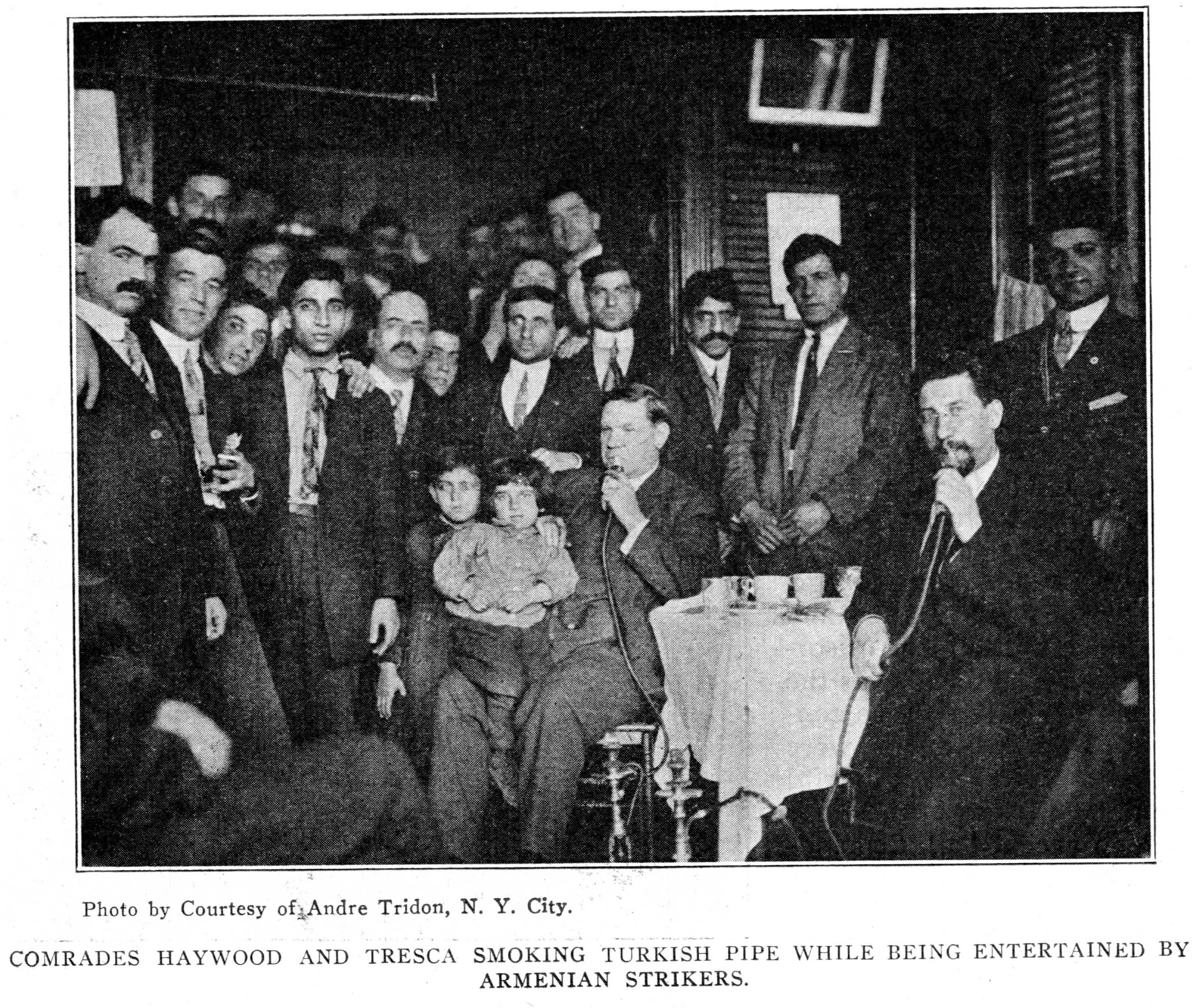
With far less factional strife than the previous convention, the Ninth I.W.W. gathering in September, 1914 at Chicago’s Hungarian Hall was notable for several things, among them the passing of the leading General Secretary-Treasurer office from Vincent St John to William D. Haywood; on Frank Little’s report the setting up of plans for what would become the most successful I.W.W. the Agricultural Workers Organization; and meeting just the World War began taking a strong anti-war, internationalist position authored by Haywood. A daily summary below.
‘The Ninth Convention of the Industrial Workers of the World’ from Solidarity. Vol. 5 No. 247. October 3, 1914.
The Ninth Annual Convention of the Industrial Workers of the World convened in Hungarian Hall, 2017 Evergreen Avenue, Chicago, Ill., at 9:30 A. M., September 21st, 1914. Twenty-five delegates were present.
After the reading of the list of delegates, Fellow Worker G.H. Perry was elected temporary chairman, and a Credential Committee nominated.
Convention adjourned until next morning.
Although not so many delegates were present as at last year’s gathering, those present seemed to be animated by a keen interest in the future of the organization. It was also noticeable that they were all typical specimens of the working-class rank and file, with some contempt for empty theorizing and a marked preference for action.
The second day, after the report of the Credentials Committee, Fellow Worker G.H. Perry was elected permanent chairman. The Constitution, Auditing and Ways and Means Committees were elected. Then followed the assignment of a number of resolutions from the locals, and one from the Syndicalist International, to the various committees.
After this were read the reports of General Organizer Wm. D. Haywood, General Secretary Treasurer Vincent St. John, the General Executive Board, G.E.B. Members, J.W. Kelly, J.M. Foss and F.H. Little, and the report of “SOLIDARITY” and the I.W.W. PUBLISHING BUREAU. These reports were all handed over to their respective committees.
As the above-mentioned documents will be considered by the convention when reported upon by the committees, in order to save repetition, their substance will then be given to our readers.
The Hungarian Hall is a fine building, the property of the organization, and of ample size. The pool-room provides a means of relaxation for the delegates during recess. Visitors have been few during the first two days.
Wednesday morning, Sept. 23rd, saw a much larger number of visitors who turned up to witness the proceedings than hitherto. A photographer from one of the Chicago papers wished to photograph the group of delegates. The matter was submitted to them and was promptly and unanimously rejected: there was evidently no overweening desire for newspaper fame among those assembled.
A proposal which met with instant and general approval was one to send telegrams to all those who are at present in jail in the cause of labor.
A long discussion followed the finding of the Constitution Committee on Resolution No. 3, submitted by Local 8, Br. 1, of the M.T.W., Philadelphia. The Committee did not [] in the resolution, which was to the effect that the per capita tax should be split three ways by Local Industrial Unions, where there is a District Council: five cents going to General Headquarters, five to the N.I.U. and five to the District Council.
Del. Baker, of Philadelphia M.T.U. supported the resolution. He explained the need of organization in Philadelphia and the necessity of sufficient funds being on hand for organizers. G.E.B. Member Little said the locals advocating the split in the tax did not realize that their district was not the only place on the I.W.W. man.) In many other localities and industries were masses of workers needing organization. Fellow Workers Nef of 341. Chicago, and Herman, of 179, New York, both expressed themselves as opposed to any cutting of the amount which goes to General Headquarters as it would certainly make more difficult the country-wide organization of industry Gen. Sec-Treas. St. John said that if the locals could not get any organization done with the 35 cents per member they could do but very little more with the extra few cents. He showed that the M.T.W. would have had less funds under the proposed change than they have previously had, as they have received financial help from the Gen. Office exceeding in value that which they would have saved by splitting the tax. At present there were demands for organizers from all parts of the country and Headquarters. could not respond because of scarcity of funds. It would be suicidal to still further limit the funds at disposal for general organizing purposes. Dels Inger, Christ, Boose, Mattingley and others spoke against the change. G.E.B. Member Welsh and Del. Baker said that the proposal was the effect of the influence of irresponsible persons who dropped into locals and affected the membership. The motion was carried to adopt the recommendation of the committee that the resolution be not accepted.
A resolution to limit delegates at conventions to one vote each, irrespective of the size of the bodies they represent, was lost after some discussion. A number of other minor resolutions to amend the constitution were unfavorably disposed of.
The discussion of the Gen. Organizer’s report was encouraging and constructive, ending in the declaration of the convention to adopt certain suggestions with regard to the unemployed trouble in the coming winter. It was understood that parades to City Halls, Capitols, and so on, should be discouraged as nothing more substantial than hot air is to be found in these political centers. The delegates agreed with Haywood that the places for the unemployed to demonstrate were the places where there was plenty of food and clothing, so that they could help themselves. It was also determined that the organization should take definite steps to organize the unemployed with a view to both immediate relief and eventual membership in our organization in times of prosperity. Another suggestion in the Gen. Organizer’s report which was unanimously endorsed was that of providing regular instruction for the development of speakers and in organization book-keeping.
Today, Sept. 24th, the convention proceedings were particularly noticeable, for the amount of genuinely constructive work accomplished.
It was realized that an urgent necessity of our growing movement was a number of fellow-workers efficiently trained in book-keeping, auditing, publicity and relief work, who would always be ready to take up the burden of work in great labor upheavals. The necessity of a uniform system of book-keeping was also advanced. This induced the delegates to decide that measures should be taken for the instructing of the membership on these lines.
Several pregnant suggestions were adopted regarding the increased circulation of SOLIDARITY. Emphasis was laid upon the systematic house-to-house distribution of papers, to be followed up by subscription campaigns. It was recognized that one of the most important things is the retaining of present subscribers. This could best be achieved, according to several delegates, by the sending of mailing lists from SOLIDARITY’S office to the locals, the members of which would then institute a visiting campaign in order to induce previous subscribers to renew. During the discussion on G.E.B. Member Little’s report, dealing with the section relating to his trip through the harvest country, it was decided that some means should be taken for concerted and efficient action on the harvest fields next year. It was proposed that a conference be held, composed of members from the different locals bordering the harvest district, and that this conference determine ways and means for the harmonious grouping of the hitherto spasmodic efforts of harvest organization.
An important motion, which was passed unanimously and without discussion, was that all speakers be instructed to recommend to the workers the necessity of curtailing production by means of “slowing-down” and sabotage. All rush work should be done in a wrong manner. The publication of an explanatory leaflet on this subject was recommended.
A motion to throw open the membership of Propaganda Leagues to all applicants regardless of economic status was emphatically turned down.
The convention recognized the necessity of holding more and larger protest meetings, and in other ways providing more publicity for men in jail. It was pointed out by fellow worker Little that the Hop Strike in California, although strong enough to materially affect the pocket books of the Hop Barons did not secure the liberty of their imprisoned fellow workers. The fight should be carried on into the fruit ranches of California. Every man that can should go to California this winter without neglecting to carry a couple of Sab Cats with him.
Another adopted resolution, which bids fair to give an added impetus to propaganda was the recommendation that a manifesto be prepared to be scattered country-wide among the English speaking workers. It was recommended also that data be gathered for the preparation of leaflets in various foreign tongues. Altogether, this day was auspicious because of the amount of fruitful and constructive matter which was. submitted to the delegates and because of the hearty manner in which it was received and endorsed.
On Friday, the 25th, the concluding session of the convention was held. The proceedings, from beginning to end, were marked by unusual ability to dispose of business with dispatch, without friction or waste. One of the most important resolutions adopted was one to send out a call, through General Headquarters. for I.W.W. men to settle temporarily in Montana in order to make their influence felt on the industries of the state. This, it was expected, would influence the good gentlemen who are so eager to call for the militia at every opportunity. The incoming G.E.B. was instructed to draft a message to be sent to the Montana state authorities informing them that the present fight of the insurgent miners would be considered as our fight.
The result of the voting for officers was as follows: On ballot for General Secretary-Treasurer: W.D Haywood, C.L. Filigno, Jas. P. Thompson. On ballot for General Organizer: Joe, J. Ettor, Elizabeth Gurley Flynn, Fred Isler. On ballot for Editor of SOLIDARITY: B.H. Williams, Justus Ebert, Jas. P. Cannon. The following three delegates were elected to the G.E.B.: F.H. Little, W.E. Mattingly, Minneapolis. and A.C. Christ. Detroit. Vincent St. John declined nomination for Secretary-Treasurer and for General Organizer.
A forcible resolution against war was put by Wm. D. Haywood and was passed unanimously. The resolution was to the following effect: The world stands aghast at the wire raging in Europe where millions of men of many nations are killing each other with modern machines of slaughter. The ignorance of the working class is the reason for the continuation of the war. For the ignorance of class interest among the workers the politicians are responsible. The Social Democracy was a movement that engendered a spirit or patriotism within political boundary lines. The industrial movement will wipe out all boundaries and establish an international relationship between all races engaged in industry. We condemn the ruling class for their murderous instincts. We condemn the ruling class for the fall of civilization, for the terrible sacrifice of human life and for the destruction of property of immeasurable value. We, as members of the industrial army, will refuse to fight for any purpose except for the realization of industrial freedom.
Towards the close of the proceedings, the convention went into executive session in order to discuss organization matters to be referred to the G.E.B.
The general impression of both delegates and visitors was that a general and vital impulse to wider organization and increased militancy will result from this convention. Although nothing spectacular occurred this was, perhaps, one of the most notable of I.W.W. annual gatherings. It was marked by a rigid avoidance of personal vilification or of futile quibbling and was business-like and earnest all through. It seemed that the delegates and the membership which had sent them, realized to the full the mighty task which lies before our organization, and that they were resolved to lose no time and waste no energy in preparing for its accomplishment.
The most widely read of I.W.W. newspapers, Solidarity was published by the Industrial Workers of the World from 1909 until 1917. First produced in New Castle, Pennsylvania, and born during the McKees Rocks strike, Solidarity later moved to Cleveland, Ohio until 1917 then spent its last months in Chicago. With a circulation of around 12,000 and a readership many times that, Solidarity was instrumental in defining the Wobbly world-view at the height of their influence in the working class. It was edited over its life by A.M. Stirton, H.A. Goff, Ben H. Williams, Ralph Chaplin who also provided much of the paper’s color, and others. Like nearly all the left press it fell victim to federal repression in 1917.
PDF of full issue: https://www.marxists.org/history/usa/pubs/solidarity-iww/1914/v05-w247-oct-03-1914-solidarity.pdf

