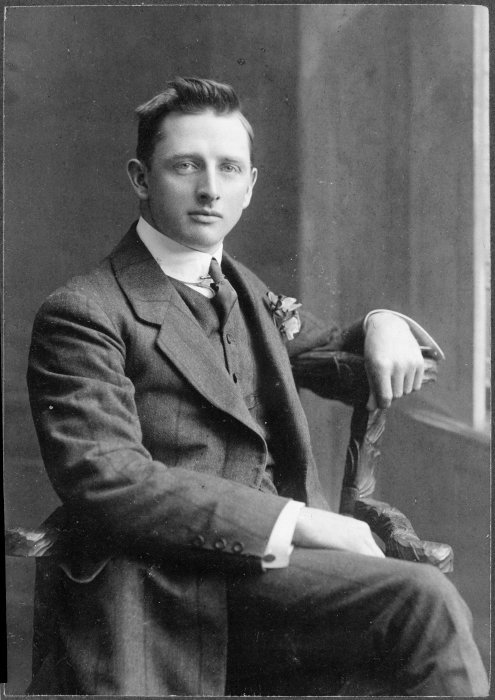
Tom Barker, born in England, was a self-educated, working-class Marxist, a leading figure in the New Zealand and Australian I.W.W., deported to Latin America for his anti-war and union activities, where he worked the Buenos Aires docks and became a leader of the international marine workers organizing. In 1921 he traveled to Europe to attend the Syndicalist Congress in Berlin and then as delegate to the first conference of the Red International of Labor Unions. Below is a letter where he describes Soviet Russia to his comrades in the I.W.W. He would stay in Russia working with Haywood on the Kuzbas Industrial Colony for years, though never joining the Party. A defender of the Russian Revolution, he remained a syndicalist and continued to write for both the wobbly and Communist press for a number of years. He would return to England in the late early 1930s where he worked for the Electric Company and stayed active for decades in Labor politics.
‘Red Russia and the I.W.W.’ by Tom Barker from Industrial Pioneer. Vol. 1 No. 3. April, 1921.
RED RUSSIA is passing from the war period to that of industrial construction. The Red Army, after its great victory over the White forces of General Wrangel, is demobilizing for the new fight on the industrial front, where problems are more complex and intensified. It is, I think, quite true that very few other countries could have withstood the combined forces of war, hunger and cold for nearly seven years in the way that Russia has done. Her people have an enormous power of resistance, which has left them still sturdy and strong in a contest that would have destroyed the more nervous Americans and Britishers by the million. The Russians have also enormous recuperative power, and I am sure that there is no country in Europe, excepting perhaps Norway and Sweden, where the general mass of the people are so healthy and vigorous. Such is their power of both resistance and recuperation that their health and vigor is maintained on food which would probably utterly ruin the fastidious stomachs of Western peoples.
Red Russia is alive to the needs of the moment. The end of the war and the pressing problems of economic reconstruction have precipitated an intense discussion upon the role of the unions in industry. The long series of wars upon nineteen fronts against the mercenary White Guards and the agents of world capitalism could only be waged by a highly centralized political and military organization. When one reflects upon the woeful state of both the political and military organizations after the fall of czardom and the Kerensky regime, one can see the tremendous organizing work that was necessary to throw a sense of direction into the aimless rabble, and by enthusiasm, propaganda and ceaseless hammering weld it into the most powerful of all modern armies.
Judging by what I have seen of the Red Army, the blood-stained imperialists of the West have as much opportunity of reducing Russia by their own dissatisfied and semi-mutinous troops as they have of unloading their shoddy goods on the inhabitants of Mars. The next time Russian armies have to march to repel an invader, they may probably not maintain that solicitude for staying within their own frontiers. The small Baltic states can neither fight nor permit outside troops to pass through their poverty-stricken lands. Finland is about to open trade with Soviet Russia, and Latvia is talking in a very conciliatory strain. The Polish imperialists cannot at present afford to give vent to their diseased policy of overrunning Europe and murdering the Jewish race. Roumania may give some trouble, but a little reflection will teach her to remember the ignominious trashing she received from the Germans in 1917, after she declared war in the usual high-sounding phrases so current among people who are bankrupt in everything else. So, undoubtedly, the efforts will come thru agents, smuggled in, to re-organize the counter-revolutionary elements still existing to some minor extent in Russia. These trouble-making gentry who could well spare themselves for some other much worthier cause—say, the white slave traffic—will find their work both hard and dangerous. The slogan, “War on the Bourgeoisie” is not a platitude, and the person—whatever his label—who works to bring more war, misery and hunger upon the Russian workers and peasants will thereby probably receive more attention than he bargains for.
As for the blockade, its effects are breaking down. It is true that highly essential things are lacking, even elemental things, but, as I have already said, the Russian will grow strong upon half the bread which he could eat. Russia’s harvest under normal conditions will feed her for five years. Last year was a bad crop year, but nevertheless the people obtained, despite this and the occupation of the best crop lands by the White Bands, nearly sufficient to feed everybody. Bad transport, engines in foul repair, dynamited bridges, destroyed track, all these have hindered the distribution of bread in some of the districts, which have gone hungry, while other districts have had a superabundance. But the best of the win¬ ter is over, and in two and a half months the country work will be in full swing, hundreds of thousands of men and women will go back to the land, the zealously guarded seed will be sown and then Nature herself will prove to the “big men with warped minds” that the blockade has been broken—not by Allied politicians, but by the Russian workers and by Mother Nature! Ploughs, are being repaired, here and there one sees a tractor being assembled. God knows how it came here; but it is going to send up the total of food produced in this great flat fertile country. Next year food will be plentiful. Vegetables and fruit will be a welcome change to the salt fish and the heavy bread. The damaged bridges will be repaired, three “sick” engines will become two “healthy” ones, the tracks will be regraded and ballasted anew, and, little by little, the feeble transport arteries will throb with new blood.
Russia is so great, so immense. Time is of little or no account and her people are slow. But there are 180,000,000 of them, and parasitism is almost destroyed. A little from so many, is ever so much more than the intensified complicated efforts of the workers in the capitalist world, working on weapons of destruction, or objects for the gratification of parasitism and all the odious professions which are bent upon perpetuating parasitism. A gorgeous and glorious year opens before Russia. It is the first year of Peace, the first year when her workers can turn from the anxiety of overthrowing her class enemies, and can enter upon the greatest work of construction that ever devolved on any people in history. If half the energy can be utilized in the reconstruction of industry that has been used in the organization of the Red Army, then success, while slow, will be assured. Such a condition of affairs is a challenge to the finest mechanics and inventors in Europe. Tools are lacking; labor is mostly unskilled. The crying need of the hour is for mechanical and technical workers; the war has killed off nearly all of them. Russia is overrun with theoreticians and draftsmen, but what she needs are men who can construct, men who can build. For instance, in Moscow there are thousands of large hotels and dwellings unfit for habitation simply because all the heating and plumbing arrangements have become disorganized and unusable. But a few I.W.W. men came into town, and under the leadership of one plumber, and with a scanty collection of tools, the obtaining of which “was like drawing teeth,” they began to solder and mend, and to put huge buildings back into use again. A little industrial experience is worth a great deal in Russia.
Russia is not perfect, but perfectly organized social systems do not fall from heaven; a great social transformation is not brought about by simply exercising the powers of pure logic. The bursting of the shell of the old society does not result in a full-grown economic chicken strutting gaily forth into the world. The period of transition is now on. The counter-revolution is not yet dead, nor is the bourgeoisie, either of Russia or of the world, ready to relinquish its designs on this country and its enormous resources. I was held up at Yamburg, the frontier station, for six days. From there I could see, half a mile away, a wrecked railway bridge blown up by White Guards, which had meant the loss of hundreds of rail miles, and perhaps the death of 10,000 workers thru starvation caused by the breakdown of the transport system.
As to the future in Russia, the I.W.W. may have little fear. Industrial construction is the essential thing, not for the moment but for many years to come. This implies economic organization, unionism, but not according to the outer-word conception of it. Speaking a week ago at the All-Russian Industrial Union of Miners, I said: “It is true that the mines in which you work, or in which you will work, are swamped by water, the machinery rusted and useless, or entirely destroyed by the White Bands, but bad as all this is, they are your mines! And bad as things are, are you not a thousand times better off now than the mining slaves of the great capitalist countries, who toil to enrich their masters, contract pthisis, lead-poisoning, and all the other ills and evils of the capitalist system?”
And so it is! It is so difficult for men who have lived all their lives under a capitalist dictatorship to realize the real position of the industrial workers in Russia. The full power is actually diverting to their hands. A few are opposing this, but certainly least of all men like Lenin or Bucharin, Tomsky or Zinoviev. I don’t believe that they desire to maintain one iota of power on the day the industrial workers are ready to assume it. But as I have said, the industrial workers are few in an immense country. Besides, as yet, the industries, owing to lack of fuel and raw material and defective transport, are only beginning to operate in part. So it is evident that while the power of the industrial workers is growing, and not merely growing, but loudly and clamorously asserting its growth, it is still a step, and possibly a fairly lengthy one before the full administration of Russia will fall entirely into their hands.
And to those who may disagree, I say, “Look at Russia!” The I.W.W. can help Russia greatly. The I.W.W. is respected in Russia more than any other outside organization. It is respected for its many fights against the American, Australian and South American authorities, and even more for what the I.W.W. have done, and are doing today in Russia. If ever there was a field for work, lasting, permanent work, it is in this country. Mechanics, engineers, turners, blacksmiths, tool makers, mechanic’s laborers, Russia wants you, and if possible, your bag of tools. And I tell you that you can fight the American boss from Russia, by building a proletarian civilization that will demonstrate to the workers of the whole world how stupid they are to tolerate the vile system of greed, piggishness and misery that prevails in capitalist countries. Industrial unionism is coming into its own in Russia, and as soon as the outside enemy is punished sufficiently to learn to leave well enough alone, all production will be carried on only to supply, to quote my old friend, John Benjamin King, “the economic wants of society.” The State will disappear, and people will live naturally, humanly and beautifully.
Fellow workers, you know as little of Russia as Russia knows of you! They have “put something across” and have lighted Eastern Europe and Northern and Western Asia with the Red Star of the Proletariat! Less criticism of Russia based upon lies and distorted facts, and more real help and desire to assist will be to the advantage of all. Remember how much Russia has done, and how little we of the outside would have accomplished, and do not presume that our experience is the sum-total of the world labor movement.
Industrial Workers of the World! If you are tired of keeping a boss, or of being continually broke, there is room and a welcome for you in Red Russia. In this country every ton of iron ore and every extra truck of coal is a nail in the coffin of capitalism, whereas in your country they mean only a speedier way to hunger and the road. Summer is coming and you will get all the food you want, and you can grow up with something in Russia, instead of going down with nothing in the land of hypocrisy, Wilson, Standard Oil, bull-durham, stool pigeons, bull pens and lawless law. Bring your card with you, and have it paid up!
Moscow, Feb. 1, 1921.
The Industrial Pioneer was published monthly by Industrial Workers of the World’s General Executive Board in Chicago from 1921 to 1926 taking over from One Big Union Monthly when its editor, John Sandgren, was replaced for his anti-Communism, alienating the non-Communist majority of IWW. The Industrial Pioneer declined after the 1924 split in the IWW, in part over centralization and adherence to the Red International of Labour Unions (RILU) and ceased in 1926.
Link to PDF of full issue:https://www.marxists.org/history/usa/pubs/industrial-pioneer/Industrial%20Pioneer%20(April%201921).pdf

