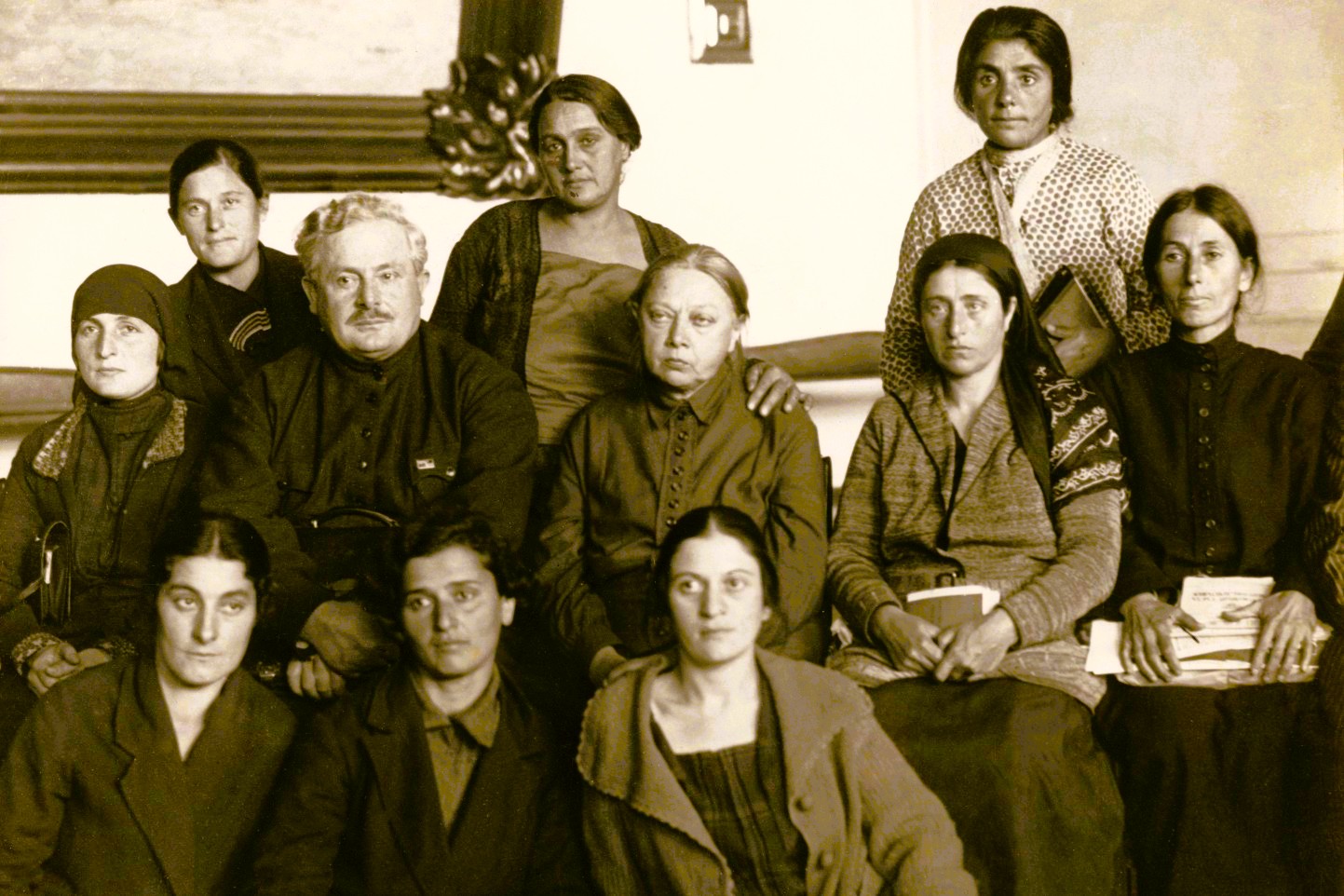
Embarking on the first Five Year Plan, isolated and surrounded by an existentially hostile imperialism, Krupskaya says the only way for Soviet women to advance and the Soviet Union survive was through a massive rising of the cultural level with its expansion of literacy, participation in administration, scientific knowledge, technique, and efficiency.
‘Knowledge is Power’ by Nadezhda Krupskaya from International Press Correspondence. Vol. 9 No. 13. March 8, 1929.
The results of the elections (in the R.S.F.S.R.) up to the 2nd February show that in the towns 24.6 per cent (as compared with 20.8 per cent at the last election campaign) of the candidates elected to the new Soviets are women, and in the country 19.4 per cent (as compared with 11.6 per cent). It will be seen that the number of women elected in town and country has increased by 3.8 and 7.8 per cent respectively. This is undoubtedly an advance, though the normal proportion is thereby by no means attained that is, if equal rights for women as laid down by the law were realised in actual life, then the proportion of women elected to the Soviets would be 50 per cent. This, however, is not the case. The inheritance of tradition is still too powerful. One of the chief causes hindering women from participating in the necessary extent in the Soviets is their cultural backwardness. When a comparison is drawn only in the European part of the Soviet Union, we find that two years ago the number of men able to read and write was considerably greater than that of the women. If we take the men and women in the towns from the age of 16 to 34 and 35 to 49, we find that in the first group 5.3 per cent (of the total male population) and 16.3 per cent (of the total female population) are illiterate, while the percentage of illiteracy in the second group is 10 and 17.8 per cent respectively; in the country the percentage for the first group is 18.4 and 52.6 respectively, and for the second group 29 and 78.9 per cent.
There exists a certain connection between the educational level and the activity of the electors. What did Comrade Lenin say? “He who cannot read and write stands outside of politics”. The urban population possesses a higher level of education than the rural, and therefore the activity of the electors in the towns is greater. At the last elections the participation in the towns was 50.7 per cent, in the villages 47.6 per cent. Meanwhile the liquidation of illiteracy has made progress, but more in the town than in the country. In the country the increase among those able to read and write is chiefly due to the women. The general increase of activity greater in the town than in the country is correspondingly accompanied by a considerable growth of the activity and authority of the women in the villages. The election participation in the towns rose to 64.3 per cent (increase 13.6%), in the village to 58.2 per cent (increase 10.6%). We must bring the election participation up to 100 per cent. This will, however, only be possible when we have achieved 100 per cent success in our campaign against illiteracy.
The working population places great hopes in the Soviet elections. The women elected to the Soviets will find that they have to learn much in order to cope with their tasks. Life is becoming more and more complicated, and it is necessary to view the situation clearly, to hold the helm on the right course and to hold it firmly.
The Soviet Union is not perfectly free. It is surrounded by the bourgeoisie. If we were not thus encircled by enemies, then we could develop at the rate required by our country: we could avoid crises at home as far as possible, we could make our influence felt solely by conviction to an extent of 99 to 100 per cent, we could choose the easiest path, instead of marching through thick and thin. We should thereby reach our goal more slowly, but without friction. But the fact remains that we are encircled by the bourgeoisie, and we must therefore realise that unless we harness every force at our disposal for the purpose of rapid advance, the bourgeois countries will defeat and destroy us. The bourgeoisie is always on the alert to attack the Soviet Union! We must not believe that it suffices to know how to hold a rifle, and to wear a gas mask, to become invincible. We must learn to handle a rifle so that no shot fails its mark, we must master the whole science of war, but at the same time we must be aware that military preparations alone will not secure our victory. Lenin wrote: “War is a test of the economic and organisational forces of any nation”.
If we continue to work on the same fines as our fathers and grandfathers before us, if we use the old prehistoric machinery, then half of our factories will lie idle; if we do not succeed in raising our industry to the level of modern technics and in rationalising labour; if we persist in using the wooden plough, if we do not keep our fields clear of weeds and other pests, if we do not organise our traffic service and commerce, then it will not be difficult for the capitalist countries to swallow us up. We must so re-organise our whole economy that it becomes one closely welded whole, in which the various branches of economy are indissolubly and properly combined. As early as December 1918 Comrade Lenin said:
“We maintain the standpoint that society must represent one great co-operative, both with regard to supply and to distribution…Society must be converted into a united co-operative of the workers.”
In order to attain this it is necessary for us to raise our industry and agriculture, our co-operative system, to a very high level. The re-organisation of industry, and of agriculture and trade, particularly a rapid re-organisation cannot be carried out without encountering the resistance of the exploiters, the resistance of those for whom the old order, the want and backwardness of the masses, were a source of advantage. It is therefore not by accident that at precisely this juncture, when we are energetically engaged in re-organising our industry and agriculture, and the Nepman has begun to adapt himself to the Soviet laws, the enemies of the Soviet power gnash their teeth. It is not by accident that they are trying by making use of our errors to agitate against the Soviet Government and the Party among the not yet class-conscious and still vacillating strata of the workers. Comprehensive agitation and propaganda must be carried on among the masses, the cultural level of the masses raised, the influence of the anti Soviet elements removed, the masses brought to take part in the work of building up Socialism. Comrade Lenin was right when he spoke, even at his dying hour, of the necessity of the greatest possible intensification of cultural and educational work among the masses, especially among the peasantry. He pointed out the extreme and decisive importance of cultural work.
Five years have passed since his death. We are now faced with this task to its full extent. The Soviets must now devote a maximum of attention to cultural work to drawing the workers, the middle and small peasantry, and especially the women, into this work, in order that the initiative of the workers themselves may be aroused and organised. In this work the Soviets must receive help from all sides: from the Party. the Young Communists, the trade unions, co-operatives, and voluntary organisations.
The village Soviets can play an especially important part. Cultural commissions are affiliated to the village Soviets. They must induce all workers, especially the organised section of the population, to participate in their work. They must at the same time exercise definite influence over the work of the schools, of the so-called reading huts, the libraries, Red Corners, the organisations for the liquidation of illiteracy, etc. They must ensure that all children (boys and girls) attend school; they must approach the parents who keep their children away from school, find out their reasons, and endeavour to remove them. The culture commissions must provide for special courses of instruction or schools in villages where there are still a large number of illiterates, and see that these are kept going regularly. The culture commissions must persuade the illiterates to learn, must see that the reading huts are always open and have sufficient books for children and adults. The culture commission must take care that the schools accord sufficient attention to the children of the small peasantry, that nuclei and various circles and courses of instruction are organized, and crèches and kindergartens provided for the relief of the mothers. The culture commission or section can accomplish much. It can insist upon more newspapers being sent, especially for the small peasantry, upon the village being brought into contact with the town by means of the wireless, upon cinema performances being given in the villages. And by thus raising the cultural level of the rural population, it will awaken at the same time their upward striving towards a new order, new economic organisation, and a new organisation of economic life.
The culture commissions of the village Soviets must be provided with popular pamphlets, to be placed within the reach of every peasant woman.
The work done in the culture commissions of the towns must be no less energetic. The workers must become the masters of their own lives, not only in the eye of the law, but in actual fact. The greatest obstacle to this is the low cultural level of especially those strata who stand most in need of the help of the Soviet power, the badly organised and less class-conscious strata. The working and peasant women have experienced for themselves, more than any other class, the weight of the fetter of ignorance and cultural backwardness. Therefore the peasant and working women who have been elected to the Soviets will certainly give a great share of their attention to the work of the culture commissions. They themselves know, and will convince the others, that knowledge is power.
And we shall all give our help to the city and village Soviets, to the activity of the working and peasant women on the cultural front.
International Press Correspondence, widely known as”Inprecor” was published by the Executive Committee of the Communist International (ECCI) regularly in German and English, occasionally in many other languages, beginning in 1921 and lasting in English until 1938. Inprecor’s role was to supply translated articles to the English-speaking press of the International from the Comintern’s different sections, as well as news and statements from the ECCI. Many ‘Daily Worker’ and ‘Communist’ articles originated in Inprecor, and it also published articles by American comrades for use in other countries. It was published at least weekly, and often thrice weekly.
PDF of full issue: https://www.marxists.org/history/international/comintern/inprecor/1929/v09n13-mar-08-1929-inprecor.pdf

