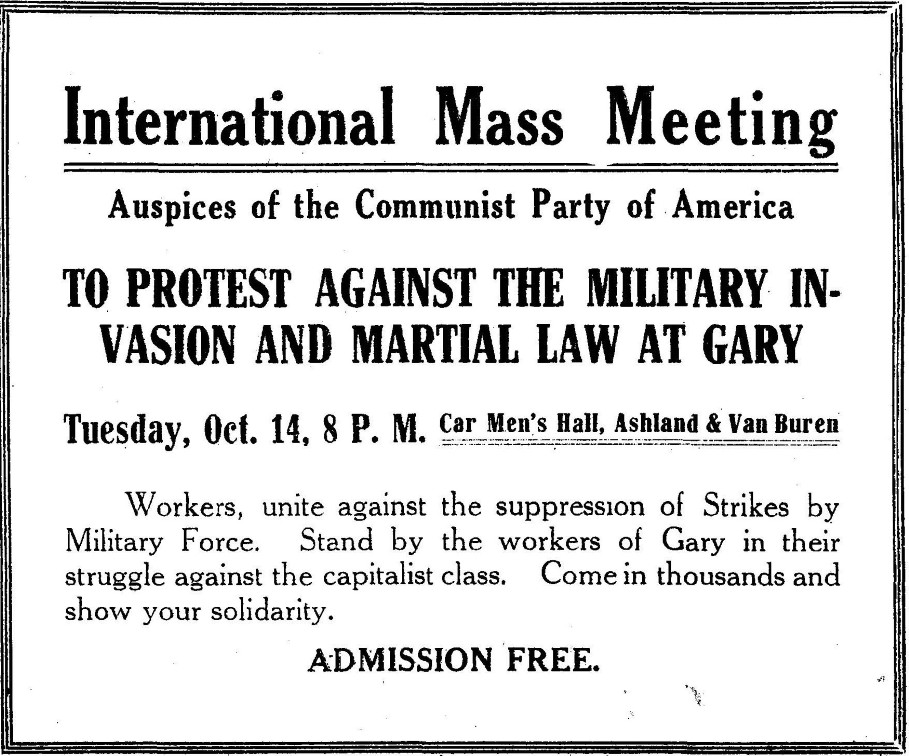
For the despised ‘hunkie’ in the steel industry of 1919 it was profits and death or to strike for a chance at life. Their strike is still unfinished business.
‘Steel and Life’ from The Communist (Old C.P.A.). Vol. 1 No. 3. October 11, 1919.
A few days ago was overheard a conversation between two business men on board a train traveling through the steel towns adjacent to Chicago. One was apparently the manager of some chemical corporation, the other, one of the directors.
This was the first day of the strike. All were scanning the horizon to read the news from the smoke stacks. The comments were the usual ones: that the men didn’t want to strike; that it was all the doing of scheming leaders; that Fitzpatrick was out to replace Gompers; that the rank and file were far more conservative than the leaders, etc.
The train went through Gary, Hammond, South Chicago. The business men turned their talk from the strike to a building scheme which interested them, because of the housing problem in connection with one or other of their plants. The train happened to be stalled along the rows of miserable cottages in Hammond and South Chicago. “One thing we have neglected,” said the manager, “is the problem of housing these foreign workers.”
Then, somehow momentarily losing the perspective of business: “Well, by God, if I had to live in one of these shacks, I guess I’d go on a strike myself.” But the thought of going on a strike was a too violent bit of heresy, so he added, after a few seconds, “Or I would get myself a farm.” Then the business discussion was resumed.
Those who live in these shacks have” long ago thought about living where there is space, fresh air, green fields.
Ben Hecht reported some conversations with strikers in the Chicago Daily News. The following is an excerpt:
“’I work 14 hours a day,’ he said. ‘I never see my kids, I never see my missus. I go to work at 5 o’clock. It’s dark at 5 o’clock. The kids is sleeping at 5 o’clock. I come home when it’s 7 o’clock in the night. It’s dark at 7 o’clock. The kids is going to sleep again. I say to the missus, “I’m tired; let’s go to bed.” So I go to bed. I don’t see nobody. Now I’m striking, I see the kids, and maybe I go to a show.”
“Why don’t you take a day off sometimes?’ I asked.
“What you talk about?’ said the man. ‘I work four years without taking a day off. If I take a day off the boss hire somebody else, and I lose my job. That’s what the boss tell me, so I work.'”
Steel workers are “hunkies.” They can be thus impersonalized in droves because, first, they are heavy laborers, and because, second, they are foreigners. Seven out of ten are actually foreign born. The other three happened to be born American citizens.
It is reported that many are planning to try the old country again, that thousands are leaving now. No doubt the figures are false, part of the propaganda to impress the foreign character of the strikers. When it comes to paying for the trip, the family men must be largely counted out. But some are leaving, and some want to leave, to be replaced by black Americans or by newly arriving foreigners.
Black, white, yellow, brown, the steel workers are all foreigners. It is not agreeable to be constantly looked down upon as a foreigner. So these workers search out those of the same nativity, and they live and work close together, speaking the mother tongue. Then there is the longing for the land where this tongue is not foreign, where the steel worker of this country may be laborer or peasant, but not “hunkie.”
This is a passing phase. Industry is already well advanced along the lines of internationality. The class call, with its challenge to the future, drowns out the weak call to the past, to the relaxation of a homeland. There is only one way: workers can no longer be foreigners to other workers; there must be class union against class exploitation.
One of the newspapers referred to the various foreign groups, and then to the balance as “hybrids” who, “for the want of anything more definite,” were called “Americans”!
The American proletariat is beginning to sense the fact from his day to day experience that the proletariat–the mass of workers in the basic industries–is without nationality. It is only a matter of place of work. The tables of figures show that over one-third of the entire American population is foreign or born of foreign parentage.
The foreign workers in steel suffer the stings of the despised foreign caste. A few acquire the snobbishness of insistent Americanism. Those who attain class consciousness and align themselves definitely in the revolutionary class conflict become patient; they accept placidly the snobberies of fellow workers or of the petty officialdom. They see the proletariat of tomorrow–and of today, in Russia!
In the magic age of steel, with its wonders of expanded industry, it is steel which exacts a toll of life sacrifice such as was not dreamt of by all the angry gods of all the ages.
One of the steel superintendents grimly remarked that the making of steel was no tea party. But men have never shrunk away from hard tasks or great hazards. The reckless toll of needless deaths, of devitalized manhood, of starved childhood in the ugly steel towns–this has not been the price of steel, but only of the gigantic steel fortunes, the imperial fortunes of the Carnegies. Fricks; Bakers, Schwabs, Morgans and the others.
The strike is not against the making of steel, with all its hazards. The revolution is not against the making of steel. It is against the making of steel profits.
The daily papers carry one statement after another by steel officials about the high wages of their workers, propaganda statements which, when they have any truth at all, are based on a few exceptional piece-rate and bonus cases. These papers never mention the war profits of steel. There is much flourish of the paltry total of steel stocks held by the workers, small accumulations of savings which mean nothing more than a span of two or three months against months against starvation, nothing more than the beggarly allowance in present pay against the always imminent layoff. The Liberty Bonds of U.S. Steel, and of Bethlehem, are never mentioned by contrast.
It took a terrific lot of vitality to earn the wages saved in these one or two hundred dollars in stocks or bonds. Schwab frankly told the British Premier that it was taken for granted that war orders meant war profits. That was the business genius for which Bethlehem stockholders were paid manifold millions. The business world nodded approval. Such is the business of war–and the war of business. Against life!
The steel strike is the cry of life against steel-despotism. But it is yet a timid, hesitant cry of revolt. It is only the cry for merciful servitude.
The owners of steel could grant all the immediate strike demands and yet go on increasing their profits. It is the unionism of these workers that must be defeated. Because there is something ominous for the future in the organization of these workers and their attainment of consciousness of group and class power.
The revolution is the issue in the steel strike. It is a palpable lie that any considerable number of the strikers have the revolutionary consciousness; and it is ludicrous that the A. F. of L. officialdom of any stripe, entertains conceptions of this strike outside the regular formulas of trade unionism. But a militant demand for human existence on the part of the workers in steel is a first epoch in the proletarian revolution in America.
The revolution is the issue because it will be learned, in defeat or victory alike, that out of the furnaces and hearth fires of steel can no longer come the sheets and slabs and rods and rails of profit-extracting industry if the worker in steel is to have the life benefits of steel. The law of profit is the law of life deprivation. Steel cannot serve both profits and life.
The revolution is to make steel serve life.
A unionism which breaks down the caste system against the unskilled and semi-skilled, a unionism which breaks down the caste division among workers against those of different color and nativity, a unionism which cannot stop at the old craft separation of workers–that is the unionism in steel against which the powerful Steel Trust is hurling its great power. Such unionism too clearly visualizes the working class array which Capitalism itself inevitably creates for its own destruction.
Capitalism is doomed by its inherent law of profits. The cry is for more production, more production. This is the escape from the vicious circle of increasing prices which keeps the worker’s living from advancing! Vain delusion. As if the greater production meant anything more than the greater accumulation of capital, which means the ever greater demand for tributes of profits! Because if the greater production were consumed by the workers, without exaction of profit, that would be for capital to commit suicide. There is only one way to end the vicious circle, and that way is to end the taking of profits.
An organized working class is arising, conscious of its destiny to rule society. Its demands for the fullness of life must quickly become the demand for a workers’ industrialism, freed from the profit cancer.
It is out of the immediate struggles, like the steel strike here and the railroad strike in England, that this power and understanding of the workers must develop. There is a manhood and courage on the part of the strikers which asserts itself against tremendously favored opposition.
The unrest of today is the birth pangs of the new civilization. There is yet to be an Age of Steel, when the ruddy ore shall be converted into the building of the dwellings of free workmen.
The carriers of the new civilization are the “hunkies” who live in the miserable shacks, and who work from dark to dark. The truth will lead them out of the darkness into the sunlight, the truth of their class power and of their way to freedom.
Emulating the Bolsheviks who changed the name of their party in 1918 to the Communist Party, there were up to a dozen papers in the US named ‘The Communist’ in the splintered landscape of the US Left as it responded to World War One and the Russian Revolution. This ‘The Communist’ began in September 1919 combining Louis Fraina’s New York-based ‘Revolutionary Age’ with the Detroit-Chicago based ‘The Communist’ edited by future Proletarian Party leader Dennis Batt. The new ‘The Communist’ became the official organ of the first Communist Party of America with Louis Fraina placed as editor. The publication was forced underground in the post-War reaction and its editorial offices moved from Chicago to New York City. In May, 1920 CE Ruthenberg became editor before splitting briefly to edit his own ‘The Communist’. This ‘The Communist’ ended in the spring of 1921 at the time of the formation of a new unified CPA and a new ‘The Communist’, again with Ruthenberg as editor.
PDF of full issue: https://www.marxists.org/history/usa/pubs/thecommunist/thecommunist3/v1n03-oct-11-1919.pdf

