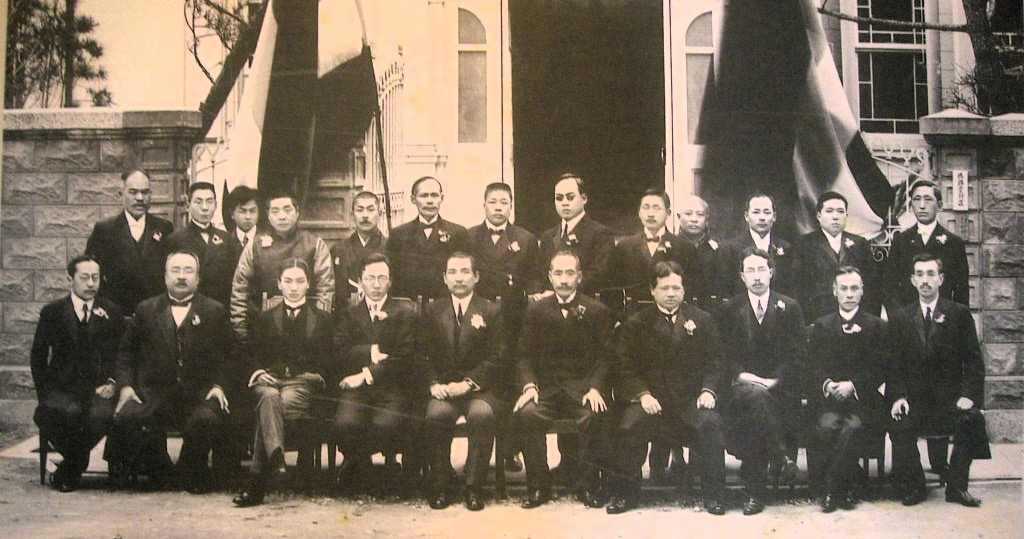
A fascinating look at the Chinese left in the aftermath of the Sun Yat-sen-led failed 1913 Kuomintang rising against the dictatorship of President Yuan. With sections on the Chinese Republican Labor Party, the Socialist Party, the Pure Socialist Society, and the KMT.
‘Reaction in China’ by Ajax from International Socialist Review. Vol. 14 No. 6. December, 1913.
DURING the last Ching dynasty the Manchus took care to suppress any society which had any trace of political aspirations or was in any way opposed to the government. But with the Chinese revolution of 1911 this restraint was removed and consequently many new liberal societies have sprung up during the last two years. Most of them however had a very short butterfly existence and simply came into life through some person’s influence and energy and when that person was discouraged or removed they ceased to exist. I was very much interested in the growth and development of the socialist and labor societies and collected their various rules and aims and translated them into English. I knew all the leaders. The principle impression produced upon me was that the Chinese socialists and labor men tried to cover too much ground. Often they expressed their ideas in rather vague or abstract terms. This may have been due to the fact that the leaders had next to no knowledge of the foreign labor movements and consequently many based their socialist plans on the noble sentiments of members of their organizations. The history of these organizations is very interesting although they are now crushed out.A
CHINESE REPUBLIC LABOR PARTY.
This party was organized by a man called Wen a mechanic employed in the Chinese government arsenal at Shanghai. Unfortunately he did not read any foreign language and could not gain by outside experience. The objects of the “party” were stated as follows:
“Our party has been formed by the workers of the whole country because of trouble experienced. We must assist each other so that the workers will work and live together as though born of the same mother and so collectively enjoy our own power, our own profits and our own burdens, which will be equally distributed…Surely everybody is tired, but the tide is rising, and cannot be kept back…We have anxious hopes that when our plans and methods are understood they will be like fire and water (i.e. spread quickly and enter every house)…Without unity the whole country’s working class cannot become a powerful body and without some scheme our influence cannot spread.
“Our general objects are: (A) to stimulate the workers to become more intelligent. (B) To circulate information so that the workers may understand. (C) To raise a leader who will direct operations. (D) To abolish the workers’ distress. (E) To get a determined working class to impeach and denounce (the wrong).”
Wen was styled the general-commander and had a staff under him called captains. These captains, by the way, were to be in duplicate, one male and one female, for each trade. This society certainly did some good in helping in a strike of the silversmiths in Shanghai early this year, when after a three days’ strike, without any funds to back them up, they gained a substantial advance in wages. It is said that one of the political spies of the government got Wen to take up a plan for the workers at the arsenal to revolt and capture the arsenal. An attack actually did take place but the authorities had been warned so that Wen was caught red-handed and was sent to Peking for trial and execution. This finished the Chinese labor party.
CHINESE SOCIALIST PARTY.
This society was established by a man named Kiang Kang-hu, just after the revolution of 1911. Although its objects and rules number thirty-seven yet the essential principles of European socialism are not included. They are not so definite, as will be seen from the following objects: 1. To assist the republic and promote the common weal. 2. To help to do away with racial differences. 3. To introduce laws which will ennoble the individual. 4. To abolish the hereditary system of bequeathing property. 5. To organize a general system of education for the common people. 6. To promote productive work for the encouragement of the laboring classes. 7. To levy taxation on land only and eventually abolish all other taxes. 8. To limit armaments and concentrate energy on competition in other matters.” The objects of this party are so general and broad as to be almost worthless, but they display very well what the Chinese think socialism is.
Although his attention was repeatedly drawn to the serious omission of the root principle of the nationalization of means of production, distribution and exchange, and Kiang promised to adopt them, this was not done, and there can be no doubt that this ideal was not understood.
In order to try and graft socialist theories on this society it was arranged that fortnightly meetings should be held in Shanghai, where another “foreign” socialist and I should deliver addresses. These had just started when the revolution broke out. At the first meeting there was present the chairman of the Peking branch, Mr. Chen Chi-lung, a youth of 28 years. He appeared to be rather a quiet and well-spoken young man, so that it was very surprising to hear that upon his return to Peking a few days afterwards he was arrested and executed. In the official report of his case it was stated that he was a member of the Chinese socialist society, of objects of which are the same as the Nihilist party of Russia and that Chen was in communication with the foreign anarchists. This, of course, is only abuse and nonsense. However, he was shot.
THE PURE SOCIALIST SOCIETY.
Another case of a socialist being executed was that of Sha Kan (also known as Fen Fen). This youth was a member of the Chinese socialist party but disagreed with the leader and therefore produced a split and formed the Pure Socialist party and issued a magazine denouncing the parent body. The principle difference appeared to be that he advocated an easy divorce and free love and from a conversation I had with him he said that he had a plan for his society to occupy an island near Hong Kong where they would establish “pure socialist.” This society, however, had not much support and soon fell through. As Sha Kan was thus without money, he left the protection of the foreign settlements here and went to his home at Nan Tung Hsien, near the mouth of the Yangtze river to collect funds. Upon arrival there, however, he was arrested and executed, for no other reasons, apparently, than that he was collecting funds for Red Cross work without authority and called himself a socialist.
YUAN.
Although these organization had not taken an active part in the recent rebellion yet President Yuan Shih-kai issued an order that the Chinese socialist party should be disbanded. This brought a protest from Mr. Kiang Kang-hu which is too long for reproduction, but the following sentences give the gist of it:
“So far our society has only studied socialism and has not taken active part in political work…We formed our society because we knew that in China there is a lack of political knowledge and that many mistakes are being made in political affairs…The officials eat the ignorant peasants as though they were fish and flesh and therefore the people are getting angry…It will be a long time before we reach the age of universal unity. Upon thinking about this my heart aches so much and my feelings are in such a state of agitation that I cannot even remember what I have written.”
This kind of writing only produces amusement in official circles. However, the society was disbanded. The leader left Shanghai for Singapore. It is said that he will proceed to Europe and America to study socialism. It was well known that he had no money, and as he left Shanghai without informing his friends it has naturally aroused much suspicion that he received money from the government for some consideration. As to whether this is correct or not no one knows. Everybody will be only too pleased if he makes good use of his time abroad in studying economic conditions and getting a sound knowledge of socialism. I consider that good hard manual work and earning his living by the sweat of his brow would give him the best insight into the class struggle and the social revolt. China suffers to a great extent from mere theorists.
KUO MIN TANG AND THE NATIONALIST PARTY.
This party also adopted socialism as one of its objects, and had the best of the reformers in its ranks, including many socialists. Dr. Sun Yat-sen was its president and he is well known as a socialist. It was the strongest of the political parties in China and had a majority in parliament at Peking. But unfortunately, as everybody knows, this organization was opposed by the president, Yuan Shih-kai, who had the support of all the old officials as well as the foreign financiers and the foreign Christian press on the China coast. Dr. Sun, however, visited Yuan Shih-kai and openly proclaimed the desire of the south to work with the north which is another way of saying the progressive (south) wanted to work with the conservative (north). But the president very unwisely did not accept this splendid offer, and instead a movement was commenced to crush this powerful party.
The first step taken was the assassination of Sung Chiao-jen, one of the leaders of the Kuo Min-tang who would probably have been selected as premier. Then by various means the ordinary course of justice was obstructed so that a proper trial never took place although there was little doubt that some government officials were implicated. This naturally created a great deal of anger in the country. Things were, however, brought to a crisis by the foreign financiers advancing £25,000,000 to the government against the protests of members of parliament and also many provincial tutuhs or governors. This gave the government the opportunity of dismissing some of these, more advanced tutuhs, and also other officials, so that it became clear that the government intended to remove all those officials who were opposed to the unconstitutional methods of Yuan Shih-kai. The south was, therefore, forced to take up arms against the government, but there can be little doubt that this was expected and desired by the government, who wished to have some excuse for wiping out the reform party.
The result of the rebellion is well known. The southern forces put up a very poor fight, due probably to the fact that they were short of money, whereas the government troops were well supplied and had so much foreign money that they could offer substantial bribes to the officers in the opposing army. The result was a collapse of the rebellion. I saw the principle engagements near Shanghai, and was very much disappointed at the poor display of the southern forces. The importance of leaders was shown at Nanking, where Ho Haiming, a journalist without military experience, held about 50,000 northern troops at bay for over a week with only about 2,000 soldiers of the eighth division. The brave defence of Nanking was the one bright spot in the whole campaign.
As a result of this collapse all those belonging to the Kuo Min Tang went into retirement. The head office of the party at Shanghai was closed and the party is extinct to all outward appearances. Nothing is now heard of them and it is in fact impossible for any criticism of the government to be expressed without great risk of life. Many executions have taken place all over the country of men whom political spies claim were against the government.
REACTION.
The result of this is that the forces of reaction are now in full power with President Yuan Shih-kai at the head, supported by the old gang of corrupt officials, and the foreign money-lenders.
Everybody expects now that the officials will bleed the people as before and then obtain foreign loans to cover the deficits in the treasury. They will “feather their nests” before the national unrest again grows too strong for them.
The position occupied by the foreign Christian powers in this movement is highly discreditable. They support President Yuan Shih-kai and his conservative party, and are only too willing to advance loans and harry the country into the direction of bankruptcy. As long as the Chinese government can obtain foreign loans it is hardly to be expected that any real reforms will be attempted. It is only when the “financial” shoe begins to pinch that matters are seriously considered and then the foreign money lenders relieve the pressure by offering another loan. If the foreign “Christian” powers would adopt the policy of supporting parliament in Peking and a democratic form of government instead of backing the autocratic regime of Yuan Shih-kai and his gang it would save China from further disaster. The most effective step would be to insist that all further loans, whether provincial or state, should be passed and approved by a parliament at Peking. This is, perhaps, too much to expect from the European Christian powers, who are influenced so much by the banks. The foreign money lenders exert a great influence in China just now as they hold the purse, and it is probable that future developments in China will be entirely and solely in their interests.
The forces of’ reaction are again in power and will blunder forward in somewhat similar style of the old mandarindom. Watching and assisting them are the foreign money lenders, who hope in the near future to so embarrass China financially as to be able to force their governments to step in and take control of the finances of the country. Hidden away underground is the secret propaganda of the reform party, who could solve the problem but who are not even allowed to express their opinions. It is very probable therefore that before very long, perhaps when the nation is once again in disgrace, these chained forces will be released and will free the national life for its natural expansion and growth.
—Shanghai, China, Oct. 7, 1913.
The International Socialist Review (ISR) was published monthly in Chicago from 1900 until 1918 by Charles H. Kerr and critically loyal to the Socialist Party of America. It is one of the essential publications in U.S. left history. During the editorship of A.M. Simons it was largely theoretical and moderate. In 1908, Charles H. Kerr took over as editor with strong influence from Mary E Marcy. The magazine became the foremost proponent of the SP’s left wing growing to tens of thousands of subscribers. It remained revolutionary in outlook and anti-militarist during World War One. It liberally used photographs and images, with news, theory, arts and organizing in its pages. It articles, reports and essays are an invaluable record of the U.S. class struggle and the development of Marxism in the decades before the Soviet experience. It was closed down in government repression in 1918.
PDF of full issue: https://www.marxists.org/history/usa/pubs/isr/v14n06-dec-1913-ISR-riaz-ocr.pdf
 Revolution's Newsstand