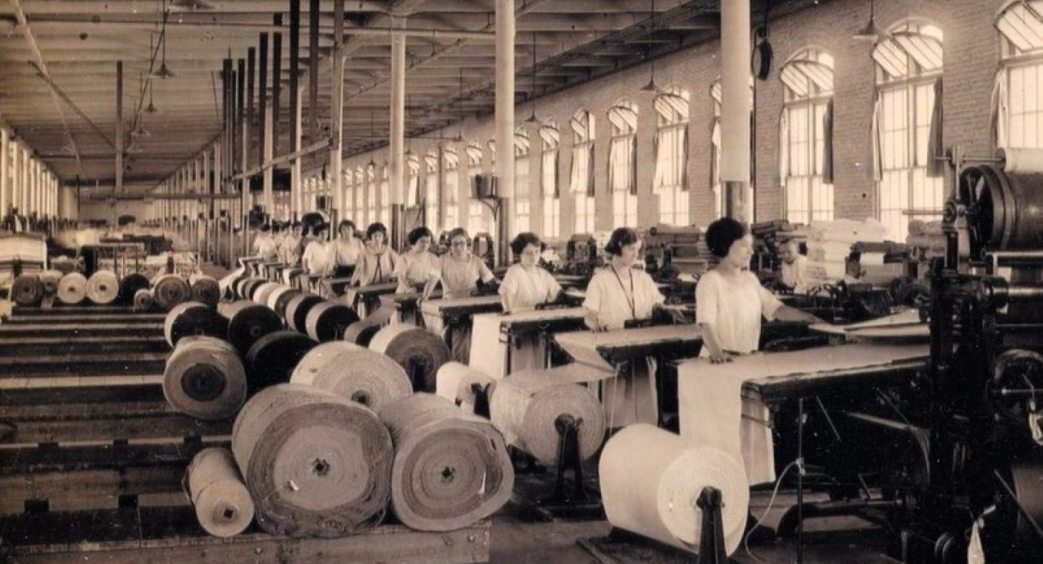
All of the hard fought gains by New England labor that saw Massachusetts textile mills unionized were reversed as manufacturers shifted those operations to the lower wage, non-union South and new sweat-shop industries enter to take advantage of local depression with its unemployment and exploiting the ambiguities of the new, circumventing previous legal oversights and collective bargaining practices. Those who had unions and enforced wages before, went to work without a voice and for far less money after. A scenario repeated over and over and over.
‘New Industries Invade Bay State’ by Ruth Shallcross from Labor Age. Vol. 20 No. 3. March, 1931.
And How the Workers Fare Therein
IN recent years the Massachusetts textile industry has allowed the cut-throat game of competition in a flooded market because it has not kept up with the times in changing methods of production. It has not scrapped machinery to meet rayon demands when cotton demands were decreasing and it has declared dividends up to the point of liquidation. Because of this losing game, mill after mill in Massachusetts has had to shut its gates, thereby throwing out of employment hundreds of workers whose lives have been centered around the textile industry. In these one-industry towns the mercantile establishments and other industries arising to meet the needs of a community have depended upon the wages of the mill workers for their very existence. So with a slow liquidation of the mills came the cry of the other industries of the towns for new productive industries.
Thus the Chambers of Commerce in such towns as Lawrence, Fall River, and New Bedford, formed so-called “new-industry committees” and advertised in New York and Boston papers. The NEW YORK TIMES, February, 1930 advertised, “a fifteen to twenty-five per cent saving in labor costs” and the BOSTON TRAVELER, June 21, 1930 advertised, “a large reservoir of labor, proper fuel rates, good power supplies and an ideal transportation centre.”
In most cases the new industries have consisted of garment shops, radio and electrical equipment factories, rubber and leather companies. The garment industry consists mostly of contract shops for low priced dresses, boys suits, shirts and underwear, many of them being sweat shops which have been run out of New York City by enforced labor laws, militant union activity, and a prevailing wage rate which is above the rate accepted by a starving force of mill labor in a one-industry town. The Chambers of Commerce have met the industries at the depot, and welcomed them into their towns with a hospitality mingled with fear, fear that if they did not acquiesce in every proposal the guests made that the guests would depart on the next train. Labor has welcomed wolf when it is forced to treat the wolf with kindness in order to save its very life, yet knowing that the wolf is going to eat it at the first opportunity.
What has the new-industry wolf done to labor? First, it has decreased wages to the starvation level and has been praised by the local Chamber of Commerce for doing so. In Lawrence, the SUN lauded the Pilot Radio Tube Corporation of Brooklyn, New York, for its efforts in bringing prosperity to the town by planning a “$50,000 payroll for 5,000 workers,” prosperity at the rate of $10 a week per person! Yet that was an increase over the prosperity the company first brought at the rate of $7.50 per week. In Fall River the new Lucky Boy Company, manufacturers of boys’ pants, forced inexperienced workers to work three days for nothing and then put them on a $5.00 a week rate with the prospect of being raised to $6 or $7 in a few months. Experienced girls begin at $8 a week. The minimum wage law decrees that experienced workers should receive a minimum of $12 or $13.75 a week, depending upon the length of service in the particular shop. Last July the wages paid averaged thirty-seven per cent below the requirements of the law. The same decree applies to the Sally Middy Company also of Fall River, yet the payroll of the week in which I worked in the shop, July 31, 1930, showed eight workers getting between one and two dollars a week; none getting between two and three dollars; ten between three and four; seven between four and five dollars, and thirteen between five and six dollars a week. Only forty per cent of all the workers received over eight dollars a week, the legal minimum decree for beginners in the industry.
Charity to the Rescue!
During the first two weeks of August 1930, the wages of the Lincoln Shirt Company of New Bedford were so near the starvation level that the good City Welfare Organization had to come to the rescue of many of the families of workers and give relief (not dole!) There has been no evidence to prove that the wages have increased since last August. The week ending August 9th I received the unbelievably low wage of $3.52 for a full time week of forty-eight hours. If I had been in the shop for six months or so and had worked up a good speed I might have made $8 or $9. Not only were wages low in the Lincoln Shirt Company but practically every Massachusetts labor law was violated. Girls under 16 years of age worked over eight hours a day. The company provided a common drinking cup; the toilets were filthy and did not comply with sanitary regulations; the forty-eight hour week was often violated, and as has been said the minimum wage law which decrees for the shirt industry, $8 a week for beginners and $13.75 for experienced workers, has been totally disregarded.
Second, the new-industry wolf has broken down union conditions which prevailed in the days when the Massachusetts textile mills were flourishing. And though organized labor has tried to fight the wolf it has had to play the role of the sheep in most instances because of the great over-supply of labor. Third, the new-industry wolf has refused to adhere to labor legislation and seems to think that the good state of Massachusetts, which brags about its labor legislation, is offering a frontier where rules and regulations may be discarded.
Just what has been accomplished by labor in fighting the wolf? In New Bedford the workers of the Lincoln Shirt Company planned a strike for better wages. This was in March, 1930. The leaders of the conspiracy were fired and the rest of the girls were threatened by the police that they would be arrested if further attempts were made at striking. The police had to protect property interests! In a situation where a choice is given between starvation by no food at all or slow starvation by under nourishment, the latter is usually chosen. So the workers remain at the Lincoln Shirt Company and when a few of us tried March, 1931 to start another attack at the low wages, in August, 1930, the workers for the most part felt compelled to accept the process of slow starvation, knowing from the 1928 textile strike in New Bedford that very little sympathy could be aroused if they refused to work during the period when work was scarce and public opinion was encouraging other Lincoln Shirt Companies to New Bedford to bring prosperity.
Labor Laws Violated
Continually since last February when the bulk of the new industries came into Lawrence, the Lawrence Central Labor Union made complaints to the State Department of Lamor in regard to violations of the 48-hour law and violation of the minimum wage law. Due to the efforts of this organization one violation of the 48-hour law was prosecuted and violation of the law ceased in one plant, the Pilot Radio Tube Corporation. Also due to persistent complaints wages in this factory were raised from $7.20 to $10.08. The Lawrence Central Labor Union has taken the following stand on the new-industry problem: “Labor wants work and prosperity that comes with increased industrial activity; it welcomes those industries that assume the responsibilities and standards of honest business; but it stands unalterably opposed to wage cutting concerns that migrate to the source of low rentals, low taxes, low power rates and then with all of those advantages, demand cheap labor. Labor standards which have been established after years of struggle and effort are at stake, as are old established companies when subjected to guerrilla competition of concerns producing at cut-rate costs.”
What has been the role of the Minimum Wage Commission and the Department of Labor in all this activity? Of course the Minimum Wage Law is not mandatory. The law does require, however, that the Commission publish in the newspapers the names of concerns not complying with the law. When the Commission has done this it has been in obscure papers and as, in one case, with the factory’s name changed. The Pilot Radio Tube Corporation appeared as the Lawrence Factories, Inc. “Three members of the Commission have made individual statements that they personally have never gone on record as favoring or opposing the Minimum Wage Law, which definitely indicates a lack of belief in and respect for the Minimum Wage Law, by members of the Commission appointed to enforce this very law.” This fact is taken from the resolution passed unanimously by the Massachusetts Federation of Labor in convention, August 7, 1930, asking the General Court of the state to investigate the operations of the Minimum Wage Law and to appoint an impartial committee in making a complete and constructive investigation of the Commission and its activities.
The only other organizations which have taken the side of labor in trying to force the new industries to comply with the law are the Women’s Trade Union League and the Consumers’ League. Both of these organizations have made continued protests to the Minimum Wage Commission but not even a preliminary inspection of the new industries was made until several months after the complaints were first sent in.
As I write the above I receive word from Lawrence that another new factory, the Sterling Underwear Company, has begun operating. It employs about fifty girls and pays wages, ranging from $5 to $15. The movement has begun. As Massachusetts textile mills move South, sweat shops of New York move to the vacated textile mills—both movements being characterized by peon wages.
Labor Age was a left-labor monthly magazine with origins in Socialist Review, journal of the Intercollegiate Socialist Society. Published by the Labor Publication Society from 1921-1933 aligned with the League for Industrial Democracy of left-wing trade unionists across industries. During 1929-33 the magazine was affiliated with the Conference for Progressive Labor Action (CPLA) led by A. J. Muste. James Maurer, Harry W. Laidler, and Louis Budenz were also writers. The orientation of the magazine was industrial unionism, planning, nationalization, and was illustrated with photos and cartoons. With its stress on worker education, social unionism and rank and file activism, it is one of the essential journals of the radical US labor socialist movement of its time.
PDF of full issue: https://www.marxists.org/history/usa/pubs/laborage/v20n03-Mar-1931-Labor%20Age.pdf

