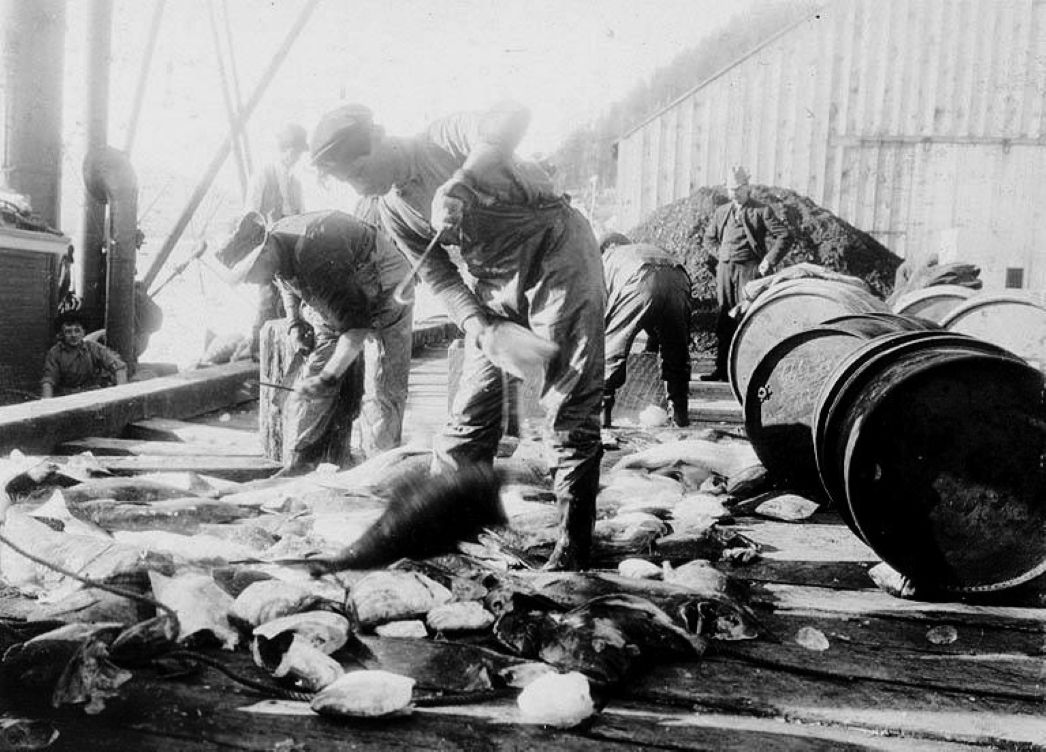
As the article notes, a little known event. The public murder of Hans Olson, Norwegian-born, anti-war fisherman in Ketchikan, Alaska by local 100 Percenters and the revenge of his shipmates in 1917.
‘Alaska Lynching: Model 1917’ by J. Abron from The Daily Worker. Vol. 11 No. 85. April 8, 1934.
American labor history offers countless instances of bloody persecution waged against those workers who resisted the World War. Witness the murder of Frank Little and Wesley Everest and the imprisonment of Charles E. Ruthenberg, Eugene V. Debs, and scores of other working class leaders. Today the Daily Worker publishes the record of another and heretofore little known incident of war-time terror against America’s workers. This account is published not merely because of its general historical value, but because, it offers a demonstration of working class spirit which may be of practical value to the growing ranks of those workers who have pledged themselves to a stubborn fight against the next war.
***
HANS OLSON was a hardy raw-boned Norwegian deep-sea fisherman whose vessel put into Ketchikan. Alaska, with its halibut catch every two weeks or so during the Winter following America’s entry into the World War.
Hungry for recreation after two week’s at sea, the fishermen were an easy prey to conniving saloon wolves. So when Hans had a few drinks he went looking for the sheriff to tell him what he thought of the war and of everything else. When the sheriff could muster enough help Hans would land in jail until he sobered up. The police force and its assistants bore ample marks of combat after each encounter with Hans.
The war was on that Summer, and there had been suspiciously little of the “slacker” hounding which terrorized every nook and cranny of the States. In the Fall, however, the forces of espionage began to flow in a Coast Guard Cutter pulled into port with a crew supplemented by picked Arkansas farmer boys rarin’ to go at the “furriners ’n’ slackers.” A horde of Department of Justice blood- hounds filtered in under the famous college full-back, “Fighting Bob” Dickert, freshly appointed Special Federal District Attorney.
A veritable reign of terror was instituted. The resistance, while practically unorganized, was constant, and fierce. Hardly a day passed without its hand-to-hand encounters between outraged workers and Dickert’s provocateurs. Every known Wobbly or sympathizer was marked for a “visit” and an arrest on any or no charge.
But “Fighting Bob” was up against a brick wall each time he brought a worker to trial for anti-war activity. The defendant’s red Wobbly card, which Dickert generally offered in evidence, seemed to affect juries in a manner precisely opposite to his expectations.
Welcomed to Ketchikan by the noisy handful of hundred per centers, he soon learned that these did not represent the temper of the general citizenry from which his juries wero drawn. These juries time and again registered, by their “not guilty” verdicts, a strange indifference to his patriotic spiels about strangling “the enemy within our gates,” these foreigners,” “these traitorous reds,” etc.
The regularity of these defeats drove “Fighting Bob” to his wits end. His vision of a quick “clean-up” of Ketchikan’s “reds,” and a fat political reward was fading fast. Something must be done and done quick. An example must be made to reestablish “law and order.”
***
THERE had always been in the town an insignificant vigilante group. This group was openly headed by the main hotel-keeper’s son, Rover Palen. This proud “native son” was an undergrown bespectacled mean-lipped man whom war hysteria alone could afford the opportunity for a bloated notoriety.
Until the advent of the war he distinguished himself entirely by his carousings, in the course of which he often encountered some outraged proletarian fist. In these encounters he always came off second best. He usually carried an old mark to meet the newest shiner. The war gave him an opportunity to be a he-man.
For weeks he had been strutting about the town, mostly “down the line,” as the red light district was called, in the swanky uniform of a military aviation student. He felt that the town did not appreciate him and he raged inwardly because he knew he was powerless to change the town’s mind.
All of Rover’s rage was now concentrated upon Hans Olson. Hans, on his last trip in town, was on a rampage and, Rover, in the full swagger of his bright uniform had essayed to assist the police force of four in subduing the fisherman. Hans had laid hold of Rover’s arm in the struggle, nearly tearing it from its socket, and had sent him sprawling, uniform and all, into a mud puddle. Rover was carried to the hospital while Hans got away to his ship.
“Fighting Bob” visited Rover every day and so did the Arkansas farmer boys from the coast guard cutter. In a week Rover was about the town again, his arm in splints and a cock-sure expression on his face. He was exceptionally un-communicative. The coast guardsmen were the same way. The whole town felt something was brewing.
***
ABOUT two o’clock one stormy morning. Hans’ vessel, the “Molly R.,” was made fast to the pier loaded to the gunwhales with her catch. Climbing up the dock’s ladder ahead of the rest came Hans.
As his broad shoulders rose above the pier’s edge, a noose was slung about his body and drawn tight by half a dozen men who had appeared suddenly from the shadows. A muffled automobile motor roared and started full speed, jerking Hans up the rest of the ladder. Landing him with a thud on the pier, the auto dragged him a full hundred feet over the rough planking of the main street. Rover Palen, who was driving, jumped from the driver’s seat and kicked the prostrate Hans. Palen was joined by half a dozen men wearing Navy regulation slickers. These menaced Hans with drawn revolvers, shouting at him, “Will ya fight for your country, you dirty foreigner?”
Hans, pain-racked but determined, answered, “Naw, ay voon’t.” “Then let’s go, boys,” Rover commanded. The car started up the main street again. Hans’ form lurched and bounced helplessly in its wake. Palen drove so that the body was dragged by violent jerks across the uneven planking which covered the main street. Hans’ flesh was ripped by exposed spike heads in the worn and rotting timbers. After they had dragged him thus for 50 yards they stopped to repeat the question, “Will you fight for you; country?” Still Hans answered faintly, “Naw, ay voon’t.”
Then, doubling back to the pier’s end, the gang stopped. Raging against Hans’ steadfastness, the diabolical crew lowered his blood-soaked, lacerated body into the icy Alaskan waters and kept him submerged for long seconds. When they hauled him up and repeated their fiendishly persistent demand that, he “fight for his country.” Hans still answered weakly, “naw.”
Again he was submerged and when he was hauled up for the second time, he was left lying on the pier unconscious and near death, Hans’ shipmates, kept at bay during his tortures by the guns of the lynchers, swarmed up the pier. They wrapped him in blankets and carried him to the hospital. The doctor there succeeded in bringing Hans into delirious consciousness in which he shouted, “Ay voon’t fight dirty capitalistic vars, you bastards. Ay voon’t go kill fellow vorkers for you parasites.” At break of day Hans Olsen died.
***
TENSION gripped Ketchikan from end to end in the days that followed the news of Hans’ lynching. Despite the eye-witness accounts of Hans’ shipmates, “Fighting Bob” Dickert knew nothing. Neither did the commander of the coast guard vessel. Rover Palen had disappeared. The coast guardsmen remained on shipboard.
Only “Fighting Bob” dropped into the Northern Bar, the town’s social center, to remark over a glass that Hans had been a “slacker.” Gradually, from a maze of feverish rumor the facts behind the lynching began to appear. From “down the line” came a girl’s story of Rover’s frequent bragging, in the midst of his debauches, that he and “Fighting Bob” were going to “clean up on every Wobbly slacker in town.”
It became known that the moment the “Molly R’s” siren sounded through the stormy bay that night Rover and the sailors had rushed from a brothel to Rover’s garage, from which he phoned “Fighting Bob” that “We’re gonna get him tonight.”
Confronted with this story at the Northern Bar the same night that it became known. “Fighting Bob’s” lips quivered cruelly as he let, out a crafty, defiant, “Well?” at his questioners. Several men started at him spontaneously, but a number of vigilantes closed in to protect him with hands gripping their sheated revolvers.
High-tensioned days followed and not an arrest of anyone connected with the lynching. Not so much as a gesture by the authorities to appease the outraged sensibilities of even those who opposed the convictions for which Hans Olson was martyred.
On the night of the sixth day after “Fighting Bob’s” defiant “Well” at the Northern Bar, six shots rang out on Ketchikan’s main street. A man fell under a dim arc lamp while another ran down a side street with a smoking revolver in his rand. A crowd gathered around the fallen man. His head lay in a pool of blood. Plainly a revolver had been emptied flush into the face and forehead at close range. A woman in the crowd stooped over the bleeding corpse, spat squarely into the ghastly face from which the blood was still trickling and remarked half-systerically, “’Fighting Bob,’ huh, huh, ‘Lynching Bob’ is the real name. The lousy rat got his at last.”
Christiansen, a shipmate, who had seen Hans lynched, surrendered, and a Ketchikan jury found him insane. He was later discharged as cured.
***
THE halibut fishermen of Alaska are mostly Scandinavians. They are a modest lot who don’t mix much with the English-speaking workers. Probably because they are too tired when they come ashore after one of their toilsome and hazardous tripe to try to learn a new tongue and mix with unfamiliar workers.
These days of unemployment, and agitation and education for solidarity of the workers, native and foreign, must have changed this condition up North.
The Daily Worker began in 1924 and was published in New York City by the Communist Party US and its predecessor organizations. Among the most long-lasting and important left publications in US history, it had a circulation of 35,000 at its peak. The Daily Worker came from The Ohio Socialist, published by the Left Wing-dominated Socialist Party of Ohio in Cleveland from 1917 to November 1919, when it became became The Toiler, paper of the Communist Labor Party. In December 1921 the above-ground Workers Party of America merged the Toiler with the paper Workers Council to found The Worker, which became The Daily Worker beginning January 13, 1924. National and City (New York and environs) editions exist.
PDF of full issue: https://www.marxists.org/history/usa/pubs/dailyworker/1934/v11-n085-apr-09-1934-DW-LOC.pdf

