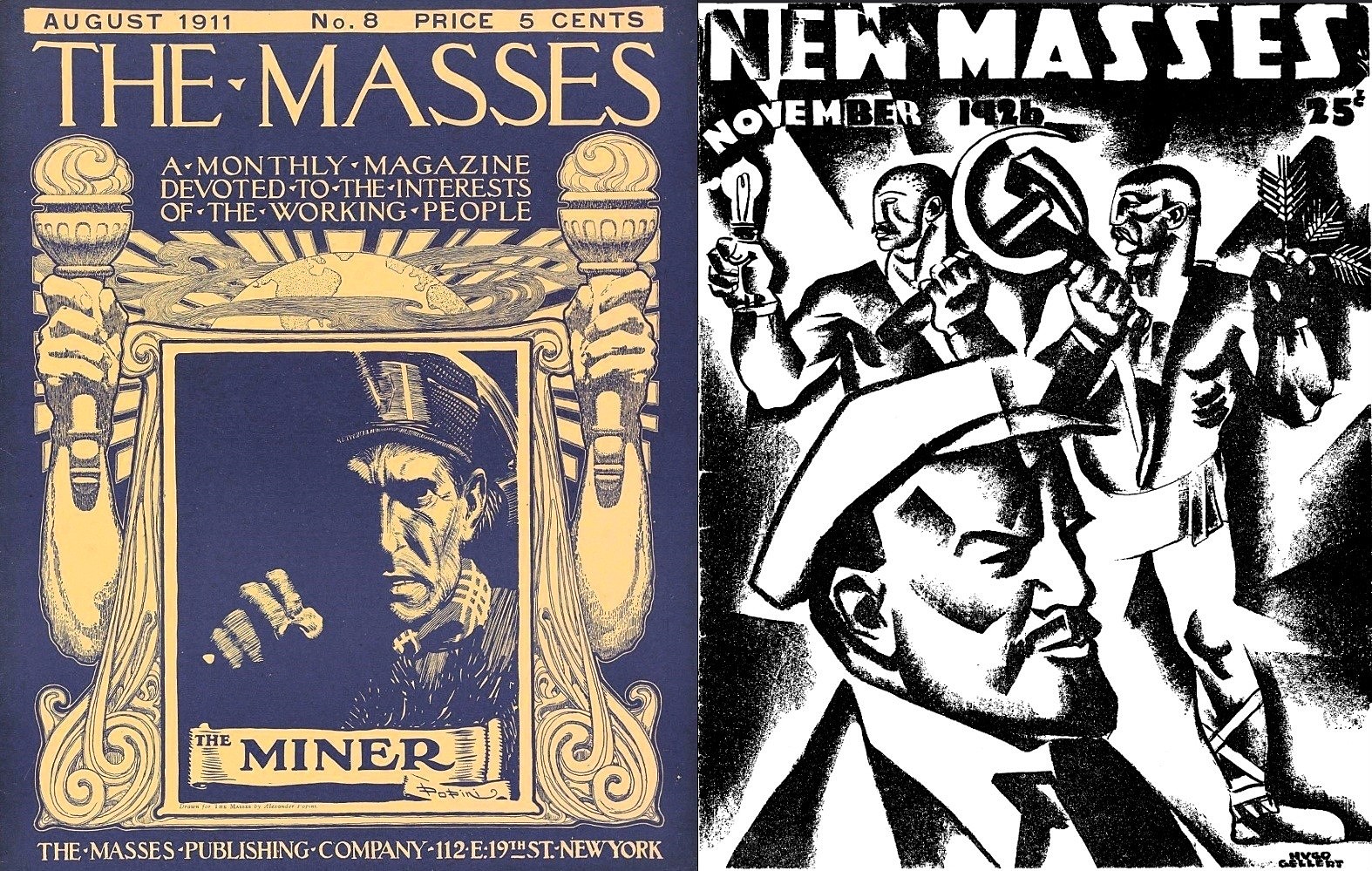
Freeman with an essay all students of U.S. Left literature will be interested in on the changes over twenty-five years since the original Masses was published in 1911, through its rebirth in 1918 as the Liberator, to a monthly New Masses in 1926 and a weekly in 1934.
‘Old Fervor and New Discipline’ by Joseph Freeman from New Masses. Vol. 21 No. 12. December 15, 1936.
The paths of the past and the present join to mark out the roadway of this journal’s future
NO RADICAL or liberal who grew up in pre-war America will ever forget the sheer excitement of the old Masses. The statement of policy on its masthead, drafted by John Reed, boldly proclaimed that it was a revolutionary and not a reform magazine. It boasted of being frank, arrogant, impertinent, searching for the true causes,
This dashing enunciation of policy was borne out by the contents. Editorials propagated the socialist creed; articles exposed the evils of capitalism; the news of the month appeared in a new light when analyzed by radical reporters; and the drawings, strong in conception, original in execution, were so many satirical bombs hurled at the crimes of the rich: and powerful against the poor and oppressed. The most talented men and women in America were writing and drawing for the Masses, stirring the imagination of young people from New York to San Francisco. The magazine published love poetry, light drawings laughing at the clichés of the moment; expositions of Freud’s sex theories; analyses of the new American literature then being fashioned by Dreiser, Anderson, Frank, and Sandburg. But all these spiritual forces were clustered around a central idea, the idea that capitalism had monstrously outlived its usefulness, that socialism alone could open new ways of life for America, for the world.
The motive power of the old Masses was the revolutionary movement in the United States. There were, indeed, two movements in the first decade of our century, one represented by the Socialist Party, the other by the I.W.W. Both groups were primarily interested in the industrial worker; they advocated, supported, and organized strikes; they fought for higher wages and shorter hours. But the Socialist Party, as distinguished from the I.W.W., had a special appeal for the more discontented sections of the middle class, upon whom the trusts were mercilessly cracking down. Had there been a third or reformist party in the United States, these people would have joined it; in its absence, they entered the Socialist Party and in the long run made it reformist. The party then included orthodox Marxists, revisionists, Fabians, and middle-class liberals for whom the word “socialism” concealed, from themselves chiefly, the ideals of the muckrakers. It contained people who despised political action to the point of syndicalism, and people who cared more for election campaigns than for strikes. There were in it advocates of sabotage and disciples of non-resistance, ministers of the gospel and militant atheists.
All these diverse moods, sentiments, and programs found expression in the pages of the Masses, then the sole cultural voice of American radicalism. Founded at the close of 1911, the magazine flowered in the following year—the Lyric Year, Floyd Dell aptly called it. For it was in 1912, when Debs polled nearly a million votes, that prewar American radicalism reached its peak. It was the year when the names of Joe Ettor and Arturo Giovannitti, leaders of the Lawrence textile strike, became household words, and when Emma Goldman could pack meeting halls in any city with lectures on anarchism, free love, and Shakespeare.
With this social ferment stirring America, the Lyric Year saw also the awakening of the intelligentsia, middle-class and proletarian, in art and literature. American poetry was entering upon its renaissance with the foundation of Harriet Monroe’s magazine in Chicago; the Irish Players and Maurice Brown were instigating the new American theater; Marcel Duchamps’s Nude Descending a Staircase aroused the rebel sons and daughters to the meeting of modern art; the emancipated sex theories of Edward Carpenter, Havelock Ellis, and August Forel had emigrated to our shores and followed close on the heels of the men and women fighting for woman suffrage; and gay clothing, colored neckties, bobbed-haired and smoking women flaunted the victory of the younger generation of that day over the prostrate body of puritanism.
For the next five years this “new” spirit was to dominate American life, and its most effective and moving voice was to be the Masses. John Reed’s powerful—reporting gave us the truest pictures of the great Paterson strike, the Mexican revolution, the European war; Floyd Dell brilliantly explained to us the new American and European novelists, poets, and playwrights; Arturo Giovannitti wrote revolutionary poetry the like of which America had never seen before; Bob Minor, Art Young, and Boardman Robinson drew cartoons which moved to deep laughter and strong indignation and a desire to fight for a socialist world; and Alexander Trachtenberg brought us every month news of the socialist movement throughout the world.
America’s entrance into the war emphasized the cleavage in the Masses, as it did in the labor movement. Most radical papers were suppressed and the magazine automatically became the chief organ of socialist and anti-war forces in this country. The editorials propagated the Wilson myth, but the publication as a whole attacked the war. The editors were arrested under the espionage act, under which Eugene Debs, Charles E. Ruthenberg, and Earl Browder were sent to prison. On the witness stand, Eastman explained that he no longer held the sentiments expressed in his anti-war editorial, and the jury disagreed. By the time the second Masses trial was held, war passions had cooled off and the editors were acquitted. Meantime, the suppressed magazine was appearing under a new name, the Liberator, and again it was the vanguard of the most advanced men and women in America. For once more a great historical event came to give it character and direction. John Reed’s classic about the Bolshevik revolution first appeared in its pages; Bob Minor and Albert Rhys Williams wrote lyrical reports from Moscow; Giovannitti’s dithyrambic verses sang of the socialist fatherland as well as of the murder of Karl Liebknecht in Germany and Frank Little in America.
The Masses and the Liberator educated a generation of Americans in modern ideas. It gave us our first true picture of our own country; the first true picture of the Bolshevik revolution, the first glimpse into the new art and literature. Thousands of young men and women all over the country were molded by this extraordinary magazine, and the most gifted of them contributed to its pages. There is hardly a name distinguished in American art and literature today which did not appear in the Masses or the Liberator.
So thoroughly did the latter reflect the American scene that when I joined its staff it was as different from the old Masses as the fall of 1921 was different from the fall of 1911. Post-war prosperity had drawn many of the original contributors away from the revolutionary movement. They found comfortable posts with bourgeois publications, and salved their consciences by criticizing the Soviet Union. Few of these had the insight or the courage to say simply, “I am a tired radical”; instead they said, “Lenin has abandoned socialism.” To prove their contention they pointed to the New Economic Policy. Floyd Dell, still at his post, ridiculed these arguments, reaffirmed his faith in socialism; Max Eastman, still half-attached to the Communist idea, proved that socialism could be built in one country, and that its success in the U.S.S.R. alone would be the most effective propaganda for the idea everywhere else.

But the founding fathers were leaving the magazine. Bob Minor abandoned his mighty cartoons for revolutionary politics; Floyd Dell went off to write novels; John Reed was dead; Giovannitti was in the trade unions. But like all truly creative men, these had left a fruitful heritage which Michael Gold, William Gropper, Hugo Gellert, and others now carried on, once more upon the basis of a vital surge among the American workers. For what the Socialist Party and the I.W.W. had been to the old Masses, the Communist Party was to the Liberator. The writers reported the class conflict; the artists portrayed it, and new ones were coming all the time: John Dos Passos, Genevieve Taggard, Reginald Marsh, and many, many others.
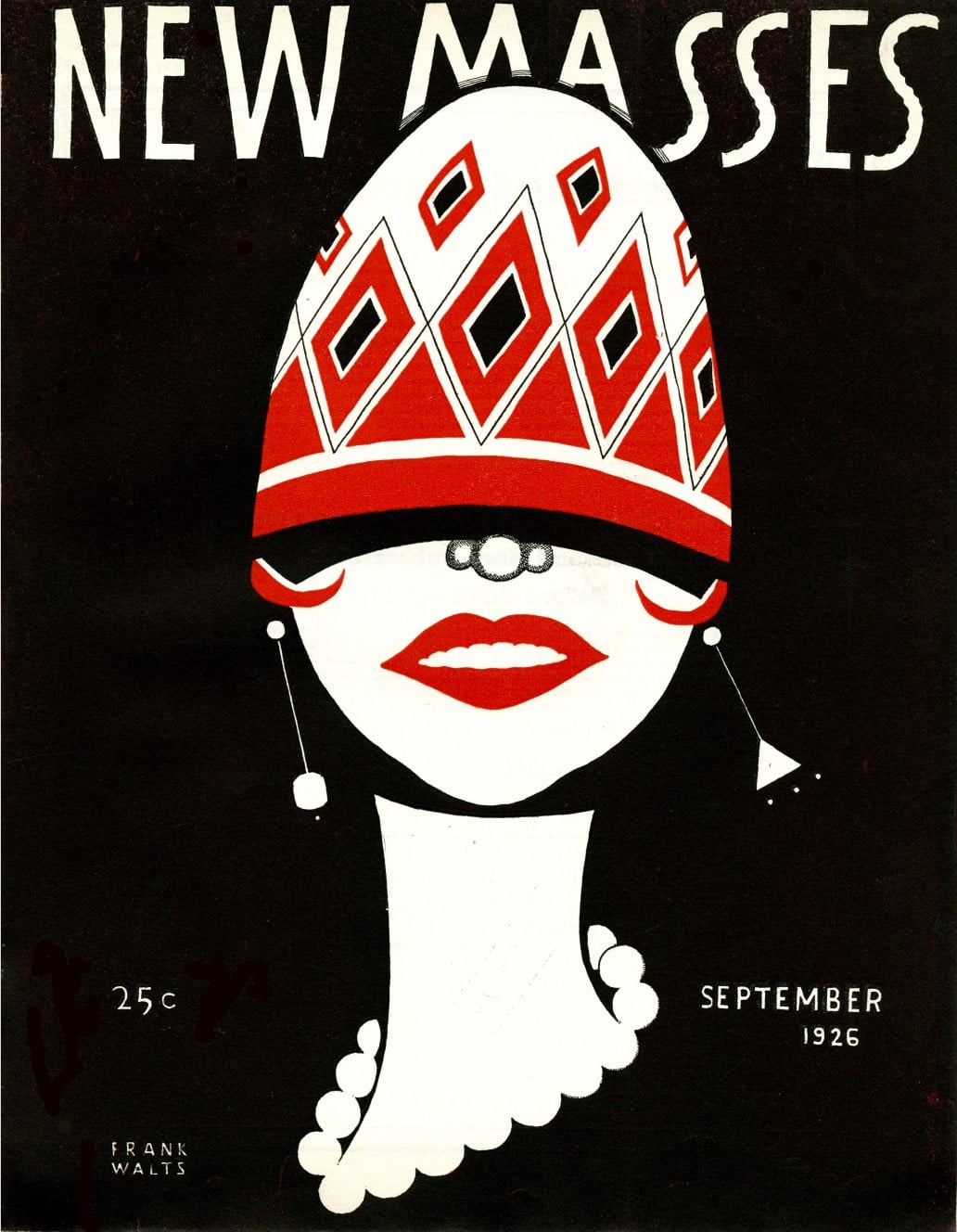
The magazine, however, encountered difficulties. Some of its supporters were now drifting away from the revolutionary movement, and the magazine was suspended for two years. Its revival in the spring of 1926 as the New Masses reflected at once an awakening of the American labor movement and the effect of that awakening upon the intellectuals. That was the year that John Dos Passos, John Howard Lawson, Mary Heaton Vorse, Genevieve Taggard, William Gropper, Michael Gold, Hugo Gellert, and others formed the Proletarian Artists’ & Writers’ League. And, mirabile dictu! the league was endorsed by men of as diverse views as Van Wyck Brooks, William Ellery Leonard, William F. Dunne, Horace Kallen, Samuel Ornitz, Upton Sinclair, Floyd Dell, and William Allen White. This, above all, was the year of the great Passaic strike, which was attracting world-wide attention because it was the first one in American history under Communist leadership. Committees of writers went down to Passaic to aid the strike; the New Masses reported the strike fully; and the intelligentsia as a whole was feeling the invigorating effects of a new American revolutionary movement that was talking about the united front and urging a nation-wide farmer-labor party at this time.
Under these conditions, the New Masses was able to start on the broadest basis. Communists, Socialists, and trade-unionists wrote for it about the industrial conflict, about American politics, about the international situation; writers and artists of the most diverse schools contributed stories, poems, and drawings whose common denominators were antagonism to capitalism, enthusiasm for the Soviet Union, and the desire for a new American literature. Proletarian literature, which the socialists had taken for granted in 1901, which Mike Gold urged in 1919, now became a frequent topic of discussion in the pages of the magazine. Pupils of the old Masses, the editors of the new were adapting to post-war America the tradition of teaching a developing generation the meaning of class conflict, inspiring them with the great idea of socialism. And once more, from every part of the country, came the young, the gifted, the enthusiastic, with their drawings, poems, and stories; and from every state in the union came the echoing voices of readers stirred by their message.
AGAIN a lyric period was interrupted by vast economic factors. The prosperity of the Coolidge-Harding years drew away middleclass intellectuals from the revolutionary movement. The magazine was now run by a handful of writers and artists devoted to the Communist idea. People began to say the magazine was “sectarian.” That was their excuse for abandoning it—just as in 1921 they justified themselves by contending that Lenin had “abandoned” socialism. What had really happened was obvious enough even then. Prosperity had blinded many intellectuals, as it had blinded the American people, to the real nature of capitalism. Sectarianism at this time meant that the writers and artists who remained in the revolutionary movement had to make their position more clear than ever, the attacks upon capitalism had to be unequivocally sharp, the differentiation from liberalism had to be unmistakable. And it was during this period, when the magazine was penniless, when the editors worked without help, sleep, or pay, that the pupils of the old Masses, now maturing, developed still younger artists and writers. This time historic conditions were different; the Communist idea demanded more deliberate organization, more purposeful and coordinated action.
This became apparent in 1930, when the overwhelming economic crisis, unexpected by everyone save the Marxists, irrevocably smashed the illusions fostered by the Big Money. Manuscripts and drawings came pouring in to the New Masses from every part of the country from men and women startled by the unemployment of millions, by their own fall from security. Artists and writers began to crowd our offices to ask questions, to talk things over. They liked the “sectarianism” of the New Masses because that made the issues clear to them. Out of these informal gatherings grew the John Reed clubs, the Theatre Union, Partisan Review, and the various other left-wing cultural organizations which stirred and informed new creative forces in America. These developed by leaps and bounds as the crisis, which big business said would be brief, dragged through the years.
By the fall of 1933 it became obvious that the New Masses had grown too small for the new America unfolding around us. The magazine had been a monthly since 1911; now things were happening too fast, and they were far too important for such slow coverage. Germany had gone Nazi, the Soviet Union was laying the foundations for socialism so rapidly and successfully that the world was startled, divided between enthusiasm and fear; Japan was making war upon China; unemployment, crawling across America like a monster, was goading men and women into hunger marches, farmers’ revolts, tremendous strikes. And writers and artists who until now had simply argued about revolutionary culture over their needle beer, were ready, out of their own bitter experience, to create it. With the crisis maturing America, a monthly was too small a medium.
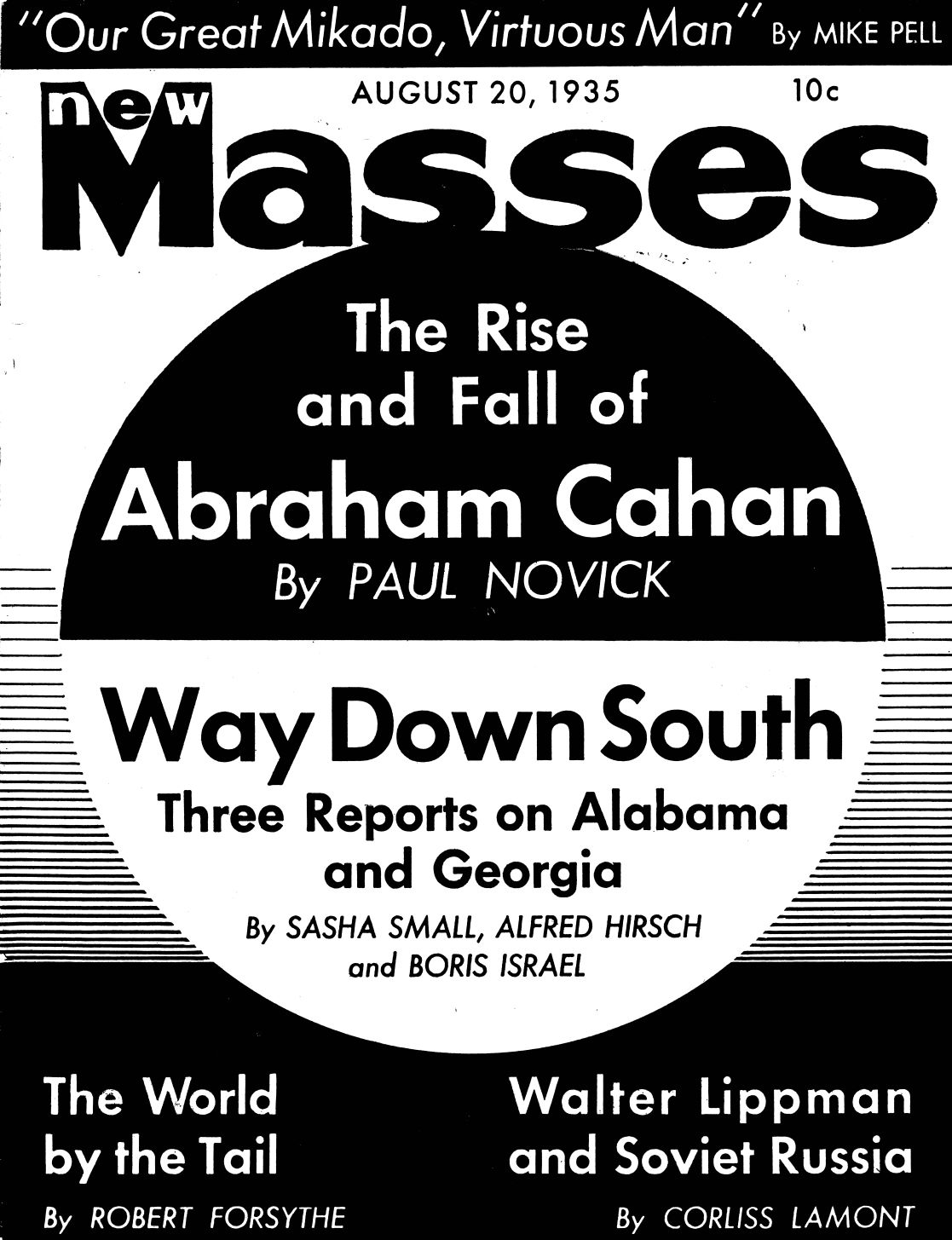
In January 1934 the weekly New Masses appeared. Its roots were in the tradition of the old Masses, the Liberator, the New Masses monthly; but its face was set toward a new period in American life. Everywhere Americans were awakening to a fuller realization of their position. Class conflict in San Francisco, Terre Haute, Minneapolis, Chicago, were arousing the workers to organization and action; farmers, dispossessed from their land, were entering agricultural groups and farmer-labor groups; professionals, for the first time in the history of this country, ere organizing in powerful trade unions; and the Communist Party, always responsive to historic changes, was entering upon a more mature stage of its development.
Above all, progressive Americans in every part of the country were beginning to understand the dangers of fascism. They had been shocked by Hitler’s tyranny in Germany; they now learned from John L. Spivak in the New Masses that fascism and anti-Semitism were spreading in the United States. They had been puzzled by the N.R.A., and the New Masses was the first weekly reaching a large middle-class audience which explained it. The South, hitherto terra incognita for many Americans, was opened for us by Erskine Caldwell. Communism, a movement maligned and distorted by its foes, was expounded in lucid terms by Earl Browder, who showed its real relation to the American tradition. Josephine Herbst brought back brilliant reports from Cuba, Joe North from Terre Haute, Bruce Minton from the West Coast. From a Europe moving rapidly toward war, John Strachey and Ilya Ehrenbourg, sent memorable dispatches, and from the Soviet Union, where that socialism which in 1911 was only a dream, already functioned, Joshua Kunitz sent exciting reports. Marxist literary criticism in America, which Floyd Dell, Michael Gold, and others had stimulated, grew and developed in the hands of Granville Hicks, Isidor Schneider, Robert Forsythe, Philip Rahv, William Phillips, Alan Calmer, and their contemporaries.
At the beginning of the economic crisis, the New Masses stirred and crystallized certain forces which later transcended their origin in scope and in depth.
The New Masses today maintains unbroken its twenty-five-year-old tradition of gathering together, informing, and inspiring the most advanced men and women of our country. It continues, under new conditions, the fight against capitalism, and for socialism. It has retained the loyalty and the genius of its earlier artists and writers like Art Young and Mike Gold, and has attracted new, gifted writers and artists from every part of the world. Above all, it retains a devoted body of readers, sensitive to errors, appreciative of good work, politically alert. This we have been able to gauge by the extraordinary response to our campaigns against fascist organizations, against the Tydings-McCormack bill, on behalf of Angelo Herndon, the Scottsboro boys, Spain, and the Soviet Union. This is a rich heritage of service to the American labor movement, to all the forces of progress in politics, art, and literature. But it is a heritage which imposes a great obligation. To those of us who have been connected with the magazine for many years, the significance of contemporary events comes with peculiar sharpness. The Greenwich Village of orange candles, batik waists, and sandals is gone; the artist today is also a conscious citizen. At his best he is a revolutionary fighter; he goes to aid the miners in Kentucky; he travels thousands of miles to Brazil to plead for Prestes and the Ewerts; he assists: the marble strikers, like Rockwell Kent; he accompanies Earl Browder to a Terre Haute prison: cell, like Waldo Frank; he commands an aviation corps in Spain, like André Malraux, or a company of loyalist milicianos, like Ludwig Renn. He is a trade union organizer in his craft, like John Howard Lawson or Stuart Davis; he works among farmers, like Jo Herbst; he labors for the emancipation of his oppressed people, like Loren Miller. The New Masses is the magazine of these writers and artists.
Many of us remember vividly the anti-Red drives of the Palmer days, but that was child’s play compared with the forces of fascism developing in this country, with the sinister aims of those who ape Hitler and Mussolini. Millions of Americans have realized this danger. They have realized, too, the inseparable connection between fascism and war. They see Spain fighting for its democratic life against fascist hordes supported by Italy and Germany; they see Japan making common cause with Hitler and Mussolini for a war against the Soviet Union. And they see everywhere, standing up to combat these forces of evil and darkness, a People’s Front determined to defend elementary liberties. They are ready to do this themselves in the United States. The New Masses is their magazine, too.
MORE READERS are coming to us, more artists, more writers—all ready to fashion an instrument which can effectively aid in the struggle against war and fascism, which can help in the formation of an American People’s Front, which can further develop an American art and literature inspired by the struggles of the working class and its allies for the advancement of mankind. These are some of the tasks of the New Masses today. Proud of its past, it buckles down to its job in the present, to the responsibilities imposed by this momentous period in the world’s history. The old Masses, product of a more peaceful era, was noted for its easy-going humor. The New Masses, product of the post-war period, has its humor, too, but is concerned primarily with the seriousness of the world-wide struggle. Fascism cannot be laughed out of existence; it must be fought; and into this fight, in which millions take part, our writers, artists, and readers want to pour all their passion and energy.
The New Masses was the continuation of Workers Monthly which began publishing in 1924 as a merger of the ‘Liberator’, the Trade Union Educational League magazine ‘Labor Herald’, and Friends of Soviet Russia’s monthly ‘Soviet Russia Pictorial’ as an explicitly Communist Party publication, but drawing in a wide range of contributors and sympathizers. In 1927 Workers Monthly ceased and The New Masses began. A major left cultural magazine of the late 1920s to early 1940s, the early editors of The New Masses included Hugo Gellert, John F. Sloan, Max Eastman, Mike Gold, and Joseph Freeman. Writers included William Carlos Williams, Theodore Dreiser, John Dos Passos, Upton Sinclair, Richard Wright, Ralph Ellison, Dorothy Parker, Dorothy Day, John Breecher, Langston Hughes, Eugene O’Neill, Rex Stout and Ernest Hemingway, Artists included Hugo Gellert, Stuart Davis, Boardman Robinson, Wanda Gag, William Gropper and Otto Soglow. Over time, the New Masses became narrower politically and more journalistic in its tone.
PDF of full issue: https://www.marxists.org/history/usa/pubs/new-masses/1936/v21n12-dec-15-1936-NM.pdf
 Revolution's Newsstand