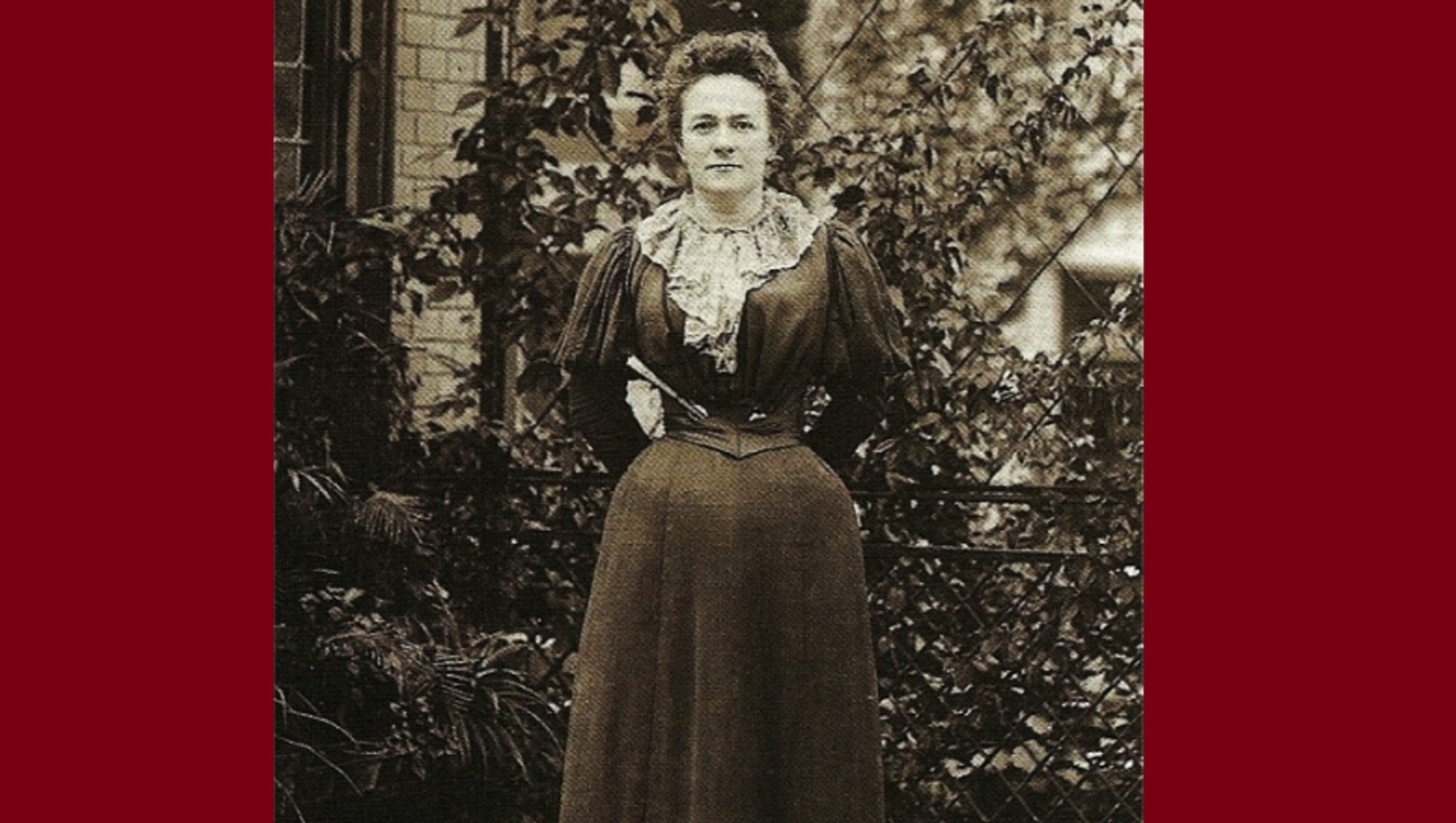
Zetkin takes Britain’s petty-bourgeois suffrage movement to task for its scheme to ‘break though’ by first getting propertied or ‘independent’ women the vote and then they would, presumably, vote to extend the franchise to their maids.
‘The Limited Women’s Suffrage Fight in England’ by Clara Zetkin from The Socialist Woman. Vol. 2 No. 15. August, 1908.
In England, at the present moment, the limited woman suffrage is being fought over with energy and passion. A bill lies before parliament which demands the suffrage for women the same terms as those on which it is enjoyed by the men. Opinions differ widely in the woman suffrage movement as to how wide or how narrow the limitations are to be. The existing electoral laws for the various local bodies present in the question of woman suffrage a real pattern book of the most varied and contradictory provisions. It is still an open question which of these laws or what combination of their prescriptions is to provide a foundation for the political woman suffrage. There are even to be found advocates of woman’s suffrage, who, “on grounds of expediency,” would be content with the exclusion of all married women from the possession of the vote. The phrase, the women are to get suffrage “on the same terms as men,” disguises the differences of opinion and the lack of clearness, and deceives, unfortunately more than anyone else, many working women as to the much more plutocratic than democratic character of the reform demanded.
It is easy to be understood that in England the bourgeois woman suffragists fight with the greatest energy for the limited woman suffrage. In doing so, they only act according to their class interests. They have no concern for the complete democratisation of the suffrage which is demanded in the interests of the proletarian women. The ladies have already shown on other occasions their incapacity for understanding the interests of the working women. We would remind you of the doggedness with which a great and very influential portion of the English Women’s Righters have opposed up to now the bitter legal protection of female labor. Here too, the ladies have always appealed to the principle of the equality of the sexes, whereas in reality they were defending nothing else than the unlimited freedom of exploitation of the propertied over the non-propertied. They thus remained true to their character as champions of the interests of the propertied classes by sacrificing in the question of woman suffrage, too, the right of the great majority of their sex to the privilege of a small minority of their class; by demanding, instead of equal political rights for all, only a privilege for a comparatively few. Under these circumstances it must astonish us to see the Socialist women and men come forward, together with the bourgeois ladies, as champions of the political monopoly of the purse. How confusingly that has worked on the ideas and actions, to the damage of the Socialist and labor movement, has been shown by the bye-elections to the English parliament. It would seem natural that at these bye-elections the women comrades should also use their whole energy in support of the labor candidates.
The English comrades who have been eminent champions for a limited woman suffrage attempt to justify their attitude with all kinds of arguments. They say that the limited suffrage is not so limited as it appears. It is so broad, they assert, that most working women–in any case, more working women than bourgeois ladies–would receive the vote. The assertion is said to be proved on the grounds of “calculations,” based partly on the names now on the municipal registers, and partly on a house-to-house canvass undertaken in Nelson. Both proofs, however, are insufficient. From different sides it is proved that the lists of municipal voters are no trustworthy declaration of the number of the women who would get the vote under a limited suffrage. Leaflet No. 2, of the “Adult Suffrage Society,” remarks, consequently, “With regard to the municipal registers this is a very slight guide, as without intimate knowledge of the constituency it is impossible to say how many more women would be qualified for the parliamentary register. And as for the enquiry from house to house is concerned, its value is certainly still less.” Enquiries that have been made in branches of Woman’s Guild have shown that most of the women are expecting to have a vote, because their husbands can vote now, for this is the interpretation which they give to the phrase “as it is given to men.” If such enlightened women workers as the members of the Woman’s Guild have so confused a conception as to the limited woman suffrage, the personal opinions of women that will be enfranchised by the limited bill are no convincing proof of the actual extent of the future political emancipation of the sex. “One of the Weavers’ officials declared emphatically that he knows that numbers of women are mistaken in this respect, and if the limited bill passed there would be a ‘painful awakening.'” In fact, most personal testimonies of women as to their future suffrage are nothing but suppositions and hopes.
Very few wives and daughters of the workers are economically or socially in a position to satisfy by themselves the conditions of the limited suffrage. These women possess neither property of their own, nor have they obtained a university degree; few of them are house-holders or occupiers of business premises, rented from ten pounds up. The greater part of the married workers have not so much property or income as to enfranchise their wives and daughters.
And how does it stand with the vote of the unmarried, self-supporting wo man? The champions of the limited woman suffrage attempt to secure the support of the working women by telling them that most of them would be enfranchised in virtue of the lodgers’ vote. Anyone who has seriously studied the conditions of life among the women workers knows that this assertion is fancy. The lodgers’ vote can only be claimed by persons who are sole occupiers of a room valued at not less than 48. per week, unfurnished. Very few working women, however, have wages which enable them to pay 48. a week for an empty dwelling. Margaret Bondfield, one of the best known English Women’s Trade Union leaders, justly states that even the skilled textile working women in Lancashire–who, as is well known, belong to the best paid. English working women–do not occupy separate rooms, but live together with a sister or a woman friend. The dress makers, tea packers, jam makers, chair makers, and other fancy workers be sides, are in consequence of their low wages, 58. to 9s. weekly, completely unable to secure for themselves a dwelling which would qualify them for suffrage. Very few even, of the female employes in the civil service–women clerks, telephone operators, etc.–would be voters under the limited suffrage. Enquiries which were recently made in London have shown that they live at home or share rooms. Women domestic servants and shop assistants would, as voters, hardly come into aeccount in consequence of their “living-in” system and the migratory nature of their employment. All in all, if the woman suffrage is to be introduced, only a small portion of the women proletariat would answer to the seventeen different provisions of the electoral law on property, university degree, employment, dwelling and service, and be able to emancipate themselves politically. Nay, the number of the non-qualified women would be certainly in proportion still greater than the number of the male workers, who are, in consequence of the provisions, shut out from the suffrage, since the women workers are, in general, still more exploited by the capitalists and worse paid than the men workers. Being worse paid, they are, according to the principle of the limited woman suffrage, less qualified to vote than the better money-earning men. This feature, too, shows clearly that for the limited woman suffrage it is not the principle of the equality of the sexes which is decisive, but the principle of the power and dignity of property and income. Besides, another fact must be brought into account. So long as the suffrage is not adult suffrage, but remains attached to property and taxation in the interests of the exploiting classes, so long will there be decisions of revising barristers and courts of appeal, who, by means of artificial interpretation of the electoral provisions, deprive many proletarians of their votes. That has already been experienced by many English workers.
As a consequence of their inferior economic position and complicated circumstances the working women would still oftener experience that their right to vote would be refused by the revising barristers and courts of appeal. Because they are poor, and not because they are women.
Progressive Woman replaced The Socialist Woman. The Socialist Woman was a monthly magazine edited by Josephine Conger-Kaneko from 1907 with this aim: “The Socialist Woman exists for the sole purpose of bringing women into touch with the Socialist idea. We intend to make this paper a forum for the discussion of problems that lie closest to women’s lives, from the Socialist standpoint”. In 1908, Conger-Kaneko and her husband Japanese socialist Kiichi Kaneko moved to Girard, Kansas home of Appeal to Reason, which would print Socialist Woman. In 1909 it was renamed The Progressive Woman, and The Coming Nation in 1913. Its contributors included Socialist Party activist Kate Richards O’Hare, Alice Stone Blackwell, Eugene V. Debs, Ella Wheeler Wilcox, and others. A treat of the journal was the For Kiddies in Socialist Homes column by Elizabeth Vincent.The Progressive Woman lasted until 1916.
PDF of full issue: https://www.marxists.org/history/usa/pubs/socialist-woman/080800-socialistwoman-v2w15.pdf

