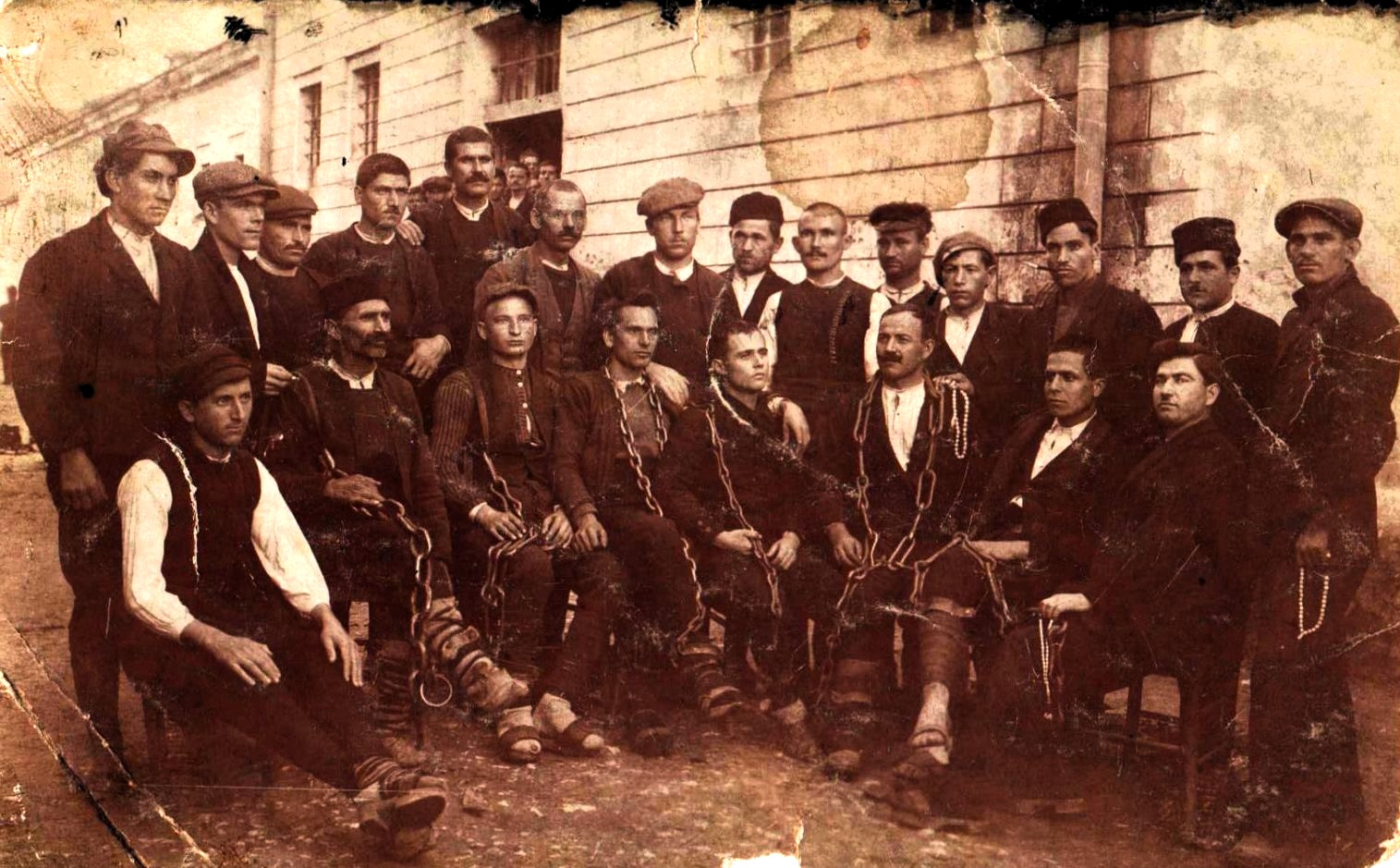
The Third International spent the better part of its first decade discussing a program before completing one in 1928 around the Sixth World Congress. Bukharin, who wrote the Programme of the World Revolution in 1918 and, with Preobrazhensky, The ABC of Communism in 1920, and was tasked by the Fourth Congress in 1922 to lead the process. As part of the discussions around 1924’s Fifth Congress, a Symposium collecting the programs of several important constituent parties, including the Bulgarian, was published. Below is the full program of the Bulgarian Communist Party as it stood in the mid-1920s. Certainly one Europe’s most important Communist Parties, Bulgarian revolutionary Marxism has a rich tradition long predating the Comintern, becoming its own party in 1903 with the split of the Social Democratic Party between the revolutionary, Narrow (Tesniak) Socialists, and the reformist Broads. The Party would heroically stand for proletarian internationalism against the Balkan and World Wars. With tens of thousands of members and an earned authority among the country’s working class, it was among most influential of Communist forces when the explosive events of 1923 saw fascist reaction successfully put down one of Europe’s best organized and combative peasant and working classes.
‘Draft Programme of the Communist Party of Bulgaria’ from Symposium on the Programme Question. Published by the Communist International, 1924.
Draft Programme of the Communist Party of Bulgaria
(SECTION OF THE COMMUNIST INTERNATIONAL)
IMPERIALISM and the great imperialist war led to a pro| found economic, social, and political crisis in capitalist society.
They opened the epoch of the proletarian revolution, whose act was the victorious revolution of the Russian proletariat.
Capitalism is impotent to find a way out of this crisis. The chaos in production and commerce grows ever more hopeless and attains utterly unprecedented dimensions. The poverty and wretchedness of the proletariat and the lower middle class, who comprise the enormous majority of the population, are increasing at a terrible rate. The hostility between the great imperialist States is becoming intensified, so that the danger of a fresh imperialist war, involving ever greater dangers to mankind than the previous one, grows more and more imminent. The class conflicts, in which larger and larger numbers of the workers become involved, are being intensified to the pitch of one civil war. The foundation of capitalism is crumbling. Im its fall the capitalist system threatens to bury the nations beneath its ruins, to thrust them into barbarism and to doom them to degeneration and to death. The only issue for humanity from the abyss is through the victory of the proletarian world revolution. Material and social conditions are ripe for this victory. The task of the C.P.B. of all lands is to organise the workers and the lower middle class for the struggle to lead them to battle, in order to prepare, to hasten and to ensure the victory of the revolution, the overthrow of capitalism, and the realisation of Communist society.
In the Balkans and in Bulgaria, the nationalist policy of conquest of the Balkan bourgeoisie, co-operating with the interests and rivalries of the various dynasties, and with the machinations of the imperialist bourgeoisie of Europe, have led to wars of which the end has not yet come. Thereby the Balkan peoples have been almost completely ruined, and have been subjected to a new economic and political yoke, that of Entente imperialism. Notwithstanding certain temporary and apparent successes in some of the Balkan lands, there has ensued an inevitable bankruptcy of the nationalist policy of the Balkan bourgeoisie, and thereby the basis of their domination has been undermined. The economic, social, and cultural development of the Balkan peoples has been completely arrested by the decay of domestic capitalism and by the foreign imperialist hegemony. The fearful devastation of the country and the poverty of the masses of the workers, has simultaneously given an impetus to the struggle of the workers and the lesser peasant. The tide of the proletarian revolution in the Balkans, the revolution that is destined to break the chains of the social and national subjugations of the Balkan peoples and the Bulgarian nation, is now rising.
The general crisis in the capitalist world and in the Balkans, intensified in Bulgaria, as in all the defeated countries, by the colossal war indemnities, imposes upon the C.P. of Bulgaria an immediate task. It is to organise the proletariat and the lower middle class for the decisive mass struggle against exploitation, poverty, and degeneration, and to pave the way for the approaching victory of the proletarian revolution in the Balkans and in Bulgaria.
The cause of the widespread and intense crisis and of the decay of capitalism and also the material conditions which will bring about the victory of the proletarian world revolution, are intrinsic in capitalist society. The C.P., in determining its aims, starts with a precise analysis of capitalist production and of its latest imperialist phase. Capitalism develops by way of the destruction of petty industry and petty agriculture. The independent artisans and the small holders suffer more and more from capitalist competition until, ruined, they join the ranks of the C.P. Those among them who continue to maintain their private proprietary rights, become dependent none the less upon the urban traders or upon the bankers or upon the village usurers, so that their working conditions grow continually worse, and greater sacrifices are forced upon them while the small producers are thus being proletarianised, and while the poverty of the petty owners in the towns and the villages is rapidly increasing, the means of production are passing into the hands of an ever small number of capitalists. The centralisation of capital and the concentration of the means of production becomes increasingly marked. Large-scale capitalist production makes inexorable progress.
The characteristic feature of capitalist production is that the means of production pass into the hands of a numerically small class the bourgeoisie. The preponderant masses of society, consisting of the workers and the semi-proletarian small producers, are compelled, in order to secure a livelihood, to sell their labour power to the capitalists and to submit to exploitation by the latter. The basis of capitalist production is surplus value or the unpaid labour of the workers. The aim of capitalist production is profit. The application of machinery to the work of production, and the various technical advances which increase the productivity of labour and swell the total of commodities on an amazing extent, are of advantage only to the capitalists and to the possessing classes. As far as the workers are concerned, these changes merely increase their dependence and intensify their exploitation by capital.
The development of capitalist production increases the number of the workers employed in production, involves the women and children in the task of production, creates a reserve army of labour, and thereby increases yet further the exploitation of the proletariat. In times of economic crisis, unemployment (which is a perpetual accompaniment of capitalist production and a terrible curse to the workers), assumes vast proportions.
The anarchy of capitalist production, in which everyone produces without considering the needs of the market, and without any possibility of considering these needs, the competition between the capitalists within each country and between the capitalist groups of various lands, the enormous increase in the amount of commodities, and the intensified exploitation of the worker and of the lower middle class—give rise to periodically recurring economic crises which are accompanied by widespread unemployment and terrible poverty for the working masses. During these crises, when millions of unemployed workers tramp the streets—idle because they have produced too much, and because the capitalist warehouses are gorged with commodities—the insoluble contradiction of capitalist society grow plain to the most superficial observer.
In this way, every advance in the evolution of capitalism, every perfection of machinery, and every achievement of technical progress, leads, not to an increase in the well-being of society, but merely to an expansion of the wealth of the privileged minority which controls the means of production and distribution. Simultaneously, the misery of the great majority of the population grows ever more intense. The contrast between the classes becomes more conspicuous, the gulf between the bourgeoisie and the proletariat, between the possessing class and the working class widens; day by day, unemployment, uncertainty as to the future, deprivation among the masses of the population, increase with giant strides.
Concurrently with this accentuation of class contrasts, the civil war between exploiters and exploited, between the bourgeoisie on the one hand, and the proletariat and semi-proletariat producers on the other, grows more acute. The number of the fighting workers increases; their organisation, their discipline, and their class consciousness are improved. There also ensues an increase in the number of those belonging to the lower middle class which are willing to fight under the working class banner. The strength of those who fight for the aims of the working class, and the day of the final overthrow of the capitalist regime approaches. At the same time, the technique of production is perfected, so that the labour process of the capitalist entrepreneurs becomes a social process. More and more quickly do the historical and material conditions ripen for the social revolution and for the realisation of Communist society whose attainment is the final goal of the C.P.
The imperialist stage of capitalist development, the imperialist world war and the subsequent victory of the proletarian revolution in Russia, created new conditions for the struggle of the working class. These conditions may be characterised as follows:—
The vigorous development of capitalism during recent decades has taken the form of an unprecedented centralisation of capital and concentration of production. Capitalist monopolies came into existence in the form of syndicates, cartels, and trusts, gaining control of more and more important branches of industry, and conquering both the home market and the international market. Then came the union between industrial capital and banking capital, and the development of financial capital. There was an increased export of capital, intensifying the competition between the capitalist States, leading to redistribution of the colonial areas and to modifications in the world market. During this new epoch of capitalist development, known as the imperialist phase, there have been extensive changes alike in the internal and in the external relationship of the capitalist States.
Within the capitalist States, political power has been concentrated in the hands of some groups of wealthy capitalists, landowners, and bankers, who have gained supreme control of large-scale industry, mines, and the soil. During the same period, an ever-increasing number of petty producers have been proletarianised. Even those who have retained their little workshops, their tiny plots of land, or their small retail shops, have completely lost their economic independence, and have been forced more and more into the same conditions as the working class. The class contrast between the bourgeoisie and the proletariat has been continuously intensified. In order to suppress the growing dissatisfaction of the proletariat and the lower middle class, to repress their inclination to struggle for an escape from their condition, the dominant capitalist groups are having recourse to an increasingly reactionary policy. As a last resource in the endeavour to maintain their dominion, they are instituting a brutal regime of bourgeois class dictatorship.
The imperialist foreign policy of capitalist States has been an outgrowth of the imperialist stage of capitalism. When large scale capitalism had secured complete control of the home market, the monopolists endeavoured to conquer the foreign market as well. As soon as the whole world had been divided up among the birds of prey, the Great Powers, new rivalries arose among them, leading to attempts at a redistribution of the spoils. The investment of increasingly large amounts of capital in the colonies and the backward lands has been followed by an increasingly vigorous attempt on the part of the bourgeoisie to subjugate these regions more effectively alike economically and politically, in order thus to safeguard capital and interest. Imperialism as a system strips the veil from the colonial policy of the bourgeoisie, so that it is displayed in all its nakedness as a policy of plunder, conquest, and the subjugation of foreign peoples and territories.
In order to fulfil the predatory aims of this imperialist policy, and in order to maintain the dictatorship of the bourgeoisie, the capitalist Governments have developed militarism to an enormous degree, so that the peoples are crushed beneath its burdens. It was imperialism which continuously intensified the conflicts between the Great Powers, until at length these conflicts culminated in the imperialist world war.
During the imperialist epoch, the development of the forces of production advanced with giant strides, and capital was centralised in the hands of a dwindling minority of large scale capitalists and bankers. Capitalist monopolies, banking amalgamations and State capitalism paved the way for the social regulation of the process of production and for the social distribution of commodities. The contradiction between social production and the private ownership of the means of production becomes more conspicuous. Economic conditions grow ever riper for the transformation of privately owned means of production into social property. The proletariat of those sections of the lower middle class who are closely akin to the proletariat, constitute the overwhelming majority of the nation. The victory of Communism will depend upon the class consciousness and the organisation of the working class—in a word, upon its strength.
The war has involved for the workers and the lower middle class the most terrible sacrifices of life, has involved devastation, poverty, and famine. Following upon the war have come the widespread economic crises, accompanied by a rise in the cost of the necessaries of life and extensive unemployment. The capitalist Governments are bankrupt alike politically and financially, so that the capitalist system has reduced society to chaos. All these circumstances have combined to render the position of the workers intolerable, increasing the discontent of the masses, intensifying the class struggle, and leading to a civil war between the proletariat and the bourgeoisie, which will end in the overthrow of the capitalist regime and in the conquest of power by the proletariat. The revolution occurred first in Russia, and this was followed a year later by revolutions in Germany, Austria and Hungary. The victory of the proletarian revolution in Russia demonstrated clearly the aims and methods of the proletarian world revolution.
Owing to the peculiar but transient conditions of production that immediately followed the war (conditions which for a time provided ample occupation for the demobilised workers), and owing to the treachery of the international social democracy under the leadership of opportunists and traitors, the European imperialist bourgeoisie was enabled to repel the first revolutionary onslaughts of the proletariat and to maintain its own dominion for a few years longer. Nevertheless, shortly after the war began the general economic crisis extended all over the world. This crisis was brought about, in part by the wastage of the forces of production, by the slackening of production, and by the impoverishment of Europe, and in part by the sudden expansion of industry and production which occurred in America, Japan, and the colonies, during the war. This crisis was the cause of a hitherto unprecedented rise in prices and of an enormous extension of unemployment, whereby the proletariat and the lower middle class in all countries has been plunged in yet more hopeless poverty.
The capitalist class took advantage of the crisis to intensify exploitation and to lower the proletarian standard of life. All the burdens resulting from war expenditure were transferred to the shoulders of the workers. Everything possible was done to strengthen the dominion of capitalism, while the working class was exposed to conditions involving degeneration and death. In pursuit of these aims, the bourgeoisie is strengthening the reaction, is organising an international counter-revolution, and is straining all its forces to strangle the revolutionary movement of the proletariat in every country, and above all to destroy Soviet Russia as the focus of the proletarian world revolution. Nevertheless, the capitalist class is incompetent to lead human society out of the universal crisis, out of the anarchy and chaos which capitalism has created. It cannot restore the economic energies of the people. On the contrary, the whole of the postwar policy of capitalism has served only to intensify the crisis, and is inevitably tending to force mankind into new and yet more tremendous imperialist wars. Pacifism sermons anent disarmament, international conflicts, and the movement in favour of international arbitration, do nothing to prevent the increase of armaments or to nullify the indications that new wars are in preparation.
The proletarian, the Communist revolution can alone lead mankind out of the blind alley into which imperialism and the imperialist wars have brought it. However great the difficulties of the revolution, and despite transient failures, the ultimate victory of the proletariat is assured.
Gradually, but unintermittingly and universally, the working class is plucking up heart, and is showing ever more definitely its determination to resist the capitalist offensive. It is organising, multiplying, and marshalling its forces in order that, safeguarded by the R.S.F.S.R., the citadel of the proletarian revolution, and led by the Communist International, which co-ordinates the energies of all lands, it may assume a decisive revolutionary offensive and proceed to the final overthrow of capitalism.
Indispensable conditions for the victory of the revolution are: on the one hand, the waging of an independent class war by the proletariat, the intensification of the revolutionary class consciousness of the workers, international solidarity, and unification of the militant workers of all lands under the banner of the Communist International; and on the other hand, a ruthless warfare against the social patriots and the centrists, not forgetting the anarchists and the syndicalists, so that the working masses, who to a large extent in the chief capitalist countries continue to follow the leadership of the social patriots, may be organised as part of the fighting of the Communist International. In Bulgaria, where the whole of the militant working class belongs to the Communist party, and where the social democrats (known in this country as the “broad socialists”) have no influence among the masses, the Communist party is in a favourable position to prepare for the victory of the proletarian revolution. It will be able to unify and to organise the still unorganised sections of the workers and the lower middle class; it can also make a powerful appeal to the middle class organisations, those of the State employees and those of the salaried employees in private undertakings, which are at present still attached to the bourgeois parties. It will be in a position to lead these united forces in a decisive struggle on behalf of their immediate and general class interests.
***
Bulgaria has developed under the general conditions of European imperialism. Its situation is, however, distinguished from that of the larger capitalist States by the fact that, despite the insatiable greed of conquest of the Bulgarian bourgeoisie, it has itself become an object of conquest and exploitation on the part of the great imperialist plunderers. The momentous nationalist and imperialist wars into which the Bulgarian people was forced by the bourgeoisie have devastated the country alike, industrially and financially. The workers and the lower middle class are subjected to a double yoke, that of the native exploiters and that of the foreign conquerors. The misery of the Bulgarian people is thus redoubled. In the case of the lesser and more backward nations, the imperialist war put the finishing touches to what the policy of conquest of capitalism and imperialism had begun. These lesser and backward nations have been conquered, and have been transformed into dependent and exploited States. The victorious Great Powers have laid their hands upon the natural wealth and raw materials of the lesser and backward nations, and also upon those of the great imperialist countries that were defeated in the war. These victims are plundered economically and conquered politically.
The exploitation to which the inhabitants of the colonies and dependencies are exposed fortifies the revolutionary movement in these lands. The only active supporters of such movements are to be found in the ranks of the revolutionary international proletariat. Hence these movements, nationalist in their inception, inevitably develop into movements making for the social revolution, inasmuch as the success of the nationalist movements can only be achieved as the outcome of a successful social revolution in Europe. The revolutionary movement for the liberation of the peoples oppressed by imperialism will, in turn, undermine the privileged position of the great parasitic imperialist States, and will hasten the coming of revolution in these latter.
In this way European imperialism has accentuated the class contrasts which had already been created of the internal development of Bulgaria. The successive wars accelerated the accumulation of capital in the hands of the bourgeoisie, intensified the exploitation of the workers, and brought about the proletarianisation of the lesser peasantry and the artisan class on a gigantic scale. The terrible sacrifices of the war, the economic devastation, financial bankruptcy, the complete collapse of the nationalist policy of conquest, have combined to shake the foundations of the bourgeois regime in Bulgaria. The tide of discontent is following, and the revolutionary movement of the masses is in the ascendant. The immediate aims of the Bulgarian proletariat must be: First of all, to place itself in the van of the movement; secondly, to unite it with the revolutionary movements of the neighbouring Balkan States; and, thirdly, to co-ordinate the whole with the mighty forces of the European proletarian revolution.
The Balkan bourgeoisie seized the opportunity furnished by the disintegration of the Balkan peoples, and by the impossibility of an economic development within the narrow limits of this region, in order to pursue a nationalist policy and to reach out towards aim of conquest in the name of “national enfranchisement.” In each of the Balkan States the bourgeoisie tried, on the lines of the foregoing policy, to fashion a single great Balkan power, each endeavouring to split up the neighbouring States, to subjugate large portions of these, and thus to secure a Balkan unity on the imperialist model. This nationalist policy of conquest led in the Balkans to frequent wars, and ultimately to the war of 1912-18, which eventuated, not in national enfranchisement, but in still greater national disintegration and enslavement, and which culminated in economic disaster for the Balkan area. Moreover, the Balkan wars increased the dependence of the Balkan peoples upon the capitalist Great Powers. Thanks to their mutual rivalries, the Balkan States became blind tools of European imperialism, which ultimately involved these States in the imperialist war. As the outcome of that war, Rumania and Jugo-Slavia achieved a temporary unification of the Rumanian and Serbian peoples, whereas the Balkan peoples were disintegrated, and great masses of their population were enslaved to their enlarged Balkan neighbours. These new States, comprising now many nationalities within their borders, can maintain their existence only with the aid of military and financial support from the Entente imperialist powers, and at the cost of the oppression of exploited classes and subjugated nationalities and of an increase in militarism and bureaucracy.
For the second time within recent years Bulgaria is devastated by war, and as a result of the latest peace settlement its frontiers have been yet further restricted. As for Greece, thanks to the national policy of conquest of the Greek bourgeoisie and the British imperialists (whose tool Greece has been in the war against Turkey), that country has suffered yet greater disasters. As an outcome of the years of nationalist and imperialist wars in the Balkans, all the Balkan States—victors and vanquished alike—have been ruined industrially and financially, and have been transformed into dependencies of Entente imperialism.
The national liberation of the Balkan peoples, the necessity for which has been brought to the front before the war by the peculiar ethnographic, historical, and geographical conditions of the region, has now become a crying need, and essential to their economic development, and, indeed, to their very life. But the Balkan bourgeoisie has proved incompetent to solve the national problems of the Balkan peoples. Despite local transient and partial successes, the nationalist policy of conquest has, as a whole, proved utterly bankrupt. For this reason, as early as 1910, four years before the Great War, the Socialist parties of the Balkans declared that the national liberation and the unification of the Balkan peoples could be achieved only by the class war, by the victory of the proletariat and the poor peasants, and by the establishment of a Socialist Balkan Republic. It was in pursuit of this aim that there was founded the Federation of the Socialist Parties of the Balkans, which after the Great War became the Communist Balkan Federation. The wars have in the Balkans accentuated class contrasts, they have intensified the class war between the proletarians and the poor peasants on the one side and the bourgeoisie and the great landowners on the other. The industrial proletariat of Rumania, comprising a very large body of workers, has been subjected to a yet more excessive exploitation; the peasants for the most part, despite all the agrarian reforms, are still the serfs of the boyars (territorial magnates); while those peasants who have received plots of land have merely exchanged dependence upon the boyars for dependence upon the bourgeoisie and its banks. In Jugo-Slavia, where the devastation wrought by the war has been especially marked, the exploitation and poverty of the working masses increases from day to day.
In Greece the crisis caused by the catastrophe in Asia Minor has given a new impetus to the struggle for the social enfranchisement of the proletariat and the poor peasants, and also to the movement among the peasants of Thessaly, who still remain in a state of feudal dependence upon the great landowners.
The bourgeoisie of the Balkan States, wishing to divert the attention of the workers and peasants from the class war, and wishing to strengthen its own class dominion, did its utmost again and again to intensify national differences, and continued its old nationalist policy of conquest. It was ready to hurl the Balkan States into a new fratricidal war at the first opportunity, provided only thereby it could drown in blood the growing revolutionary movement of the workers and peasants.
The Communist Federation of the Balkans must unite the proletariat and the poor peasants of the Balkan States for the common struggle; it must prepare the conditions requisite for the victory of the proletarian revolution in the Balkans; and it must fight for the formation of a Federal Socialist Balkan Soviet Republic.
A joint struggle by the Communist parties of the Balkans will be essential in order to pave the way for the proletarian revolution in the individual Balkan States, and in order to ensure an ultimate victory throughout the Balkan area. Such a joint campaign by the Communist parties of the Balkans is rendered indispensable by the similarity of the conditions under which the Communist parties of the Balkans have to fight, by the common danger of counter-revolutionary action at the hands of the Entente imperialists, and also on account of the urgent need the future Soviet Republics of the Balkans shall unite to form a federation. A federation alone will be able to solve the problem of nationalities. Only by a national liberation and union of the Balkan peoples can be secured the conditions requisite for their economic development.
***
The final aim of the Communist party is to bring about the social revolution of the proletariat. Thereby, private ownership in the means of production, distribution, and exchange will be replaced by Communist ownership; a purposive organisation of social production and distribution will be inaugurated; the breaking up of society into classes will be annulled; the exploitation of one section of the community by another will be brought to an end; every kind of economic, political and national subjection will be abolished; and the welfare of the multifarious development of society at large will be ensured.
The proletariat will realise the social revolution through the conquest of political power and the establishment of its dictatorship as a class. Until the seizure of power, the Communist party will make use of Parliament and the parliamentary elections in order to make the program and the watchwords of the party as widely known as possible, and also to safeguard the interests and preserve the liberties of the workers and the lower middle class. At the same time it will endeavour to unify and intensify the revolutionary consciousness of the masses, directing the fighting energies of these towards the conquest of power and towards the establishment of the dictatorship of workers’ and peasants’ councils.
The Communist Party will struggle to gain control of the municipal corporations, representing in these bodies the interests of the workers and the lower middle classes, whom it will thereby fortify for the struggle to capture the supreme powers of the State. The Communist Party fights on behalf of the right of combination, the right of public meeting, and for free speech; for an extension of the parliamentary suffrage and the granting of the suffrage to women; and, finally, for the shortening of the duration of parliament.
Speaking generally, the Communist Party avails itself of the freedoms and institutions of bourgeois democracy (in so far as these are still a reality) in order to strengthen its energies and to prepare the conditions for the proletarian revolution.
The imperialist war opened the epoch of social revolutions. During this epoch, the maximum program of the Communist Party acquires a leading and directly practical significance in relation to the struggle of the international proletariat as a whole.
The experiences of the Russian revolution and those of the revolutionary movements in other lands have plainly indicated both the goals of the working-class struggle for freedom, and the means for their attainment. These latter range from the organisation of the proletariat and the leadership of the mass struggle for immediate interests, to the revolutionary political general strike to armed revolt. The epochs of the social revolution and of the dictatorship of the proletariat represent the transition period of human society from Capitalism to Communism. During this period the Communist Party, in its role of class leader of the revolutionary workers and peasants, fights for the realisation of the following aims:—
I.—A SOCIALIST SOVIET REPUBLIC
1. The contemporary State is an organisation for the maintenance of bourgeois domination and for the exploitation of the workers and the poor. The task of the revolutionary proletariat, after the conquest of power, is to transform the State from an instrument for the oppression and exploitation of the great majority of the population into an instrument for the political enfranchisement of the masses and for liberating them from the chains of economic subjugation. This will deliver the proletariat, inasmuch as it will abolish the contemporary State and its pillars of support—parliament, the bureaucracy, militarism, etc. In place thereof it will establish a new State, the Socialist Soviet Republic, based upon the self-government of the workers and of the dispossessed classes, and upon the arming of the workers and peasants, these aims being realised by the delegates of the workers’ and peasants’ councils.
2. Under the mask of democracy the capitalist State maintains the power and privileges of a minority of property owners holding sway over an enormous majority consisting of dispossessed and exploited workers. To-day the bourgeoisie is endeavouring to fortify its shaken dominance by bloody deeds of violence and terror. Under the forms of a democratic republic it rules in reality through a dictatorship, maintained by the police, the army, and the whole apparatus of the capitalist State. Parliament and the entire constitutional and parliamentary regime are merely instruments for the exercise of bourgeois class dictatorship.
The Socialist Soviet Republic realises genuine proletarian democracy. All power—legislative, executive, and juridical—is entrusted to the workers’ and peasants’ councils, is placed, that is to say, in the hands of the producing and working classes. All the organs of the capitalist States, from the government, parliament, democracy, police and militarism, to county councils, town councils, and parish councils, are replaced by the new Soviet organisations, and by the local and central institutions, political, economic, and cultural, created by these.
The councils of workers’ and soldiers’ delegates are the executive organs of the revolutionary power of the realisation of Socialism and Communism. The participation of all active workers of both sexes, whether in town or country, in the Soviet elections, the power of recalling delegates, and the union of legislative and executive authority in the councils, ensure direct and continuous control over the activity of those, together with the immediate participation of the people in the work of the government. The Soviet power will establish complete equality in family life, equality in the relationships of men and women, for women will be freed from the burdens of the old order of domesticity.
By degrees as Communism is realised, class distinctions, classes themselves, and the State as an instrument of violence, will disappear, and the State will be transformed into an organisation for the purposive regulation of social production and distribution.
II.—THE ARMING OF THE WORKERS AND THE FORMATION OF A RED ARMY
1. To preserve its power and privileges, the bourgeoisie has recourse to all kinds of violence, and initiates a civil war. Consequently one of the first conditions essential to the victory of the proletarian revolution is the arming of the working and dispossessed class and the disarming of the bourgeoisie. Arms in hand, the revolutionary classes seize the powers of the State, suppresses the resistance of the bourgeoisie, crush the forces of the counter-revolution at home and abroad, and thus ensure their own dominion and the ultimate victory of the revolution.
2. Inasmuch as the new revolutionary power arms the workers and peasants, it creates a revolutionary military class organisation, known as the Red Army, the best instrument of proletarian dictatorship. The Red Army develops out of the nucleus groups of the most efficient, most class conscious, and most proletarian among the workers’ guards, the sections which have been constituted, thanks to the voluntary self-discipline of the workers. The political control of this Red Army, and the general control of its staff, remain in the hands of the revolutionary proletariat.
3. To maintain and fortify the proletarian dictatorship, the whole population must be armed, thus creating a Socialist militia of the entire nation. Through this organisation, the arming and the military training of the people will be secured; it will be adapted to the general organisation of production; and it will favour the training of the young. When the proletarian world revolution has been definitely victorious, when classes have disappeared, and when the State no longer exists as an instrument for the oppression of one class by another, the arming of the people will be superfluous, and will ultimately cease.
III.—THE LIBERATION AND SELF-DETERMINATION OF THE PEOPLES
1. The Communist Party fights to secure that no nation shall any longer be able to destroy or oppress another; it fights also to put an end to every form of economic and political oppression. It advocates the right of self-determination—i.e., the right of the nations to determine their own frontiers and their own forms of government.
2. During the present epoch, when the imperialist war has increased the number of the nations suffering under a foreign yoke, and when three-fourths of mankind are subject to the dominion of Entente imperialism, the struggle for the liberation of colonial, semi-colonial, and other oppressed peoples acquires a notable revolutionary significance. This struggle is shaking the world dominion of the imperialist bourgeoisie, is intensifying the internal revolutionary class struggles of the capitalist world, and is thus accelerating the coming of the victory of the proletarian world revolution. For this reason the Communist Party in all lands support the revolutionary movements for the liberation of the colonial and semi-colonial nations, and in general for the liberation of all oppressed peoples from the dominion of imperialism. But in so far as in any such movements there is manifest an attempt to subjugate other nations or to resist the freedom of the workers, the Communist Party is opposed to them.
The Communist Party fights for the complete equality of rights in respect alike of national, political, and cultural considerations, of the national minorities which the Balkan bourgeoisie has disfranchised and oppressed. It recognises, however, that their national liberation and reunion can only be secured by the victory of the Socialist, Federal, Soviet Republic of the Balkans.
3. In the Balkans and in Bulgaria, where a considerable part of the various nations has been disintegrated and has come under some other national yoke, and where for decades the bourgeoisie has been pursuing a policy of conquest in the name of national liberation, the recent wars have led to a still greater subjugation and disintegration of the Balkan peoples. The nationalist policy of conquest pursued by the Balkan bourgeoisie has not led to the uniting and the liberation of the Balkan peoples.
Nevertheless, their union and their liberation are essential conditions for their further economic and cultural development. The historic mission of uniting and freeing the Balkan peoples can never be fulfilled by the Balkan bourgeoisie, which is an agent of European imperialism. It can be fulfilled only by the workers and peasants of the Balkans, through the victory of Socialist revolution in this area, who will ensure national as well as social enfranchisement.
4. Not merely does the bourgeoisie maintain national subjugation, but it likewise endeavours to sow dissension among the peoples in order to impair the class-consciousness of the workers and the dispossessed, and to divert their attention from the class war for social liberation. In the Balkans, in particular, the bourgeoisie has done its utmost in this direction, intensifying the national rivalries among the Balkan peoples in order to fortify its own class dominion; and it has repeatedly plunged: the Balkans in war in the hope of attaining the aims of a nationalist policy of conquest.
The Communist party of Bulgaria, in common with the other Communist parties of the Balkans, aims at creating and strengthening bonds of solidarity among the proletariat and the dispossessed of all the Balkan lands. International proletarian solidarity is essential everywhere for the victory of the proletarian world revolution; it is especially requisite in the Balkans owing to peculiar historical relationship of this region.
5. The general developmental conditions of the Balkan peoples, and the danger to which they are all exposed from the European forces of imperialism and the counter revolution, make it exceptionally necessary that the workers and peasants of the Balkans should join hands for the common struggle, and that they should unite their efforts to prepare for the socialist revolution in the Balkans. The Communist Federation of the Balkans, which works for the establishment of a Socialist Federal Soviet Republic of the Balkans, strives towards this goal, realising that only through the creation of such a republic can national liberation and the right of self-determination be secured for the Balkan peoples. The Balkan Communist Federation also aspires towards a union with other Soviet Republics in a Socialist Federal Soviet Republic, as a transitional stage towards the complete unity of the nations.
IV.—THE EXPROPRIATION AND NATIONALISATION OF LARGE-SCALE INDUSTRY, TRADE, THE BANKS, AND THE MEANS OF TRANSPORT.
1. The victory of the proletariat will take away the means of production and trade from the capitalist class, and will make of them the private property of the Soviet Republic; that is to say, the common property of all the workers. In this way the main source of the economic and political power of the bourgeoisie will be dried up, the foundations of the new Socialist society will be laid, and the conditions will be supplied for a continually expanding development of the forces of production, a development which will be the chief aim of the economic policy of the Soviet Republic.
2. After the conquest of political power, the revolutionary proletariat will proceed, above all, to expropriate and nationalise those means of production and trade in which the process of capitalist concentration is most advanced, and in which the conditions suitable for social production already exist. Among these may be mentioned: large-scale industrial and commercial enterprises, mines, banks, the more important means of transport.
3. Now the revolutionary proletariat will turn its attention to small-scale production. There is nothing to expropriate from the petty artisans, for these own no property beyond a few primitive hand tools. But exploitation in the field of small-scale production will be abolished, as in production at large. The small industrials, therefore, who to-day can live only by the ruthless exploitation of their craftsmen, while sharing in the arduous labours of these, will have no other resource than to replace individual labour by co-operative labour, and tools by the machinery of the modern workshops and factories which have been transformed into social property. The Soviet power will help the small industrials by supplying them with raw materials and credit, and by centralising the distribution of the produce. It will do its utmost to favour the formation of cooperatives among the small industrials, and the perfection of technique of the co-operatives of production. This will rapidly increase the productivity of the labour of the small industrials, and will promote their well-being.
4. While the Communist Party explains to the small industrials that the causes of their hardships are rooted in the development of capitalism, and that they must look for salvation to the victory of the revolution, already to-day the party fights for their immediate interests, demands a reduction of the taxation with which they are burdened, advocates the granting to them of cheap credit and raw materials, the support of their cooperatives, and the assurance of their maintenance; it supports their political rights and liberties, etc. But at the same time the Communist Party continues unceasingly to defend against exploitation the workers employed in petty industry, tries to accelerate the formation of co-operatives in this branch of industry, and also to promote the utilisation of machinery.
5. To bring about a purposive organisation of social production, the Soviet power endeavours to an increasing degree to induce the trade unions to participate in the control of production. The unions must enroll all the workers, and must become the main pillars of social production. In this way the direct participation of all the workers in the control of the economic life of society will be rendered possible.
6. The Soviet power declares that work is obligatory upon all able-bodied members of society; endeavours to promote the inauguration of a Socialist labour discipline. It also tries to promote increasing efficiency of control, and to secure that this control shall to an ever greater extent pass into the hands of the actual workers. Thus only will the proletariat be able to restore and yet further to develop the productive forces of society.
In the early days of Socialist society the payment of wages must take into account the skill and the intensity of the labour. But as the productive forces develop, the differences between the skilled and the unskilled worker, etc., will tend to disappear. When Communist society is fully established we shall be able to realise in actual working the formula: “From everyone according to his capacity, to everyone according to his need.”
V.—THE NATIONALISATION OF THE BANKS.
1. Immediately after the conquest of power the revolutionary proletariat will seize the State banks, will nationalise the private banks, and will unite all the banks into a unified bank of the Soviet Republic. In this way the banks, instead of being a centre of the economic dominion of financial capital, and instead of being the tool of the political dominion of the exploiters, will become an instrument for the liberation of the working-class and for the promotion of the economic revolution.
2. By monopolising the whole banking system and radically modifying and simplifying banking operations, the Soviet Republic, concurrently with the organisation of a purposive social economy, will effect the annihilation of the banking system of capitalist society, and will transform it into a central bookkeeping system for Communist society.
3. In conjunction with the nationalisation of the banks and the development of a Socialist organisation of production and distribution, the Communist Party will endeavour to carry out a number of measures to prepare the way for the expansion of the means that will make it possible to dispense with the use of money. In the transitional period from Capitalism to Communism, during which the Communist production and distribution of products has not yet been completely organised, the abolition of money is impossible. (The payment of labour in produce, the introduction of State credit cards, the replacement of money by cheques, etc.)
VI.—THE NATIONALISATION OF LAND, THE EXPROPRIATION OF THE GREAT LANDLORDS, THE SOCIAL ORGANISATION OF AGRICULTURAL PRODUCTION.
1. The land is the fundamental basis of production, and for this reason the proletariat cannot take any serious step towards Socialist organisation without first abolishing private property in land. After the conquest of power the revolutionary proletariat will annul all forms of private property in land, and will declare all the land, private, municipal, State, church, etc., together with the forests and the inland waterways, to be the property of society under the supreme supervision of the Soviet Republic.
2. The proletarian revolution will not take away the land of the semi-proletarians and poor peasants; that is, of those who possess so little land that in order to make a livelihood they are compelled to work for the village usurers and the urban capitalists. In like manner those who work their farms solely with the aid of their own families and without hiring labour will be left undisturbed in the use of the soil.
The semi-proletarian, the poor peasant, and the small tenant farmer will be allowed after the revolution the free use of the land they have hitherto been tilling. As much as possible, indeed, they will be given additional land and farming implements, in so far as they can work their farms without hired labour. On the other hand, those who require hired labour to work their farms will be deprived of any land in excess of what they can till themselves. The surplus land thus taken away will be placed at the disposal of the poor peasants.
The proletarian revolution will not interfere with the extensive utilisation of municipal lands, or of the waterways and the woods, in so far as they are utilised for the support of the population; it will merely take steps to ensure that this utilisation shall be reorganised upon communal, co-operative, and collective lines.
By these measures the revolutionary proletariat will at length win over to the side of the Communist revolution the poor peasants and the semi-proletarians of the villages, who constitute the overwhelming majority of the population (in Bulgaria five-sixths), and who, in conjunction with the agricultural labourers, represent the decisive power in the country just as the proletariat does in the towns.
3. The proletariat also endeavours to secure the support of the middle peasants, inasmuch as it protects their interests and does not deprive them of their land except in so far as they exploit wage labour or lend aid to the counter-revolution.
4. The proletarian revolution will unconditionally take over the large landed estates, the great forests, the fisheries, and the large farms with all their implements, converting them into model Soviet institutions to be worked by the agricultural labourers for the benefit of the proletarian and peasant State of the Soviet Republic. Moreover, the superfluous land of the great landowners will be taken away. If they oppose the Communist revolution the whole of their land will be taken and converted into Soviet farms; or else it will be given over to the agricultural labourers, to agricultural co-operatives, etc.
5. The proletarian revolution will free the peasants from their indebtedness to the usurers and the banks, from the taxation and the arbitrary measures of the capitalist State, from the exactions of the judicial authorities, the police, the foresters, and the other officials of capitalist society.
6. All the existing taxes imposed on the peasantry will be replaced by a single tax in kind upon the surplus, after allowing for the support of the family and for the amount needed for carrying on agriculture. This tax will be organised on a graduated basis by the workers’ and peasants’ councils which will be established in the villages after the conquest of the power by the revolutionary proletariat. These councils will consist of the delegates of the rural proletarians and semi-proletarians and the poor peasants, and even those owners of medium estates, so long as they do not employ hired labour.
7. In order to increase agricultural production, the Soviet Republic will give the peasants all possible help, and will do everything in its power to make their existence easier. However, the small and even the middle farmers cannot increase agricultural production owing to the lack of machinery, knowledge, technique, and economy of labour power. The existence of an agricultural population can only be made secure by the introduction of industry into agriculture and by the development of the industry itself. The Soviet Republic will preserve the up-to-date private, State and other big agricultural concerns, from partition, will give all possible advantages to the Soviet farms, the village communes, and the agricultural co-operatives which work on the land on a communal, collective, and co-operative basis. Moreover, they will aim by means of the propagation of agronomic knowledge, as well as by the example of collective production, to persuade the small middle farmers that it is in their interest, and in that of all the workers, to amalgamate, and to adopt the communal form of ownership and exploitation of land. This would spare them unnecessary work, and will leave them more time for education and for participation in the government of the Soviet Republic. At the same time it would raise the cultural level, and would benefit all the workers.
8. The Soviet Republic will free the peasants from the exploitation by the traders, by organising the distribution of the products through the co-operatives, and by thus supplying the rural population with manufactured goods and the necessary stock by means of barter for agricultural produce. In case of need it will organise the support of the peasants and of peasant agriculture by the town workers; and, conversely, it will promote the support of the town workers and of manufacturing industry by the peasants.
9. The Soviet Republic will endeavour to promote a link between town and village by a purposive regulation and association of the development of manufacturing industry and agriculture; it will promote the bringing of educational and other facilities into the villages, facilities equal to those obtainable in the towns (such as healthy schools with a modern equipment, reading rooms, theatres, gardens, hospitals, alms-houses, lying-in hospitals); and will do its utmost to secure easy communication between the towns and the villages.
10. The Communist party is actively fighting against the exploitation of the agricultural labourers, the semi-proletarians, and the middle peasants by the great landlords and the usurers; against their being plundered by middlemen, banks, and by the State (which last fleeces the peasantry, including the middle peasants, through excessive taxation). The Communist party watches over the general economic and political interests of the working peasants; it has done its utmost to prevent the wars into which the bourgeoisie plunged them, and will do its utmost to prevent such wars in the future; it joins forces with the proletariat for the realisation of Communism, which alone can bring deliverance to the peasants.
VII.—THE ORGANISATION OF SOCIAL DISTRIBUTION.
1. In order to satisfy the indispensable needs of the poverty-stricken masses, and in order to ensure the uninterrupted continuance of production, one of the first tasks of the new revolutionary power will be to seize all the discoverable depots of the primary necessaries of life and of raw materials that are in the hands of the bourgeoisie.
2. The Soviet power will nationalise wholesale commerce both at home and abroad, converting it into a monopoly of the workers’ and peasants’ State, turning to account for the new organisation of distribution the co-operatives and the trade unions of the workers in the distributive trades. Retail trade, on the other hand, will only disappear by degrees, concurrently with the adequate organisation of the new apparatus for the social distribution of goods, which is to replace the mechanism of private trade.
3. For the organisation of the purposive distribution of goods, the Soviet power will utilise the extant co-operatives of the workers and the propertyless. For this reason it is even at the present time an essential task for the Communist Party to attract the broad masses of the workers into the Bulgarian working class co-operatives and to do everything in its power to strengthen these organisations.
But the Soviet power will also avail itself of the services of all the other co-operatives facilitating at the same time their transformation from petty-bourgeois and bourgeois co-operatives into distributive co-operatives run by proletarians and the propertyless. It will promote the growth of independence and a spirit of discipline among all the workers who are enrolled in the co-operatives. It will endeavour to ensure that the whole population shall join the co-ops, which must ultimately be amalgamated into one great co-operative embracing the whole Soviet Republic.
In this way the entire population will gradually be organised into a network of distributive co-operatives. Centralised into a general distributive apparatus, these will be competent to supply all necessary articles with the greatest speed, purposiveness and economy, and with the smallest possible expenditure of labour.
4. In order to lessen the distress caused to the workers by the continual rise in prices and by the exactions of the profiteers, the Communist Party makes the following demands:—
(a) The State shall forcibly take possession of whatever quantity of articles of prime necessity for the support and feeding of the workers that may be found in the hands of the great bourgeoisie of the urban and rural districts; it shall establish fixed prices through the instrumentality of the workers’ communes, and shall ensure just distribution under the control of the trade union and co-operative organisations. Any difference between the prices of which the articles are taken over by the State and the prices at which they are supplied to the general population shall be borne by the State.
(b) The monopoly of inland wholesale trade shall be exercised by the State and the municipalities in conjunction with the workers’ trade unions and co-operatives.
(c) Retail trade shall be supervised by the State, representatives of the consumers participating in this supervision.
(d) Profiteering in articles of prime necessity and speculation in exchange shall be severely punished.
(e) The State shall have a monopoly in the import and export of the articles of prime necessity and in other articles, the co-operatives participating in the exercise of this State monopoly, and due regard being paid to the interests of small-scale producers.
VIII. THE REPUDIATION OF NATIONAL DEBTS AND WAR INDEMNITIES, THE LIBERATION OF THE WORKERS FROM THE EXTANT BURDEN OF TAXATION.
1. Economic restoration and the development of the forces of production encounter an insuperable obstacle in the enormous national debts and in the huge war indemnities with which all countries, and in especial those which are backward and dependent (as in Bulgaria to wit), have been burdened by the imperialist war. In proportion as the revolutionary proletariat wins to power, it will repudiate national debts and cancel war indemnities. Such repudiation and cancellation can be secured in no other way than by the success of the international proletarian revolution.
2. The Soviet power will substitute all existing direct and indirect taxes which press upon the working class, by a graduated income tax and a capital levy imposed upon the bourgeoisie which will amount to the confiscation of all large fortunes.
In proportion as the number of nationalised undertakings increases, State expenditure will to an ever greater extent be defrayed by the direct transformation of part of the income of the nationalised undertakings into State revenue. Thus by degrees the State will cease to be, as it were, a parasitic organism battening upon production, and will tend more and more to become an organisation whose function it is to guide the economic activities of the country, and the budget will become a statement of accounts of the economic activities of the State.
3. As long as the capitalist regime remains in being, the Communist Party will fight on behalf of the following fiscal reforms:—
(a) The abolition of all the direct and indirect taxes that burden the workers: and the propertyless; the abolition of all existing forms of compulsory labour, which for the workers is tantamount to a revival of the corvée.
(b) The graduated taxation of the capitalists and property owners, right up to the confiscation of large incomes, with the establishment of a minimum income which shall change in accordance with the changes in the cost of living to be free from all taxation.
(c) A graduated death duty rising in proportion to the size of the legacy and remoteness of relation, so that for very large legacies to remote relatives may be completely confiscated.
(d) The acquisition by the State, without compensation, of part of the capital invested in large commercial and industrial undertakings, banks, and large capitalist agricultural enterprises, and the State to acquire participation in the management of these enterprises under the control of workers and employees’ committees.
IX. PROTECTION OF LABOUR AND SOCIAL MAINTENANCE
1. The development of capitalist cartels and syndicates, and employers’ federations to combat the workers on the one hand, and the destruction of productive forces, the economic crisis and the increasing cost of living after the war on the other, will cause the fight for improvement of the condition of the working class and the conditions of labour much more difficult, and weakened the efforts of the labour organisations. Taking advantage of its position as the dominant class, the bourgeoisie will reduce to nought the improvement which the workers have obtained by stubborn trade union fighting and by legislation.
Only by the conquest of power can the working class in a sufficiently short time introduce real legislation for the protection of labour, which will enable it to achieve the stage reached by decades of trade union fighting. The principal aim of such labour legislation is to establish a normal working day, a sufficient wage, prohibition of child labour, and protection of women labour, technical and hygienic improvement of the conditions of labour.
2. The revolutionary proletariat will provide for all toilers not exploiting the labour of others, complete social insurance in the event of accident, unemployment, incapacitation, sickness, old age, and death. Social maintenance will be provided cut of the funds of the State and property owners that will be allowed to remain, on the basis of complete independence of management by the insured with the participation of the trade unions.
3. Labour inspection will be established to control the carrying out of labour laws and social insurance. The trade unions will be given the right to take part in the appointment and dismissal of workers, in the fixing and regulation of wages, in the distribution and registration of labour generally in the organisation of production.
4. The Soviet Power will apply labour inspection to all petty and home industry as well as the non-nationalised medium and large undertakings, completely abolish the employment of child labour, and in proportion as the productivity of labour increases, will reduce the working day, increase wages, and also connect productive labour with the practical study of technique.
5. The Soviet Government will extend social insurance to all victims of war and natural calamities, such as conflagrations, floods, etc., as well as victims of abnormal social conditions. It will resolutely combat all forms of parasitism and aim at returning to labour all those who have been temporarily disabled.
6. At the present moment, when the bourgeoisie are increasing their exploitation of the workers to monstrous dimensions, and when the increasing cost of living is reducing real wages, increases the poverty of the proletariat and dooms it to physical and mental degeneration, the Communist Party considers its greatest aim to be to fight for the protection of the direct interests of the broad masses of the toilers in town and country, and therefore puts forward the following demands:—
(a) Increase of wages for all workers including those employed by the State, in accordance with the rise in the cost of living and the establishment of a minimum standard of living, the exact level of which is to be determined by collective agreements between the trade unions and employers.
(b) The introduction of a universal eight-hour day and six-hour day for young workers, with an unbroken thirty-six-hour weekly rest.
(c) The introduction of legislation to protect women and children employed in industry and also guaranteeing the safety and hygienic conditions of labour, equal pay for equal work for men and women.
(d) Social insurance against accidents, sickness, unemployment, incapacitation, old age, and death, to be provided out of funds supplied by the State and the employers, the workers to take part in the management and control of insurance.
(e) The institution of factory inspection, factory inspectors to be elected by the workers.
(f) Workers’ control of production in large industrial undertakings through factory committees, elected by the workers in the various enterprises. The extension of such control over all large commercial undertakings and banks through committees of bank and commercial clerks. (The abolition of trade secrets, etc.)
X. HOUSING FOR THE WORKERS
1. The alienation of houses of large house-owners and their transfer to urban workers’ councils. The clearing of all unsanitary areas and the transfer of the inhabitants of slum districts to the better districts and houses of the bourgeoisie; to supply all working class families with all the necessary domestic utensils and furniture; to supply to labour organisations desirable premises and to maintain them at the cost of the State.
2. The construction of hygienic houses in town and country, and the construction of hygienic houses at the expense of the State for the homeless section of the toilers.
3. The Soviet Government generally will improve the housing conditions of the toilers by striving to abolish the distinction between town and country, by uniting industry and agriculture and by creating for all members of society good conditions of housing and work to facilitate all-sided physical and mental development.
4. To alleviate the housing needs of the toiling masses, the Communist Party puts forward the following immediate demands:—
(a) The compulsory alienation by the State of all superfluous bourgeois premises that can be used as residences and their transfer to the working population under the control of committees elected by the tenants.
(b) The construction by the State and municipalities of hygienic houses to be let to the workers at low rents.
(c) The encouragement and support by the State and municipalities of the construction of hygienic houses and communal land by housing co-operatives, formed by workers insufficiently housed.
(d) The general construction of sanitary requirements in working-class districts (drainage, water supply, paving, means of communication, etc.).
(e) The State and municipalities to fix rents within the paying capacity of working-class tenants, representatives of the latter to take part in the fixing of such rents.
(f) The institution of house inspection with the participation of working-class tenants.
XI. COMPULSORY, UNIVERSAL, SCIENTIFIC, LABOUR EDUCATION FOR THE YOUTH OF BOTH SEXES AT THE EXPENSE OF THE STATE.
In the sphere of education, the Communist Party aims at giving the individual universal, harmonious, mental, and physical development, training the coming generation by scientific labour education to take part in production and to the free use of science, art, and culture.
The school must not only be the conductor of Communist principles, but also the conductor of the mental organised and instructive influence of the proletariat on the proletarian and semi-proletarian sections of the toilers, with the view to training a generation capable of independently building Communist society. To achieve this aim, the Soviet Government will act in the following direction:—
1. The introduction of universal, free, compulsory polytechnical education for the use of both sexes up to the age of seventeen; such education as will give a theoretical and practical acquaintance with all branches of production.
2. The establishment of children’s homes, kindergarten, and similar institutions for the social upbringing of young children, and for the considerable alleviation of the conditions of mothers.
3. The complete institution of the uniform labour school, instruction to be given in the native language, mixed classes, the schools to be absolutely Soviet schools, i.e., free from all religious influences and instruction and closely connected with social productive labour, training universally developed members of Communist society.
4. The complete maintenance of school children (food, clothing, boots and school appliances) by the State.
5. The training of new cadres of workers in the sphere of education by passing them through the school of Communist ideas.
6. The attraction of the toiling population to active participation in work of education (the development of councils of popular education, mobilisation of literates, etc.).
7. Universal State encouragement and support of workers’ and peasants’ self-education (the establishment of school extension, institutions, libraries, adult schools, peoples’ palaces, universities, cinematographs, scientific societies, etc.
PDF of full book: https://www.marxists.org/history/international/comintern/index.htm#:~:text=the-,Programme

