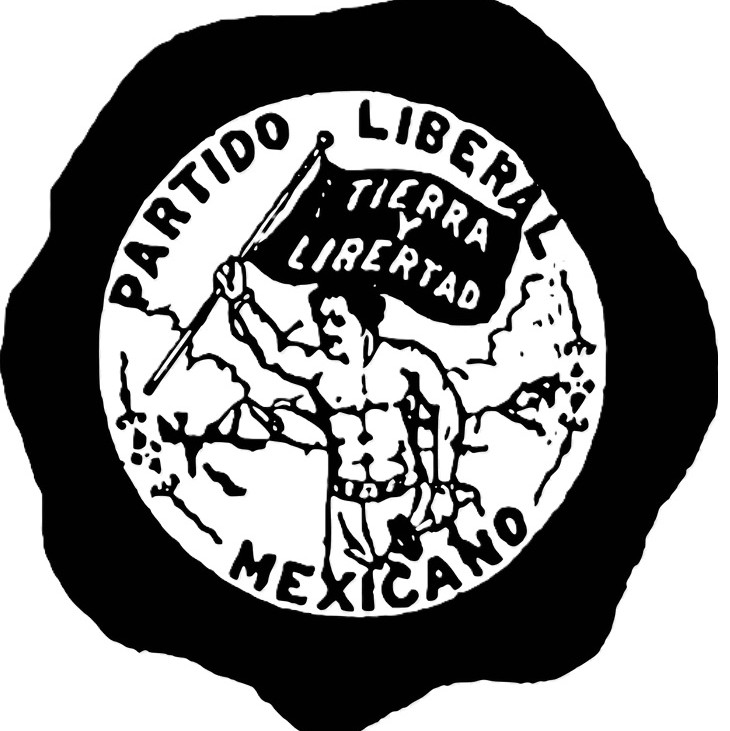
After decades in power, actions against the rule of the aged Porfirio Díaz were gathering pace in nearly all classes and sectors of society. In 1910, they would explode, Diaz would fall and the world-changing Mexican Revolution would commence. Already veterans of the revolutionary opposition to Diaz, the Partido Liberal Mexicano, here under the names of Enrique Flores Magon and Praxedis Guerrero, were involved in the important strikes that had broken out in northern Mexico in the ’00s and were fiercely persecuted in Mexico and their exile-bases in the U.S. They would be the most recognizable Left force of the Revolution’s first years, taking parts of Baja in 1911 with the a mass campaign in support of their prisoners developing in the United States, and more than a few volunteers from here who would fight–a number dying–with them for Land and Liberty. Below a manifesto from the PLM from 1909 on the causes of a revolution already underway.
‘Manifesto of the Partido Liberal Mexicano’ from The Weekly People. Vol. 19. No. 10. June 5, 1909.
The publicity which in the last two years has been given to the cause of the Mexican revolution has aroused much sympathy among the workers of all countries, a sympathy that is growing less and less a matter of mere resolutions and words and is becoming more and more practical in its desire to aid. But as there still seems to exist some doubts of the Mexican working-class movement, we, members of the Junto of the Mexican Liberal party, issue this manifesto:
“The capitalist press in general, as well as those papers directly subsidized by the Dictator of Mexico, Porfirio Diaz, has ceaselessly been forging public opinion in favor of the employers. Their printed lies have raised barriers which keep the wage slaves of Mexico from coming to a fraternal understanding with their brothers in other lands. It is to remove these doubts, to tear down these barriers, to make clear the solidarity of the international labor movement, that this manifesto is written. This cry from the shadow of the Mexican slave huts is not for mercy or pity, it is a cry of protest against the executioners of the working class. You, our brothers, must not sleep while the common enemy continues its ruthless extermination of the peons of our unfortunate country. The shackles which are being bound upon our limbs are binding yours as well.
“The conditions of the working class in Mexico are different from those in other countries, different because Porfirio Diaz has for years been conspiring with foreign capitalists to build up system which will create dissension between the Mexican workers and the workers of other lands. He has given vast grants of lands, mineral claims and railroad franchises to foreign capitalists, who on their part have hired foreign managers and foremen for their works, in which the foreign workmen were paid often double the wages allowed the Mexicans for the same class of labor. This crafty system of breeding discord among the workers has made it impossible for the Mexicans in the shops, factories and railroads to organize as is done in other lands. The result of this great capitalist conspiracy has been to keep the standard of living in Mexico down to a point of starvation and to make great riches for the foreign friends of Diaz at the expense of the entire Mexican working class,
“To create dissension and hate between the Mexican and foreign workers has been the plan of the capitalists in order to safeguard their riches. To isolate the Mexican worker and drown his efforts for freedom in rivers of blood is the purpose of Mexico’s despoilers. For these things, and for the cause of the Mexican proletariat, we come to you, workers of all countries, to inform you of what is going on in Mexico.
“To show with what a lavish hand the Diaz government has enriched the American capitalists, it is only necessary to point out that E.H. Harriman owns 2,500,000 acres of oil land west of Tampico, that the Hearst interests control in the neighborhood of 3,000,000 acres near the city of Chihuahua, and that the total area of territory now cornered, on the gulf coast alone, by the joint interests of the Standard Oil and Harriman is over one thousand miles long by an average of seventy miles in width, running through the richest lands of Mexico. These are but a fragment of the concessions granted by Diaz to American capitalists.
“A bloody saturnalia has followed the career of Porfirio Diaz, whose record of killings among his own people is popularly estimated to be over thirty thousand lives.
“It was at Monterey, in the elections of 1902, that the troops fired into a peaceful body of marching citizens, strewing the streets with piles of dead and dying!
“It was in front of the Rio Blanco mills, during the strike of 1906, that sixty-four men, six women and four children were shot down by the soldiery of Diaz!
“It was at Cananea, in 1906, that the rurales under Kosterlitsky, and the cowboys under Greene, massacred the striking miners and drove them back to work!
“These are but a few of the blood incidents in the career of the butcher of Mexico.
“Mexico’s revolution is not purely political revolution–it is a social problem which relates to us directly. We are compelled to meet force with force, for so the tyrant Diaz has decided. We did not seek strife, we were driven to it. We have learned the lesson so ably expressed by a great thinker—’Better a handful of force than a bag of rights.’
“Our program is simple; we do not attempt to realize everything in a day, and so we will begin with the untying of the rope which binds, in order that we may go on to progress. Freedom of the press, speech and education, the right of public assemblage and the turning back to the people of all the great holdings of uncultivated lands: the abolition of capital punishment and the present brutal system of prisons; the abolition of debts which the peons have carried upon their shoulders for many generations, binding them to their masters in practical slavery from birth to death. These reforms are all in the program of the Liberal party. The eight-hour day, a minimum scale of wages, and the right of the people of the Republic to participate in all public questions, is also part of our program. In this fashion the Mexican revolution will open a trench in which will be built a social organism more just, more harmonious with the sentiments of solidarity and love such as will some day rule the world. It is axiomatic that those who work for the individual work for the mass, and that the emancipation of one people shortens the days of the whole world’s slavery.
“Those nations which have attained comparative freedom should not close their eyes to the miseries of the less fortunate; nor should they turn their backs upon a struggle which is for the benefit of all.
“The armed mercenaries of the Mexican Despot drive our countrymen into prisons of torture where life is prolonged merely to make the agony more cruel, and it must be remembered by you that the power to commit these atrocities has been obtained by Diaz, in large part, from his friends, the foreign investors, of whom many come from the United States.
“But not only in Mexico are we tracked by the police agents; in the United States we are also hunted like wild animals. Mexican homes in this country are entered without warrant, the patriots manacled and hurried to United States jail, while others are secretly taken to the border and delivered into the hands of the waiting rurales.
“In the Federal prison at Leavenworth, Kan., are our comrades, Antonio de P. Araujo, A D. Guerra, P.G. Silva and L. Trevino, all made convicts because of their love for their country and determination to fight for the liberties of Mexico. In Texas jails are still other Mexican political prisoners, Basilio Ramirez and Calixto Guerra, who have been held since last July and are still awaiting trial.
“The power of Diaz in the United States is shown in various ways: In January last, in Tucson, Ariz., a young workingman by the name of Cenaido Reyes was arrested because of his resemblance to a well-known member of the Mexican Liberal party. This young Mexican was not a revolutionist, but because the authorities thought that they had captured a man that Diaz wanted he was hurried to the border and, without trial, passed over into the hands of the rurales. From that moment to this he has disappeared from the face of the earth, his sorrowing family being unable to ascertain whether he is alive or dead. Such are the secret workings of the Diaz government in this country.
“The friends of Diaz in the United States are ever ready to assist him in crushing the attempts of the Mexican people to free themselves. Here is an example of their work: Many of the large coal mine owners in Oklahoma and northern Texas also own valuable concessions in the coal fields of Coahuila: at the time of the uprising in June, 1908, these employers cut wages and reduced the number of days’ work in their American mines in order to prevent their Mexican miners from sending financial aid to the revolutionists.
“But in spite of all–the massacres in Mexico and the imprisonments in the United States–we continue our struggle for liberty. We, the Mexican proletariat, must be free, and there is no price that we will not pay to attain this end.
“Enrique Flores Magon,
“Praxedis G. Guerrero,
“For the Organizing Junto of the Mexican Liberal Party.
“San Antonio, Texas, May 10, 1909.”
New York Labor News Company was the publishing house of the Socialist Labor Party and their paper The People. The People was the official paper of the Socialist Labor Party of America (SLP), established in New York City in 1891 as a weekly. The New York SLP, and The People, were dominated Daniel De Leon and his supporters, the dominant ideological leader of the SLP from the 1890s until the time of his death. The People became a daily in 1900. It’s first editor was the French socialist Lucien Sanial who was quickly replaced by De Leon who held the position until his death in 1914. Morris Hillquit and Henry Slobodin, future leaders of the Socialist Party of America were writers before their split from the SLP in 1899. For a while there were two SLPs and two Peoples, requiring a legal case to determine ownership. Eventual the anti-De Leonist produced what would become the New York Call and became the Social Democratic, later Socialist, Party. The De Leonist The People continued publishing until 2008.
PDF of full issue: https://www.marxists.org/history/usa/pubs/the-people-slp/090605-weeklypeople-v19n10.pdf

