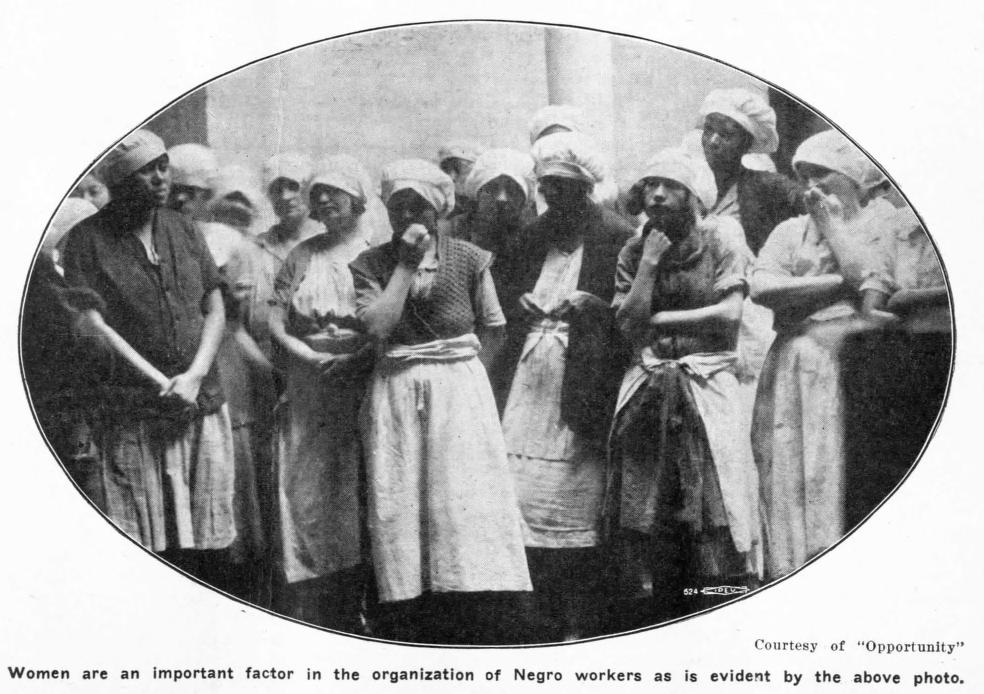
The then head of the Economics Department at Howard University with a piece that was also published as a pamphlet surveying the position of Black labor and the relationship with the union movement.
‘The Negro Worker’ by Abram L. Harris from Labor Age. Vol. 19 No. 2. February, 1930.
A Problem of Vital Concern to the Entire Labor Movement
The known Negro union membership is about 56,000. The total number of Negro workers employed m transportation, extraction of minerals and manufacturing is around 1,300,000. So Negro workers are only about 4.3 per cent organized. About twenty-one per cent (20.8%) of all American wage earners, excluding agricultural workers, are trade union members. Therefore the Negro is only about a third as well organized as all workers. The problem doesn’t stop there, however. There are 348,000 Negro workers employed in iron and steel, meat packing, textiles, lumber and furniture, and tobacco—industries of unskilled and semi-skilled workers which are hardly touched by unionization. The organization of the Negro, therefore, involves the greater problem of organizing the unskilled and semiskilled in the basic industries which lies at the root of militant unionism.
To accomplish the purposes of progressive labor the first need is to create a greater degree of solidarity than now exists among the workers. The two great obstacles to such labor solidarity are the psychology of craft unionism and the psychology of race prejudice. White workers, both organized and unorganized, have sought time and again to prohibit the employment of Negro workers, or to limit it to menial occupations or to those jobs that offered organized white workers little direct competition. They have tried to reduce Negro labor to a class of noncompetitors. The employers, although not free from race antipathy themselves, have not hesitated to exploit it as a means of carrying out a policy of “divide and rule.”
Thus, during the early period of capitalistic development in steel, packing, coal and shipping, the employers used Negro labor only spasmodically, in case of a strike, or in a period of industrial expansion, when the supply of foreign labor was insufficient to meet the emergency, or because foreign labor had learned the necessity of unionization. Between 1880 and 191 5 southern Negro labor was something of an industrial reserve for many basic industries. This reserve was not chiefly agricultural, as is often thought. Its background was agricultural, but in the eighties Negroes began to move gradually from the rural sections to the cities of the South, thence to northern industrial centers as occasion warranted.
The Negro Enters Industry
In 1915 huge waves of this southern Negro labor poured into the northern industries when large numbers of our recent immigrants returned to their former homes to answer the call to arms. When the United States entered the war more of this labor drifted north in response to the demand created by industrial expansion. And after the war it continued to come because of the cessation of foreign immigration, and because employers, traditionally hostile to the employment of Negroes, awoke to their value in breaking strikes or in defeating the purpose of unionism. And Negro workers undisciplined in collective bargaining, ignorant of trade union traditions, distrustful of white workers, especially when organized, and led by opportunist leaders nurtured upon philanthropy and the doles of the rich, not only accepted struck jobs with impunity, but accepted the employer’s terms as to wages and working conditions, chief of which was non-membership in trade unions, as a long denied opportunity for relief from economic slavery.
These changes of Negro labor from South to North, from domestic and small industrial employment to capitalistic industry, occasioned much bitterness between Negro and white workers, as was exhibited in the Chicago and East St. Louis race riots. But one wonders why astute trade union leaders had not foreseen in the sporadic employment of Negro strikebreakers in the early industrial development, the uses to which they might be put at some later time. For example, the once militant but now almost shattered United Mine Workers saw that their ability to control the northern coal fields was dependent upon the degree to which organization was effected among both white and black miners in the southern fields. Although the union failed to accomplish its aim, it recognized the necessity of organizing both white and black miners inasmuch as Negro mine labor was not only employed in West Virginia, Alabama, Kentucky and Tennessee but had a long history dating back to the 80’s in the breaking of strikes in Illinois, Pennsylvania and Ohio. Had similar strategy been employed by other unions, it is not at all unlikely that at least the seeds of working class solidarity would have been sown among Negro and white masses before the exodus to the North.
A Policy of Exclusion
The fact that Negro labor was chiefly unskilled meant that it had no place in a Labor Movement that was based upon skilled craftsmanship, despite the fact that it could be used, thanks to the increasing mechanization of heavy industries, to defeat the purposes of unionism. This applies with almost equal force to the organization of the unskilled white workers. Such unions as the machinists, the boilermakers, the blacksmiths, the molders, the plumbers, the sheet metal workers, and the tile workers were never too friendly to their less skilled brother, the white helper. As a matter of fact, these unions for a long time opposed the admission of the white helper and sought to confirm his status in order to preserve their monopoly of the job.
Some of these unions who were most bitter to the white helper were likewise hostile to the Negro. They sought to forestall Negro competition by excluding Negro mechanics from the union. So clauses were written to that effect in the union’s constitution or ritual. And many unions like the carpenters, the bricklayers, the confectionery workers, and the hotel workers, that had no constitutional barriers against Negro membership and that felt keen competition from the employment of Negroes, were forced to organize them into segregated locals; or leave them out of the union as the leader of the molders did in Nashville, Tennessee, because the white molders objected to the organization of the Negro and because the Negroes were afraid of being discharged once they had joined the union.
Today there are no less than 26 unions whose constitutions or rituals limit membership to white men. They are the Brotherhood of Railway Carmen, the Switchmen of North America, the Brotherhood of Railway and Steamship Clerks, Freight Handlers, Express and Station Employes, the Order of Sleeping Car Conductors, the Order of Railway Telegraphers, The National Organization of Masters, Mates and Pilots of North America, the Railway Mail Association, the Wire Weavers Protective Association, the Commercial Telegraphers, the Boilermakers, Iron Shipbuilders and Helpers Union, the International Association of Machinists, the Brotherhood of Dining Car Conductors, the Order of Railway Expressmen, the American Federation of Express Workers, the American Federation of Railroad Workers, the Brotherhood of Railroad Station Employees and Clerks, the Train Despatchers, the Railroad Yard Masters of America, the Neptune Association, the Brotherhood of Locomotive Engineers, the Brotherhood of Railway Conductors, the Brotherhood of Locomotive Firemen and Enginemen, and the Brotherhood of Railroad Trainmen.
Ten of the above unions are affiliated with the American Federation of Labor, which has appealed to them to lower the barriers to Negro admission. Those unions that have responded were forced to do so because of increasing Negro competition. But their response has usually taken the form of separate organization characterized by one or all of the following discrimination.
Auxiliary and Federal Unions No Remedy
Negroes are to be organized into auxiliary locals but only where their employment has become traditional. The auxiliary locals of Negro members are to be subordinate to the nearest white local. Negro members may not transfer to white locals; they are not eligible for office; they may not be promoted to skilled work; or they are to be represented in conventions or conferences only by white members. This is the kind of response the Carmen and the Blacksmiths made to the appeals of the Federation. The Boilermakers have not as yet decided how they will respond. But in reverence to the sacred doctrine of trade autonomy, the Federation officials accepted these half-measures as something of a victory, which firmly established the Federation’s claim of organizing all workers regardless of race. At one time the Executive Council was decidedly opposed to the affiliation of unions that openly debarred Negro workers. This attitude delayed the admission of the Machinists. And it has been said that it was also a factor in the Federation’s refusal to accept one of the railroad brotherhoods. But the Machinists were admitted without relinquishing the right to debar Negroes of the craft.
The Federation has sought to get around the racial discrimination of its affiliated bodies by empowering the Executive Council to charter directly local and federal unions of Negro workers who are debarred from the union of their craft, or who are unskilled, and therefore, unorganizable into craft unions. This gesture has not materially improved Negro organization or increased Negro trade union affiliation.
In the first place the responsibility for the members of a Negro local obtaining the prevailing wage is likely to fall upon the very union that denies them admission; and the Federation, which, as has been claimed, is the “international” of such Negro locals, surely cannot force a local of a national or international union to handle wage grievances of one of its directly chartered Negro locals. In the second place, these locals of Negro workers usually become mere dues paying entities that are separated from the main currents of the trade union world. In the third place, the leaders of the Federation have been too well satisfied with meager results vigorously to push organization among” Negroes. And in the fourth place, when persons inside and outside of the Federation have called attention to the weakness of its Negro organizational policy, it has merely passed resolutions, or congratulated itself that it could find no fault with its past methods and results. Yet of the hundreds of Negro locals and federal unions organized by the Federation between 1917 and 1924, there are not more than 22 at present.
Instead of merely passing resolutions expressing a desire to see more Negroes in the labor movement, as it did at its recent and previous conventions, the Federation should inquire into the reasons for its past ineffectiveness among the unorganized white and black workers. It should seek to establish some definite machinery for bringing about greater cooperation among Negroes and whites in the labor movement. A part of such machinery should certainly have been incorporated in its program of workers education long ago. A proposal of this kind emanated from one of the conventions of the National Association for the Advancement of Colored People a few years back, but failed to provoke any response from A. F. of L. leaders. To effect an understanding between white and black labor is, of course, no simple task. What the leadership of organized labor needs to be censured for is not its failure to effect greater harmony but its refusal to make some attempt toward a realistic understanding of the problem and the issues involved. If progressives in their turn are to make headway in bringing Negro and white workers into closer alignment for economic and political action they must first understand the difficulties and prepare to remove them. This is what conventional trade unionism has failed to do.
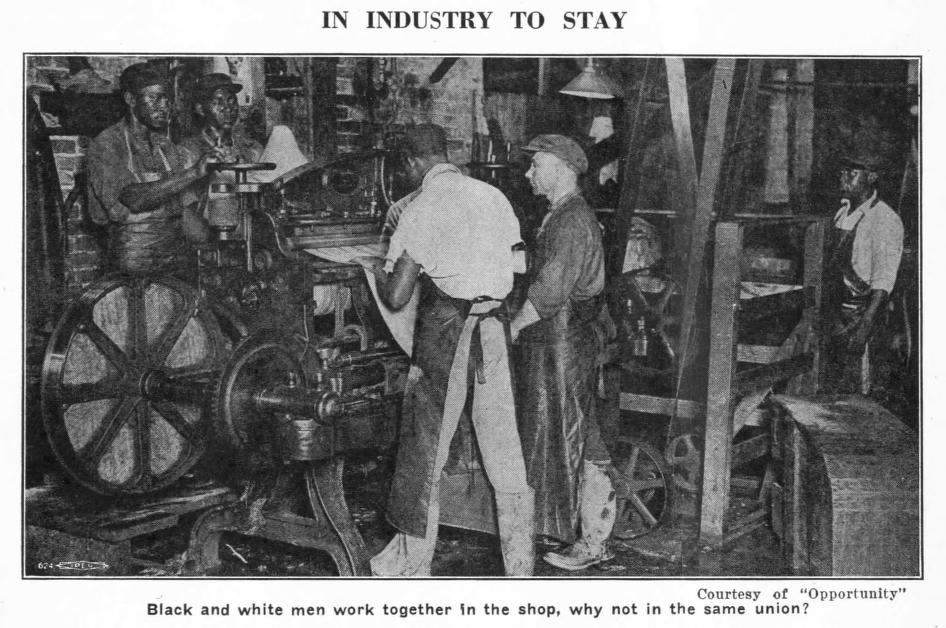
The known Negro trade union membership was about 45,000 in 1926. If the membership of the independent Negro unions, chiefly paper unions, is included, the total membership was about 56,000. According to the census for 1920 there were almost 1,300,000 Negroes employed in transportation, extraction of minerals and manufacturing. So Negro workers, including those above ten years of age, were about 4.3 per cent organized. But only 20.8 per cent of all American wage earners, excluding agricultural workers, are trade union members. The Negro, therefore, is about a third as well organized as all workers. When skill is made a requirement for trade union affiliation, less than 16.6 per cent of the 825,000 Negroes employed in manufacturing industries are available for affiliation, since 68 per cent of them were unskilled and 15.5 per cent semi-skilled.
A Problem of the Unskilled Workers
Moreover those industries in which trade unionism is weakest, having capitulated to the offensive of welfare capitalism, or where craft unionism can make little headway because of integration and specialization, have the greatest number of Negro workers. For example, in iron and steel there were 106,000 unskilled and 24,000 semi-skilled Negroes in 1920 in the food industries, mainly packing, there were 28,000 unskilled and 16,000 semiskilled; in textiles, there were 18,000 unskilled and 8,000 semi-skilled; in lumber and furniture, 107,000 unskilled; and in tobacco 20,000 semiskilled and 21,000 unskilled Negroes. A Labor Movement which avoids the unpleasant job of going into these industries because the workers have manifested no desire for organization or because organization will take time and money, is both timid and reactionary, and will become the victim of its own inertia. It is the task of progressives to precipitate action among workers in these industries. And effective action cannot ignore the position of Negro labor if for no other reason than that organized white labor is fully protected only when Negro and white workers are equally organized. That there are obstacles in the way of unity between white and black labor, progressives need not deny. But they should deny that these obstacles are insuperable.
This denial should not take the form of the radical’s stock in trade generalization about the solidarity of economic interest between white and black workers. It should be embodied in intelligent appraisals of situations where Negroes and whites are being brought or have been brought into industrial relationship. In such situations it would devolve upon progressives to show white and black workers how race prejudice defeats their mutual welfare. In this connection special attention may be made of the situation in the South. It is the opinion of certain white workers there that “the two races should have separate, distinct organizations connected by central bodies composed of representatives of both races.” It has been remarked that this “is an advance over the shortsighted, opportunistic policy which is still in vogue in most white labor circles,” namely that of excluding Negro workers from unions altogether or at any rate being indifferent to the needs of this group.
Bi-Racial Movement Dangerous
It will have to be borne in mind that there are dangers connected with anything which may lead to the development of a bi-racial movement. White employers are not actuated by racial interests. They will not hesitate to use white labor versus black, and vice versa. Certainly in the long run white and black labor cannot rise “to the highest position in the economic order apart from each other. Nevertheless, vague, fine-sounding idealistic phrases do not solve the problem. We emphasize that intelligent appraisals of concrete situations where Negroes and whites are being brought into industrial relationship are essential.
But this is not all. The sympathy of groups of Negro workers who can lead the masses of their fellows must be won. To do this progressives will have to begin from the bottom and build up. They must carry to the Negro workers some understanding of modern industrialism and the position of the workers under it, remembering that the Negro is of recent industrial experience. And, finally, progressives must realize that Negro economic and political leadership is opportunistic and middle class. On the political side it teaches the masses that their national interest is best protected by the Republican party; and that in local political matters they should follow the policy of “rewarding their friends and punishing their enemies.” Being economically weak the Negro, like all such classes, has looked to legislation for the removal of the social and economic disadvantages from which he suffers. A Labor Party which would connect the Negro’s special racial demands with its broader economic and social reforms can in time wean large sections of the Negro workers from the major parties.
On the economic side, the Negro masses have been taught that their welfare is best promoted by adopting a conciliatory attitude to those who control industrial and economic opportunity, through subservience to the wealthy, and through the establishment of a sort of self-sufficient Negro petit capitalism. Here the progressives must demonstrate to the Negro masses that their problem, like that of the white masses, is inevitably that of work and wages. For even if the Negro leaders who look upon the creation of Negro financial and business enterprise as the economic salvation of the Negro masses, are successful in realizing their ideal, the institutions that they hope to establish are to be run on the basis of economic individualism and private profit, despite the tendency of these leaders to confuse “racial cooperation in business” with genuine consumers cooperation. But the success of a Negro petit capitalism will give economic reality merely to our contemporary Negro middle class which is temperamentally detached from the realities of working class life. But however successful Negro business enterprises may be, and whether it proceeds on a quasi-self-sufficient racial basis or takes its chances for survival in the general competitive arena, it must in the nature of things remain a diminutive force in modern industrialism, which is to say, that its heralded power for meeting the problem of Negro unemployment will be of small importance. The great masses of Negro workers will continue to find their employment with those who now control finance and industry. And the few Negroes who will obtain work at the hands of the black capitalists of tomorrow will not thereby cease to be wage earners. Their problem will merely be shifted from the center of modern economic life where white capitalists dominate to the margin where small Negro enterprisers earn the wages of management.
The Immediate Task
Thus progressives must carry to the Negro masses some realization of the causes of unemployment, low wages, and the need for labor unionism and cooperation, in general; and of the reasons that explain the special severity of industrial disadvantage upon them as a racial group, in particular. None of these lessons will take root if they are presented spasmodically and, above all, if the white workers are unwilling to accept Negroes into working class fellowship. As great as these difficulties may seem, a policy of letting well enough alone or one of delay will never overcome them.
Progressives therefore will do well to begin to grapple with them now. In meeting this problem they must carry out a militant labor program, namely the organization of these workers who have been neglected by traditional trade unionism; the reestablishment of unionism in those industries where it has petered out or failed to establish control because of lethargic and self-satisfied leadership which refuses to recognize the inadequacy of craft unionism in such highly integrated and mechanized industries as packing, steel, rubber and automobiles; the stimulation of an offensive against the open shop, company union, employee welfare capitalism of the trustified industries; and weaning Labor of subservience to the two major political parties in order to create independent working-class political action.
Labor Age was a left-labor monthly magazine with origins in Socialist Review, journal of the Intercollegiate Socialist Society. Published by the Labor Publication Society from 1921-1933 aligned with the League for Industrial Democracy of left-wing trade unionists across industries. During 1929-33 the magazine was affiliated with the Conference for Progressive Labor Action (CPLA) led by A. J. Muste. James Maurer, Harry W. Laidler, and Louis Budenz were also writers. The orientation of the magazine was industrial unionism, planning, nationalization, and was illustrated with photos and cartoons. With its stress on worker education, social unionism and rank and file activism, it is one of the essential journals of the radical US labor socialist movement of its time.
PDF of full issue: https://www.marxists.org/history/usa/pubs/laborage/v19n02-Feb-1930-Labor-Age.pdf

