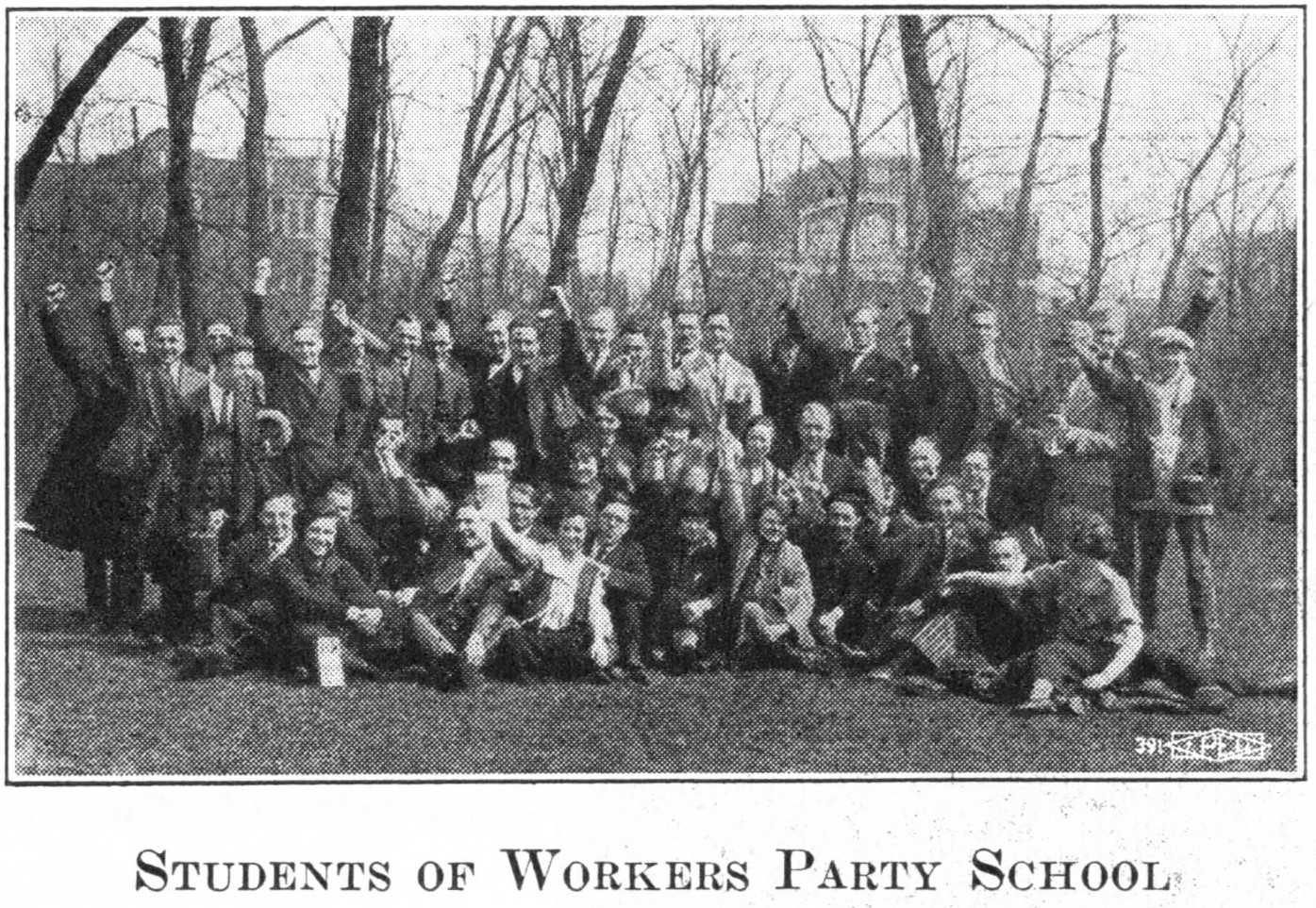
From the Y.C.I.’s 1923 leadership meeting, a set of resolutions dealing with educational work, both internally and externally, of the Young Communists, including a general statement; the main resolution; report of the Education Department; and a resolution on obtaining materials.
‘On Education’ from Resolutions and Theses of the Fourth Bureau Session of the Young Communist International, July 1923.
EDUCATIONAL WORK
which has as its aim a deepening of the knowledge of the entire membership in general and of the functionaries in particular, becomes more and more urgent and extensive. The daily actual struggle demands constant preparedness from the members of the Communist Youth organizations, and above all sufficient ammunition to carry it through. Be it only in the struggle against Fascism; or a campaign against imperialist war agitation; or the representation of economic interests in the trade unions or in the shop; for every form of work an education is necessary. A new element now appears in our midst the functionary of the nucleus. He is not one who has been gradually developed in the branch; he has not gone thru all the stages from distributing literature to branch chairman; he is often a member who has been only recently attached to the movement, or who has, at most, passively attended meetings where the reins were held by older and more experienced comrades. Now he is a functionary of the nucleus, perhaps even secretary, and has many and important duties. He must help with advice and with action, if the whole important work of the shop nucleus is not to become wrecked. The experiences of the past six months have shown plainly that it is necessary for the education committee to occupy itself principally with the
Training of Functionaries of Shop Nuclei.
The effecting of the decisions, beginning with the Executive Committee and going down to the smallest units, guarantees that no reversal shall take place in the reorganization work so proudly begun.
Of no less importance is the forming and training of
Working Groups of Propagandists.
The example of the Russian League shows that they are a powerful instrument for the militant work of the Communist Youth organizations. Their core must be formed from the most capable comrades of the shop nuclei, who must popularize in the shops, the ground of our organization, every action and every campaign.
For the support of the
Educational work among the Masses
the issuing of abundant material has been planned, the leading idea of which is the support of the practical struggle within all spheres.
For this work, however, a preliminary condition must be created by the Leagues. All previous experiences must be reported immediately, new experiences must be reported and exchanged. In a special resolution directions are given as to the substance of the reports on the educational work.
***
RESOLUTION ON EDUCATIONAL WORK
The Organization of the Educational Work
THE Leagues of the Young Communist International are at present confronted with the tasks of transforming their organization and continuing their work on the basis of the shop nuclei. This work demands that the educational work of the Leagues shall be carried on in such a manner that the practical work of the nuclei will receive the greatest attention and support.
With the influx of many new members into the organization (especially through the nuclei) and with regard to the lowering of the average age of the membership in most Leagues, and the hitherto insufficient training of their members, the creation of an active, well trained staff of League officials has become an urgent necessity.
The organization of the educational work of the nuclei for the development of an extensive propaganda and educational work among the masses of the young workers –all such work to be in connection with topical political events–and the systematic training of officials for the leadership of this work, are therefore the most important tasks of the Leagues in the sphere of education.
In order to achieve these aims under the present conditions we need Leagues with an organizational structure which will actually bind together all the members.
The main forms of the educational work, which constitute the system of education, and which are adapted to the needs of the various sections of the League members, are the following:
1). Nucleus.
2). Branch (Political School).
3). Collective propagandist groups and classes.
All League members, in accordance with the extent of their political knowledge, belong to one or other of these post important links of the educational system, which are kept together by the process of preparing the members and transferring them from the lower to the higher stages. The first stage must prepare the members for the branch, and the branch must make them fit for the working groups and classes for propagandists. On the other hand the members of the working groups of propagandists organize the various forms of nuclei and branch work and provide the nuclei and branches with active League workers.
I. THE EDUCATIONAL WORK OF THE NUCLEUS
The Fourth Bureau Session endorses the instructions of the Executive Committee on the organization of the educational work of the nuclei and especially stresses the necessity of developing it on the basis of the vital problems of the young workers in the shops.
The educational work of the nucleus must be organized and carried through in the following manner:
1). Appointment of a member of the nucleus committee to take charge of the educational work; in larger nuclei, the election of an educational committee.
2). Establishment of definite tasks, or the elaboration of a scheme or system for the educational work; inclusion of every nucleus member in the working out of the scheme of work, and the collective elaboration of the various parts of this plan; appointment of individual members for certain tasks; examination of the scheme of work by the nucleus committee, and endorsement of it by the nucleus meeting.
3). Winning of Party officials for the support of the educational work, by giving reports, making speeches, and by joint discussion with the members of the Party nucleus on the character, the forms, and the methods of the educational work.
4). Utilization of all nuclei meetings for the discussion of economic and political events and for the treatment of simple theoretical subjects.
5). Distribution of subjects to the various members of the nucleus who, with the aid of the educational officials, or, of the nucleus committee, prepare speeches and deliver them at a meeting of the nucleus.
6). With the extension of the work and the strengthening of the nuclei, the organization of study circles for dealing with the problems of the conditions of work and with the life 8f the young workers; of the youth movement; of the labor movement; and of Marxism, can be begun. It should be attempted to win the non-organized young workers of the shop as participants in these circles. The officials of the branch who have been delegated to the nucleus for co-operation and assistance should be used for the leadership of these circles.
7). Leadership and guidance of the self-education and of the independent reading and study of the members of the nucleus.
8). Organization of public nuclei meetings and propaganda among the young workers of the shops, in order to interest them in the discussions of the vital problems of the situation of the working class youth in the respective shops, and induce them to participate in the shop meetings.
9). Organization of various kinds of mass educational work for the young workers of the shop; oral news service;1 evenings for the reading of papers; evenings for questions and answers; etc.
10). Issuing a posted bulletin,2 dealing with the problems of the young workers in the shops; and inducing the young workers to contribute to that paper.
11) Distribution of literature; increasing the number of subscribers and readers of the League organ and of the international magazines.
12). Establishment of a youth library in connection with the labor library existing in the shop.
13). The organization of “hikes”, excursions, sport arrangements, etc., in addition to the political work.
14). Inducing the League members and the other young workers in the shop to visit branch meetings and to participate in the work of the branch.
II. LEADERSHIP AND SUPPORT OF THE EDUCATIONAL WORK OF THE NUCLEI BY THE LEADING BODIES OF THE LEAGUE
After the formation of the nuclei it is the tasks of the leading bodies of the League to support the general activity of the nuclei, and particularly their educational work. fulfilment of these tasks demands the following measures on the part of the branch committees:
1). Discussion of the problems of the practical work of the nuclei, by all the educational officials of the nuclei.
2). Examination of the composition of the nuclei, with regard to political knowledge, and of the cultural level of the members.
3). Support and help of the nuclei in elaborating the tasks of the scheme of work for the forthcoming period, in the sphere of education.
4). Appointment of officials who are instructed to participate in the educational work of the nuclei.
5). Outlining the most important problems which must be dealt with by the nuclei meetings of the respective locality, and the elaborating of data, theses, etc., on problems of a general nature and for special subjects. The provision of such material and its uniformity is an important task of the district committees, especially in those localities where the branches are unable to furnish it independently.
6). Organization of working groups of propagandists, who shall meet regularly for the discussion of the problems of practical nucleus work.
III. THE TRAINING OF OFFICIALS
In this field the following tasks must be accomplished:
1). Most problems of the League work must for the purpose of popularizing them among the whole membership be presented to the meetings of delegates, by the leading bodies; and to the meetings of nuclei chairmen, etc., for discussion.
2). Leadership of the self-education and of the independent reading of the officials.
3). Charging of the officials with various Party activities and the utilization of the Party circles and schools for the education of the officials.
4). Organizing of classes for officials, for the various kinds of League work, on a local scale.
5). Continuation of the organization of classes on a district and local scale.
These classes must, above all, deal with the fundamental problems of the League and Party work, and must, therefore, serve the Marxian education of the officials.
IV. WORKING GROUPS OF PROPAGANDISTS
The collective propagandist groups represent combinations of the most active elements of the League These groups, the work of which must be systematically organized, have for their task the training of the propagandist forces of the League. They must meet regularly for the discussion of all problems of the regular propaganda, as well as of the special campaigns of the League and the International, and to prepare for further discussions in the nuclei, etc.
The Fourth Bureau Session therefore considers the formation of collective propagandist groups as the best means of combining the officials of the branches, and endorses the directions that have been issued regarding these, by the Executive Committee.
The Bureau Session stresses the necessity for systematic and regular work of these propagandist groups, and instructs the leading bodies of the League to pay great attention to the preparation and carrying through of the meetings of these groups, and to supporting them in every possible way.
The support of the Party must also be won to these working groups of propagandists. The Party must place at their disposition lecturers, educational material, literature, etc.
The plans of the working groups of propagandists should, if possible, be discussed with the respective educational committees of the Party, and should be adapted to the work of the League and of the Party, in the respective periods. The members of the working groups of the propagandists must also participate in the work of the Party. They must co-operate in the Party circles, make speeches at Party meetings, etc.
V. THE IMMEDIATE TASKS
The Fourth Bureau Session of the Young Communist International calls the attention of all National Executive Committees to the forthcoming winter period and requests them to use this period for intensified work in all the practical tasks outlined in this resolution in the sphere of educational work. It asks them to submit, immediately or as soon as possible, plans of work for this period, to their Leagues: The accomplishing of these tasks on the general principles of the educational work of the Young Communist Leagues means the beginning of a serious communist educational work during the winter period. In order to facilitate these difficult tasks the following measures must be carried thru:
1). Elaboration of schemes of work for all phases of the educational system.
2). Careful consideration of the character and methods of all kinds of educational work.
3). Elaboration and publication of material, pamphlets, and guides to methods in the various problems of educational work.
4). Preparation of regular campaigns for the occasions of the anniversary of the Russian revolution, Christmas, New Year, Liebknecht Day, March events, and at the end of the school year when children who have completed their studies finally leave school.
5). Organization of classes for officials, especially for the officials in small districts.
6). Organization of the training of the leaders of children’s groups.
Furthermore the most important immediate tasks consist in the elaboration of plans on the following problems, in the various countries:
(a) Anti-Fascist propaganda;
(b) Anti-religious propaganda;
(c) Work among the youth of the rural districts.
VI. THE ORGANIZATIONAL TASKS OF THE EXECUTIVE COMMITTEE OF THE NATIONAL EXECUTIVE COMMITTEE
For the best utilization of past experiences, and for the correct leadership of the educational work of the various Leagues, the following must be carried through:
1). Establishment of educational departments in the National Executive Committee of each and every League.
2). Permanent systematic leadership of the activity of the educational departments of the Leagues, by the Executive Committee of the Young Communist International.
3). Regular reporting on the educational work, by the National Executive Committees to the Executive Committee of the Young Communist International.
4). Extension of the educational section of the International of Youth by
(a) Publishing more articles of a leading character; (b) Publishing reports on the experiences of the various Leagues.
5). Publication of material dealing with both facts and methods–data, booklets, etc.–by the Executive Committee of the Young Communist International.
***
DECISION on the Report of the Educational Department of the Central Committee to the Educational Department of the Young Communist International
IN order to guide the educational work of the various by educational of the Executive Committee, the Fourth Bureau Session of the Young Communist International decides as follows:
The educational department of every League must furnish to the Executive Committee, every second month, a comprehensive report attached to which shall be some sample material. These reports must deal especially with the following questions:
(a) EDUCATIONAL WORK IN THE LEAGUE
Results since the last report–separately for members and functionaries; are there any new plans–central district, provincial, etc.? special descriptions of experiences and results of the educational work in the nuclei and in the training of functionaries if possible with statement of the number of members participating, and the percentage of the entire membership; what is the subject of the educational work political, anti-religious, natural science, historical, etc., stated in percentages; if courses have been given programs are to be included; was any special literature issued on respective subjects; are there libraries in Party, League, branch, or nuclei; the use of the libraries; what has been accomplished in regard to the support and control of the individual development of the members; what connection has the educational work as a whole had with the actual and political tasks of the League?
(b) EDUCATIONAL WORK AMONG THE MASSES
Forms and results of training work among the non-party youth evenings of propaganda, art, and literature, etc.; relationship of these in percentage to the other educational work of the League; statement of the number involved, if possible; to what extent could the nuclei assume the work of this educational campaign; in what way do connections with the workers’ sport organizations exist, in this sphere?
***
DECISION on the Obtaining of Methodical Instructions and Material for the Educational Work in the Leagues
IN consideration of the complete lack of suitable educational material for the work of the Leagues, and owing to the difficulty of obtaining such material from the Leagues themselves, the Executive Committee must increase its efforts in this direction. The following material is especially necessary for the immediate work of the Leagues–in addition to that already mentioned for the educational work of the nuclei.
1). FOR THE STRUGGLE AGAINST MILITARISM
Instructions for the political work of conscripted League members in the barracks, such as the political connection of the League with the soldiers in the barracks and in the army. Catechism for soldiers; belles lettres literature of a revolutionary anti-militarist character; stories of the battles of the Russian Red Army in the struggle for communism; stories of the lives and education of the soldiers in the Red Army.
2). FOR THE STRUGGLE AGAINST FASCISM
A book of information on Fascism (eventually one for each of the principal countries) giving the peculiar characteristics of Fascism, internationally and in each country, its tendencies and its methods; with instructions or theses as to the nation and communism (the Jewish question, etc.); the union between workers, peasants, clerks, officials, and technicians; belles lettres literature on the fascist revolution in Italy, stories of battles with White Guards in the Baltic countries, in the border states, and in Russia, in which the underground work of the revolutionists is treated especially, in a sympathetic and stimulating way.
3). FOR ECONOMIC TRADE UNION WORK
Publication of all decisions hitherto arrived at, in this sphere of work, in the form of a pamphlet with a popular introduction. Issuing of a popular pamphlet concerning the daily small tasks in the shops; questions of tariffs, etc., is desired with the co-operation of the Leagues.
4). FOR WORK IN THE RURAL DISTRICTS
Regular compilation of material on the situation of the peasant youth, or the young farm workers; further, a popular propaganda pamphlet directed to the rural youth; and methods of instruction as to land propaganda.
5). FOR ORGANIZATIONAL WORK
A pamphlet, which should be a small manual explaining the tasks and the organizational work of the functionaries of the League, with special emphasis upon the work of the nuclei functionaries; the organization of work groups and of collective propagandist groups.
6). FOR INTERNATIONAL TRAINING OF LEAGUE MEMBERS
The history of the Young Internationals; the historical tasks of the Young Communist International; the history of the international labor movement; regular and comprehensive compilations of material on the situation in the other internationals of youth, the Young Communist International; and a yearbook of the working youth.
7). FOR THE NUCLEUS
A regular bulletin for the educational work of the nucleus, to appear every six or eight weeks, containing instructions and material, as for instance–“How to direct the educational work of the nucleus”. Working plans for this educational work, in connection with proletarian memorial days, especially calendar events, religious festivals–material for anti-religious education–memorial days of inventions which are of importance in particular shops; bourgeois and patriotic memorial days with corresponding oppositional material, etc., and political and economic daily occurrences; biographies of leaders of the working class, with sources of material; the development of the nucleus library; distribution of literature; How is mass educational work directed among the shop youth wall drawings, written newspapers, questionnaires, discussions, excursions, “hikes”, games, sports, etc.
8). FOR THE FUNCTIONARIES
Methods of instruction something like the following: How do I make a report? how do I read a book? how can I educate and develop myself? how do I collect material for my work among the working youth? how do I prepare and direct courses? with outlines for programs and instructions for training work; conferences of the leaders of nuclei education; instructions for the activities of the individual in charge of literature; instructions for the work of propagandist collectives and working groups; wall drawings; collection and compilation of experiences in the educational work in the various countries.
Substantial material for anti-religious propaganda; theses on political and economic themes; (for this purpose the first series of Rüstzeug3 should be extended and developed); articles on the most important questions in those spheres of knowledge which must be mastered by young communists, and which may serve as a basis for evenings of discussion and reading, for instance the role of the Young Communist Party, its historical basis and function; political economy; history of society; religion and its injurious effect upon the working class, etc., etc.
9). FOR EDUCATIONAL WORK AMONG THE MASSES
Methods of instruction with examples of the same, with special emphasis on the anti-religious propaganda among the working youth; conversations and discussions; art evenings; living picture groups at demonstrations; political games; moving picture shows, etc., at public meetings; material for illustrated lectures; the sex problem; more popular propaganda literature; what does the Young Communist International want? What do the Young Communist Leagues want? Belles lettres revolutionary and anti-religious literature etc.
NOTES
1. The oral news service means that from time to time comrades report the various items of news known to them, by word of mouth, to the meetings of the nuclei.
2. A posted bulletin is a large sheet of cardboard or stiff paper pasted on the wall containing only the title. Upon this blank all comrades record news items, or opinions on the political or economic situation, or draw cartoons, etc. At regular intervals the blank is renewed. In Russia these poster bulletins are pasted up in the factory; where this is possible in capitalist society t should be done, otherwise the bulletins should be pasted up in the clubs and branch rooms of the Leagues.
3. This is a League publication in German containing material, facts, figures, etc., for League functionaries.
PDF of full book: https://www.marxists.org/history/international/young-communist-international/4th-bureau-session.pdf

