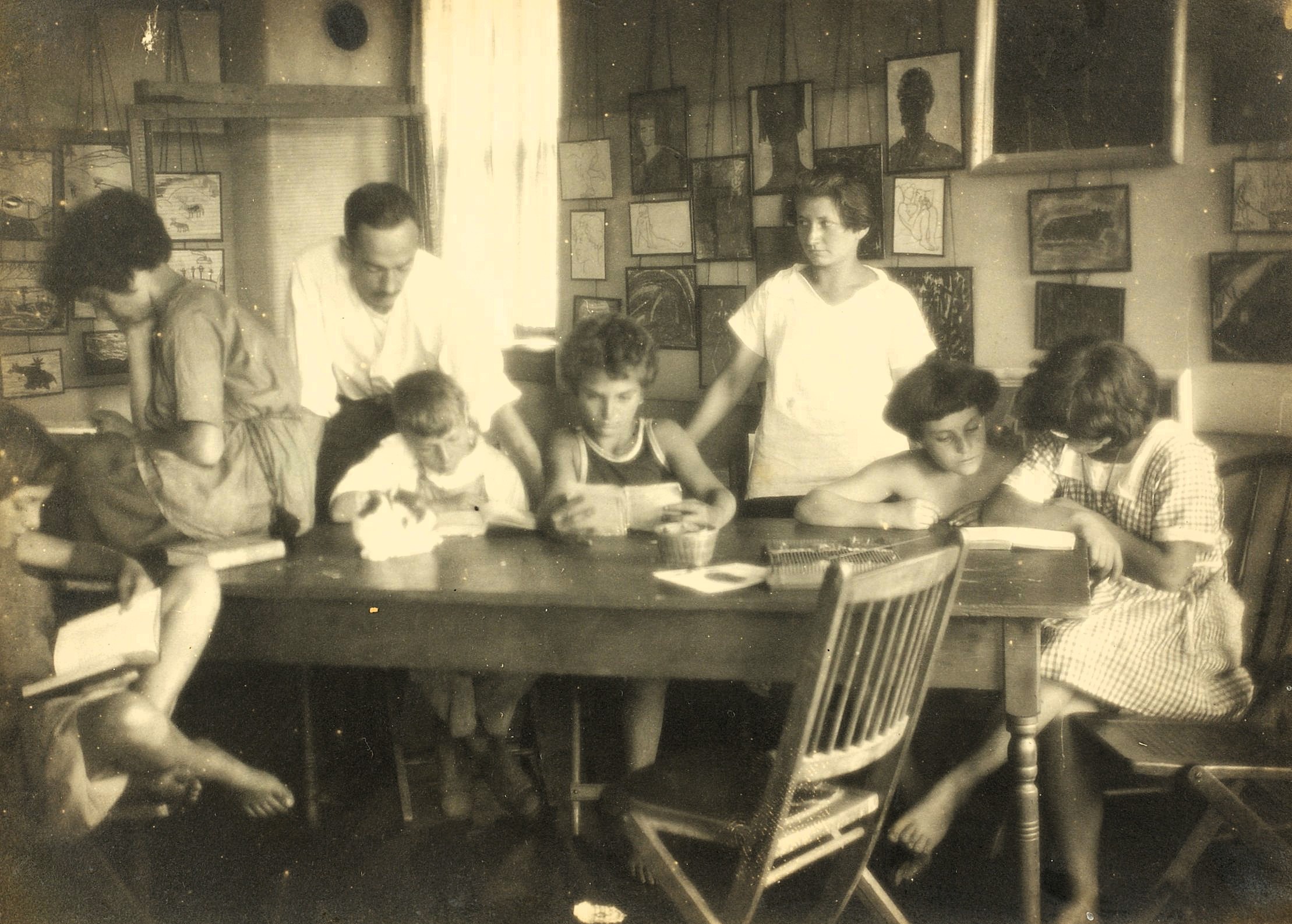
Michael Gold at his best in this piece of reportage on his months spent at the New Jersey children’s educational commune, the Stelton Modern School founded in 1914. The colony was a part of the movement inspired by the martyred Spanish educator Francisco Ferrer that became an institution for anarchist-leaning radical communities in the 1910s. A wonderful read.
‘A Little Bit of Millennium’ by Michael Gold from The Liberator. Vol. 4 No. 3. March, 1921.
STELTON is in New Jersey, some fifty miles out on the Pennsylvania railroad. It is an uneventful suburban stop in country flat and green as a Dutch meadow, the evening alighting place of two score or more simple-minded American commuters. They turn to the right of the station, where the village clusters. But you, fellow-malcontent, walk left for two miles along a macadam road, and so come to the Ferrer colony, a strange exotic jewel of radicalism placed in this dull setting, a scarlet rose of revolution blooming in this cabbage patch, a Thought, an Idea, a Hope, balancing its existence in the great Jersey void…
But I exaggerate. Most visitors sniff a little at the Ferrer colony. They come with preconceptions, dreams and prejudices. They have heard how five years ago Harry Kelley, Leonard Abbott, Joseph Cohen and others of the dwindling faithful in the anarchist movement of America, brought out a group of children and settled in an old farmhouse they had bought co-operatively.
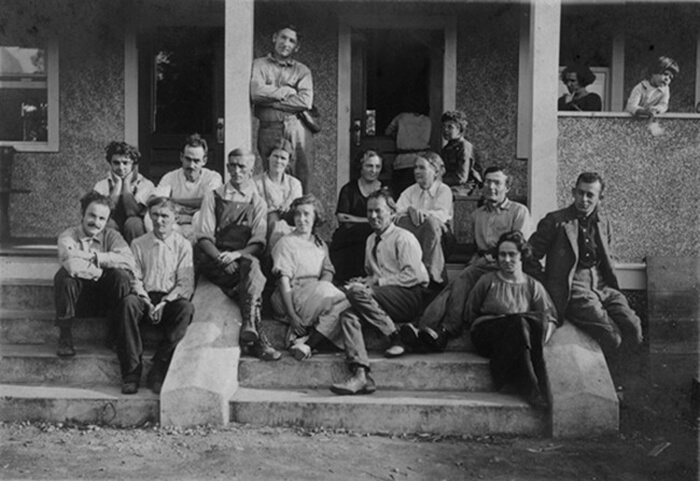
Others arrived each year, bought land and built shacks, till now there is a big school and about three hundred of the comrades scratching out a hardscrabble living there. Visitors come expecting a rosy millennium. The colony started in that spirit, but the visitors find weird tar-paper shacks, fantastic in architecture as a futurist drawing, muddy roads, papers and tin cans littering the crossroads at the entrance to the colony; also intensely human scandals, rumors and jealousies thick as the mosquitoes and almost as plentiful as in any other closely-knit community. It is not the millennium, the visitors exclaim, as they glumly try to make a meal off the whole wheat bread and raw salads they are offered. No, it is not, a friend of the place will say. It is merely another proletarian attempt to realize the millennium in the midst of a world of capitalism. The experiment is bound to fail, as Jesus failed in his attempt to establish Christianity in a world of stiff-necked Jews and brassy-bowelled, shrewd Romans. Such experiments always leave some mark, however, and Stelton has made its own on the page of radical history here.
I lived at the colony for a few months last summer and wish to testify for it. There are numbers of such colonies scattered throughout the country, the conditions about the same as Stelton, I suppose, the same hard-pan farming, the same slim larders and ice-bound shacks in winter and gossip and internal difficulties. I knew an old house painter in Boston who had piously worked his head off in about twelve attempts at such colonies, and had seen them all fail. I know all the theories arrayed against such colonies. They are said to be relics of the Utopian pre-Marxian Socialism. They mislead as to the purpose of the revolution, which is to enter the State and capture it, not try to change it from without. These colonies, too, take lots of precious material away from the firing line, which is in the cities, in the ranks of the class-conscious workers. There are many other good objections needless to repeat; every reader of the Liberator has surely shied a brick at Utopianism in his time. I have; I say again that colonies are not revolutionary in the scientific sense, that whoever sees in them the way and the path has not the diamond-hard mind of the revolutionist, that the revolution can only be fought and won by organization of the world proletariat at the centres of production.
Colonies are not scientific revolution; no, but they are a part of the art of the revolution. They are direct action by the proletarian soul. They are as spontaneous, as inevitable, as useful and as beautiful as the writing of poetry. They are the poetry created by the hard hands of inspired workingmen, and whoever does not understand them, does not understand something that is in the heart of the proletarian. Those dreamy-eyed, dear people who become desperate in the mill of the capitalist cities and who escape to colonies, go there to make themselves over in the image of the proletarian Superman. They are as sick of the slime in their souls as any great sinner entering a monastery. They wish to become free workers–gentle, creative, loving, truthful men and women, toiling shoulder to shoulder in a community of friends, envying no one, commanding no one, taking no thought of the morrow or of the individual self, living according to that divinest of rules for the conduct of life, “From each according to his ability, to each according to his need.” This is Communism, and in Russia they have made the first infantile steps towards it. It will come in time. But colonists cannot wait. They wish to live the good life in their own generation; the world revolution seems too far off. They thirst for perfection and righteousness with the thirst of Shelley and the passion of Danton; the cities hold them down. How can they wait? Can a lover wait for the lips of the beloved? Can a poet wait years while a song is aching for expression within him? Can a race-horse wait easily for the starter’s shot, or can a wobbly wait until Chicago sanctions a strike? Off they go, sinking time, money, labor, dreams and heartache into some scheme such as that of Stelton; impatient, impractical, narrow as youth, and as beautiful. It is the poetical folly of the proletariat; it must be allowed them, for God knows they have to be practical enough, most of the time; they walk the earth enough.
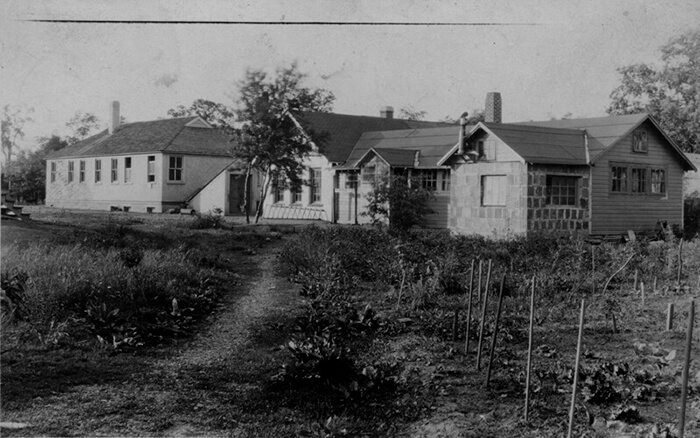
Of course colonies fail, as Stelton has failed, for how can you have communism with people who have been bred body and soul in the old capitalistic world, who, though they reject it with all the fervor of their conscious selves, have its dogmas in the very marrow of their bones?
But such failures are useful and good; they are experiments; they teach something. They are like the play of children, who with bits of wood and sea-shells and old bottles, build theatres and houses, and rehearse at being men and women. These colonies are little laboratories in the real Communism. City revolutionists, intellectuals, parliamentarians and apartment-house Bolsheviki–we have forgotten what the original Communism is. Anarchists have it to their glory that they have never forgotten. They can be fools; many of them are reactionaries and obstructionists just now; as guides to the politics of today they may be reliable as so many Mad Mullahs; they are rash and arrogant and dogmatic, many of them, but they have never been wrong as to what the future must bring.
Anarchists have seen more clearly than any of the other radical parties, that the revolution is a final uprising against civilization, not capitalism alone; that it will bring forth a new man, with new desires that will transcend even that current “law” of economics that so many of us are obsessed by, the law of large scale production. They have seen that the revolution will be a bold, complete and Goth-like destruction of all the present values, the virtues as well as the vices; and that it will probably bring about the disintegration of the cities and a return to nature, simplicity, the clean daylight splendor of the free communes.
In Russia, though the military state is still necessary (as gas-masks were necessary in the trenches), there are many signs that this pure and ancient anarchist-communism is at the core of the great experiment, waiting to exfoliate in its season. There are the Communist Saturdays, days of volunteer labor, which Lenin has declared to be germs of the future week of voluntary communist toil. Peasant communes are encouraged, subsidized and given preference over individual land owning. There is Prolet-Kult, the evocation from the masses of the art and science latent in them, the creation of the workers’ culture, based on human brotherhood and not on egotistic beauty-seeking in art and idle curiosity and power-worship in science. And then there is the education of the children, the Communists of the future, with the old pedagogy rooted out like a weed, and anarchist autonomy coming into its place as the golden rule in teaching. These are all symptoms of what is in growth in Russia.
Everyone does his own work about his own little shack in Stelton. Everyone lives simply; nearly all are vegetarians. Manual labor and poverty are the rule, so that whoever is good or whoever is wise is easily recognized. A learned young Jewish philosopher, a most persuasive little pessimist, was for months the janitor at the school, lecturing occasionally on literature when he was in the mood. A German carpenter is a student of Goethe and writes poetry. A newspaper editor washed dishes at the hotel during the summer. A poet is the best farmer on the tract, and a singer built hencoops by day–and built them well. All are equal. There is private property, but everyone thinks it a sin. There are no police, however, no thieves, and no class divisions.
But I do not wish to speak of the adults at Stelton. I have already indicated that they, like myself, and you, rapid reader, and the Pope, and Jack Dempsey, and the Sultan of Sulu, and the members of Tammany Hall, and the members of local New York and of the Socialist Party, and Julius Gerber and Louis Fraina, and Alexander Berkman, and even that battered hoary paladin of 100 per cent. Communism, Hippolyte Havel–all, all of us are warped and betrayed and flawed and spoiled, absolutely unfitted for the brotherly life of the communes of the future.
The most communistic person at Stelton is Harry Kelley, who began his apprenticeship under Kropotkin in London when he was a youth, and now, at his fiftieth year, bears still on his bowed shoulders community burdens most of us duck when we can. Harry has been true as the north star; has never lost faith, though on his devoted head has beaten many a storm; he is the mainspring of the group at Stelton.
And yet Harry, generous as he is, has been warped, too, by capitalism, and has his moods, prejudices and moments of unbrotherly cantankerousness.
All of us are spoiled. The adults have been able to accomplish little at Stelton, beyond escaping, in their own persons, the fever and mechanistic hell of the cities. They are a group of workers who have returned to nature, and have found a little peace. Perhaps this is something. But it is the children at Stelton who make the place a spot of revolutionary importance. The cause is lost and must die with us who are grown-up; we are what we are, instruments of hatred and tears. We have adapted ourselves successfully to life under capitalism, and therefore would be failures under communism. It is the children we must look to in hope. Even though the revolution should burst tomorrow, we should have to begin training the children, as in Russia, for the life of the future. They alone, in an atmosphere free of fear, can learn to work and create and love in true equality; we have too little faith for that.
The education of the children; this is the true revolution; this is what Ferrer taught and was killed for teaching by the capitalist class in Spain. Children are first in everything in Russia, and at Stelton, where the adults have fled from the class struggle, instead of following the more heroic method of winning it, the children, too, are the centre of all the communal life, and the one great good that has come from the experiment there.
The children! They are everywhere one turns in the colony, dotting the place with color so that one comes upon them with joy as upon blue flowers under the corn-rows; The whole green tract is their school, and they absorb that universal education that comes to man only through all of his five senses, and that he misses if he reads only books and knows only abstractions.
They are in the barn, helping milk the cows, or currying old Fred, the horse, whom they love. They are working in the fields with Sherwood, each proud of his little garden, each planting seeds and marvelling at the mystic chemistry of Nature, that turns loam into vivid flowers and clean, sweet vegetable food. They build little houses of their own, and write plays and act them, and they dance and sing, and draw, and edit and set type for their magazine, and raise chickens, and sail rafts on the pond, and fly kites and wash dishes. They do as much useful work every day as the average man, and they learn more, and yet you would think it was all play. They do it with noise and barbaric exuberance, and it is like a constant hymn of joy sung in the worship of life.
At the beginning the children at Stelton were taught reading, writing and arithmetic by the regular academic methods–from books, in class rooms. But last summer a final test of faith was made, and all compulsory classes abandoned. The children come from proletarian families, and the proletariat still has the outsider’s reverence for book culture, so that the school lost many children when this plan was dared.
I saw how it was working. A big hand-press and many cases of type were set up in the basement, and Paul Scott was put in charge, a shrewd, genial, philosophical tramp printer and ex-agitator, who among a thousand other adventures was once run out of Mexico with Benjamin De Casseres for publishing a revolutionary labor paper Porfirio Diaz didn’t like.
The children saw him print a few leaflets, and it would have taken all the chariots of hell after that to prevent them from learning how to print. Uncle Scott’s was the most popular resort on the colony. He is not a professional teacher, but he is an easy-going, wholesome person, wise as good fathers and able workers are wise, and he just gave all of them printer’s sticks, showed them the fonts, and let them find out the rest for themselves.
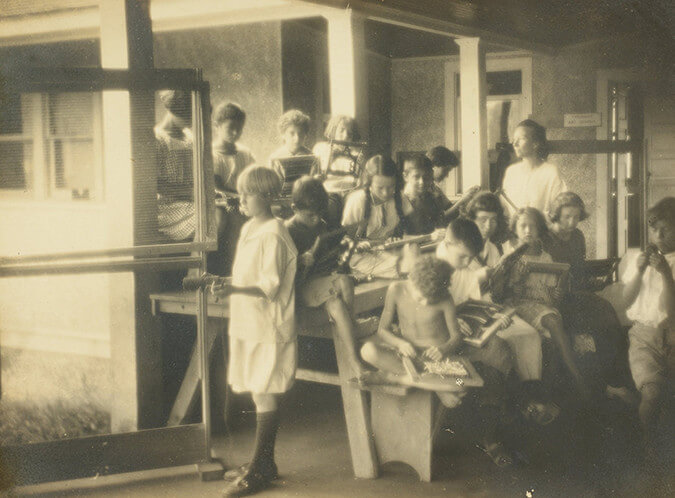
Day after day I came into the printing shop and saw the busy youngsters happy at their task. They printed cards with their names on them, they printed little poems they had written, they published their magazine. Uncle Scott told them stories of his travels between times; also he corrected their grammar; also he gave the youngest of them private tips as to what grown-ups meant by a and b and c, when he was asked anxiously. Thus, when the practical need arose, out of their own inner necessity, the children learned reading. The children learn reading at Stelton, because they want to work in Uncle Scott’s printing office. They learn writing and arithmetic for similar practical reasons. Every day they make raffia baskets and weave carpets and other things on a hand-loom, and before they can get the material they must present a slip asking for the quantity they will need. So they learn to write; they plead, beg, fight, and commandeer one of the teachers into teaching them this little knack.
Also a group of the boys built a number of miniature shacks near the farm-house, and Jimmy Dick, the arithmetic teacher, had to come down and work out fractions and other measurements for them, and teach them how to estimate the amount of wood needed, and how to fit the angles of a roof. Thus they acquired arithmetic.
These houses were interesting affairs–two being small, private dens where several cliques of poets came for that high solitude (away from girls and “kids”) that is so necessary to the art. Another was a more pretentious affair, with much room, and fancy burlap wall paper, and a coat of red paint. This was intended as a guest chamber for parents, and the boys were saving their pennies to buy a cot. And the other structure was a post-office, with wire netting, and a desk, and pens everything. The children spent long afternoons here writing letters to all their friends, and those who could not write were generously taught by the others.
How it flows! What a lesson this all is to those dolts who are perpetually asking us the terrible questions: But who will do the dirty work under Communism? But how are you going to get people to keep active without competition?
The need for work, for expression, is as much a need of the human organism as is bread. Without work men decay. These children, unhampered, with no class work, with no punishments, examinations or competition, learned because it is useful to learn, worked and built things because there is something in the body and spirit of man that demands this. Capitalism has become a monstrous, evil dam that blocks the wide flowing of all of man’s instincts for work and creation.
And capitalist civilization has been successfully reared on one fundamental lie: that nature is not our home. Civilization is another name for the artificial, for cities, for intellectual castes occupying themselves with their phantom studies, for sickness and jails and wealth and poverty.
I loved to watch the children at Stelton growing up in the midst of the true reality.
Let all who love art practice it; begin as the cave man began, without technique, without precedents and masters. Technique has made cowards of us all.
The children at Stelton learned to draw in such a simple direct and beautiful way that I never tired of watching them. Hugo Gellert was their teacher. He would come down in his bare feet, an old cotton shirt and corduroy trousers, and sit down at a big table on the school porch and start to draw something. Ten or twelve kids would grab paper and crayons and follow his example. They would draw anything they wanted to. Some would draw the trees standing on the lawn; others would sketch Hugo, or their pals; some would sketch Fred, the horse, from memory, or Mike, the poor old hound who had attached himself to the school; or they would just draw imaginatively, from the emotions, innocently, with the primitive sweetness and truth we all have forgotten in this tangled age.
“Hugo,” they would cry, “is mine good? Is this good?” “Yes, fine, peachy,” Hugo almost invariably said, and it is strange how this easily-won praise stimulated them. Indiscriminate praise may be bad, but Hugo loves art as William Morris loved it, and when he praises a thing it is for the joy, the sincerity and the truth that went into it. Children still have all these virtues in whatever they do.
The children, last summer, took to writing poems when the printing press came and the magazine was started. Here is one of them:
AN ODE TO RUTH
By Samuel Pearl
Ruthy is a lollypop, with big round staring eyes,
And all the time she’s out of doors she gazes at the skies;
She gazes at the birds that fly, and at the sky so blue,
But just the same I do believe she’s a lollypop, don’t you?
I drove the milk wagon for some time about the colony, while the regular milkman was working on his shack, and I always had a crowd of the kids with me. Work was a picnic, life a perpetual riot. One of my assistants was a young, pugnacious tough-nut named Herbert Spencer Goldberg, who always dodged school and hated lessons. But he was caught in the wave of poetry that swept the school when the magazine was started, and I was surprised to find three of his efforts in the last number–in free verse, as might have been expected.
The one that follows is a symbol to me of our whole society at the present moment. We fear Communism, we fear the new order where even artists and intellectuals may have to work, we fear equality and freedom. But let us not fear. Let us trust in men’s instincts. Happy and great days are ahead for humanity.
THE WOODS
By Herbert Spencer Goldberg
There was a time that I used to live in front of a great wood. I used to think I would never go into the woods, but a day came that my father said, “Come into the woods and help me chop wood.” I said all right, and I went. And I was so happy.
The Liberator was published monthly from 1918, first established by Max Eastman and his sister Crystal Eastman continuing The Masses, was shut down by the US Government during World War One. Like The Masses, The Liberator contained some of the best radical journalism of its, or any, day. It combined political coverage with the arts, culture, and a commitment to revolutionary politics. Increasingly, The Liberator oriented to the Communist movement and by late 1922 was a de facto publication of the Party. In 1924, The Liberator merged with Labor Herald and Soviet Russia Pictorial into Workers Monthly. An essential magazine of the US left.
PDF of full issue: https://www.marxists.org/history/usa/culture/pubs/liberator/1921/03/v4n03-w36-mar-1921-liberator-hr.pdf

