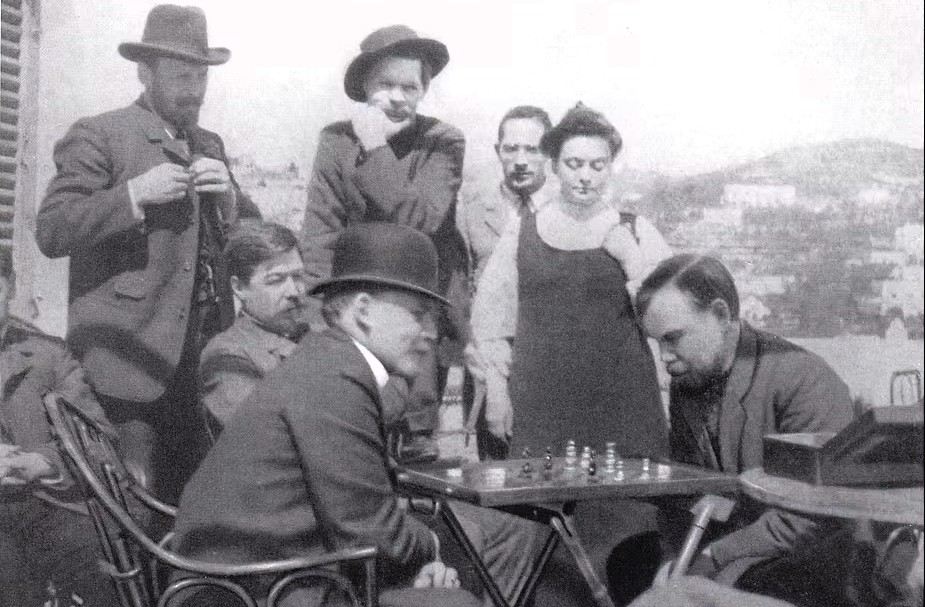
In this 1915 essay written while living next door in Swiss exile, Lenin analyses two recent books; one an academic work on Italian imperialism, the other by an Italian Socialist, Barboni, on the war. In doing so he offers insights into both Italian economy and the political limits of much of the Socialist movement at the time.
‘Imperialism and Socialism in Italy’ (1915) by V.I. Lenin from Collected Works. Vol. 18. International Publishers, New York. 1930.
(A NOTE)
In order to elucidate the problems placed before Socialism by the present imperialist war, it is useful to cast a glance at the various European countries, thus to learn to distinguish between national modifications and details of the general picture and that which is fundamental and essential. Things are better seen from a distance. The less the resemblance between Italy and Russia, the more interesting it is, in some respects, to compare imperialism and Socialism in both countries.
In the present note we only intend to call attention to material bearing upon this problem as presented by a bourgeois professor, Roberto Michels, in his book Italian Imperialism, and by a Socialist, T. Barboni, in a book Internationalism or Class Nationalism (The Italian Proletariat and the European War), both of which appeared after the beginning of the war.1
The talkative Michels has remained as superficial as in his other works, hardly touching upon the economic side of imperialism. His book, however, contains a collection of valuable material on the origin of Italian imperialism and on the change that is the main characteristic of the present epoch and that is most obvious in Italy, namely, the change from the epoch of wars for national liberation to an epoch of imperialist and reactionary wars of plunder. Revolutionary-democratic Italy, that is, revolutionary-bourgeois Italy, the Italy that cast off the yoke of Austria, the Italy of Garibaldi’s time, decisively changes before our very eyes into an Italy oppressing other peoples, robbing Turkey and Austria, an Italy of a crude repulsively reactionary and rapacious bourgeoisie whose mouth waters in the expectation of a share in the plunder to which it is admitted. Like every decent professor, Michels, of course, considers his servility before the bourgeoisie as “scientific objectivism”; he calls this division of plunder “a division of that part of the world which still remains in the hands of weak peoples” [p. 179]. Disdainfully rejecting as “Utopian” the point of view of those Socialists who are hostile towards colonial politics of any kind, Michels repeats the argument of those who think that Italy, judging by the density of her population and the force of the emigration movement, “ought to have been the second colonial power,” ceding priority only to England. The argument that forty per cent of the Italian people are illiterate, that even at present the country knows cholera riots, etc., Michels repudiates by pointing to England! Was not England, he says, a country of unprecedented poverty, humiliation, deaths due to starvation among the working masses, alcoholism, misery, and filth in the slums of the cities in the first half of the nineteenth century, when the English bourgeoisie was so successfully laying the foundations of its present colonial power?
It must be admitted that, from the bourgeois standpoint, this argument is unassailable. Colonial politics and imperialism are not healthy, curable deviations of capitalism (the way philistines think, together with Kautsky); they are an inevitable consequence of the very foundations of capitalism. Competition among individual enterprises makes it inevitable for the entrepreneurs either to become ruined, or to ruin others; competition between individual countries places before each one of them the alternative of either remaining behind, ever running the risk of becoming a second Belgium, or ruining and conquering other countries, thus elbowing their way to a place among the “great” powers.
Italian imperialism was named “imperialism of the paupers” (Pimperialismo della povera gente) owing to the poverty of Italy and to the desperate misery of the masses of Italian emigrants. Arturo Labriola, the Italian chauvinist, who differs from his former opponent, G. Plekhanov, only in that he somewhat earlier revealed his social-chauvinism, which he reached by way of petty-bourgeois semi-Anarchism, and not by way of petty-bourgeois opportunism, wrote in his book on the Tripolitan War (1912):
“…It is obvious that we are fighting not only against the Turks…but also against the intrigues, the intimidations, the money, and the armies of plutocratic Europe, which cannot tolerate that small nations should dare to make one gesture, to say one word that would compromise its ironclad hegemony” [p. 22]. The leader of the Italian nationalists, Corradini, declared at the same time: “In the same way as Socialism was a method of freeing the proletariat from the bourgeoisie, nationalism will for us Italians be a method of freeing ourselves from the French, the Germans, the English, the North and South Americans who, in relation to us, appear as a bourgeoisie.”
Every country which has more colonies, capital, armies, than “we” have, deprives “us” of certain privileges, certain profits or super-profits. As among individual capitalists the one who has machines above the average, or certain monopolies, receives super-profits, so among nations, the one that is economically better situated than others receives super-profits. It is the business of the bourgeoisie to fight for privileges and advantages for its national capital, and to fool the people or the populace (with the aid of Labriola and Plekhanov) by dressing up the imperialist struggle for the “right” to plunder others as a war for national liberation.
Prior to the Tripolitan War, Italy did not plunder other nations, at least not to a large extent. Is this not an intolerable offence to national pride? The Italians are oppressed and humiliated before other nations. Italian emigration was 100,000 annually in the seventies of the last century; now it has reached from 500,000 to 1,000,000. All these people are paupers, driven from their country by hunger in the literal sense of the word. All these people supply labour power in the worst paid branches of industry, all this mass inhabits the most crowded, poverty-stricken, and filthy sections of the American and European cities. From 1,000,000 in 1881, the number of Italians abroad increased to 5,500,000 in 1910, the bulk of this mass living in the rich and “great” countries, in comparison with whom the Italians appear as the crudest, most unskilled, poor and defenceless labour mass. Of the main countries consuming cheap Italian labour, France counted in 1910, 400,000 Italians (240,000 in 1881); Switzerland, 135,000 (41,000 in 1881); Austria, 80,000 (40,000); Germany, 180,000 (7,000); the United States of America, 1,779,000 (170,000); Brazil, 1,500,000 (82,000); Argentine, 1,000,000 (254,000). “Brilliant” France which, 125 years ago, fought for freedom, and therefore calls its present war for its own and the English slaveholders’ “colonial rights” a war for liberation, keeps hundreds of thousands of Italian workers in special ghettos. The petty-bourgeois crew of this “great” nation does its best to keep them in isolation, to insult and humiliate them in every possible way. The Italians are disdainfully called “Macaroni” (let the Great Russian reader remember how many contemptuous names are current in our country in relation to those of non-Russian blood who were not fortunate enough to be born with the rights to the noble great-nation privileges which serve in the hands of the Purishkeviches as a means of oppressing both the Great-Russian and the other peoples of Russia). France, the great nation, concluded a treaty with Italy in 1896 which stipulates that the latter is not allowed to increase the number of Italian schools in Tunis! The Italian population of Tunis has since increased six times. There are in Tunis 105,000 Italians as against 35,000 Frenchmen, but among the former there are only 1,167 landowners, with an aggregate of 83,000 hectares, whereas among the latter there are 2,395 landowners who have grabbed 700,000 hectares in that colony. How can one fail to agree with Labriola and other Italian “Plekhanovists” that Italy has a “right” to hold its colony in Tripoli, to oppress the Slavs in Dalmatia, to divide Asia Minor, etc.?2
In the same way as Plekhanov supports the Russian war of “liberation” against the German intention to turn Russia into its colony, so the leader of the Reformist Party, L. Bissolati, raises a hue and cry against the “invasion of Italy by foreign capital” [p. 97], namely, German capital in Lombardy, English in Sicily, French in Piacentino, Belgian in the street car enterprise, etc., etc., without end.
The question has been put squarely and one cannot fail to recognise that the European War has been of enormous use for humanity in that it actually has placed the question squarely before hundreds of millions of people of various nationalities: either defend, with rifle or pen, directly or indirectly, in whatever form it may be, the great-nation and national privileges in general, as well as the prerogative or the pretensions of “our” bourgeoisie, that is to say, either be its adherent and lackey, or utilise every struggle, particularly the clash of arms for great-nation privileges, to unmask and overthrow every government, in the first place our own, by means of the revolutionary action of an internationally united proletariat. There is no middle road; in other words, the attempt to take a middle position means, in reality, covertly to join the imperialist bourgeoisie.
Barboni’s book is, in substance, entirely devoted to covering up this latter act. Barboni puts on the airs of an internationalist exactly as our Mr. Potresov does; he argues that, from the internationalist point of view, it is necessary to find out the success of which side would be more useful or more harmful to the proletariat, and, of course, he decides this question against Austria and Germany. In a perfectly Kautskyist spirit, Barboni proposes to the Italian Socialist Party solemnly to proclaim the solidarity of the workers of all countries—in the first place, of course, of the belligerent countries—to proclaim internationalist convictions, a programme of peace on the basis of disarmament and national independence of all nations, including the formation of a “league of all nations for the mutual guaranty of inviolability and independence” [p. 126]. It is in the name of those principles that Barboni declares that militarism is a “parasitic” phenomenon in capitalism, a thing “not at all necessary”; that Germany and Austria are permeated with “military imperialism”; that their aggressive politics were a “continuous threat to European peace”; that Germany had “always rejected the proposals for limitation of armaments advanced by Russia [sic!!] and England,” etc., etc., and that the Socialist Party of Italy declares itself in favour of Italy’s intervention on the side of the Triple Entente at an opportune moment.
It remains unknown which are the principles that guide one in preferring the bourgeois imperialism of England to that of Germany. Economically, Germany developed in the twentieth century faster than the other European countries; in the matter of the division of colonies, it was particularly “wronged”; England, on the other hand, developed much more slowly; it has grabbed a whole world of colonies; it often applies there, away from Europe, no less bestial methods of oppression than the Germans; with its great wealth it hires millions of soldiers of the various continental powers to plunder Austria and Turkey, etc. Barboni’s internationalism, in reality, reduces itself, like that of Kautsky, to a verbal defence of Socialist principles, under which hypocritical cover the Italian bourgeoisie is defended in practice. One cannot fail to notice that Barboni, having published his book in free Switzerland (where the censor deleted only one-half of a line on p. 75, dealing obviously with criticism of Austria), did not find it necessary in the remaining 143 pages to mention the main principles of the Basle Manifesto, or conscientiously to analyse them. On the other hand, our Barboni quotes with deep sympathy [p. 103] two former Russian revolutionists who are now advertised by the entire Francophile bourgeoisie: the petty-bourgeois Anarchist, Kropotkin, and the Social-Democratic philistine, Plekhanov. No wonder! Plekhanov’s sophisms do not differ in substance from Barboni’s. In Italy, however, political freedom easily tears the cover off those sophisms, revealing more clearly Barboni’s actual position as an agent of the bourgeoisie in the camp of the workers.
Barboni regrets the “absence of a real and actual revolutionary spirit” within German Social-Democracy (exactly in Plekhanov’s way); he ardently greets Karl Liebknecht (as he is greeted by the French social-chauvinists who do not see the beam in their own eye); but he decidedly declares that “we cannot speak of the bankruptcy of the International” [p. 92], that the Germans “did not betray the spirit of the International” [p. 111] inasmuch as they were prompted by a “bona fide” conviction that they were defending the fatherland. In Kautsky’s sanctimonious spirit, but with the addition of Romance eloquence, Barboni declares that the International is ready (after a victory over Germany) to “forgive the Germans as Christ forgave Peter a moment of distrust, to heal by oblivion the deep wounds inflicted by militarist imperialism, and to extend a hand for an honourable and brotherly peace” [p. 113]
A touching picture: Barboni and Kautsky—probably not without the aid of our Kossovsky and Axelrod—forgiving each other!!
Being fully satisfied with Kautsky and Guesde, with Plekhanov and Kropotkin, Barboni is dissatisfied with his own Socialist Labour Party in Italy. In this party, which was fortunate enough prior to the war to rid itself of the reformists, Bissolati and Co., an atmosphere, he complains, was created in which those who, like Barboni, do not agree to the slogan of “absolute neutrality” (i.e., to a determined struggle against those who stand for Italy joining the war) “cannot breathe” [p. 7]. Poor Barboni complains bitterly that men of his kind are labelled in the Italian Socialist Labour Party as “intellectuals,” as “individuals who lost contact with the masses,” as “people hailing from the bourgeoisie” who “wandered from the straight path of Socialism and internationalism” [p. 7]. “Our party,” says Barboni with indignation, “is training fanatics more than it educates the masses” [p. 4].
What an old tune! It is the Italian variation of the well-known tune of Russian Liquidators and opportunists decrying the “demagogy” of the wicked Bolsheviks who “incite” the masses against the dear Socialists from the Nasha Zarya, the Organisation Committee, and Chkheidze’s fraction! What a valuable admission this is, however, on the part of an Italian social-chauvinist: in the only country where for several months the platforms of the social-chauvinists and of the revolutionary internationalists could be freely discussed, the working masses, the class-conscious proletariat, have adopted the latter, whereas the petty-bourgeois intellectuals and opportunists have adopted the former.
Neutrality is narrow egotism; it is lack of understanding of the international situation; it is meanness in regard to Belgium; it is “absenteeism,” and “those who are absent are always wrong,” says Barboni entirely in the spirit of Plekhanov and Axelrod. But since there are two open parties in Italy, one reformist and the other a Social-Democratic labour party, since in that country it is impossible to fool the public by covering up the nudity of Messrs. Potresov, Cherevanin, Levitsky and Co. with the fig-leaf of Chkheidze’s fraction or of the Organisation Committee, Barboni openly admits the following:
“From this point of view I see more revolutionism in the activities of the Socialist-reformists who quickly realised the enormous importance that such an overhauling of the political situation [in consequence of a victory over German militarism] would have for the future anti-capitalist struggle, and who, in perfect consistency, joined the Triple Entente, than there is in the tactics of the official revolutionary Socialists who, like a turtle, hid under the shell of absolute neutrality” [p. 81].
In connection with this valuable admission, it remains for us only to express a wish that some one of the comrades acquainted with the Italian movement should gather and systematically analyse the enormous and most interesting material furnished by Italy’s two parties as to what social strata, what elements, with whose aid, by which arguments, the revolutionary policy of the Italian proletariat on the one hand and the lackey service to the Italian imperialist bourgeoisie on the other were defended. The more such material is gathered in various countries, the clearer will the truth appear before the class-conscious workers as to the causes and meaning of the collapse of the Second International.
In conclusion, we wish to note that Barboni, facing a workers’ party, attempts by means of sophistry to play up to the revolutionary instincts of the workers. The Socialists-internationalists of Italy who are opposed to a war in reality waged for the imperialist interests of the Italian bourgeoisie, appear in his presentation as adherents of cowardly abstinence, of an egotistic desire to hide from the horrors of war. “A people educated in the fear of war horrors,” he says, “will probably also be afraid of revolutionary horrors” [p. 83]. Side by side with this loathsome attempt to disguise himself as a revolutionist, we find a crudely practical reference to the “clear” words of Minister Salandra, who said that “order would be maintained at any price,” that the attempts at a general strike directed against mobilisation would only lead to “useless slaughter.” “We could not prevent the Libyan (Tripolitan) War, less so will we be able to prevent the war with Austria” [p. 82].
Like Kautsky, Cunow, and all the opportunists, Barboni consciously, with the meanest intention of fooling a section of the masses, ascribes to the revolutionists the silly plan to “frustrate the war” “at once,” to allow themselves to be shot down in a moment most opportune for the bourgeoisie. He thus attempts to evade the task clearly formulated at Stuttgart and Basle, namely, to utilise the revolutionary crisis for systematic revolutionary propaganda and preparations for revolutionary mass actions. That Europe is passing through a revolutionary moment, Barboni sees quite clearly:
“…There is one point [he says] on which I deem it necessary to insist even at the risk of becoming irksome to the reader, because without having a clear idea of that point one cannot correctly estimate the present political situation, The point is that the period we are living through is a catastrophic one, a period of action when there is no longer any question of propounding ideas, of formulating programmes, of defining a line of political behaviour for the future, but of applying a live and active force for achieving results within months, possibly within weeks. Under such conditions, it is no longer a question of philosophising over the future of the proletarian movement, but of consolidating the point of view of the proletariat in face of the present situation [pp. 87-88].”
One more sophism under the guise of revolutionism! Forty-four years after the Commune, after half a century of gathering and preparing the mass forces, the revolutionary class of Europe must at the present moment, when Europe is passing through a catastrophic period, think of how quickly to become the lackey of its national bourgeoisie, how to help it plunder, violate, ruin, conquer other peoples, and not how to unfold, in mass proportions, a direct revolutionary propaganda, and preparation for revolutionary actions.
N. LENIN.
Kommunist, Nos. 1-2, 1915.
NOTES
1. Roberto Michels, L’imperialismo italiano, Milan, 1914; T. Barboni, Internazionalismo, o nazionalismo di classe? (Il proletariato d’Italia e la guerra europea). Edito dall’autore a Campione d’Intelvi (provincia di Como), 1915.
2. It is highly instructive to note the connection between Italy’s transformation into an imperialist country and the government’s conceding to an election reform. The reform increased the number of voters from 3,219,000, to 8,562,000, in other words, it “nearly” introduced general suffrage. Prior to the Tripolitan War, Giolitti, who accomplished the reform, was decidedly against it. “The motives for this change of policy by the government and the moderate parties,” says Michels, “were essentially patriotic. Notwithstanding their old theoretical aversion towards a colonial policy, the industrial workers, and more so the lower strata, had fought against the Turks in perfect discipline and obedience, contrary to all expectations. Such slavish behaviour as regards the government’s policy deserved a reward which would stimulate the proletariat to continue along this new road. The President of the Council of Ministers declared in Parliament that by his patriotic behaviour on the battlefield of Libya the Italian worker had proven to the country that he had reached the highest stage of political maturity. He who is capable of sacrificing his life for a noble aim is also capable of defending the interests of the fatherland as a voter, and he therefore has a right that the State should consider him worthy of the fullness of political rights” [p. 177]. The Italian Ministers are good talkers! Still better ones are the German “radical” Social-Democrats who at present repeat the following argument of a lackey: “We,” they say, “have fulfilled our duty, helping ‘you’ to plunder foreign countries, whereas ‘you’ do not wish to give ‘us’ universal suffrage in Prussia…”
International Publishers was formed in 1923 for the purpose of translating and disseminating international Marxist texts and headed by Alexander Trachtenberg. It quickly outgrew that mission to be the main book publisher, while Workers Library continued to be the pamphlet publisher of the Communist Party.
PDF of full book: https://archive.org/download/imperialwar0018vile/imperialwar0018vile.pdf

