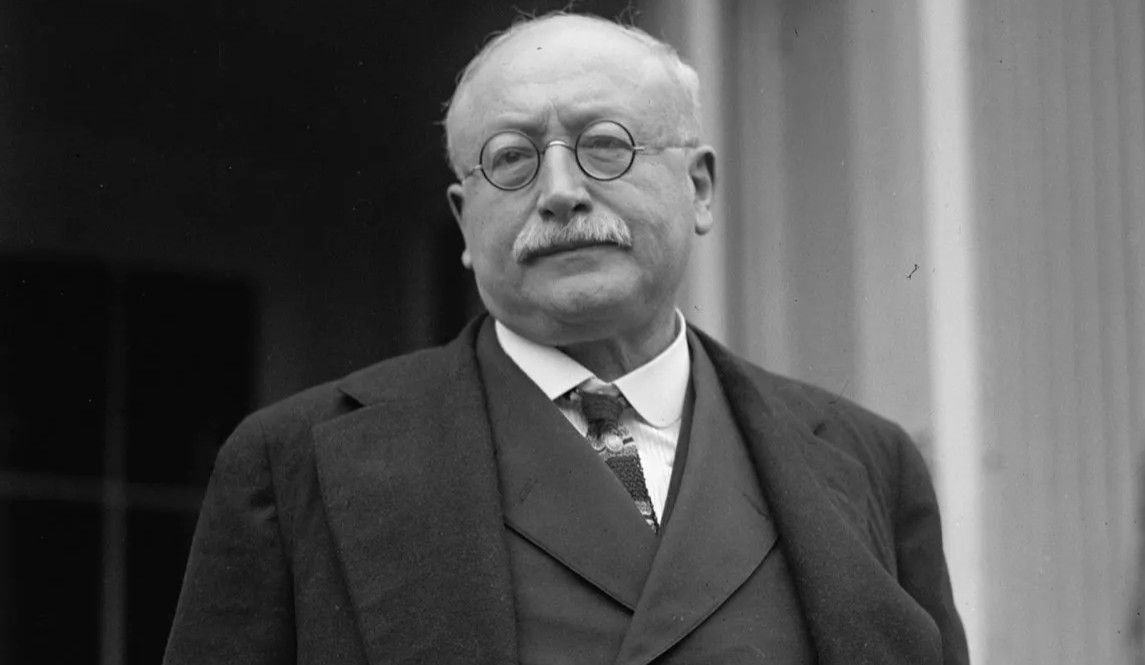
While most of the apostate jingoes in the U.S. Socialist movement supported United States imperialism during World War One, the Milwaukee Congressman Victor Berger chose the path of his opportunist mentors and supported German imperialism. Louis Boudin says he should be shown the door.
‘Recall Berger’ by Louis B. Boudin from The Class Struggle. Vol. 2 No. 2. March-April, 1918.
The election of Victor L. Berger, as one of the Delegates of the Socialist Party of this country to the contemplated International Socialist Peace Congress, is one of the most disgraceful things that have happened in the entire history of the party, and calculated to do it infinite harm. This action should be reversed as speedily as possible, and before the harm done shall have become irreparable.
In the entire membership of the Socialist Party there could hardly have been found another man so little suited for the task of delegate to an International Socialist Peace Congress than Victor Berger. In fact, his selection as one of the delegates casts reflection on the entire delegation, and is well calculated to give color to the accusation that the entire movement for the holding of an international Socialist Peace Congress is tinged with a pro-German bias, which is supposed to be the justification for the Government’s refusal to issue passports to the delegates.
Ever since the outbreak of the great world-war, Victor L. Berger has been conspicuous in the advocacy of everything that tended to help the success of German arms, and in defending the worst excesses of German Imperialism. In so doing he has repudiated every principle of socialist internationalism; and has treated with the greatest contempt and contumely the anti-militaristic position and the peace professions of the Socialist Party of America. A born jingo, he has been a German jingo and an American jingo by turns—contriving a synthesis of the two which has become familiar under the name of Hearstism, an attempt to put American jingoism at the service of German Imperialism.
When the German cohorts succeeded in wiping Servia off the map in the summer of 1915, Berger’s Milwaukee Leader published an editorial eulogy of this enterprise, advocating the permanent Germanization of the Balkans, and approving highly of the action of Messrs. Scheidemann and Co. for supporting the Kaiser in his Balkan expedition. In order to make his German imperialism more palatable to his Socialist readers. Mr. Berger assured them that the Kaiser’s Balkan policy had been approved in advance by Karl Marx himself, and that Scheidemann and Co. in supporting that policy were carrying out the last will and testament of Karl Marx.
And when, a year later, Hearst and other jingoes—some American and some German, and some both—tried to embroil this country in war with Mexico, Berger loudly demanded war,—in defiance of the Socialist Party which was holding meetings protesting against such a war. Berger’s enthusiasm for a Mexican adventure by the United States was so great that his then puppet in the Mayor’s chair of Milwaukee ordered that the day when the Milwaukee National Guardsmen were to leave for the Mexican border be kept as a public holiday, so that the citizens of Milwaukee could give ‘our boys’ a proper send-off, for the expedition which Berger evidently believed would keep them employed in Mexico long and profitably. The Milwaukee Leader even went into the flag business so as to be able to supply its readers with American flags for the joyful occasion.
During the three and a half years that the great European conflict has lasted, there was not an occurrence, either in American or world politics, that Berger has appraised otherwise than from the point of view of German imperialism. When the German Socialists split into a Kaiser and anti-Kaiser party, he openly ranged himself on the side of the Kaiser Socialists, and in opposition to the Liebknecht group and the Independents.
When the Russian Revolution broke out—and it was feared at Berlin that it might lead to reorganization of Russia’s military resources and a vigorous prosecution of the war by the new Russian Republic—Berger heaped abuse upon the Russian Revolutionists, informing them at the same time, however, that they could redeem themselves by making a separate peace with Germany, and advising them to lose no time in doing so.
During the terrible days of the last months of the “peace negotiations” between Russia and Germany, the Milwaukee Leader did its best to discourage the fighting spirit of the Russian Revolutionists and their sympathizers in this country, searching for precedents in American Revolutionary history to justify a separate peace. In his zeal for a separate peace, he even went to the extent of praising the Bolsheviki—whom he hates and despises for their internationalism—when they seemed to be inclined towards a separate peace.
But all this is nothing in comparison to Mr. Berger’s latest feat in “internationalism” a la Berlin and Potsdam.
When the world stood amazed and horror-stricken at the dismemberment of Russia by Germany and the strangling of the Russian Revolution by German Militarism, when Germany was actually marching her army into a defenseless country, into a country that has thrown away her arms, Berger actually came out with a defense of German Imperialism in its nefarious work of raping Russia and strangling the Revolution.
Whenever an extraordinary occasion arises and Mr. Berger wants to convey some special message to the world, he usually has himself interviewed, Hearst-fashion, by his own paper. Such an occasion arose when Germany started on her march into Esthonia after Russia threw away her arms. And Berger was equal to the occasion. On the same day that his paper brought the news of Germany’s march into Esthonia, Washington’s Birthday, he published an interview with himself on the front page of his paper, in which he frankly took German Imperialism under his protection and openly put his stamp of approval on what the Kaiser and his cohorts were doing in Russia.
“Creating independent states”, Berger reported himself as saying, “is not annexing them to Germany.”
“Poland, Courland, Lithuania, Esthonia, Livonia and Finland are to be independent states, which according to the London version means, that they are annexed to Germany. The average reader will not be able to make out the sense of this. At least we Socialists stand for the right of every nationality to assert itself and to live its own national life as far as this is possible. No nation can do so without being independent in its own internal affairs.
“I fail to understand how Poland will become annexed to Germany by being declared an independent state, especially if the Polish speaking part of Austria and of Germany (Galicia and Posen) be included in that national unit.
“I fail to see how an independent Finland will mean that it is annexed to Germany. The same holds good for an independent Courland, Esthonia, and Livonia.”
Thus does our American Scheidemann outdo his German original. For Philip Scheidemann did not have the gall to pretend that Germany was creating “independent states” out of dismembered Russia. This brazen approbation of the Kaiser’s handiwork was left for his American representative. And as if in a desire to add insult to injury Berger hypocritically refers to a possible inclusion of Galicia and Posen in the new Polish “national unit”, although there is not a man in Germany or out of it, that believes such a thing possible, and although Berger’s own favorite Socialist Party in Germany has expressly declared itself against it.
And this is the man who is to represent the American Socialist movement at an International Socialist Peace Congress!
Berger should be recalled at once. And the Socialist Party locals who want their party represented at the International Socialist Peace Congress, whenever it comes, by a real Socialist and not a Hindenburg Socialist, should lose no time in moving for his recall.
***
As we go to press, the news comes that Berger was indicted under the Espionage Act; this is unfortunate, as our sympathies are naturally with all those under prosecution by the government. But this must not deter us from doing our duty by the Party. The matter is entirely too important to permit such considerations to influence us in the least. We cannot permit the government to impose upon us undesirable leaders by indicting them.
The Class Struggle and The Socialist Publication Society produced some of the earliest US versions of the revolutionary texts of First World War and the upheavals that followed. A project of Louis Fraina’s, the Society also published The Class Struggle. The Class Struggle is considered the first pro-Bolshevik journal in the United States and began in the aftermath of Russia’s February Revolution. A bi-monthly published between May 1917 and November 1919 in New York City by the Socialist Publication Society, its original editors were Ludwig Lore, Louis B. Boudin, and Louis C. Fraina. The Class Struggle became the primary English-language paper of the Socialist Party’s left wing and emerging Communist movement. Its last issue was published by the Communist Labor Party of America. ‘In the two years of its existence thus far, this magazine has presented the best interpretations of world events from the pens of American and Foreign Socialists. Among those who have contributed articles to its pages are: Nikolai Lenin, Leon Trotzky, Franz Mehring, Karl Liebknecht, Rosa Luxemburg, Lunacharsky, Bukharin, Hoglund, Karl Island, Friedrich Adler, and many others. The pages of this magazine will continue to print only the best and most class-conscious socialist material, and should be read by all who wish to be in contact with the living thought of the most uncompromising section of the Socialist Party.’
PDF of full issue: https://www.marxists.org/history/usa/pubs/class-struggle/v2n2mar-apr1918.pdf

