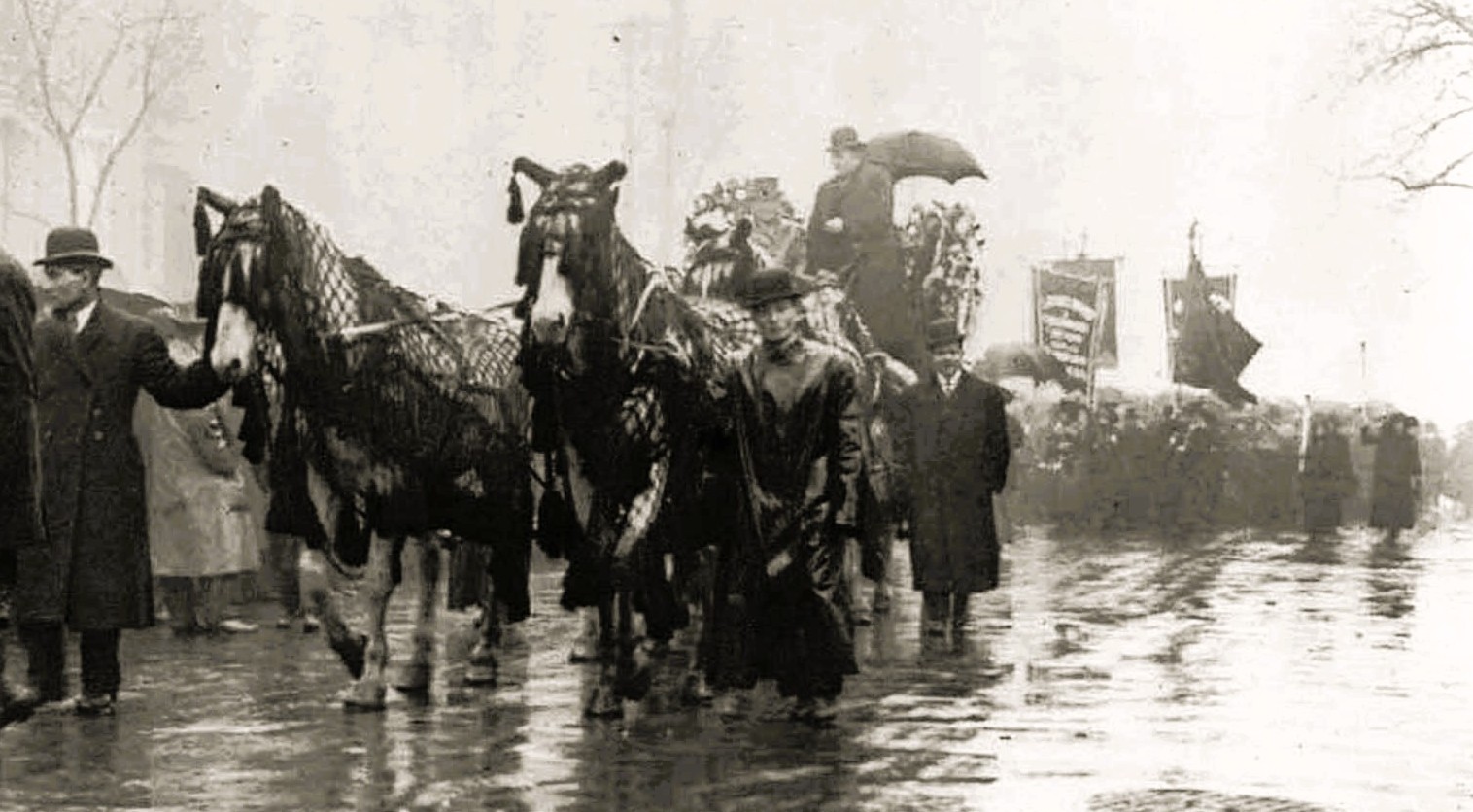
The need for the working class to exercise our own rites and develop our own traditions in remembering our dead.
‘A Cenotaph for the Unknown Worker’ by Helen Sahler from Labor Age. Vol. 18 No. 8. August, 1929.
Suggesting A Shrine In His Honor
WE who conceived the idea of publicly honoring the Unknown Soldier did a significant thing. It was an original idea to raise a stone to an unknown man; it brings to mind the altar once erected in Athens to the Unknown God. Such monuments imply a measure of humility in the erectors: they seem to acknowledge a falling short, to confess a failure of understanding.
The public giving of tribute to men unrecognized and gone to oblivion marks a peg ahead in evolution, for man is prone to glorify the conspicuous. It means the developing of a juster and more humane valuation. This honoring of the Unknown Soldier, this gathering about a tomb with flags furled and drums stilled, is a ferment for peace, for humility and pity do not engender jingoism.
But, as this homage is new, let some of us make the rendering of it entirely new and give it to one of a newly acclaimed calling, instead of to the age-long lauded warrior caste. Let us give it to the man behind the hoe and the machine instead of to the man behind the gun. Let not the Unknown Soldier alone be deemed worthy of such tribute and the Unknown Worker remain unhonored. Shall the long, grinding hardship of a life of harrowing insecurity be forgotten and only the pangs of a sudden death remembered? Shall not the hands that wrought as well as the hands that fought be held up?
Why not on May Day take a leaf from the book of the inaugurators of the Armistice day celebration and initiate a three minute silence in honor of the Unknown Worker? Instead of standing about a cenotaph, at one agreed time, in America, in Europe, and on to the frontiers of the labor movement, in every workshop, field and factory, let men stand in silent commemoration. Also at all the mass meetings at that hour let the hush fall. Silence such as this will echo and re-echo around the world.
Such a demonstration will be potent as well as impressive. It will be potent for unity, for all factions and wings can unite in such an observance. Luckily, as silence is the form of commemoration, there will be no opening for discussion. Customs and traditions weld organizations, by them strong institutions are riveted together. Rites are as binding as the paying of annual dues and the passing of resolutions, and by more of such bonds, which stir the imagination, warm the heart and brace the will, the labor movement would be strengthened. And what a rich reservoir of associations and memories there is to draw upon, as yet barely tapped! So let us inaugurate this May Day pause, and by honoring the departed heroes and martyrs, the living unknown worker will be fortified and inspired.
If an actual cenotaph could be erected so much the better. But in what city of the United States would land be granted for such a purpose? Such is the irony of it, that he who dug the foundations, dredged the harbors, descended into caissons, laid the sewers, paved the streets, raised the skyscrapers, may be denied the plot for such a grave in the city his hands built.
Some will quote William James in his Talks to Teachers and say that the reason monuments are raised to soldiers instead of to subway workers is because they follow an ideal. But William James wrote before we had conscription and before the great development of the labor movement. There is a twofold sentiment that draws the crowd around the grave of the Unknown Soldier. The crowd knows that many of those who fought did so because they would be shot as deserters if they did not or put into prison if they refused to serve, but it gathers about the Grave as that of a representative of the highest type who fought for an ideal. It also gathers in sympathy for the sufferings and sacrifices, voluntary and involuntary, incurred by all taking part. So with the Grave of the Unknown Worker. It will stand as representative of the highest type of toiler, of the one broadly and deeply conscious of the significance of labor. It will also stand as a symbol of recognition for the sufferings and sacrifices, voluntary and involuntary, incurred by the mass of workers.
This cenotaph will be a shrine for those who have been dumb for centuries, dumb not only in death but inarticulate in life. Here will be an abiding place for the Egyptian slave, condemned to make bricks without straw; for the peasant vainly rebelling against his miseries in the days of Luther; for the moujik shot down on Red Sunday. A shrine for him whose bones lay buried, marked only by the drifting sands of the desert, by the black loam of northern fields, by the snows of the steppes.
Here poetic justice can be rendered, the only kind, alas, that can be offered to the great host represented. Sadly inadequate, merely a gesture. What can ever atone for the injustice, the extortion, the ignominy endured? A happier future won for others, the attaining of it accelerated by the lesson of their experience? That is not amends. But such as it is, let the tribute be given. So let us stand with bowed heads in those minutes of remembrance, gazing far down the dusty trial of years at the column of marchers, of the strong and the weak, of the young and the old, pressing forward, stumbling, falling, rising again, driven by the whip of want, wielded by the hand of oppressors, until the long line fades in the midst of the past.
Before such a spectacle, speech is hollow, words are silence, a quiet august as death–this shall be the medium for our homage.
Labor Age was a left-labor monthly magazine with origins in Socialist Review, journal of the Intercollegiate Socialist Society. Published by the Labor Publication Society from 1921-1933 aligned with the League for Industrial Democracy of left-wing trade unionists across industries. During 1929-33 the magazine was affiliated with the Conference for Progressive Labor Action (CPLA) led by A. J. Muste. James Maurer, Harry W. Laidler, and Louis Budenz were also writers. The orientation of the magazine was industrial unionism, planning, nationalization, and was illustrated with photos and cartoons. With its stress on worker education, social unionism and rank and file activism, it is one of the essential journals of the radical US labor socialist movement of its time.
PDF of full issue: https://www.marxists.org/history/usa/pubs/laborage/v28n08-Aug-1929-Labor%20Age.pdf

