The background to Italy’s revolutionary Biennio Rosso, Two Red Years, from a leading figure of the Italian revolutionary Left in the U.S. Originally from Sicily, Cannata was at this time editor oft he I.W.W.’s Il Proletario.
‘Red Italy’ by Giuseppe Cannata from One Big Union. Vol. 2 No. 10. October, 1920.
There are so many agencies interested in suppressing the truth about the momentous events occurring on the continent of Europe that our erstwhile close neighbor becomes daily more and more enveloped in an impenetrable smoke-screen of falsehood and secrecy. The performances of the American press in relation to Russian news have already reached the apex of perversion and imbecility; as to Italy, these performances are only beginning. The Italian situation must be indeed clouded in mystery to the ordinary worker who gets his news from the prominent capitalist newspapers. Occasionally he reads of interviews with amiable American gentlemen returning from business trips to Italy; the amiable gentlemen are invariably optimistic; according to them the “Italian people are getting down to hard work,” “their industry and thrift, their innate common sense will carry them thru their present difficulties. But unfortunately, some sensational event occurs to disturb the impression thus created—we have widespread hunger riots; we have general strikes; we have civil disorder and commotion. At this point the Italian Embassy intervenes with the stereotyped official statement “that the whole affair has been greatly exaggerated by the enemy propaganda agencies, always busy discrediting Italy abroad in order to prevent her economic rehabilitation.”
The recent remarkable achievement of the Italian Metal and Machinery Workers in “locking out” their capitalist masters moves me to present to the American workers a general picture of the Italian situation, brief and therefore necessarily incomplete as to details. My impressions in the matter are developed from a knowledge of the psychology, temperament, traditions and working class movements of Italy; from direct correspondence and personal contact with recent immigrants or sailors from there.
The Economics of Italy
No single factor exerts such a great influence on events past and present in the labor movement of Italy as the economic status of the country in general. Italy is next to Belgium, the most densely populated country on the face of the earth; today its approximately 125,000 square miles of territory embrace a population of forty million. The density of its population is practically twice that of France. A thickly populated country may have a sound, economic basis if (like England and Belgium) it has available in its own soil or from its colonies, within convenient transportation distance, the prerequisites to intensive modern industry—coal, oil, iron, cotton, etc. Curiously enough, Italy with its immense population is essentially an agricultural country—it has little iron, practically no coal and no petroleum. Because of the insufficient area, and despite a fairly efficient agriculture, it cannot raise its own requirements of wheat, corn, meat and other primary essential foods. Its exports consisted almost entirely of luxuries and non-essentials (silks, art, glass-ware, olive oil, marble, sulphur, citrus fruits, dried fruits, cotton goods etc., etc.) and never served to cover more than a fraction of the imports. The resulting adverse trade balance was offset before the war by two special sources of national income, which served to make possible a rather precarious financial existence:
1. The tourist industry.
2. The exportation of man-power (emigration) resulting in income abroad. Italian emigration before the war had assumed colossal proportions, the high birth rate making it a permanent national practice. No less than seven million natives of Italy are today spread over the face of the earth in search of a chance to make a living.
The effect of the great war on the Italian economic and financial structure can be easily imagined. The special sources of income were greatly diminished; exports ceased while the imports of raw materials and finished products for the orgy of destruction reached unheard of proportions.
The entire economic life was thrown out of gear; immense munition and metallurgical plants sprang up in Northern Italy, depending on England and America for their raw material. Foreign loans succeeded each other rapidly and five national loans aggregating over fifty billion lire were floated. Italy emerged from the war with a total indebtedness amounting to seventy-five per cent of her national wealth; with a debauched currency (present exchange rate 23 lire to a dollar; pre-war rate 5.17 lire to a dollar) and with immense tracts of ruined territory on her hands.
Last December the financial statement of Minister of the Treasury Schanzer showed a deficit of two milliards 800 million lire. Six months later Meda’s statement showed the deficit to be twelve milliards. Neither statement includes any interest payments on the foreign debt; the Allies have been obliged to remit them. Meda’s budget as estimated for the year 1920-21 is summarized as follows (in millions of lire):
Ordinary receipts: 10,000
Extraordinary receipts (sale of war stocks, etc.: 1,500
Total 11,500
Ordinary expenses: 12,050
Extraordinary expenses:
1. Cereals: 6,300
2. War, Marine, Colonies: 2,000
3. Liberated and redeemed areas: 2,000
4. Maritime traffic: 500
Total expenses: 23,700
Less total receipts: 11,500
Deficit: 12, 200
A national economic situation which was always a source of misery and poverty to the vast masses of industrial and agricultural laborers and small peasants, has now reached a stage in which life to the worker has become a nightmare of suffering and privation.
Italy is on bread rations; the spectacle of a people burning wood in locomotives and industrial plants is not unique with blockaded and beset Soviet Russia. Capitalist Italy has been reduced to the same extreme by a coal-price amounting to 18 times the pre-war charge. The government flour monopoly, which creates a state deficit of six billion lire through money sent from yearly in order to sell bread at a moderate fixed price, does not place the means of subsistence within the average worker’s wage. To such a pass has capitalism and imperialistic war brought the Italian proletariat!
Revolutionary Traditions and Working-class Movements
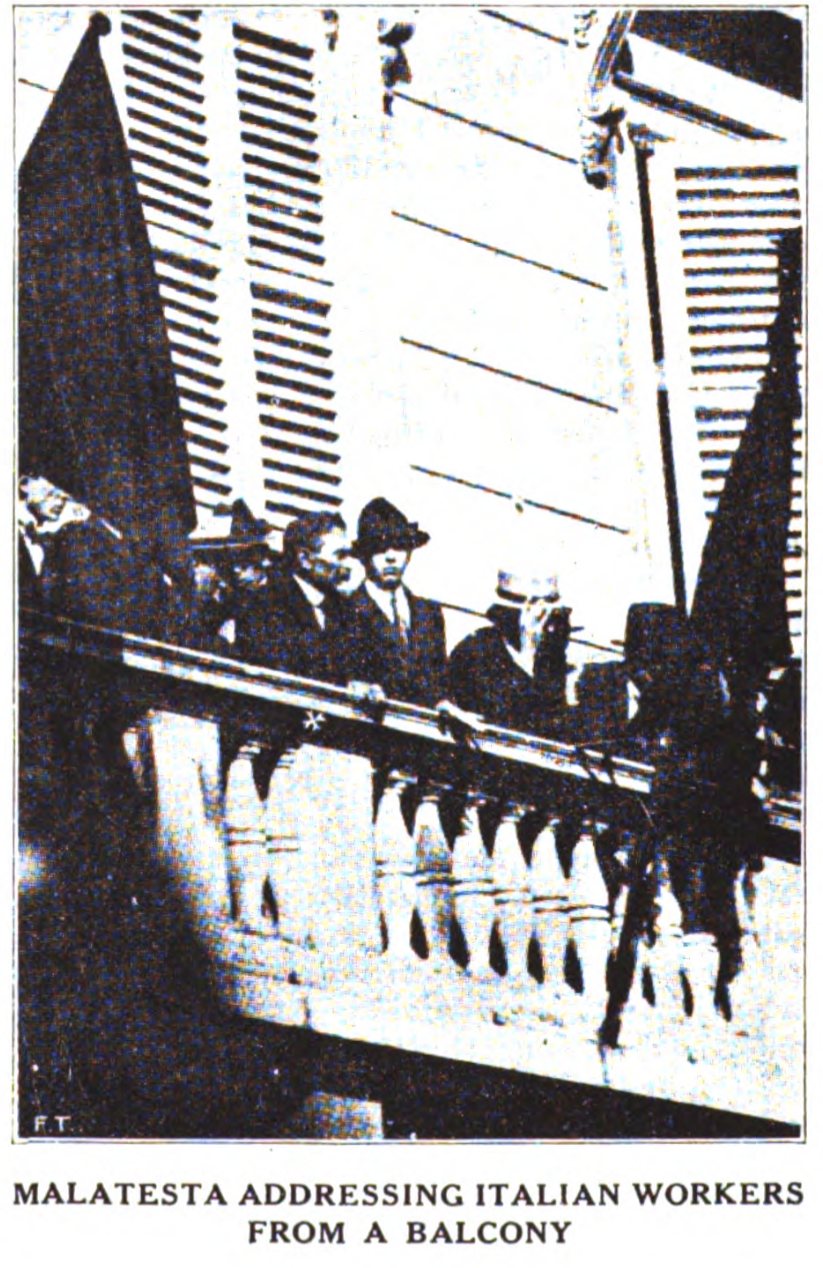
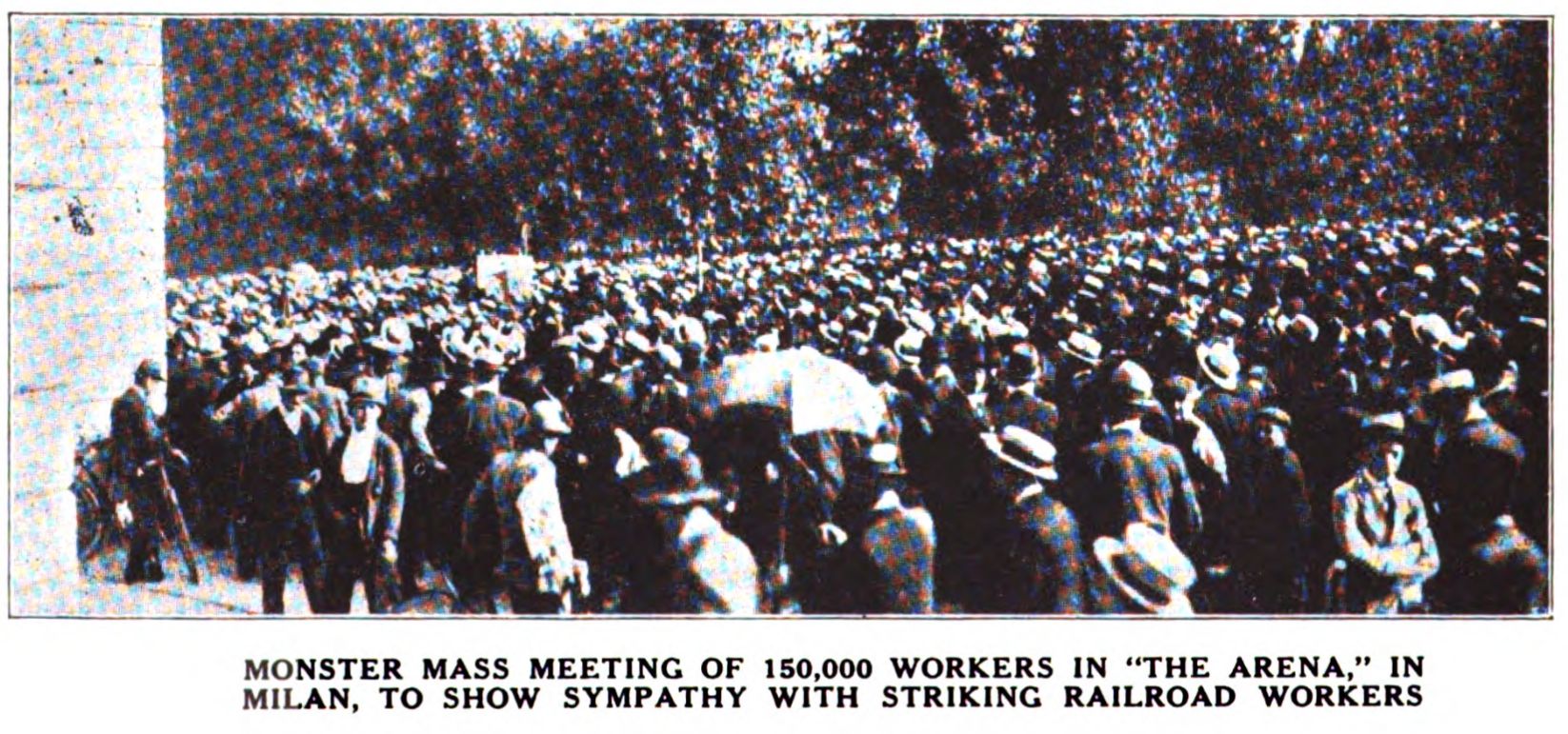
The modern Italian worker has no horror of the word “revolution”; the wars for national unity, which had a very popular character, are barely half a century old. The economic misery of the country, due partly to its natural deficiencies and partly to an indolent and unenterprising bourgeoisie and a corrupt and thieving governmental officialdom, has several times forced the workers to surge blindly forward into bloody insurrectionary movements under the lash of impellent necessity. The years 1893 in Sicily and 1898 in Northern and Central Italy are written in the memory of the Italian workers in letters of blood. They were hopeless unorganized struggles, throttled by the military with the utmost ferocity. There followed the phase of economic organization and socialist political activity, then the inevitable turn to economic action beginning with the remarkable general strike of 1904 and the ascendancy of the syndicalist criterion of direct action in the years immediately preceding 1914. This period witnessed a wonderful series of industrial and general strikes. The bourgeois press accused the workers of having gone strike-mad. The hanging of eight socialists in Japan in 1908 provoked a strike of 150,000 workers in the City of Milan) which witnessed five general strikes from 1912 to 1914. The killing of three workers caused the economic paralysis of the entire nation. Many of these “protest-strikes,” called for 24 hours, continued for days and days thru the sheer will of the workers to advance further and further in their “revolutionary gymnastics.” On one occasion the entire city of Milan, the Italian Petrograd of the coming revolution, was in the hands of the workers for three days. To go one step further would have meant revolution; the workers retired of their own volition; the time was not yet ripe. Just previous to the world-war, and following the disastrous economic consequences of the Tripolitan war, there occurred the highly successful semi-insurrectionary movement known as the Red Week of 1914. In such a temper and with such recent memories did the Italian workers enter the period of military terror and oppression that characterizes war. Conscription shattered the ranks of organized labor; the Italian Syndicalist Union, with a pre-war strength of about 125,000 members, was only able to maintain thru the war a membership of 30,000; its leaders were interned in concentration camps; its activities hampered.
Italian labor rebounded from the oppression of the regime of war and militarism with remarkable vigor. The ranks of all radical organizations filled rapidly; the Russian revolution seems to have caused a veritable psychological landslide. Amnesty for political prisoners was speedily obtained. One hundred and fifty-six socialists were elected to the chamber of deputies; the Italian Syndicalist Union reached a membership of 350,000, entering even the cities of undeveloped Sicily.
The Union of the Toilers of the Sea achieved practically one hundred per cent organization, and with the General Confederation of Labor, the Syndicat of Railway Workers and other minor labor bodies gave Italy an organized workers’ army of about 2,500,000 men.
The Italian Syndicalist Union is a revolutionary Industrial Union; it is probably more closely related to the I.W.W. in its several characteristics than any other organization in the world. The independent unions of raliway workers and marine transport workers are syndicalistic rather than socialistic in their activities.
The General Confederation of Labor and the Socialist Party, numerically the strongest organized force in Italy, work hand in hand and with the Moscow Third International. All Italian labor is thus formally lined up to the extreme left; “moderate” socialist opinion is represented exclusively by a section of the socialist parliamentary group and part of the officialdom of the General Confederation of Labor. It is superfluous to state that their influence with the proletarian rank and file is not very great.
Exercising Absolute Job Control
The enormous increase in organized strength of the workers and the prevalence of almost unanimous revolutionary intent in their ranks has given rise to a new tactic in the class-struggle which is highly significant and instructive. It is a tactic characterized by calm assurance and the sensation of limitless power; it is deliberately and systematically efficient and invariably successful. It is the exercise on the part of the workers of absolute job control.
It is not exaggerating to state that the Italian labor movement today is a state within a state. It is a state with its own international foreign policy which the workers, through the exercise of their economic strength, carry out against the wishes of capitalists and government. The main tenet of this proletarian foreign policy at present is the defense of Soviet Russia against foreign aggression. The activities of the transport workers in this connection have been positively brilliant. Seamen have repeatedly forced the unloading of munitions at Genoa, Naples and Trieste; one shipload of munitions was seized by the crew and carried to Fiume; 56 Italian sailors on the British steamer Calabria struck in the port of New York when they discovered that the steamer was to carry Polish reservists to Danzig recently.
The railway workers regularly and methodically inspect all freight and side-track all war material. In effect, it may be said that the Italian industries still belong to the capitalists, but the workers operate them for their own particular interests, at least in part.
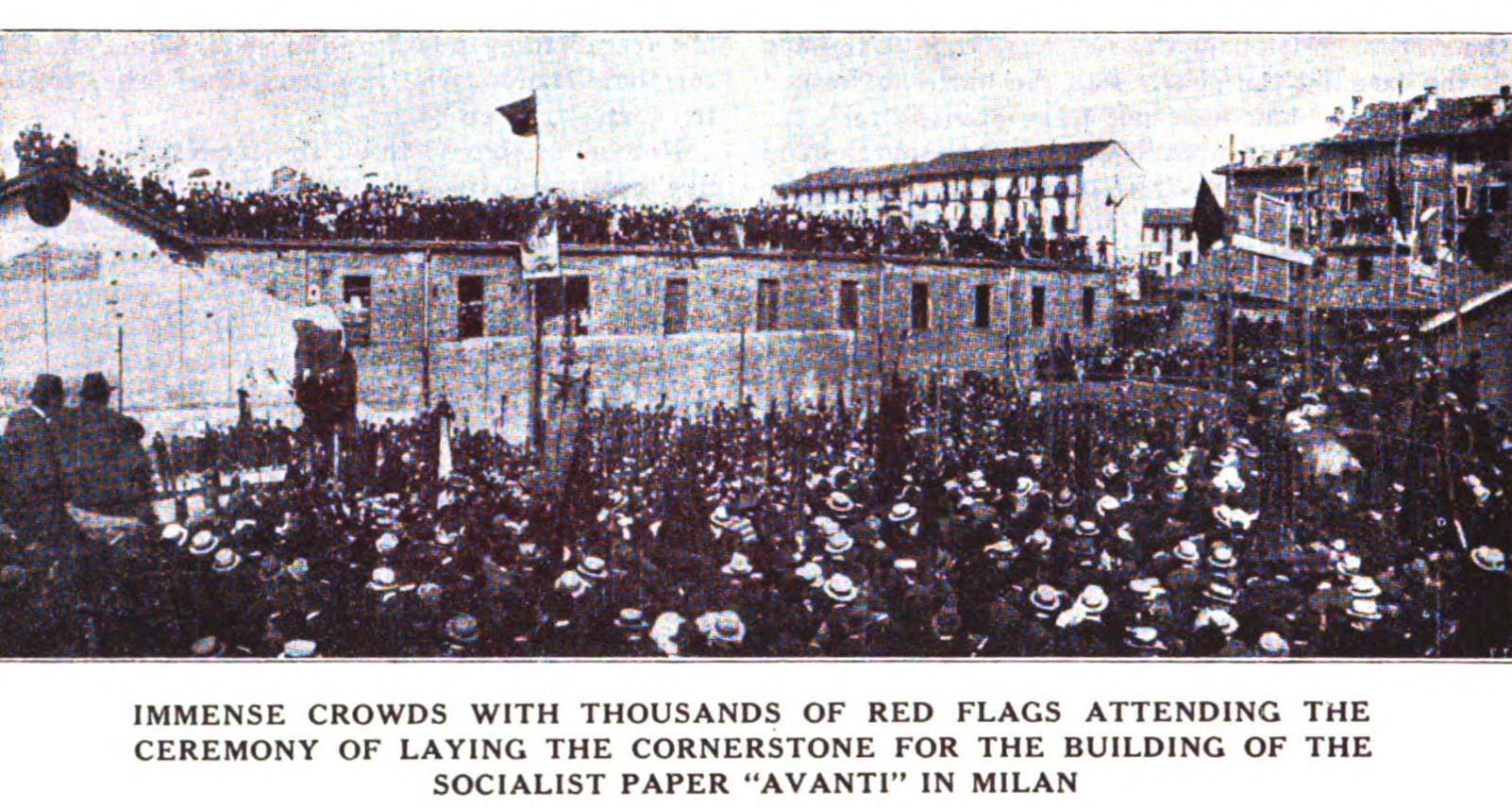
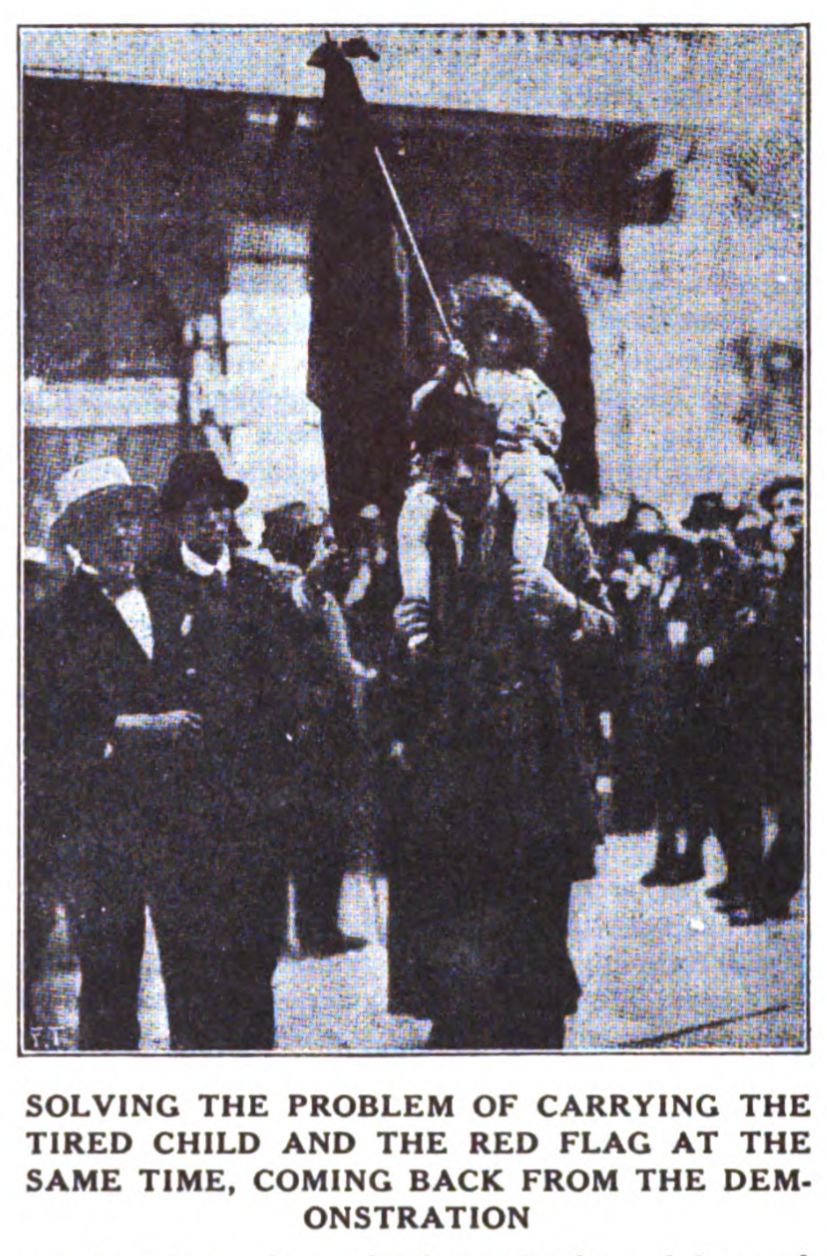
In the vicissitudes of the internal struggle, the workers are also using their newly-found power to daily humiliate the capitalists and accustom them to the bitterness of defeat. It has become a struggle in many cases over trivialities and for pure moral prestige. The workers in various shipyards have actually by job action forced the employers to fly the red flag on every ship launched! In the arsenal of Leghorn within the last two weeks a governnment torpedo boat destroyer took the water ablaze with red flags. After a nationalist mob had wrecked the offices of “Avanti” the socialist daily in Rome recently, the railway men retaliated by refusing to carry the bourgeois papers out of the city for distribution.
The Last Phase: Locking-out the Capitalist.
Before taking up the recent events in the metallurgical industry of Italy, which have attracted world-wide attention, it may not be amiss to state that the principle of seizure on the part of the workers has already been applied in several cases. In the agricultural field, the seizure and working of unused land has been legalized by the Visocchi decree; what the government of Giolitti was unable to prevent, it sagaciously sanctioned. The first example of the seizure and operation of an industrial plant on the part of the workers occurred in February of this year at Sestri Ponenti, Italy, during an agitation led by Angelo Faggi, formerly editor of “Il Proletario,” the Italian organ of the I.W.W. The workers held and operated this factory efficiently till driven out in a bloody encounter with the Royal Guards (Guardie Regie), the newly recruited force of highly paid mercenaries, which Nitti organized as the potential White Guard of the Italian bourgeoisie in the coming revolution.
The present controversy in the metallurgical industry arose from the workers’ demands, embodied in a memorandum asking for an advance of approximately 35 per cent in wages and the satisfactory adjustment of various matters affecting workers’ control in the factories. The Italian Syndicalist Union has over 50,000 members in this industry and considerable influence on the 400,000 members of the Italian Federation of Metal Workers, affiliated with the General Confederation of Labor, and the other minor bodies of organized workers. It is particularly strong in Milan, Sestri Ponenti, Piombino, Terni and Bologna. In Turin it exercises considerable influence because it has consistently countenanced a “shop-steward” movement, highly popular with the rank and file of the Federation of Metal Workers, and somewhat disagreeable to the leadership of the Socialist Party and the General Confederation of Labor. In fact, it may be said that the sole bone of contention between Syndicalists and Communists anarchists on one hand and maximalist socialists on the other is the insistence on the part of the former that the Socialist Party, with its heterogeneous leadership held in unnatural unity thru the vision of coming power, shall not extend its hegemony over the workers into the revolutionary period by the organization of politically dominated soviets, as has happened in Russia under a different set of conditions. The Italian shop-steward (Coasigli di fabbrica) movement isa highly intelligent rank and file attempt to place the destinies of the Italian revolution directly in the hands of the producers.
The refusal of the National Federation of Employers in the Mechanical and Metallurgical Industry to accede to the demands of the workers caused a general “slow-down” strike to be initiated on Aug. the 20th, over one half million metal workers participating in the movement.
Production was reduced practically 50 per cent for a period of almost two weeks. The employers retaliated against this effective measure by declaring a general lock-out and the workers responded by effecting a counter lock-out of the capitalists! The workers seized over 500 plants in various parts of the country, barricaded themselves in, hoisted the red flag on the roofs and mounted machineguns for defense against possible attack. Production was continued as in normal times, in some factories with the collaboration of the office and technical staffs, and in other factories without.
A curious factor in the situation has been the strictly neutral and pacific attitude of the Italian government. Personally I believe that the extremely crafty Signor Giolitti, the old fox of Dronero, elevated again to the rank of premier by a dying and impotent bourgeoisie, is still trying to make good his old boast of having been able “to relegate Carl Marx to the attic,” by his policy of corruptive conciliation towards the political socialists. The desire for power for its own sake, appears to be strong enough in Giolitti that he may even attempt to disprove Marx, by cutting loose from the sinking ship of capitalism, and perpetuating his political state through a policy of pliancy and adaptation to new economic forms of social life. It must be remembered that Signor Giolitti has already legalized the expropriation of unused lands, recognized and established commercial relations with Soviet Russia, declared openly the neutrality of the government in all industrial disputes, threatened the confiscation of all war-profits and in other ways flown straight against the drift of bourgeois good usance and custom. Meanwhile the Royal Guards are active as ever maintaining intact the authority and prestige of his government. Signor Giolitti is indeed a 20th Century Machiavelli and a statesman of resourcefulness; but the Italian workers have a keen enough intelligence and know so precisely what they want and how they are going to conquer it, that the stratagems of this latter-day Moses will prove absolutely futile.
With the Italian workers in complete possession of the splendidly equipped and excellently organized metallurgical industry, which includes all plants manufacturing munitions of war, two roads only are open to them—they will either extend the movement and gradually force the seizure of all industry which means revolution and the proletarian dictatorship, or they will of their own free decision, compromise once more with capitalism to renew the struggle at a more opportune time. The present situation precludes stagnation; in order to function, the metallurgical plants must secure raw materials and dispose of finished products. At this date of writing (Sept. 12) the railway-workers have begun delivering raw materials without authorization; over two hundred plants in the textile, shoe, rubber, chemical and lignite mining industry have been seized. It is to be foreseen that certain elements in the Socialist Party and the General Confederation of Labor will advocate renunciation and moderation, basing their thesis on the economic insufficiency of the country in case of revolution and consequent blockade. It is also to be foreseen that the Syndicalist and Communist Anarchists will advocate to the rank and file the immediate expropriation of capitalism and the proletarian assumption of power. As to the result, the next few days will tell.
Whatever the outcome of the present struggle, it will remain a milestone in the proletarian advance to power. The action of the metallurgical workers in Italy blazes a new trail for the world-proletariat. It is a road which the I.W.W. has for years recognized and advocated amid universal doubt and unbelief. The Italian lockout of capitalism has shown at least the possibility of a preponderantly powerful economic organization, with unanimous revolutionary intent, ignoring all the agencies of capitalist authority and resistance, and thru its sheer irresistible might taking possession of industry in the name of the producers. If impotent raging capitalism should then attempt violence, the blood of the victims would be upon its own head. Contrast the austere good sense, the serious moderation and sense of responsibility of the common worker, Eduardo Gili, today “commissar” of the Fiat automobile works in Turin, employing 40,000 men, with the violent ravings of capitalist reactionaries and white-guardists:
Gili is quoted by the Chicago Tribune of Sept. 12, as having answered as follows to the correspondent’s question: “If the government stops playing neutral, or if the owners send armed men to occupy their plants what will you do?”
“Two can play at that game,” said the commissar, “but we won’t use violence unless it is forced upon us. We have machine guns, grenades, and armored trucks, and, moreover, we are friendly with the soldiers, who are our conscripted brothers.
“But we don’t want any more war, nor do they. I believe everything will progress peacefully.”
“We’ve learned this much already, that men will work in good spirits without superintendents. When the business end of buying and selling has been arranged, Italian labor will own the industries. This will come some time soon, even if we don’t succeed now.”
The words of Gili are prophetic, the proletarian revolution in Italy is inevitable; it is imminent.
The nationalist intellectual apologists of bourgeois Italy refer to the modern phase of her national existence as the “realization of the Third Italy,” presumably the legitimate successor in greatness to Ancient Rome and the Medieval Republics of Venice, Genoa and Milan. Capitalist Italy, in a world dominated by brutal overbearing ambition and unbridled speculation and struggle, which make small psychological appeal to her people, has achieved but a meagre estate. She is politically, economically and culturally a vassal of the lords of coal and iron. To her people, as to all the oppressed of the earth, there is approaching an era in which constructive, creative and artistic genius shall have full opportunity for development, and the labor of brawn and brain shall be the noblest enterprise of man. It is for the achievement of the Fourth Italy, the Italy of the coming Industrial Communist Civilization, that our proletarian brothers across the seas are delivering their final and mightiest blows.
One Big Union Monthly was a magazine published in Chicago by the General Executive Board of the Industrial Workers of the World from 1919 until 1938, with a break from February, 1921 until September, 1926 when Industrial Pioneer was produced. OBU was a large format, magazine publication with heavy use of images, cartoons and photos. OBU carried news, analysis, poetry, and art as well as I.W.W. local and national reports. OBU was also Mary E. Marcy’s writing platform after the suppression of International Socialist Review, she had joined the I.W.W. in 1918.
PDF of full issue: https://www.marxists.org/history/usa/pubs/one-big-union-monthly/v02n10-oct-1920_One%20Big%20Union.pdf

