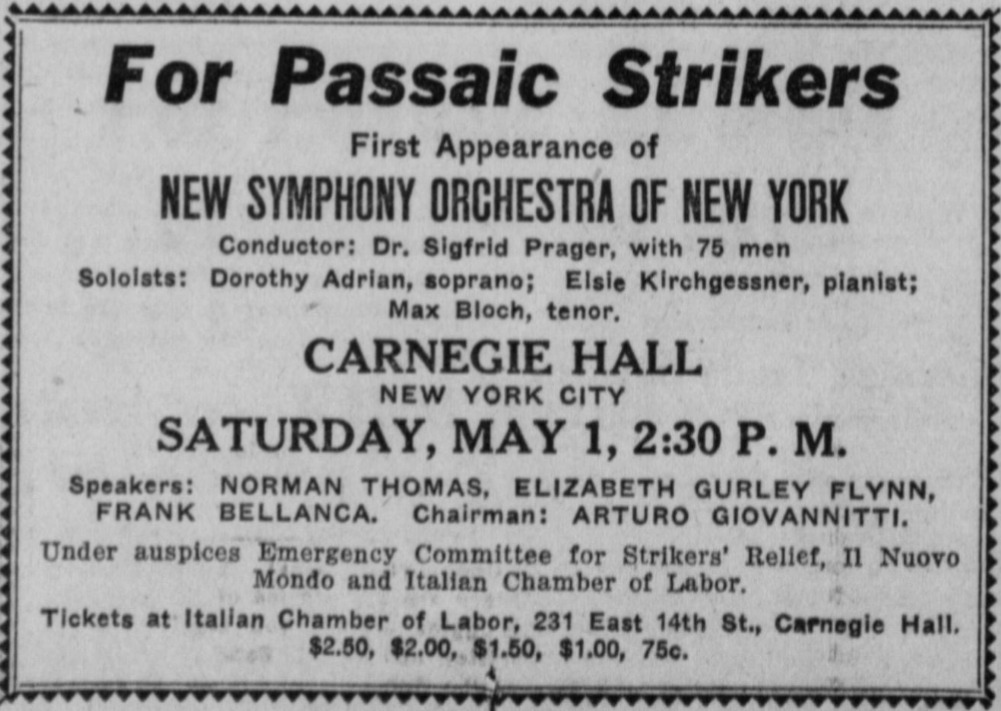
In many ways, 1926’s strike in Passaic is exemplary of a whole era of radical working class organizing and can serve as an entry point for learning about past Communist practices in community-union building. The struggle there even created a limited, but real, united front between the S.P. and C.P. in defense of those facing persecution for their strike activity. A rarity for the decade.
‘One Front for Passaic Defense’ by Art Shields from The Daily Worker. Vol. 3 No. 29. April 25, 1926.
UNITED FRONT DEFENSE FOR PASSAIC STRIKE
All Groups Join Hands Against Terror
NEW YORK, April 23. “It means a better settlement for the strikers,” said Forrest Bailey, director of the American Civil Liberties Union, hailing the formation of a joint committee of all organizations that have been supporting the gallant struggle in Passaic, Garfield and Clifton, New Jersey.
The joint committee unites the International Labor Defense, the American Civil Liberties Union, the League for Industrial Democracy, the Emergency Committee for Strikers’ Relief, the Federated Press, with the United Front Committee of Textile Workers and the Passaic strike relief committee in a common movement for the defense of all strikers who are arrested or who are beaten up or denied the right to walk the streets and hold meetings.
Rejoice Over United Front.
James P. Cannon, Norman Thomas, Elizabeth Gurley Flynn and Robert W. Dunn all voiced their joy that a united front movement had been formed behind the lines for the defense of the strikers.
“There is real solidarity,” said Cannon, “a sweeping national campaign, with all these organizations teaming together for the New Jersey workers.”
United Means Strength.
Added Bailey: “We have all come together because the strike has reached a crisis. Unity means strength, It means a better settlement for the strikers.”
Elizabeth Gurley Flynn, who has been speaking to the strikers nearly every day despite threats of arrest, declared:
“This means more protection to the workers in their fight. It helps them to win.”
Norman Thomas, who defied the “riot act sheriff” and is under $10,000 bail, announced the purpose of forming the committee as follows:
“It is just plain horse sense for the organizations which in one way or another have become interested in legal cases which have developed in the Passaic strike to get together. These various committees and organizations have differences in function and philosophy, but they are one in seeing to it that the strongest possible legal fight shall be made to prevent any man from paying a martyr’s price as a result of the struggle of the workers in and about Passaic.
Joint Committee Eliminates Friction.
“Of the six or seven organizations represented in the joint committee, only two, the Civil Liberties Union and the International Labor Defense, are regularly equipped for handling legal defense cases. Various cases will be apportioned to those organizations logically. Each organization, together with the defendants concerned, will be solely responsible for the defense of cases assigned to it. The other organizations, like the League for Industrial Democracy, which I represent, will help raise the funds and distribute the publicity. The Emergency Strikers’ Relief Committee will continue its efforts to raise a sufficient bail fund.
“At all times, however, the joint committee will prevent friction and repudiation and be in itself a witness to the possibility of united action in behalf of labor’s right to organize, conduct meetings and conduct a peaceful strike.”
The List of Organizations.
The organizations that have united in the joint committee and their representatives on the joint committee are as follows:
American Civil Liberties Union, Forrest Bailey and Morris Ernst; International Labor Defense, James P. Cannon and Joseph Brodsky; League for Industrial Democracy, Norman Thomas; United Front Committee, Albert Weisbord; Passaic Strike Relief Committee, Alfred Wagenknecht; Emergency Committee for Strikers’ Relief, Clarina Michelson; Federated Press, Art Shields; Gurley Flynn Is Secretary.
Elizabeth Gurley Flynn and Robert Dunn are members at large. Mary Heaton Vorse, whose human interest stories on the Passaic workers have been a powerful factor in arousing working-class support, is co-operating closely with the committee.
Elizabeth Gurley Flynn was chosen as permanent secretary of the committee.
Many Tasks Are Divided.
Work will be divided up as follows: The International Labor Defense, by an arrangement with the joint committee, will conduct the defense of all strike prisoners. This means not only the Weisbord case and those of other organizers and those of 264 arrested strikers, but of Robert Dunn, Esther Lowell, David Weinstein and others seized while investigating police brutality on the picket line.
The Civil Liberties Union will handle the Norman Thomas test case; the prosecution of officers where false arrests have been made and injunctions brought against authorities who close meeting halls and deny picketing.
The United Front Committee will conduct the legal defense against the Forstmann-Huffmann injunction and will continue in charge of the campaign for a congressional investigation.
The policy to be followed in prosecuting each case is to be determined by the organization responsible for same in agreement with the defendants. Each organization may collect funds in its own name, but under a caption indicating that all the organizations represented in the joint committee are working together and that the appeal is issued by authority of the joint committee. The expense involved in conducting each case shall be paid by the organization responsible for conducting it.
Plan Consultation Committee.
Each organization will employ its own attorneys, but in order to prevent duplication a consultive committee of three, consisting of Attorneys Ernst and Brodsky and Miss Flynn, was ap pointed. A unified bail fund will aid efficiency.
A big mass meeting by the joint committee is being organized for next week. The separate organizations are holding preliminary meetings in the meantime.
The Daily Worker began in 1924 and was published in New York City by the Communist Party US and its predecessor organizations. Among the most long-lasting and important left publications in US history, it had a circulation of 35,000 at its peak. The Daily Worker came from The Ohio Socialist, published by the Left Wing-dominated Socialist Party of Ohio in Cleveland from 1917 to November 1919, when it became became The Toiler, paper of the Communist Labor Party. In December 1921 the above-ground Workers Party of America merged the Toiler with the paper Workers Council to found The Worker, which became The Daily Worker beginning January 13, 1924. National and City (New York and environs) editions exist.
PDF of full issue: https://www.marxists.org/history/usa/pubs/dailyworker/1926/1926-ny/v03-n096-NY-may-04-1926-DW-LOC.pdf

