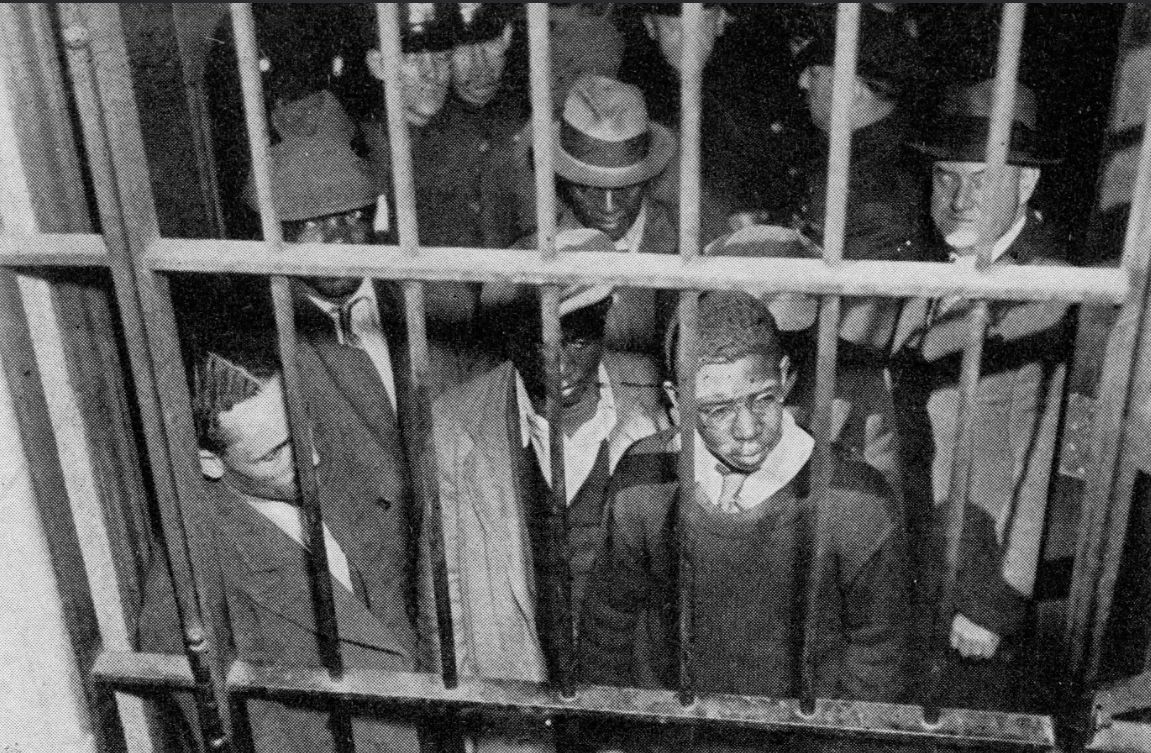
One of the events that defined the Harlem of the 1930s was the so-called ‘race riot’ of 1935. A rebellion against police brutality, it was a scene so often repeated since. Yet it was in stark contrast to most big city ‘race riots’ of that time, pogroms against isolated Black ghettos, and marked the growing confidence and militancy of Northern Black workers.
‘What Happened in Harlem’ by Sasha Small from Labor Defender. Vol. 11 No. 5. May, 1935.
(The events in Harlem on the night of March 19, which followed the beating of a Negro child in a local store, when the pent up indignation of the Negro people against discrimination, starvation, horrible living conditions, police brutality, was unleashed by the provocative methods of the police, are sufficiently well known by this time. The Labor Defender wishes to present two chapters of what followed these events. Ed. note.)
I. A NIGHT IN A HARLEM JAIL
Over one hundred people, the great majority of them Negroes, were dragged from the milling crowds that surged through Harlem’s streets. They were kicked and punched into patrol wagons and taken to the police stations. Inside the jail, the savagery of the police knew no bounds. One Negro worker was kicked up the stairs to the finger printing room. He was smacked up against the wall. A uniformed policeman held him fast while a plain clothesman kicked him in the stomach. As he doubled over in pain he was repeatedly hit over the head and face with a black jack until his face was cut open over the right eye. Another prisoner was black-jacked until his face was swollen beyond recognition. All night long the wounds on his head bled so profusely that his shirt was dyed a deep crimson. Out of a total of 45 prisoners crowded into a cell so small that they could not even sit down, thirty spent the night trying to nurse each other’s wounds. Calls for a doctor were met with brutal jeers and threats. No food was given to the prisoners for 24 hours. The attitude of the police and detectives can only be compared with the revolting description of Nazi fiends in charge of Hitler’s concentration camps.
The only term used in addressing the Negro prisoners was “black bastard” supplemented by unprintable epithets. The white prisoners received no better treatment, “Why don’t you stay the bell in the Bronx where you belong,” detectives, drunk with brutality, shouted at them as their black jacks cracked down on defenseless heads. Threats of instant shooting flew through the air. “Get in there before I shoot you in the back.” In the finger printing room, up and down the stairs policemen called to one another. “Why don’t you shoot him and be done with it.”
On leaving the station house, several policemen derisively called back over their shoulders, “I think I’ll go out and shoot me a few n***s” As they came in again, they shouted that “race rioting” was rampant, that white people were being killed in the streets and one came in with the news that “nine cops had been killed.”
II. THE MAYOR’S COMMITTEE INVESTIGATES
In sharp contrast to the orgy of savagery inside the jails, the atmosphere in the West 151st Court room, was all politeness and dignity. The committee appointed by Mayor La Guardia to investigate the events in Harlem sat behind the judge’s bench and heard eyewitness after eyewitness testify to what happened.
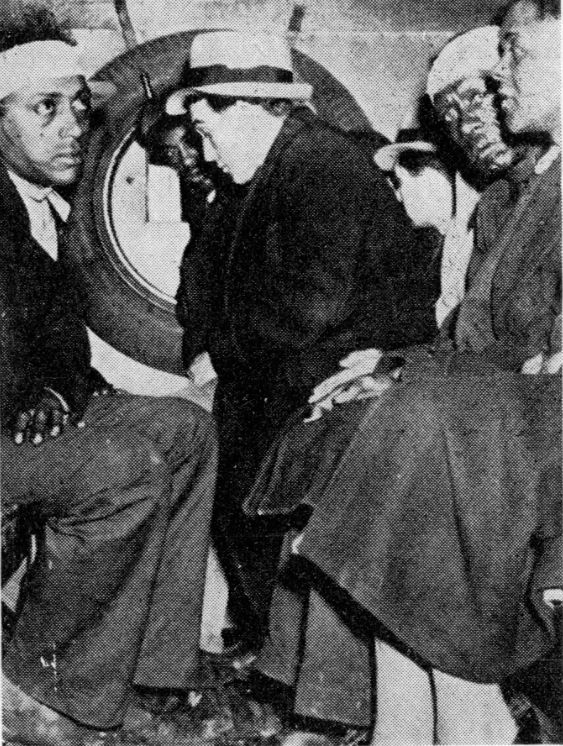
The politeness of the police was so unnatural, so studied they sounded like frightened little boys in a Sunday school speaking their pieces. They addressed all the Negroes very carefully as “Mister.” Inspector De Martini, of the Harlem division, began every section of his testimony with the words, “the Negro people in Harlem are my best friends.” The eloquent and unanimous “Oh Yeah?” from the audience disturbed him somewhat, but he went right on.
Space does not permit a complete report of the testimony. Louise Thompson, organizer of the International Workers Order, who was an eyewitness to the events, vividly and completely pinned the responsibility for the disturbance where it belonged–on the conditions in Harlem and the provocative behavior of the police.
The carefully rehearsed stories of the police were quickly and completely contradicted by the telling questions asked by various eyewitnesses. The Captain of Detectives, who calmly announced all those responsible for the killing of three Negroes on the streets, had been questioned and completely exonerated in the murders, soon lost his smooth composure and like a cornered rat, defended himself and his men against “all the foreigners and hoodlums in this city and especially in Harlem who don’t have any respect for the law and the police.”
The cry of race riot raised immediately by the gutter press was entirely destroyed by eyewitness accounts, of Negroes rushing to the assistance of white workers grabbed and man-handled by the police.
What these open hearings, which are still in progress, are proving conclusively is that the immediate responsibility for the Harlem events, falls upon the shoulders of the police. It became very clear that if the police, instead of sneaking the child out through a cellar door and not producing him again until 3 a.m. the next morning in a police station, had brought him back into the store and shown him to those who saw him beaten and dragged away, none of the rage that followed upon the belief that he had been murdered would have broken loose. If the police had not ridden rough shod into the crowds that gathered in protest in front of the Kress store and all the other stores, which consistently refused to employ Negro help and charged exorbitant prices for their goods, no windows would have been smashed. If the police had not begun their brutal attack and finally shooting into unarmed, defenseless Negro people–what has come to be known as the Harlem Riot would not have occurred on the night of March 19th.
The people of Harlem are writing the committee’s report in words that cannot be misunderstood. No amount of official white wash can cover up the Harlem situation.
Labor Defender was published monthly from 1926 until 1937 by the International Labor Defense (ILD), a Workers Party of America, and later Communist Party-led, non-partisan defense organization founded by James Cannon and William Haywood while in Moscow, 1925 to support prisoners of the class war, victims of racism and imperialism, and the struggle against fascism. It included, poetry, letters from prisoners, and was heavily illustrated with photos, images, and cartoons. Labor Defender was the central organ of the Scottsboro and Sacco and Vanzetti defense campaigns. Editors included T. J. O’ Flaherty, Max Shactman, Karl Reeve, J. Louis Engdahl, William L. Patterson, Sasha Small, and Sender Garlin.
PDF of full issue: https://www.marxists.org/history/usa/pubs/labordefender/1935/v11n05-may-1935-orig-LD.pdf

