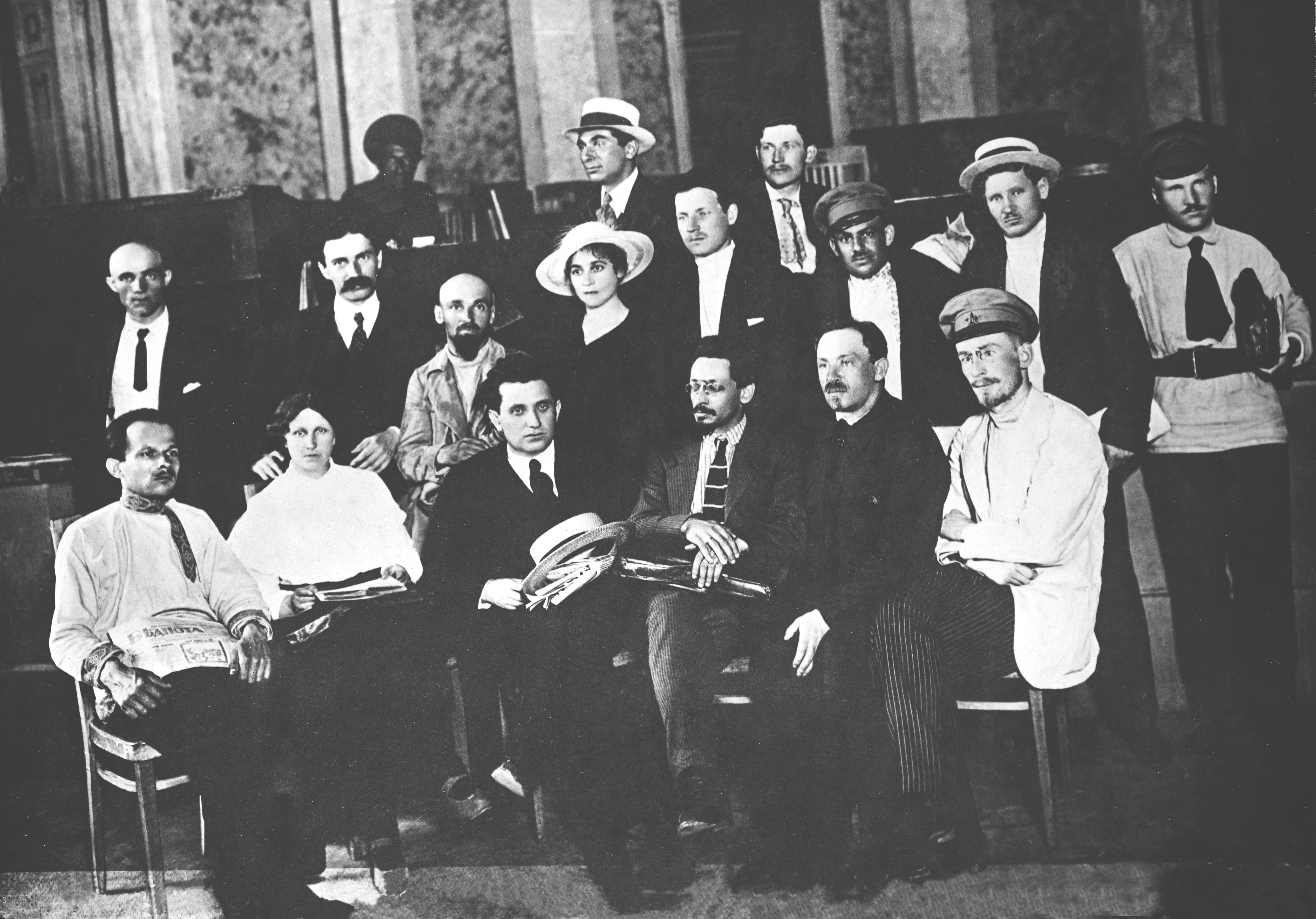
Already an issue demanding to be confronted in 1920. Tasked by the Central Executive Committee of the Soviets to report on the growing problem of government bureaucracy, Zinoviev presented the theses below to the Eighth All-Russian Congress in December, 1920.
‘Theses on the Work of the Soviet’ by Grigory Zinoviev from Soviet Russia (New York). Vol. 4 No. 10. March 5, 1921.
ZINOVIEV was entrusted with the report on paragraph 6 of the order of the day of the Eighth All-Russian Soviet Congress, “On Regulation of the Activity of Soviet Organs of the Center and in the Country, and on the Fight Against Bureaucracy”. The presidency of the Central Executive Committee makes public the following theses of Zinoviev on this question:
Danger of Bureaucracy
1. One of the most important tasks which the Soviet power had already set for itself in the first period of its existence, was the creation of a government machine which would stand as closely as possible to the masses, and be the least bureaucratic and simplest possible, a machine in which each worker, male or female, could find his place intelligently. Bureaucracy means literally: the domination of the government office, neglect of the real nature of a thing together with a more or less punctual execution of its form—thus may the present bureaucracy be characterized, although it may not by any means be entirely confused with excessive punctuality in carrying out formalities, which are really indispensable in the colossal work of a state. The danger of bureaucracy was already visible in the first period of the proletarian revolution. As early as two and a half years ago the Soviet Government first sounded the alarm and gave warning of this danger. A significant place was granted to the question of the fight with firmly established bureaucracy in the party program of the Eighth and Ninth Congress of the Russian Communist Party. But under the influence of external conditions the bureaucratic disease was ever assuming a more severe and chronic form. Experience has shown that a long period of time is necessary for transforming present Soviet Russia into a real organism (Commune). The growth of bureaucracy in the first three years of the existence of the Soviet power was above all conditioned on the following principal factors:
Economic Ruin and Poverty.
The Soviet power took possession of the country at a moment when the powers of production and the old machinery were almost destroyed. The growth of bureaucracy was effected, for example, through such factors, as the breakdown of the means of transportation. If the organs of traffic are able to despatch only the most limited number of passengers and goods, there results as a consequence, involuntarily, a complicated system of filtration of those desirous of travel, through a large number of administrative offices, through the system of travel licenses, etc., etc. If the scanty supply of materials for shoes, which the Soviet power provides, must be apportioned under unfavorable conditions among a very large number of needy people, a no less complicated system likewise arises, which increases the acute shortage of paper. And if the country is unable to provide any fuel, there naturally result many misuses in wood rationing; so, for example, in large cities, as a defensive measure against theft and smuggling even the scantiest wood transports are provided with protection licenses which again give occasion to new bureaucratic outgrowths. These examples can be multiplied without end.
Even in the early days of the proletarian revolution, in consequence of the attack of world imperialism on the workers’ and peasants’ republic, the Soviet power was compelled to create an ever larger Red Army. The success of the Soviet power in the matter of the organization of a Red Army proved the life power of our great Revolution, for only that revolution is worthy of being called won, which knows how to defend its gains with an armed hand. But on the other hand, the necessity of maintaining an army for a long period of time, must exercise its unfavorable influence on the Soviet structure.
Bourgeois Specialists
2. Bureaucracy consists not only in writing too much. The conditions of an arduous civil war, which consumed almost the entire work of the worker-and-peasant state (to the extent of almost nine-tenths) in an outright struggle for existence on the part of the directly threatened Soviet power — these conditions did not permit Soviet Russia to approach systematically and quietly the erection of a vigorous and simple administrative apparatus. All interests were subordinated to the tasks of war. The front could not bear even the slightest delay. New offices and commissions were created in the greatest hurry. As a result, the apparatus did not become simplified, but complicated. All the best forces and means of organization had to serve the Red front. Disputes over jurisdiction, especially in the provinces, made this service impossible. Even the central organs of the Soviet power suffered the same fate. The best responsible administrative powers proceeded to the front. The role of the bureaucratic elements and their influence grew in a similar relation.
The cultural level of the masses of the people and the inheritance of Tsarism—illiteracy—must on the other hand unavoidably check the process of attracting larger masses of workers and peasants for administrative work, particularly in the first years of Soviet construction. The successes won in this field are significant in and for themselves, but they are only a drop in the bucket when compared with what is yet to be accomplished here.
The bringing in of bourgeois specialists for the economic and administrative structure was absolutely necessary and unavoidable. But the less reliable portion of the specialists, who completed their work without spirit and without energy, brought the worst traditions of the bourgeois bureaucracy into our economic and administrative organs. In view of these malpractices by the worse elements of the bourgeois members of the intelligentsia, that part of the workers and peasants which has been won for direct administrative work is particularly angry with the specialists. For that reason there exists an ill feeling towards intellectual workers which is so often unjust. But the inconsiderate contempt for “specialists” who have been branded as bureaucrats, although in some cases nothing can be said against them, has nothing to do with the real struggle against bureaucracy. The whole complex of these conditions furnishes that difficult environment with which the assembling Eighth Congress will have to reckon—a Congress which will be convened at a moment when we have already completed the first part of the war. The period of the civil war is approaching its end. For that reason, the Eighth Congress, which raises the question of the fight against bureaucracy, must not point to the fact that this conflict consists in the restriction of the amount of red-tape in the Soviet offices, but above all it must root out the previously mentioned causes for the increasing power of the bureaucracy. To fight against bureaucracy means to fight against economic ruin, to fight against poverty, to raise the cultural level of the people, to win back the best administrators of the Red Army for Soviet work, to admit more proletarian elements into the cultural offices, to simplify the system of our economic and administrative organs and to put life into the activities of the rural Soviets.
Reconstruction Work
3. This work must be begin in the provincial Soviets and its organs. In three years of proletarian revolution, the Soviets have made considerable progress. In the first period, immediately after November 7, the Soviets were, above all, organs of revolt and of seizure of power. In the second period, approximately until the victory over Wrangel, the Soviets were, above all, organs of the universal mobilization of the masses for the war. At present, at the time of the convening of the Eighth Congress, the third period begins.
The Soviets must become, above all, the organs of mobilization of the masses for the reconstruction of domestic administration. In view of this new administrative perspective, one must recollect what was said in 1917 regarding the meaning and the role of the Soviets: the Soviets are organs in which there is found the provision of the freest and most organized course for the masses, the Soviets as organs into which there is always assured the infusion of fresh strength from the “lower strata”; the Soviets as organs in which the masses learn at the same time both law-making and the execution of their own laws. It is absolutely necessary to adhere to the holding of regular new elections in the Soviets. Provision must be made not only for the regular convening of plenary sessions of the Soviets and their executives, but also for this—that in these sessions, not only shall questions of agitation be discussed, but also the most important administrative economic questions. That particular executive committee which has held no meeting during the period of one month without an adequate excuse must be dismissed. The sessions of the executive committee must be public and accessible to all workers and peasants. In large cities and in important industrial centers the executive sessions must be held alternately in different working districts, in factories, and in barracks. The same applies to the district Soviets, where such exist Important questions of Soviet life have to be considered at mass meetings with the cooperation of Soviet members at the right time and before the decisions go into effect.
Soviets and Trade Unions
4. Now, when the economic front has become the main front, a great task will be allotted to the trade unions. The role of the trade unions in production will continually acquire a greater importance. In a certain measure, the burden of work falls on the trade unions. The first task of the Soviets in the provinces is a systematic stimulation of the trade unions in the achievement of their tasks of production. The provincial Soviets should under no circumstances set for themselves as a task the supplanting in any way of the trade unions in the building up of production. On the contrary, by the coordination of their work with the trade union committees, they are to promote the activity of the latter and mutually to approach the goal of our struggles of today—the building up and increase of production. The entire complex of these measures is the best means of fighting bureaucracy.
Provincial Soviets
5. A step forward must be taken in comparison with the decisions of the Seventh All-Russian Congress, in granting to the provincial Soviets not only the right of control of the activity of different representations of the central organs in the provinces, but in granting the right of immediate participation in the activity of such organs. That concession would contribute at the same time to the simplifications of the activity of the central offices above all the economic offices.
The Central Executive Committee had instructions to work out during the period of one month, means for the transfer of function of certain plenipotentiary commissions of the central offices in the country to the provincial Soviets, that is, directly to the local proletariat. Wherever the corresponding decisions of the Seventh Soviet Congress had not yet been carried out through the fault of the local Soviet or of the central offices, this had to take place within a period of two months under the personal responsibility of the leader of the corresponding organs.
Skilled Workers
6. The recall from the Red Army of at least a preliminary number of skilled workers and of responsible Soviet employees must be promptly placed on the order of the day of the provincial Soviets. Experiments made in this field have proven to be very successful.
Central Executive Committee
7. Similarly, it is necessary to put life into the activity of the Central Executive Committee. The Central Executive Committee must be called into session at least once in two months, as is provided in the decisions of the Seventh Congress. Based on the experience of three years, the Eighth Congress must present a series of general lawmaking questions to the jurisdiction of the Central Executive Committee. The laws, decrees, and orders considered here must be made public by the Central Executive Committee quite some time before they go into effect, and before they are proposed for the deliberation of the country Soviets. The control of the Central Executive Committee over the activity of different Soviet organs in the country must be made more regular than has been the case heretofore.
Collegiums of the People’s Commissariats
8. The Central Executive Committee in its new make-up, and the Council of People’s Commissars receive from the Eighth Congress the urgent task of scrutinizing the composition of the collegiums of the People’s Commissariats and of the collective important central organs. Into all these organs, fresh energy is to be infused, particularly proletarian elements, workers and peasants who have done active work in successful organizing.
Questions of Jurisdiction
9. Disputes about questions of jurisdiction which are multiplying rapidly, and in fact are occurring in all acuteness between different divisions of one office, are doing a great deal of injury to the upbuilding of the Soviet state, and in any case they are promoting bureaucracy.
For that reason, the Central Executive Committee and the Council of People’s Commissars, are instructed by the Eighth Congress, systematically to set boundaries between each other’s activities so that above all, the paving of energy, the bare possibility of execution of work and the avoiding of duplication—would have to be taken into consideration.
Publication of Decrees
10. In all cases not of pressing importance, the Council of People’s Commissars also makes public its decrees before putting them into effect in order to be able to take into consideration opinions and experiences of the Soviets, and in order to make corresponding changes. The first experiment should be made with the Agrarian Law.
Workers’ and Peasants’ Inspection
11. The institution of workers’ and peasants’ inspections must be extended, and must immediately effect an introduction of broader proletarian strata into administrative work as required by the decree of the Central Executive Committee of February 17, 1920. The Workers’ and Peasants’ Inspection Committee received exact, fixed, more extensive authority, that is, the bringing in of thousands of workers for the revision of the common kitchens in Petersburg, of the proletarian council of elders, of proletarian home administration, etc.
Simplifications
12. In their fight against bureaucracy, the Central Executive Committee and the Council of People’s Commissars, must critically examine the execution of the simplest state functions, for example, the apportioning of provisions, the assignment of dwellings, forcible measures for the abolition of smuggling, registration of births and deaths, etc. In all these fields, the greatest possible simplification should be gradually introduced.
Utilization of Surplus Employees for Industrial Activity
13. With the cooperation of the trade unions, the wage scale and the number of officials of different offices in the central cities and in the country must be checked up, and the working standard of the employees of the Soviets, their quantitative relations, their working efficiency, etc., must be definitely determined. The mobilization of superfluous employees into productive work—e.g., for the war with illiteracy—must be strictly carried out. In doing this, care must be taken that these shifts of labor power should be considered not in the way of a punishment but rather as a more suitable utilization of their working energies. The superfluous employees could also be transferred, in accordance with their abilities, to useful work in the industries.
Raising the Efficiency of Production
14. The ending of the first period of the civil war renders possible a slacking of military activities, but at the same time it confronts the Soviet power with new and enormous difficulties. The psychology of our transition period is determined among other things by this: that exhausted masses of workers and peasants who suffer unheard of privations, are ever making more demands of the Soviet power, since they justify these by the settlement of the war. Here too some of our comrades committed gross blunders. Instead of pointing out to the workers and peasants that we cannot conquer poverty without raising the efficiency of production up to the maximum, instead of directing the attention of the masses to matters of production, instead of educating the type of worker-manager who can lead in production, instead of all this, we are often content merely with reviling the bureaucracy. The Eighth All-Russian Soviet Congress demands of all adherents of the worker and peasant power, to abandon this procedure as false and to fight the principal causes of bureaucratic disease in order to destroy them effectually.
In the three years of the existence of the Soviet power, there has grown up in the government, in the districts, and in the circuits, a new generation of active State workers which has gone through a good school of class struggle. The Eighth All-Russian Soviet Congress is convinced that just this new proletarian generation will be able to take up the fight against bureaucracy and to build up again the worker and peasant democracy in the Soviet. The fight against bureaucracy should in no case involve a weakening of our administrative forces and of discipline. On the contrary, all the facts of the moment demand of us a military punctuality in our construction work, that work, with M its self sacrifice, to which the Eighth Congress of the Russian Communist Party has summoned all of our Soviets, party organizations, and trade unions.
Petrograd, December 11, 1920.
Soviet Russia began in the summer of 1919, published by the Bureau of Information of Soviet Russia and replaced The Weekly Bulletin of the Bureau of Information of Soviet Russia. In lieu of an Embassy the Russian Soviet Government Bureau was the official voice of the Soviets in the US. Soviet Russia was published as the official organ of the RSGB until February 1922 when Soviet Russia became to the official organ of The Friends of Soviet Russia, becoming Soviet Russia Pictorial in 1923. There is no better US-published source for information on the Soviet state at this time, and includes official statements, articles by prominent Bolsheviks, data on the Soviet economy, weekly reports on the wars for survival the Soviets were engaged in, as well as efforts to in the US to lift the blockade and begin trade with the emerging Soviet Union.
PDF of full issue: https://www.marxists.org/history/usa/pubs/srp/v4-5-soviet-russia%20Jan-Dec%201921.pdf

