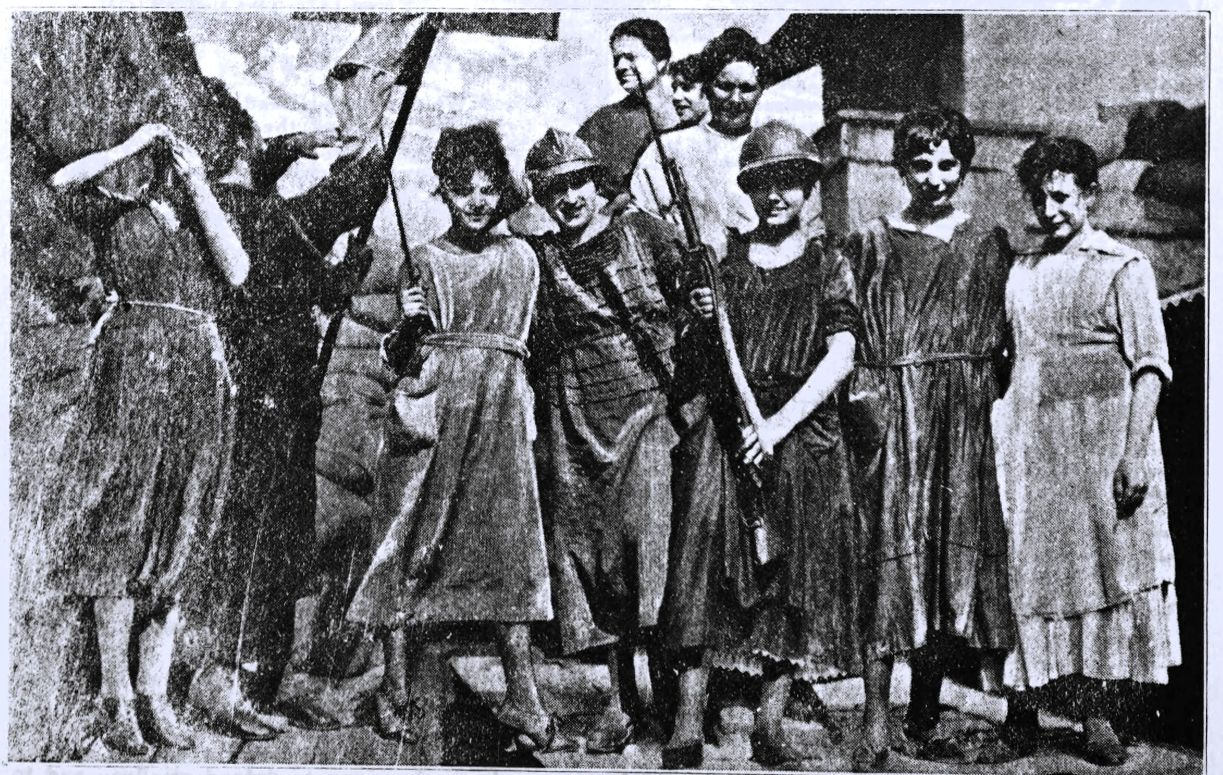
Cannata, editor of Il Proletario, continues with his analysis of Italy’s Biennio Rosso, Two Red Years.
‘More About Italy’ by Giuseppe Cannata from One Big Union. Vol. 2 No. 11. November, 1920.
I. In the Realm of Morale.
A social system in good working order creates and then derives support from a species of spiritual enthusiasm which pervades large sections of the population; without this faith in its virility and greatness the dominating class goes into moral bankruptcy and is finally eliminated as a factor in social life.
To understand properly the crisis that Italy is traversing today it must first be clearly understood that capitalism as an economico-political system has lost practically all moral prestige, all faith in its ability to function. It has lost this prestige first with the workers and then successively with all social classes till today the capitalists themselves are driven to pessimistic apathy and despair. The wherefore of this downfall is not far to seek: to capitalism and its allied movements (nationalism, militarism, imperialism) popular opinion lays the blame for the late “victorious” war—a national disaster fatal in its effects on the economic life of the country. If the popular resentment against the late war is great, no less wide-spread and profound is the displeasure with the “fold men’s” peace of Versailles, which is commonly estimated as a cruel, crushing triumph of the great capitalist trio among nations, France, England and the United States, at the bleeding expense of the rest of the world. The Italian people as a whole are turning away from capitalism as from a fatal genius, bringer of hunger, pestilence, despair and death.
To fill the void left by the capitalist failure, various popular movements have risen to added power and prevalence, practically all of which repudiate the capitalistic system of production. Even the invigorated clerical party has a radical economic program, and one of its factions is outspokenly communist. D’Annunzio, in staging his politico-military melodrama at Fiume, makes villains out of the “money-changers” of Versailles, and derives inspiration for his brand-new constitution from ancient Rome and Soviet Russia. The great and significant growth, however, has taken place in the ranks of the revolutionary organized workers. The Italian workers had been well trained by syndicalist propaganda and action to the role of an aggressive, combative social class aspiring to the assumption of industrial control and social dominance, even before the war. The violent rebound from the restraint of war and the influence of the Russian example kindled a veritable devastating flame that destroyed forever all respect and obedience to the rules and tenets of bourgeois society. In the post-war period, the prestige of the ruling classes, their right to dictate, to order and to command has been the object of continuous and fatal attacks on the part of the workers. Their prerogatives have been torn down piece-meal; the cry of defiance has ever been flung in their faces and the threat of revolution rung in their ears till its actual accomplishment would be a relief to many of them.
The Italian psychological upheaval has already produced the “Carmagnole” of the proletariat, a taunting ditty in which the simple statement is repeated exultingly over and over again that “the red flag will triumph, and the bosses, also, will have to go to work.” This song of defiant revolt has spread like wild-fire among the workers of Italy and its bold notes are ever heard in the mills, mines and the fields. It is called “Bandiera Rossa” (the Red Flag).
The conclusion from these brief facts is simple: On the field of morale the forces of the proletarian revolution have completely eliminated their capitalist opponent. The social revolution in Italy is already an accomplished fact in the minds of the workers. Its actual carrying out is now determined solely by expediency and outward circumstances.
II. On the Economic Filed.
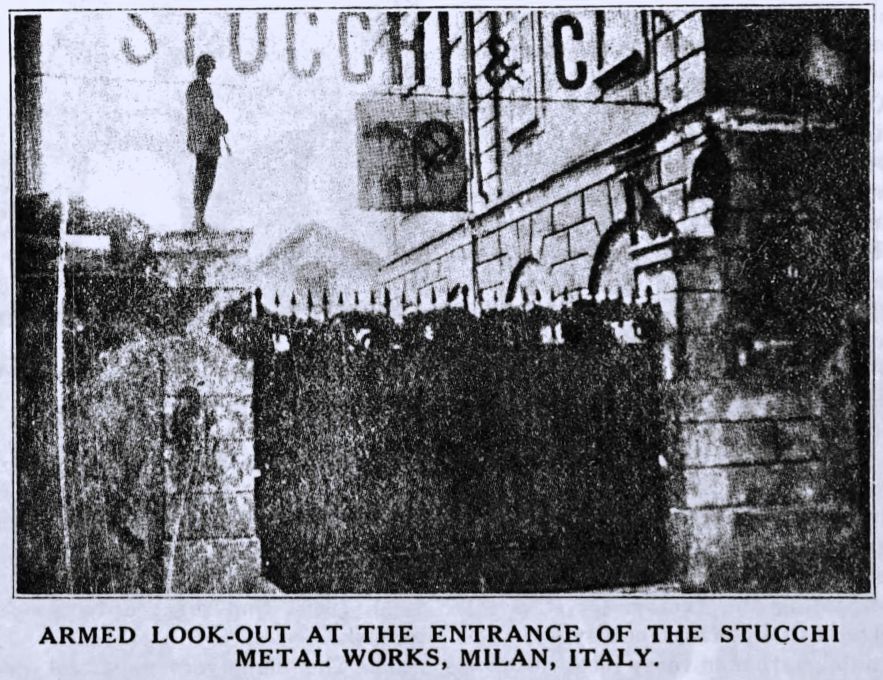
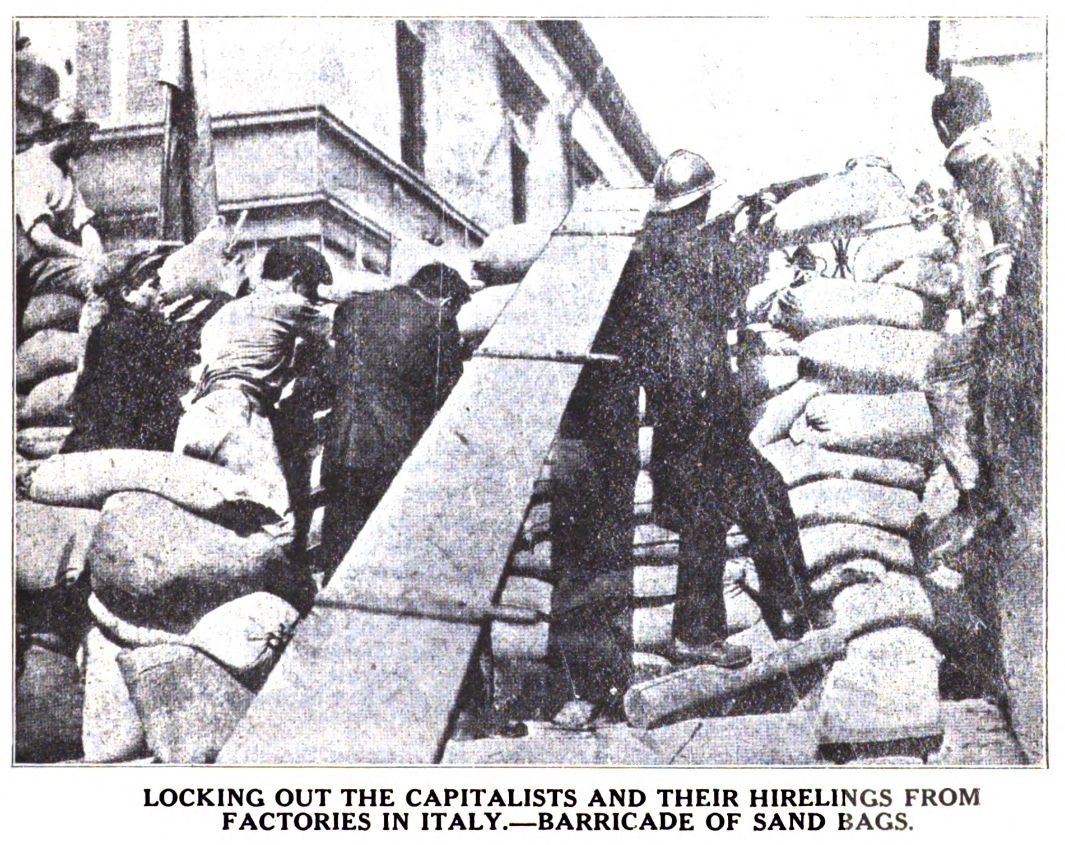
In my article in the last number of the O.B.U. Monthly I pointed out that the recent “lock-in” in the metal and machinery industry in Italy would necessarily and in a very brief time develop one of two solutions—the extension of the movement to other industries, and revolution or a temporary compromise with capitalism. The moderate socialist leadership of the Confederation succeeded in persuading their followers into the acceptance of a proposal advanced by the Italian premier, Giolitti, which is equivalent to the second solution above mentioned. The Italian Syndicalist Union and the Communist-Anarchists led by Errico Malatesta consistently and vehemently advocated the first solution—immediate revolution; they went further, advising the workers not to obey the terms of the settlement by evacuating the factories. It is my firm belief, supported by what fragmentary news the bourgeois dailies publish, that in those localities controlled by the Italian Syndicalist Union the workers are still in possession of the factories and the government has not yet made a move to dislodge them. The solution offered by premier Giolitti amounts to actual joint control of industry and provides for the following terms:
1. The Workmen’s Council must control the purchase of raw materials.
2. Supervise the sale of finished products.
3. Fix the price of finished products.
4. Superintend the grading of wages.
5. Control all goods unloaded.
6. Decide what task each workman is better adapted to accomplish.
7. Obey the conditions of employment of the industrial establishments.
8. Control the general expenses of the establishments and especially limit the expenses of the present proprietors and directors, who will participate in the profits to the extent of 50 per cent.
9. Decide when new machinery is necessary.
10. Supervise hygienic and sanitary conditions in industrial establishments.
11. Insist that the proprietors furnish necessary utensils.
12. The employers must not resort to artificial industrial crises.
13. The employers must prevent “dumping.”
To some employers these terms have appeared a worse humiliation than out-and-out confiscation and they have actually offered to turn their properties over to their employes organized as a producing unit.
The principal effect of the metallurgical workers’ agitation has been to spur all other workers to accomplish at least as much. To date the occupation of various textile mills, ship-yards and miscellaneous enterprises has been recorded in the news. The iron mines of the island of Elba are in the hands of the workers and likewise the sulphur mines of Sicily. Sixty macaroni factories were occupied in a single day in Torre Annunziata, near Naples. The confiscation of large estates by well-organized bands of armed peasants in southern Italy is a daily occurrence. The occupation of land is not temporary but permanent and upon terms of unconditional surrender; to anyone that knows the southern Italian peasant, it will appear quite inconceivable that any force in Italy will ever succeed in separating him from his newly acquired holdings.
To illustrate the technique of the present wave of land-seizure, I shall quote from a letter of an ex-resident of Detroit, Mich., at present on the warpath in his native Sicily:
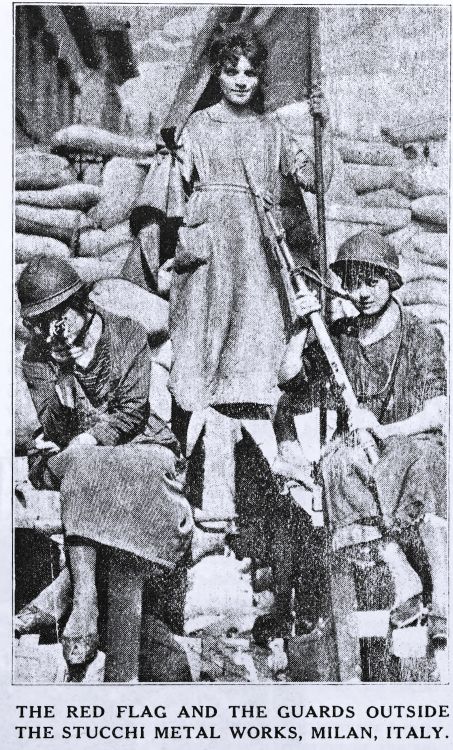
“On Sept. 17 we were invited to be at Formosa (Sicily) to return the keys to the owners of the feudal estates there as the season was at an end. Under the leadership of the co-operatives of Monte Santo and Paceco, 25,000 peasants gathered on the highway. Suddenly a beautiful carriage appears on the bridge of Scialacchi; the carriage is stopped, but instead of the landowner, it contains one of his servants who has come to secure the surrender of the keys. Upon seeing that ragged multitude of men, women and children, armed with rifles and clubs, the man shook with fear. He announces his mission and, as one man, the mob shouts its firm resolve never to surrender the land that they habitually work. The lackey returned to Trapani to inform his master of what had occurred, and the army of armed peasants proceeded to occupy every large estate in the province. Within the period of four days, the red flag was unfurled over the entire province of Trapani, Sicily.”
The status of industrial ownership and control in Italy today is highly confused and indefinite, and subject to daily change. Some enterprises are owned and controlled outright by the workers; others are under joint control with the employers, and still others are owned nominally by the state and leased to the workers. As in the case of its moral prestige, the Italian capitalist is losing his right to private ownership and control of the means of production gradually and piecemeal. The normal struggle of the unions for an ever-increasing share of the control of industry has simply been spurred on and accelerated by favorable circumstances. As their share of control increases, that of the capitalist diminishes till it eventually disappears entirely. On that day the most essential feature of the social revolution will have been accomplished.
III. On the Political Field.
The most remarkable phenomena in the Italian situation has occurred on the political field, where the bourgeois state has failed completely to function as the defender of private property and capitalist interest in general. The government of Premier Giolitti has openly declared its neutrality in the class-conflict on the economic field; that it has strictly adhered to this extraordinary stand is clearly demonstrated by the following touching resolution, passed at a meeting of 300 employers, held in Turin, on Sept. 9, 1920. It shows that the Italian bourgeoisie is somewhat prematurely assuming the air of an oppressed class:
“The employers of the various industries of Turin, in meeting assembled, beg to repeat to your excellency (Premier Giolitti) the protest which we recently had occasion to present to the vice-prefect of Turin regarding the failure of the government to protect our constitutional rights, and to enforce the laws, a failure which amounts to connivance with the law-breakers. We ask the immediate intervention of the government, not to carry out a futile and difficult repression for the misdeeds already committed, but to avoid with all means further crimes against property, and the personal liberties of free press and inviolate domicile, the exchange of products between the occupied factories be stopped, by an injunction on trucking from the plants mentioned. We further declare that the present attitude of the government We ask especially that which tends to destroy the faith of the defenders of the present institutions in the ability of said government to uphold our constitutional liberties. Unless steps are taken to remedy the situation, we shall be forced to institute through our own initiative the defense which the government denies us.”
It would be too much of a task to enter, in the limits of these brief notes, into any speculation as to the ultimate motive of Premier Giolitti in his present policy. Essentially it is not a policy deliberately and freely chosen by him; he is rather making a virtue out of necessity and trying to snatch from an extremely desperate situation whatever elements of personal support and prestige are still available. He is not bamboozling the workers any with his astute manoeuvers; their attitude towards the government is one of militant and watchful vigilance; in effect they say to it: “Keep your hands off the economic disputes, and we shall keep our hands off you—for the present.”
A few words may not be amiss about the actions of the Italian Socialist Party in the present crisis. Hiram K. Moderwell has written for THE FREEMAN of September 29, and Oct. 6, what is undoubtedly the most nearly correct account of the Italian situation that has so far emanated from an official American correspondent in Italy. Mr. Moderwell is not very enthusiastic about the party that has been called “Moscow’s trump card.” About its political leadership of the workers in the larger sense, he has this to say, “The official party, which professed to be directing the revolutionary movement, was actually restraining, if not sabotaging, the movement it pretended to lead.” It is an actual fact that the Italian proletariat has been for fifteen years ever ready for bolder action than the Socialist Party was willing to countenance. The Syndicalist elements playfully call the “revolutionary” politicians “the firemen (extinguishers) of the revolution,”
As to the practical parliamentary activity of the 156 socialist deputies in the Italian chamber, Moderwell has this to say:
“In the meantime the Socialist parliamentary delegation is in no end of trouble. Pledged to collaborate with no bourgeois government, it can do nothing but vote “no” on every question involving the life of a ministry. Since it is predominantly of the right, its speeches, though usually the best in the chamber, are scarcely calculated to advance the social revolution. In the meantime, the extreme right of the party, while observing the letter of party discipline, makes no secret of its desire for a collaboration ministry. Turati continually gives interviews calling the official Socialist policy disastrous, and ridiculing the idea of a soviet regime for Italy. The delegation, in its efforts for “results,” is reduced to a miserable divorce-law project.”
Moderwell could have added that the politicians did not fail to pass a law increasing their own salaries immediately the chamber opened last winter.
The distinguishing feature of the Italian upheaval to date have been the positive and constructive acquisition of moral prestige and economic control on the part of the organized revolutionary workers. The Political State has been reduced to quasi-impotence; the conquests of the workers on the economic field have stripped it of most of its social significance and power.
Events in Italy seem to be moving towards a syndicalistic rather than socialistic solution of the social problem.
One Big Union Monthly was a magazine published in Chicago by the General Executive Board of the Industrial Workers of the World from 1919 until 1938, with a break from February, 1921 until September, 1926 when Industrial Pioneer was produced. OBU was a large format, magazine publication with heavy use of images, cartoons and photos. OBU carried news, analysis, poetry, and art as well as I.W.W. local and national reports. OBU was also Mary E. Marcy’s writing platform after the suppression of International Socialist Review, she had joined the I.W.W. in 1918.
PDF of full issue:

