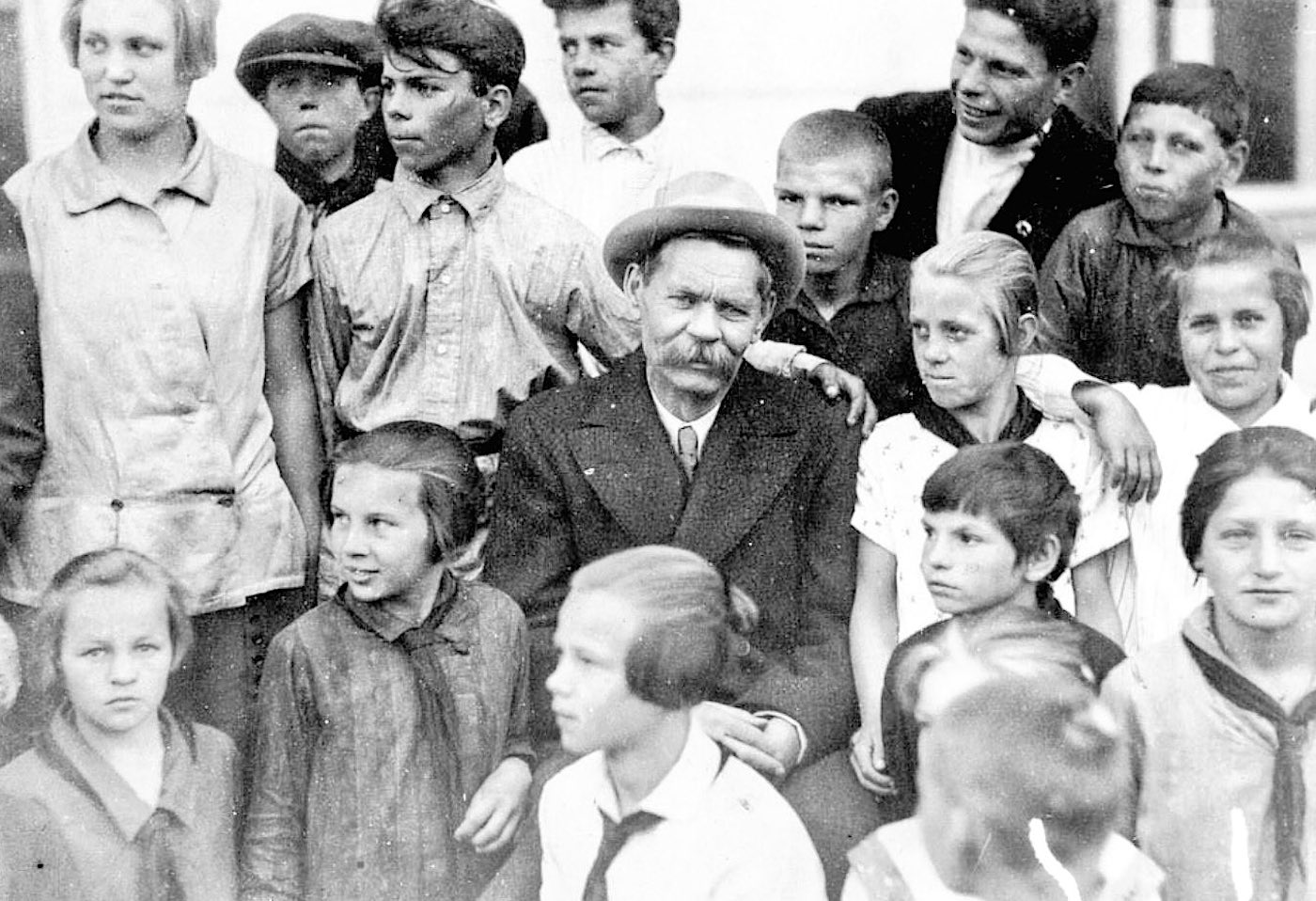
An outraged Maxim Gorky writes an article to Pravda asking how it could be that ten years after October a leaflet calling for pogroms, and signed by people identifying themselves as Communists, could appear in the Soviet Union.
‘Anti-Semitism’ (1929) by Maxim Gorky from Culture and the People. International Publishers. New York, 1939.
WASTREL is not merely a term of abuse: it is an exact definition of a man who is wasted to life. Under our conditions a wastrel is a creature who is profoundly and incurably infected with the diseases of the “old world”: envy, greed, human hatred, and enmity of all that contradicts his habits and tastes and what he has retained from the old days, from the conditions of life under which “men are wolves to one another.” This “legacy of the past” has become as deep-seated in the blood of the wastrel as syphilis and the craving for alcohol. Wastrels are therefore not only a social but a biological phenomenon. They have been produced and reared by the ruthless and bestial struggle for self-preservation, the “struggle for individual existence” that is natural and inevitable in a class state, where people are inevitably divided into slaves and masters, and where men must devour each other so as not to be devoured themselves.
A wastrel can only regard the “struggle for existence” as a struggle of man against man. As to the struggle of the collective will for mastery over the forces of nature in order to emancipate people from inhuman, senseless, and involuntary toil, the wastrel is constitutionally incapable of understanding it. He is just as accustomed to the methods and conditions of life of the old world as moles, marmots, and rats are accustomed to the conditions of their zoological life. The fundamental principle of the wastrel, his faith and spiritual world, can be summed up in the simple words: “I want to fill my belly.” Other people also want to eat, but this is something the wastrel is incapable of taking into account. He is a creature who is narrowly and preposterously restricted by his individual desires. To him the world is a place where people fill their bellies, and where he wants to fill his belly with more food and more tasty food than others. His whole will-power, his mind, and everything he calls his “spiritual urge,” is directed towards this purely animal aim.
The other day some wastrels of the criminal family, that is to say, who commit villainies, sent me a leaflet entitled “Order to Communists,” the authors of which, for reasons which will be easily understood, preferred to conceal their identity under the pseudonym “Communist Committee.” This “Order” is written rather ungrammatically and very odiously. It calls upon Communists to start a Jewish pogrom. “Rise, you Russian people and all you nations—Tatars, Chuvashes, etc.—and kill the Jews!” This filthy document is nothing new to me, and, to tell the truth, does not in itself arouse my indignation. I have been fighting anti-Semitism to the best of my ability for thirty years, and I have read several score of such documents in my time. Nor do the wastrels themselves arouse any excessive indignation in me—for I am thoroughly convinced that they are doomed to extinction.
What does arouse my indignation, and very deeply, is something else, something more serious. I ask myself: How is it possible for such documents to appear in our country on the eve of the twelfth anniversary of the October Revolution? What sort of cultural environment is it, that allows in its midst such revolting villainy as anti-Semitism? Are we really to believe the spiteful assertions of the White émigré news-papers that Communists are also infected with anti-Semitism? Personally I am convinced that the authors of the leaflet are not Communists (for the Party knows how to sweep such garbage out of its ranks with a firm hand), and that they have only chosen the popular name of the Party in order to conceal their disgusting faces.
Nevertheless, I am perplexed by the strange fact: How is it possible in a country where, not merely in word but in actual deed national enmity is rejected by the whole political and cultural work of its dictators—the working class—and by the whole work of its brain—the Party—how is it possible in this country for anti-Semitism, that fatal expression of human hatred, to flare up so shamelessly and cynically?
There can be no question but that anti-Semites must be fought. But two questions arise: Are we fighting zealously enough; and how should the fight be waged?
In my opinion, the Russian people in the mass are not prone to anti-Semitism. This is eloquently borne out by many facts: for example, the “Subbotnik” (Sabbatarian) sect in the Kuban and on the Volga; the unchristened Jews, whom the peasants in certain parts of Siberia, elect as village elders; the attitude of Russian soldiers to Jewish soldiers; and so on. Moreover, what I have seen of the Jewish agricultural colonies in the Ekaterinoslav Province, and of the peasants of the Ukraine, enables me to affirm quite positively that the accusation of anti-Semitism cannot be levelled at the Russian people as a whole. The plunder of Jewish towns and villages and the wholesale murder of Jews were part of the system of the tsarist government. As we know, they were first applied on a large scale in the ‘eighties. Alexander III once said to General Gurko: “You know, I get real pleasure when Jews are beaten up”! This is no anecdote, but the authentic words of a Russian emperor. It was a particular method of combating the “internal enemy.” In the ‘nineties the pogroms were repeated on an even wider, more cynical and atrocious scale. It should be borne in mind that the Romanov government kindled racial enmity which resulted in bloodthirsty massacres, not only between the Russians and Jews, but also between the Tatars and Armenians in the Caucasus.
But it was the Jews who were murdered and robbed most of all, because they were nearer, closer to hand, defenceless, and therefore could be beaten up more easily and comfortably. They were beaten up on the pretext of participation in the Russian revolutionary movement. I, personally, do not think that, in the struggle against the autocracy, the Jews played a bigger role than should have been played by Jewish workers and artisans stifled within the “pale” by restrictive laws and police tyranny.
When the tsarist government was in difficulty, it was nearly always the Jews who suffered most. I might mention the campaign against the Jews started by the disgraceful Beiliss trial. In 1915 the most shameful anti-Jewish propaganda was started in the army; all Jews in Poland and Galicia were declared the spies and enemies of Russia. A disgusting pogrom broke out in Molodechno. It has been established that this Jew-baiting originated at headquarters, and, of course, it could not but contribute to the disintegration of the army, in which there were about half a million Jews.
The people, enraged and blinded by want, were unable to detect their true enemy. If the authorities sanctioned the killing and robbery of Jews—why not kill and rob them? In the same way German shops in Moscow were also plundered during the war because it was suggested and sanctioned.
While the government, through the police, was engineering pogroms and doing nothing to prevent robbery and murder, people who were obviously abnormal used the press to disseminate hatred against the Jews. In Kiev this was done by a certain Shulgin, a journalist who, incidentally, definitely stated in his book Days that he also “hates His Majesty the Russian people.” He was, as you can see, insane. In St. Petersburg the despicable propaganda of anti-Semitism was carried on by an important newspaper, Suvorin’s Novoye Vremya. In Moscow the lawyer Shmakov, another degenerate type, was also active. Lastly, there was Dr. Dubrovin’s monarchist organisation, which killed the well-known and talented journalist Yollos, and Gertzenstein. I, personally, always regarded the disseminators of racial and national enmity as degenerate and socially-dangerous people.
These are the conditions which produced and nurtured such characters as Petlyura. His activities will be revealed in court by the documents; they are vivid and eloquent testimony to the blood-thirsty activities of the gang of brigands which he commanded. I have nothing to add to these documents, which I know to be authentic.
I am no defender of terrorism, but I cannot deny the right of a man to self-defence. It seems to me that a murder may be committed entirely from the fear that what has once been done may be repeated, and from the natural desire to prevent something more horrible than one’s own moral death.
International Publishers was formed in 1923 for the purpose of translating and disseminating international Marxist texts and headed by Alexander Trachtenberg. It quickly outgrew that mission to be the main book publisher, while Workers Library continued to be the pamphlet publisher of the Communist Party.

